The Royal Regina Rifles
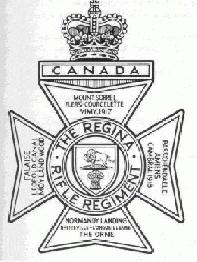
Armorial Description
A maltese Cross surmounted by a bar bearing the word CANADA with the Crown
above; superimposed upon the cross an annulus inscribed THE REGINA
RIFLE REGIMENT. On a shield within the annulus, the arms of the City of Regina (on the
upper half a buffalo, on the lower half a sheaf of wheat); the arms of the
cross inscribed with battle honours of the regiment selected to be borne on
the badge.
Official Abbreviation: RRR
Motto: Celler et Audax (Swift and bold)
Battle Cry: 1-2-3 UP THE JOHNS!
Battle Honours (38)
First World War
MOUNT SORREL
YPRES, 1917
Somme, 1916,'18
PASSCHENDAELE
FLERS-COURCELETTE
AMIENS
Thiepval
Drocourt-Queant
Ancre Heights
Hindenburg Line
ARRAS, 1917,'18
Canal du Nord
VIMY, 1917
CAMBRAI, 1918
Scarpe, 1917, '18
PURSUIT TO MONS
Hill 70
FRANCE AND FLANDERS, 1915-18
Second World War
NORMANDY LANDING
THESCHELDT
BRETTEVILLE-LORGEUILLEUSE
LEOPOLD CANAL
CAEN
Breskens Pocket
THEORNE
The Rhineland
Bourguebus Ridge
Waal Flats
Faubourg de Vaucelles
MOYLANDWOOD
FALAISE
The Rhine
The Laison
EMMERICH-HOCH ELTEN
The Seine, 1944
Deventer
CALAIS, 1944
North-West Europe, 1944-1945
Colonel-in-Chief: Her Royal Highness Princess Anne, The Princess Royal, GCVO
Authorized Marches:
Quick March: Lutzow's Wild Hunt
Double Past: Keel Row
Regimental Headquarters
THE ROYAL REGINA RIFLES
THE ARMOURY
1600 ELPHINSTONE STREET
REGINA SASKATCHEWAN S4T 3N1
Order of Precedence: 36
Go back to the Infantry Regiments page.
Go back to the Army home page.
|



 Army.ca Forums