|
|

They shall grow not old, as we that are left grow old

|
|
The Royal Newfoundland Regiment
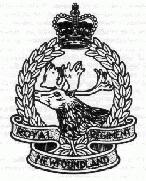
Armorial Description
A caribou head, within a wreath of laurel leaves surmounted by the
Crown; below, and supporting the wreath, a scroll inscribed ROYAL
NEWFOUNDLAND REGIMENT, mounted on a claret background.
Official Abbreviation: R Nfld R
Motto (Unofficial): Better Than the Best
Battle Honours (16)
First World War
GALLIPOLI, 1915-16
Egypt, 1915-16
YPRES, 1917,'18
LANGEMARCK, 1917
France and Flanders, 1916-18
POELCAPELLE
ALBERT (BEAUMONT HAMEL), 1916
CAMBRAT, 1917
Somme, 1916
LYS
LE TRANSLOY
BAILLEUL
Arras, 1917
Kemmel
Scarpe,1917
COURTRAI
Colonel-in-Chief: Her Royal Highness Princess Anne, The Princess
Royal, GCVO
Authorized Marches:
Quick March: The Banks of Newfoundland
Regimental Headquarters:
Box 2028
St john's, Newfoundland
A1C 6B5
Location of Sub Units:
1st Battalion
HQ, A Company, Band
St. john's, Nfld
2nd Battalion
HQ, B Company, Band
Grand Falls, Nfld
A Company
Corner Brook, Nfld
C Company
Stephenville, Nfld
Alliances:
The Royal Scots (The Royal Regirnent)
The Castle
Edinburgh, Scotland
The Royal New South Wales Regiment
New South Wales, Australia
Order of Precedence: 48
Go back to the Infantry Regiments page.
Go back to the Army home page.
|

|
|
| |
March 6
1831: Albany New York - Born on this date Philip Henry Sheridan, General, Union Army, US Civil War.
1836: Mexican General Santa Anna and his large army slaughter Davy Crockett and rest of 189 Texas volunteers after 13 day siege. General Sam Houston and his Texans capture Santa Anna 46 days later, with battle cry, Remember the Alamo.
1858: Lance-Corporal Goat of the 9th Lancers won the Victoria Cross for his persistent efforts to recover the body of an officer killed in combat during the Indian Mutiny. To do so, Goat had to dismount and work under enemy fire to hoist the body over his horse. His first attempt had to be abandoned due to the approach of enemy cavalry, but he finally succeeded in retrieving the body for proper burial.
1902: Queen Alexandra's Royal Naval Nursing Service was established.
1916: During fierce fighting near the formidable Hohenzollern Redoubt on the Western Front, a shell blast severed the leg of Corporal Cotter, East Kent Regiment, just below the knee. He was also wounded in both arms. Despite his appalling injuries, Cotter managed to make his way to a large crater some fifty yards distant occupied by men from his battalion, and took charge of them, organising the successful defence of the crater against a German counter-attack. For two hours he controlled the defenders' fire, changed their positions to deal better with fresh attacks, and only allowed his wounds to receive the most improvised of dressings. It was fourteen hours before he could be safely evacuated to a dressing station, and he soon afterwards died of his wounds. He was awarded a posthumous Victoria Cross.
1944: After over 30 hours of hunting, U-744 is finally sunk when forced to the surface by the combined efforts of HMC Ships CHAUDIERE, GATINEAU, ST. CATHERINE'S, CHILLIWACK and FENNEL as well as HMS ICARUS and HMS KENILWORTH CASTLE.
1944: US bombers start daylight raids on Berlin from bases in Britain
1945: Allied tanks and infantry, led by US First Army, drive into Cologne
1945: VEEN, effective dates for battle honour begin (to 10 Mar 45)
» Download the iPhone/iPad Military History app! «
|
|



