

- Reaction score
- 14,196
- Points
- 1,160
83,303 convertible CRV-7 rounds currently being divested.
Guided version[edit]
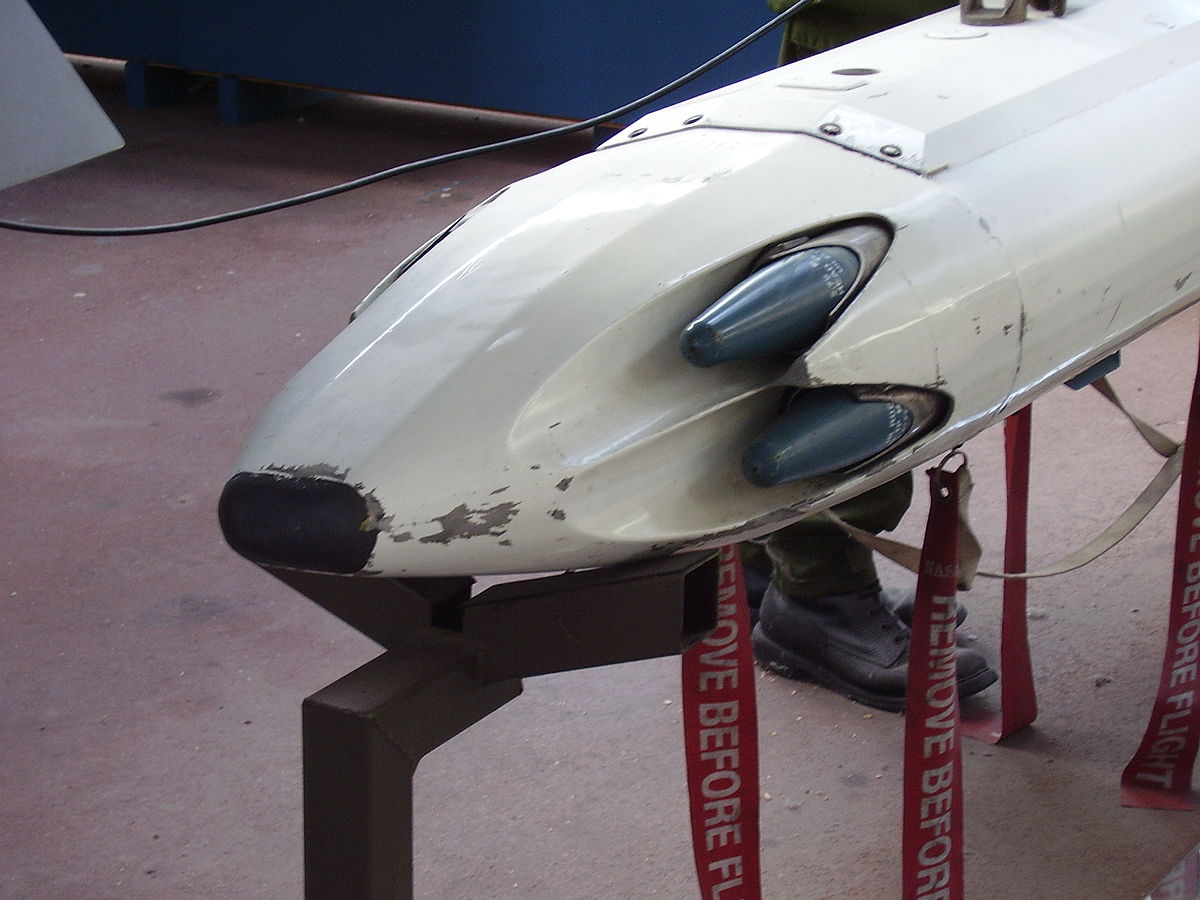
In 2006 Bristol started testing a new version of the CRV7, the CRV7-PG. The weapon was introduced at Eurosatory 2006.[16] Bristol's current owners, Magellan Aerospace, offered it for sale starting in 2007.
The PG version, for "precision guided", adds a seeker developed by Kongsberg Defence & Aerospace to the front of any version of an otherwise unmodified CRV7. The seeker uses a simple inertial guidance system through the midcourse, and homes during the terminal approach using a laser designator. Other versions offer anti-radiation seeking, or GPS guidance. The precision guided kit includes the addition of tail fins and an in-flight control system. Combining the laser seeker with the FAT warhead produces a capable long-range anti-tank missile that is faster and much less expensive than traditional platforms like the AGM-114 Hellfire.
A version of the CRV7-PG was also developed for special forces use, fired from a single tube mounted on a 6 x 6. In use, the weapon would be driven into the field and fired from behind cover, aiming at a designated location from a forward team.[17]
- Milan Machala & Radek Doskocil , "Contemporary Trends in Development and Modernization of Rocket Systems" Archived 2011-07-21 at the Wayback Machine
CRV7 - Wikipedia
 en.wikipedia.org
And of course there is a Canadian carriage prototyped and tested.

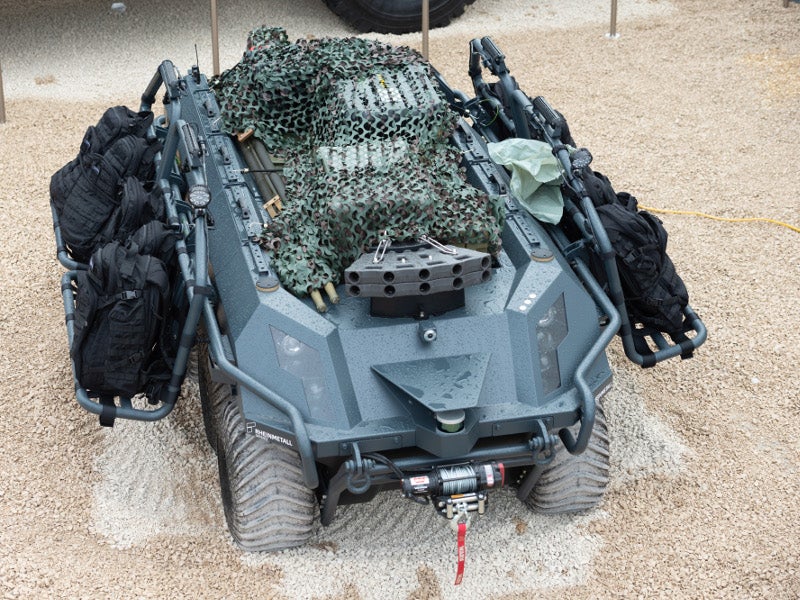
Mission Master UGV: Rheinmetall Autonomous Vehicle
Review Rheinmetall’s Mission Master autonomous unmanned ground vehicle series, supporting cargo transport, surveillance, and weapon payloads.
 www.army-technology.com
The vehicle has a length of 2.95m and a base weight of approximately 750kg. Its modular design allows for carriage of 600kg easy-to-install payloads for operations on land, while its payload carrying capacity is reduced to 300kg during amphibious operations.
LG1 has a mass of 1520 kg without ammunition
C3 has a mass of 2400 kg without ammunition
And Arnold also produces this 23 round package

| Specifications | |
|---|---|
| Production history | |
| Service history | |
| AGR-20 (APKWS II) | |
 1)top picture: standard Hydra-70 2)bottom picture: APKWS | |
| Type | Rocket |
| Place of origin | United States |
| In service | 2012-present |
| Used by | See Future and potential users |
| Manufacturer | BAE Systems |
| Unit cost | $22,000[1] |
| No. built | 50,000[2] |
| Mass | 32 lb (15 kg)[3] |
| Length | 73.8 in (1.87 m)[3] |
| Diameter | 2.75 in (70 mm) (unfired)[4] |
| Muzzle velocity | 1,000 m/s (3,600 km/h; 2,200 mph; Mach 2.9) at max[4] |
| Effective firing range | 1,100–5,000 m (0.68–3.11 mi) (rotary wing); 2–11 km (1.2–6.8 mi) (fixed wing)[5][3] |
| Maximum speed | 2,425 ft/s (739 m/s)[6] |
| Guidance system | Distributed Aperture Semi-Active Laser Seeker |
| Launch platform | See Launch platforms |
The AGR-20 Advanced Precision Kill Weapon System (APKWS) is a design conversion of Hydra 70 unguided rockets with a laser guidance kit to turn them into precision-guided munitions (PGMs).[7] APKWS is approximately one-third the cost and one-third the weight of the current inventory of laser-guided weapons, has a lower yield more suitable for avoiding collateral damage, and takes one quarter of the time for ordnance personnel to load and unload.