
and then uber all over in the ICE driven Toyotas.thats why they think you will take the train. To avoid the 30 min charging lol

You are using an out of date browser. It may not display this or other websites correctly.
You should upgrade or use an alternative browser.
You should upgrade or use an alternative browser.
EV's, Gas/Oil, and The Future- another swerve split from- JT Hints Boosting Canada’s Military Spending
- Thread starter ytz
- Start date

- Reaction score
- 10,676
- Points
- 1,260
HSR makes long trips faster, and when around home they charge the EV at home while they sleep.I didn't know charging an EV took that long.
A little confused by those whom push HSR to save time would also be ok with 30 minute+ stops while on the road.
So, they would save time on travel between centres, and save time compared to us luddites having to stop at gas stations.

I assure you that I spent much more than 30 minutes a week in Canadian Tire.
That is either a good thing or a bad thing, depending on which side of the ledger you are on…
I'd say it's a sign of retirement. Lol. I am not spending 30 mins in a store anywhere.....
He collects stats on many countries. The rest of his stats showing the transition curves are amazing.
Broader stats are interesting too:
I used to work with a guy who would commute between Montreal and Toronto in a Tesla model 3. During the winter, he cursed having to stop a couple times each way to make the trip. So there are always situations where BEV are not the most convincing option.
How many years ago was that?
Charging speeds have dramatically improved in even past 5 years. A decade ago, fast charging was 50 kW. These days, new fast charging stations are built with 400 kW chargers. Even the cars have seen dramatic increases in charging speed. One specific example. Nissan Leaf charging speeds. Gen 1: 50 kW. Gen 2: 100 kW. Gen 3: 150 kW. Let's say you need to fill up 50 kW. In about 15 years, they went from taking an hour to 20 mins. And of course, 150 kW is rather average these days. The higher end vehicles with 800V architecture charge at 250+ kW. At that speed if you don't get back to your car from the bathroom fast enough, you're getting charged occupancy charges.
- Reaction score
- 3,199
- Points
- 1,090
I'd say it's a sign of retirement. Lol. I am not spending 30 mins in a store anywhere.....
He collects stats on many countries. The rest of his stats showing the transition curves are amazing.
Broader stats are interesting too:

- Reaction score
- 28,544
- Points
- 1,360
6-7yrs, so that makes sense. Ironically, one of our colleagues, left the company and went on to do marketing with FLO chargers.How many years ago was that?
Charging speeds have dramatically improved in even past 5 years. A decade ago, fast charging was 50 kW. These days, new fast charging stations are built with 400 kW chargers. Even the cars have seen dramatic increases in charging speed. One specific example. Nissan Leaf charging speeds. Gen 1: 50 kW. Gen 2: 100 kW. Gen 3: 150 kW. Let's say you need to fill up 50 kW. In about 15 years, they went from taking an hour to 20 mins. And of course, 150 kW is rather average these days. The higher end vehicles with 800V architecture charge at 250+ kW. At that speed if you don't get back to your car from the bathroom fast enough, you're getting charged occupancy charges.

Ours:
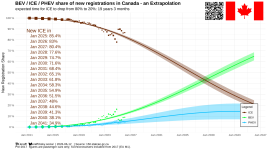
What I'm substantially intrigued by is all the land that will be freed up in urban and suburban areas by gas stations. They usually have prime locations. Wonder if they'll just become a car wash with a convenience store? How many will get redeveloped? High EV adoption starts driving gas station closures. Norway went from over 4000 gas stations in the 60s to 1200 in the 2010s and there's predictions of less than a 1000 by the end of the decade. Once we pass the crossover on the graphs I would think has station closures or conversion accelerates.
you really think so? Seems like they would be good locations for recharge units or satellite parking for people in high-rises where they can park overnight and charge their batteries. Most of them are on corners so traffic can come at them from at least two directions even if it is a divided road. but then again a lot of them have already closed. Used to not be unusual to see all 4 corners with a gas station on it now they seem more scattered except in the vicinity of large shopping areas.What I'm substantially intrigued by is all the land that will be freed up in urban and suburban areas by gas stations. They usually have prime locations. Wonder if they'll just become a car wash with a convenience store? How many will get redeveloped? High EV adoption starts driving gas station closures. Norway went from over 4000 gas stations in the 60s to 1200 in the 2010s and there's predictions of less than a 1000 by the end of the decade. Once we pass the crossover on the graphs I would think has station closures or conversion accelerates.

- Reaction score
- 19,188
- Points
- 1,160
Of course, where does all this electricity come from?

Halifax Tar
Army.ca Legend
- Reaction score
- 20,781
- Points
- 1,260
Six minutes: wander around where the thing you need used to be before they rearranged everything.
Twenty-one minutes: search for a staff member to help.
Three minutes: pick up what you need and pay for it.
My local CT got out of guns so I don't wander as much as I used too

Early 1970s. Mid-1970s is when they started tacking on a bunch of emissions stuff to existing engines. I had a 1978 F-150 with the 351 and it was a pig on gas, especially at northwestern Ontario distances.
Gas prices were a stick of gum and hand shake no ? Lol
But seriously, if you're buying a truck and milage is concern, don't buy a truck.

- Reaction score
- 7,447
- Points
- 1,160
Price-wise, I don't remember and, like many other things, was relative. I wasn't making the same money in the '70s that I was in the '90s.Gas prices were a stick of gum and hand shake no ? Lol
But seriously, if you're buying a truck and milage is concern, don't buy a truck.
I dealt an early-70s GMC Jimmy with a 3xx V8, and prior to that had an F-150 so was well familiar with truck ownership. This one was brutal and I was new to northwestern Ontario distances. I ended up installing an aftermarket tank simply to give it decent range.
Of course, where does all this electricity come from?
Same place electricity came from in the 70s, 80s and 90s when air conditioning became more common. We grew the grid to meet that demand. And EVs are generally speaking not much more than a residential AC unit, if you're charging at home overnight. We're also growing the grid for things like data centres. So I don't get why people worry about this. As long as there is demand, the market will supply it.
- Reaction score
- 43,503
- Points
- 1,210
Evening charging is outside peak demand hours.Same place electricity came from in the 70s, 80s and 90s when air conditioning became more common. We grew the grid to meet that demand. And EVs are generally speaking not much more than a residential AC unit, if you're charging at home overnight. We're also growing the grid for things like data centres. So I don't get why people worry about this. As long as there is demand, the market will supply it.
Evening charging is outside peak demand hours.
People have this weird idea that everything with EVs is automatically an existential problem. When the number of gas cars sold went up, there was no Helen Lovejoyesque panic about where the oil would come from. And that's a finite resource. But with something that has marginally more power draw than a large AC, heat pump or clothes dryer, all of a sudden we need to panic?
The good thing is that we have countries like Norway (cold climate and longer rural driving distances) that are two decades ahead of us on the adoption curve. We can see what pitfalls and challenges they've had and anticipate them. I personally don't think EVs will be close to the challenge that these data centres are today. And what utility wouldn't want an extra $50-100/mo in revenue? This is exactly why Quebec is so happy to electrify everything from heating to driving. Keeps money in their local economy.
PrairieFella
Army.ca Veteran
- Reaction score
- 4,844
- Points
- 1,110
For those asking where the power comes from - look at all the recent annoucements. Churchill Falls is largest electricity generation project in North American history. New reactors coming online at Bruce. SMRs being developed on the prairies. New wind farms in MB to supplement the hydro dams. The list goes on. We are building out a bunch of power generation and unlike the Yanks, most of it is clean. Thats a benefit for everyone. How can you not get excited about harvesting the power of the atom or gravity itself?
you really think so? Seems like they would be good locations for recharge units or satellite parking for people in high-rises where they can park overnight and charge their batteries. Most of them are on corners so traffic can come at them from at least two directions even if it is a divided road. but then again a lot of them have already closed. Used to not be unusual to see all 4 corners with a gas station on it now they seem more scattered except in the vicinity of large shopping areas.
This is what is intriguing. Nobody knows what will happen. But we can see from Norway that they've had a precipitous decline in the number of gas stations that started long before EVs even got there. Vehicles becoming fuel efficient alone dented demand. In Canada, this was countered by population growth increasing the total number of cars. But even here. As per Google, Canada has seen a 43% decline in the number of gas stations from 1989 to end 2024. From 20 360 to 11 611. We seem to build fewer gas stations that are larger and further apart, which individually serve a ton more vehicles.
In Norway though, this trend sped up substantially with the advent of EVs. And they are only at a third of their on-road fleet being fully electric. Because in suburban and rural areas where people have garages, they don't need a charging station. They have their garage. Beyond that, chargers are best placed where concurrent activity is possible. So grocery stores, coffee shops, work places, malls, etc. Any place where you can do something for 15-30 mins other than sit in your car. In theory some of these locations could become a coffee shop or diner with a charging stand. Still can't see the need for many of those in suburban areas. In downtown cores where people park on the street, sure, there will need to be more fast charging places. But a lot of downtown areas have actually seen losses of gas stations. Most famously, Lower and Midtown Manhattan have 4 gas stations for over 700 000 residents. The land is just too valuable to use it to sell fuel.
For those asking where the power comes from - look at all the recent annoucements. Churchill Falls is largest electricity generation project in North American history. New reactors coming online at Bruce. SMRs being developed on the prairies. New wind farms in MB to supplement the hydro dams. The list goes on. We are building out a bunch of power generation and unlike the Yanks, most of it is clean. Thats a benefit for everyone. How can you not get excited about harvesting the power of the atom or gravity itself?
Yep. We are going to double or triple the amount of generation by the end of the century.
There's the ones you mention. Then there's megaprojects like Wind West. Turns NS into the Saudi Arabia of offshore wind. The full Wind West proposal is equivalent to a quarter of Canada's total current electricity consumption.
Excited to go back to the era of this country doing big things. Unfortunate that so many Canadians have lost the ability to think big.
Evening charging is outside peak demand hours.
And peak can be shaped by policy. Too much solar? Incentivize cheap rates to shift consumption to daytime. See parts of Australia giving a few hours of free electricity per day at peak.

- Reaction score
- 8,943
- Points
- 1,260
Length of new car ownership plays into this.
A new car bought in 2026 will be held on average for 9yrs. Owners of top Japanese cars tend to hold onto their cars for 11 to 15yrs.
I bought a hybrid Corolla in the summer of 2024 and I currently average around 42.3m/g with it. Or, it you prefer metric, 5.3L/100km gas consumption. Realistically I will hold onto this car for 12-14yrs. Dollars to doughnuts in 2036, 2038, my next car will be a Plugin-EV or an EV by that timeframe. I will also be 67-69yrs old by then and my driving habits/needs will have changed by then.