• Thanks for stopping by. Logging in to a registered account will remove all generic ads. Please reach out with any questions or concerns.

Waterloo + 200 years (merged)

daftandbarmy

Army.ca Fossil
Reaction score
43,182
Points
1,160
http://en.wikipedia.org/wiki/Battle_of_Waterloo

The Battle of Waterloo, fought on 18 June 1815, was Napoleon Bonaparte's last battle. His defeat put a final end to his rule as Emperor of France. The Battle of Waterloo also marked the end of the period known as the Hundred Days, which began in March 1815 after Napoleon's return from Elba, where he had been exiled after his defeats at the battle of Leipzig in 1813 and the campaigns of 1814 in France.

After Napoleon returned to power, many countries which had previously resisted his rule began to assemble armies to oppose him. The principal armies of Napoleon's opponents were commanded by the United Kingdom's Duke of Wellington, and Prussia's Gebhard von Blücher. These armies were close to France's north east frontier, and Napoleon chose to attack them rather than wait for them to cross into France.

While the campaign hung in the balance for most of its duration, the decisive battle became the Battle of Waterloo. Allied forces, under Wellington, withstood a final French attack, and counter-attacked while the Prussians, arriving in force, broke through on Napoleon's right flank.

“ The nearest run thing you ever saw in your life — According to Wellington ”


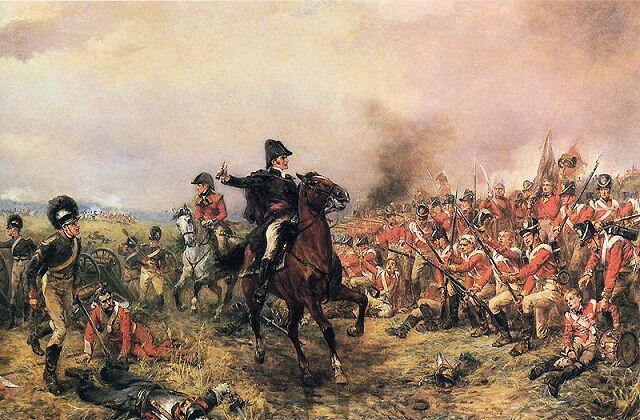
Up Guards and at 'em....


General Baron Jomini, one of the leading military writers on the Napoleonic art of war had a number of very cogent explanations of the reasons behind Napoleon's defeat at Waterloo.[142]

In my opinion, four principal causes led to this disaster:

The first, and most influential, was the arrival, skilfully combined, of Blücher, and the false movement that favored this arrival;[143] the second, was the admirable firmness of the British infantry, joined to the sang-froid and aplomb of its chiefs; the third, was the horrible weather, that had softened the ground, and rendered the offensive movements so toilsome, and retarded till one o'clock the attack that should have been made in the morning; the fourth, was the inconceivable formation of the first corps, in masses very much too deep for the first grand attack.[144]

http://en.wikipedia.org/wiki/Battle_of_Waterloo
 
We might also add Ney's inexplicable decisions (there were more than one) to launch unsupported cavalry attacks. He wasted the best cavalry in the world, for no effect, rendering it useless when, later, it was really needed.

But British leadership (aplomb) and firmness was, without doubt, the key factor: always more important than Blücher.
 
E.R. Campbell said:
We might also add Ney's inexplicable decisions (there were more than one) to launch unsupported cavalry attacks. He wasted the best cavalry in the world, for no effect, rendering it useless when, later, it was really needed.

But British leadership (aplomb) and firmness was, without doubt, the key factor: always more important than Blücher.

It seems that most cavalry on both sides were lacking in what could be described as common sense. Not much has changed in 195 years I would say!

 
Cavalry officers had a problem spelling two syllable words like "tactics." They were, however, quite comfortable with simple words [adjetctive carefully chosen] like "charge."
 
A couple of typos.  I'll fix.

Old Sweat said:
Cavalry officers have a problem spelling two syllable words like "tactics." They are, however, quite comfortable with simple words [adjective carefully chosen] like "charge."
 
BqQAw1sCAAAhPLd.jpg:large


But 'twas [also] a famous victory.
 
I just had a thought, odd as it may seem. If the Iron Duke had been given a choice of a UAV to see what was on the other side of the hill or a machine gun with unlimited ammunition, which one do you think he would have chosen?
 
My guess is the UAV.

Wellington already had the Georgian equivalent of the machine gun: disciplined British infantry. But what I've read of both Waterloo and the Peninsula suggests that he was, always,starved, for information and, usually, operated with far, far less useful intelligence information that he wanted.

It seems to me that Wellington, like his peers, didn't understand the best use of cavalry: recce. My sense is that it was the Americans (Lee and Jackson) who 'got it' and used Stuart, brilliantly, in that role.
 
Wellington, I believe, said something to the effect that other generals' cavalry won battles for them, his only got him in trouble. True or not, I don't know, but the British cavalry was not really up to the standard of the continental armies.

In the case of the Civil War cavalry, it was extreme effective as a reconnaissance arm considering the distances to be covered over difficult terrain. The advent of repeating fire arms also had a large effect on its ability to fight effectively mounted - something the Texas Rangers taught the Comanches a couple of decades back when they adopted the Walker Colt as a sidearm.

Back to Wellington at Waterloo, I agree he would have taken the UAV and made bloody good use of it.
 
daftandbarmy said:
General Baron Jomini, one of the leading military writers on the Napoleonic art of war had a number of very cogent explanations of the reasons behind Napoleon's defeat at Waterloo.[142]

In my opinion, four principal causes led to this disaster:

The first, and most influential, was the arrival, skilfully combined, of Blücher, and the false movement that favored this arrival;[143] the second, was the admirable firmness of the British infantry, joined to the sang-froid and aplomb of its chiefs;  . . .

Its sad to see that we continue the masquerade that the British won the battle of Waterloo. The fact was that Wellington's army of around 107,000 consisted of just under 40,000 British, 30,000 Dutch and some 37,000 Germans from several states. Of the British, the majority were new recruits or second line troops as the cream of Wellington's Peninsular Army had been sent to fight in America; only a very few made it back in time. The simple fact was that Wellington's infantry was "Allied" and not a "British". The Prussians added another 125,000 so one can see how in the minority the British really were.

The Brits however have always been able to punch above their weight when it came to rewriting the history books and very quickly after Waterloo the mythology of the "British" victory became fact.

I don't mean to disparage the role that the British did play. In fact they mostly paid for the war against Napoleon and their troops played an important role. What I dislike is that most of our understanding of the battle (and the overall war) comes from British historians who mostly tend to minimize the value and very significant role of the Brits' allies.

If you would like to read a bit of a different view of the battle see if you can rustle up a copy of David Hamilton-Williams book Waterloo: New Perspectives which deals very well with the battle and why the myth arose and was perpetuated. One caution. Hamilton-Williams is a contentious author and there is much criticism of his research by the traditionalist authors. Nonetheless, IMHO, no study of the 1815 campaign is really complete without reading his book.

:cheers:
 
I don't think, FJAG, that anyone (certainly not me) is saying that the Brits won it by themselves, but ...

    1. Wellington's deployments/dispositions were excellent given how little he really know about Napoleon's intentions; and

    2. The British infantry, especially at Hougoumont (and yes Dutch and King's German legion troops also fought exceptionally well there) and Maitland's brigade at the centre of the British line, when the Imperial Guards attacked, were decisive.

I think Wellington changed war in the Napoleonic wars by bringing (from India and the Royal Navy) discipline. British firepower was multiplied because Wellington didn't need to mass his infantry: they could and did fight in relatively thin ranks whereas most continental infantry marched, deployed and fought in thick, sometimes 12 deep, ranks. Some of what I've read says that Wellington learned the value of discipline in India, other accounts suggest he learned it from the Royal Navy. I don't think it matters - what did matter was that he led superbly disciplined British infantry against the far, far less well trained French. I remained convinced that good discipline and even better training matter more than experience. (But I have to add that the best training I ever received, in a long career, was from (one in particular) senior NCOs who were both exceptionally disciplined and great disciplinarians and wonderfully experienced and excellent trainers/teachers.)
 
FJAG said:
Its sad to see that we continue the masquerade that the British won the battle of Waterloo. The fact was that Wellington's army of around 107,000 consisted of just under 40,000 British, 30,000 Dutch and some 37,000 Germans from several states. Of the British, the majority were new recruits or second line troops as the cream of Wellington's Peninsular Army had been sent to fight in America; only a very few made it back in time. The simple fact was that Wellington's infantry was "Allied" and not a "British". The Prussians added another 125,000 so one can see how in the minority the British really were.

The Brits however have always been able to punch above their weight when it came to rewriting the history books and very quickly after Waterloo the mythology of the "British" victory became fact.

I don't mean to disparage the role that the British did play. In fact they mostly paid for the war against Napoleon and their troops played an important role. What I dislike is that most of our understanding of the battle (and the overall war) comes from British historians who mostly tend to minimize the value and very significant role of the Brits' allies.

If you would like to read a bit of a different view of the battle see if you can rustle up a copy of David Hamilton-Williams book Waterloo: New Perspectives which deals very well with the battle and why the myth arose and was perpetuated. One caution. Hamilton-Williams is a contentious author and there is much criticism of his research by the traditionalist authors. Nonetheless, IMHO, no study of the 1815 campaign is really complete without reading his book.

:cheers:

My Dad (3 Div Arty) pointed out that Montgomery was always willing to fight to the last Canadian.

Some British traditions die hard!
 
Richard Sharpe and his band of Riflemen won the Battle of Waterloo for the good Duke.

At least that's what the series alludes to..... :nod:
 
Jim Seggie said:
Richard Sharpe and his band of Riflemen won the Battle of Waterloo for the good Duke.

At least that's what the series alludes to..... :nod:

In part that's my point. I love the Sharpe series but Cornwell's interpretation in Sharpe's Waterloo borrows from the worst of the British accounts where the Dutch and Belgians are given short shrift, and in some cases accused of cowardice and stupidity. The Germans at least were treated well although Cornwell's focus was on the King's German Legion which was in a class by itself.

Sorry E.R. Campbell. I know you haven't said it but I think the vast majority of the public that even knows that there was a Battle of Waterloo fully believe that the British thin red line, all by its lonesome, beat back the French. In large part that comes from the British historical accounts that gloss over the allied role.

I know Jomini was a Swiss, French, Russian but he wasn't at Waterloo and I think his comments about "firmness of the British infantry" is what set me off. Let's call a spade a spade. If the Dutch hadn't held on so tenaciously on the 16th against Ney at Quatre Bras and if d'Erlon's corps had not been meandering back and forth between Quatre Bras and Ligny then Wellington would most probably never have made a defence at Waterloo.

For that matter Jomini himself hadn't been at Waterloo and the treatise from which the quote comes was written by him in 1862 some 47 years after the battle and when he was some 83 or so years old. Principally it is an analysis of the French political and military aspects of the entire 100 days campaign and covers the allies very superficially. I think whatever he may say about "British firmness" owes more to his study of the British historians than anything else.

I just want to give the Belgian/Dutch/Germans their due.

:stirpot:
 
The real reason for the Allied victory at Waterloo:

"It has been a damned serious business - Blücher and I have lost 30,000 men. It has been a damned nice thing - the nearest run thing you ever saw in your life...By God! I don't think it would have done if I had not been there."

http://www.napoleonguide.com/aquotes_welli.htm
 
Why we must remember the bloody cost of Waterloo

Some 55,000 soldiers were killed and wounded during the Battle of Waterloo, a carnage comparable to the first day of the Somme. A new book written by a surgeon ahead of this summer's 200th anniversary argues that sacrifice must not be forgotten

http://www.telegraph.co.uk/history/11447354/Why-we-must-remember-the-bloody-cost-of-Waterloo.html
 
Don't forget to look at these artifacts.  I wish they had them all on the link.

http://www.telegraph.co.uk/news/picturegalleries/uknews/11372322/Battle-of-Waterloo-artefacts-See-the-coin-that-saved-a-soldiers-life.html
 
Wow, #4 is quite something.....must have knocked him into next week......

Larry
 
Back
Top