• Thanks for stopping by. Logging in to a registered account will remove all generic ads. Please reach out with any questions or concerns.

Canadian River Class Destroyer Megathread

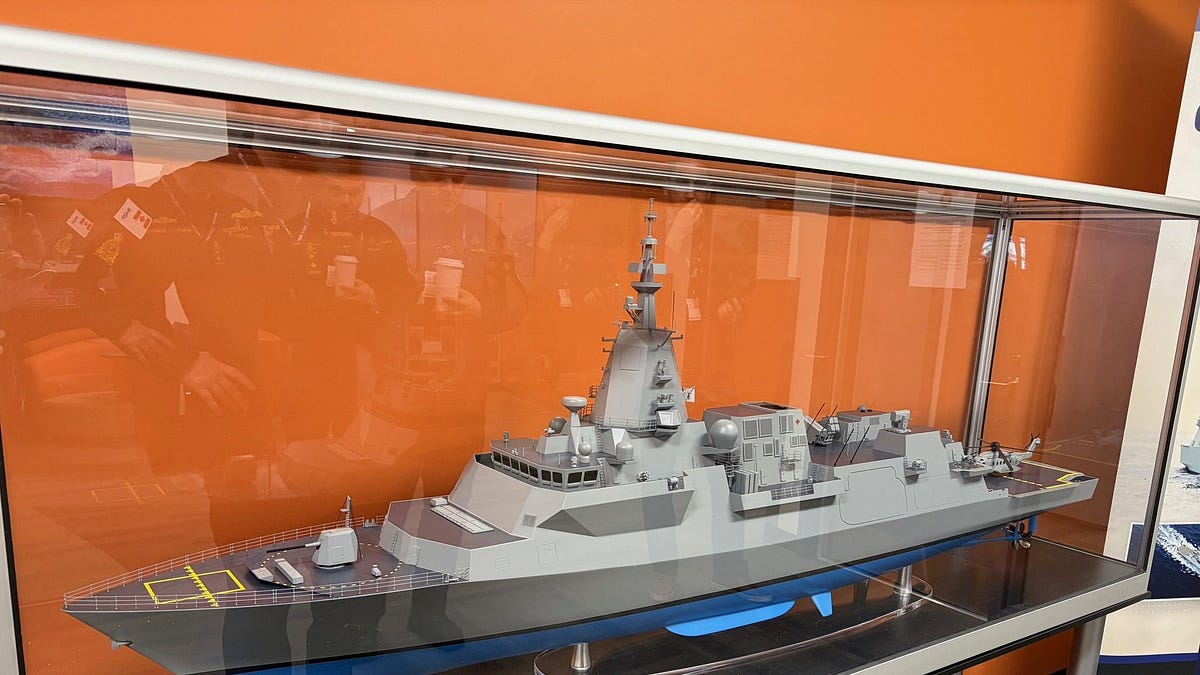
To be honest, if I had a ship with AEGIS, I'd want the single 21 shot launcher as well.

Having 2x 11 shot ones is actually less effective, since they wouldn't be tied directly to AEGIS I don't think. And you'd only have 11 shots per side if they were in the same spots as have been shown in past renderings.

Having the 21 shot launcher up high with wide arcs gives the best solution I think.
To clarify, SeaRAM is just Phalanx with the 20mm cannon replaced by an 11 cell RAM launcher, while the full 21 shot launcher is known as the Mk 49 Guided Missile Launching System (GMLS). The previous rumour was two 21 shot launchers likely where the Phalanx slots are, but it seems that never came to pass.

Note - it looks like the 'official way' to set this all up based on how I see things is to open the rear cover, rotate the launcher fore/aft, setup the working platform on the mount, setup the overhead rail and chain fall, then load/unload cannisters.

I suspect it could be done by hand without the platform in a pinch to get a couple tubes loaded up in a real emergency.

Rules would have to be bent/broken for that though...and there'd have to be a really good operational reason to do so.
The biggest issue with the model we see is physically getting the missile reloads from their storage area all the way up to that elevated position where the launcher itself is present.

No idea either.
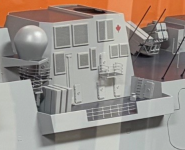
Noah seems to think it might be JAGM as well, which I think is fairly accurate. Lockheed Martin has a number of different navalized JAGM launchers available and the USN is considering fitting them to their Burke class destroyers as a cheap and low impact layer to their small boat/anti-drone defences. It is possible that the launcher we see on the model is a placeholder, a custom RCN model or something like the below decks mount in the right hand first image, but mounted above deck.

The newest variants of JAGM have a 16km~ range and a multi-mode seeker that permit attacking stationary or moving targets even in visual/EW degraded environments. Price tag looks to be something like $325,000 USD per shot roughly, 1/3~ of a RAM shot cost. If we could get something like 27 JAGM per 3x3 launcher (with 1 slot each used for exhaust), that would give the RCD a load of 54 fire and forget missiles at a relatively low cost to deal with closer range targets.

Seems like a pretty good boost in capability to me?

qnImvjE.jpeg


RCD6SU5.jpeg


9Xd9kFc.jpeg
 
If it is JAGM then we can probably make an assumption that this is the first modification in recognition of naval drone warfare. Hellfire family can be used against drones both airborne and waterborne. And it's much cheaper than shooting a RAM, ESSM at a target. But the launchers are not normally in that configuration. They are usually quad launchers with a 5th exhaust tube.

Doesn't look like NULKA and if it was that's a lot of NULKA for a single ship.
 
More reasons I dont' think its JASM. The RAM was obviously moved away from the midships breezeway because that's where the intakes are for the main stack, so you don't want missile exhaust chemicals pulled into there. Also that long railing on the side of the stack is for Replenishment at Sea so you likely don't want missile exhaust blasting anywhere near that either.
1774290374586.png

Similarly if you look where the "JASM" is placed you usually want your missile exhaust not setting fire to radomes, railings and whatever stuff is overhanging (or close to overhanging).

We'll have to see. I'm only speculating here. Whatever is in that box is pretty tall.
 
OK! That's all very interesting. When I first saw it I assumed it was just an expanded pack of Nulka's. So, some new form of chaff we haven't seen yet? Or could it be an active (like the French designed ones) anti torpedo munition launcher?
 
The sliding pad-eye is a detail that I'd thought about, and was pretty sure was going to be in that area, but is now confirmed to me. I was wondering for a bit if they were going to try and rig the RAS deck via the mission bay area.

More details to add....
 
More reasons I dont' think its JASM. The RAM was obviously moved away from the midships breezeway because that's where the intakes are for the main stack, so you don't want missile exhaust chemicals pulled into there. Also that long railing on the side of the stack is for Replenishment at Sea so you likely don't want missile exhaust blasting anywhere near that either.

Similarly if you look where the "JASM" is placed you usually want your missile exhaust not setting fire to radomes, railings and whatever stuff is overhanging (or close to overhanging).

We'll have to see. I'm only speculating here. Whatever is in that box is pretty tall.
I think the placement is screwy regardless of what you put into the launchers, as even a soft launched system would be dangerously close to impacting the various items you mention being so close to. Even considering that, you have a potential for a misfire fouling important sections of the ship instead of being carried clear or otherwise dropped somewhere non-important.

With the weight savings of removing CAMM, single RAM etc. you would think their would be capacity for extra launchers. If deck penetration is a problem on the forward deck then options like the BAE Adaptable Deck Launcher may work to add mk41 capacity still forward of the existing VLS. BAE ADLS
It seems most likely that overall weight is the problem, not so much strictly available space. The RCN has already done extensive modifications to the baseline Type 26 design with the integration of AEGIS and SPY-7, there is likely caution being taken not to overload the design like it seems the Australians have done. They have apparently been dealing with stability, weight and future margin issues alongside a laundry list of other items partially caused by their insistence on 32 VLS.

The RCN also desperately needs the first few RCD's ASAP, so have been cutting back on costly and unnecessary additions/modifications to finalize the initial batch for production. 24 VLS is the base standard for the Type 26.
 
Back
Top