• Thanks for stopping by. Logging in to a registered account will remove all generic ads. Please reach out with any questions or concerns.

Canada moves to 2% GDP end of FY25/26 - PMMC

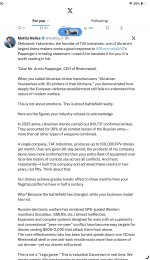
I think this is better positioned in this thread than the Ukraine thread.

It is glorious and I hope to hell we are paying attention.
You know who could make a shit ton of money right now. Somebody who could produce a cheap drone with the sole purpose of killing drones.

I’ve been on two of the three sides of the military procurement (operator and supplier, but not procurer), and agree with most of his points. But we should take the right lessons, and I think one of them is the spiral is tightening, not that the current reality is the end state.
 
I think this is better positioned in this thread than the Ukraine thread.

It is glorious and I hope to hell we are paying attention.

Apparently Rheinmetall has completely forgotten that during the last massive war (hint: angry failed artist), women played a vital role while the men were away in Europe and Asia fighting. Those housewives put out some insane numbers back then too.

Mr. Yakovenko is spitting fire.

Fire Comment GIF by Bashar
 
You know who could make a shit ton of money right now. Somebody who could produce a cheap drone with the sole purpose of killing drones.

I’ve been on two of the three sides of the military procurement (operator and supplier, but not procurer), and agree with most of his points. But we should take the right lessons, and I think one of them is the spiral is tightening, not that the current reality is the end state.
True.
And the big one for me: “… we iterate weekly”. You can’t even get on someone’s calendar in Canada within 4 weeks.

Edit: image shamelessly copied from @grandparoy2 over on the X app..
 

Attachments

  • IMG_0065.jpeg
    IMG_0065.jpeg
    556.8 KB · Views: 9
And what do you do when that highly trained kit gets damaged or destroyed and a new widget takes 6 months to produce? A UGV can protect a lot of ground but if it gets destroyed and you dont have a replacement, you then need infantry. We as a military cannot use tech as a crutch
What are you protecting in Canada with a UGV? The context of my argument was @Kirkhill's suggestion that we could recruit 500,000 people for employment within in Canada.

Are the Red Hordes going to pour across the arctic into Yukon, NWT, or Nunavut?

We need better ISR, more aircraft, ships, GBAD, etc.... All high tech, low personnel count things. We don't need regiments of motorized infantry sitting around waiting for a job to do inside the country.
 
Last edited:
We do have a neighbour who has recently threatened our sovereignty and been a little reckless in wielding military power.
Realistically if that's the threat that we are wanting to be designing our military to defend against, then a domestic nuclear deterrent is really the only logical option. We would go bankrupt trying to build a conventional force strong enough to defeat a US invasion.
 
I don't know why but...

500,000 people.

That can be organized into a Moscow meat wave. A. One. Singular.
That assumes that concentration is a thing. That it is desirable. That it is necessary.
It also seems to presuppose that the only valid reason for our Government to raise, condone and support such a group is to engage in slaughter.

That is not my Militia.
That is not my Homeguard.
That is not my National Guard.
That is not my Hjaemmevaernet.

Slaughter is only one facet of my Militia.
Like the National Guard, like the Hjaemmevaernet it is one thing they prepare for.
But most of their service has been on smaller taskings that don't involve killing people.

We assume that our government will always be there to bail us out.
We assume that our highly competent, and well-paid, insurance policy will always be there to save us when the universe gets frisky and does the other thing.

But if that is true why do we get advice to prepare to self-rescue, to prepare for 72 hours on our own, to prepare for two weeks in the dark in January because the ice dragged the lines down, or the Pineapple express washed out every bridge on every connection to salvation?

500,000 people
From 40,000,000.
1 in 80 people.

Ontario has a population of 16,000,000 - or 40% of the 40,000,000 -
So you get 200,000 people to help you out of your crisis.
Congratulations. I doubt you will ever need that many snow shovelers but hey! whatever.

In Alberta we are closer to 4,000,000 - so we get a force of 50,000
Saskatchewan has a million and gets 12,500
That would also be what Calgary gets.
PEI with a population of 182,000 would get a 2200.
Lethbridge gets 1000
Norwood, ont has a population of 1600 so it gets a government sponsored force of 20.

There are 5100 municipalities im Canada and over 600 first nations communities.
500,000 divided among those communities means an average response team of 88 people available to help handle a 72 hr disaster from local resources.

It could also be a source of smaller scale assistance.
There is a lot of moaning about how you never get everybody out when you call for them.
Suppose that went into the plan.
Suppose it was accepted that there are many minor tragedies that don't require everybody to break away from their daily lives.
Suppose it was accepted that 100% turnout might be hard but 10% turnout might be easier.

Your organization of 500,000 becomes 50,000 available today. May be it is a different 50,000 tomorrow, or a week come Friday next.
You are looking at a labour pool on which to draw.

it also happens to be a labour pool of people that are willing to employ arms in defence of their families, their communities and His Majesty's Government.

It is not 500,000 riflemen lined up shoulder to shoulder recreating St Julien's Day.

It is a pool of individuals from which you can draw people that have time to give.

And I am willing to bet that if Enderby got cut off for 72 hours then there would be a good chunk of the population with time on their hands wondering what they are going to do next.

My 500,000 is not a Group of Armies storming into North Dakota. It is 5000 separate Companies that most days can scare up a Section or a Platoon in support of a good cause, either at home or abroad.

There are 156,000 security guards in Ontario. What do you do with them all? Where do they all go?
 
An attack at home.

Cause otherwise why would Canadians care?

The reality is that most of our deployments are wars of choice we participate in, for geopolitical reasons beyond defence of the homeland.
Currently correct. The theory is if you can stop the threat beyond our borders then you are winning. The problem is that the future is unpredictable. Who foresaw Czechoslovakia in '68, the Falklands, the Gulf Wars, Afghanistan, Ukraine? As Robert Gates once said in a speech at West Point about the US track record of predicting future conflicts has been perfect: "We have never once gotten it right."
And as much as I understand the big Army dreams here, the reality is that when it comes to those geopolitical returns our biggest payoffs are air, naval, missile defences, cyber and space. Things where our economic heft let us contribute and which aren't people heavy. But also areas that smaller NATO members can't really do. It also goes to speed of mobilization. We can move aircraft and air defences over and have them ready to fight in days. Moving a full brigade takes weeks.
The problem with unpredictability of the nature of future conflict is that it makes choosing the right force composition a bit of a crap shoot. There are some standard tropes in the above statement such as the speed of deploying a force. When it comes to NATO, we can easily agree to a brigade task and preposition equipment and stores for it maintained by a small in-country cadre. At 3,000 personnel, five CC-330s could fly them over in 24 hours; an 11,000-member division in 72 hours (if the RCAF would organize and train for such missions)

Our air and naval resources are both valuable and essential for the defence of the homeland. How many can we spare as a committed force overseas? The ratio of air to sea to land is a political problem that needs solving. In the current environment - as demonstrated in Ukraine - ships will not be sailing in the Baltic and the the RCAF operations will be limited. Whatever modern technologies these services field, they will never be able to seize and hold ground. For Europe, especially the smaller nations, ground - their ground - matters. That means armies will continue to matter. Look at the small size of Ukraine's air force and the size of its army. The nature of war has changed but the fight remains on the ground.
The CA Mod effort probably has it right to aim to anchor a division in the fight and be overweight on all the Division level enablers. The Eastern Europeans can provide the boots. And those boots will be more comfortable fighting at home than we could ever be.
When it comes to political capital, allied ground forces remain the most significant symbol of a nation's resolve to share the burden of defence. As you've probably sensed from my other posts, I'm not a fan of the army's current modernization program. This is not because I dismiss the need for the army but because I disagree utterly with the organizational structure and the continued reliance on large and poorly organized and equipped regular forces and the even worse reserve forces. My biggest problem with the large proportion of the regular army is its personnel costs. Here I agree with @Kirkhill.
We have lost a sense of personal responsibility. We have lost a sense of community. And we have lost a sense of being individually capable.

We have hired professionals.
. . .
But God!. Are they expensive!
It's a big problem and I don't see our leadership in solving that problem
Canada until the 1970s was very Eurocentric. The people that mobilized for war were probably within 2 generations of immigrating from Europe. They were motivated to defend what they saw as kin.
I'm an immigrant with European roots. I didn't join the army for the above reason at all. I didn't know anyone who did in those days. I was part of the melting pot concept.
Add in just typical other motivations (sense of adventure in a time where long distance travel was exceptionally rare).
It was the sense of adventure.

The root of our problem was - believe it or not - Vietnam issues below the border. These had a great influence on the younger generation that I was a part of and which was reinforced by the world views of our shiny new Prime Minister. Trudeaumania was a thing. The CAF was massively downsized (even if he was dragged kicking and screaming to buy new kit eventually) The public view of the military had deteriorated in Canada as much as the US. We sought refugee in calling ourselves UN peacekeepers but the military's reputation amongst the public has never recovered.
I think we'd find it much harder to motivate hundreds of thousands of Canadians today to go fight in the Baltics. But it might be easier to motivate tens of thousands to do as a higher skilled force.
That's sophistry and a tad pejorative.
There is no realistic scenario where we will need half a million people in uniform to defend Canadian soil.
That depends on how much one wants to leave vital national infrastructure open to sabotage.
Defence of Canada needs lots of high tech kit and highly trained specialists to operate it. It doesn't need 400, 000 Pte Riflemen.
That's simply a guess on your part. See above for unpredictability. Personally I see numerous threats. Many can and should be dealt with by use of the sophisticated high tech equipment and highly trained specialists of which you speak. But . . .
What are you protecting in Canada with a UGV? The context of my argument was @Kirkhill's suggestion that we could recruit 500,000 people for employment within in Canada.

Are the Red Hordes going to pour across the arctic into Yukon, NWT, or Nunavut?
In 1970 my highly-paid troop (by those days' standards) stood guard on vital infrastructure in Montreal for several weeks. Believe me, it's not a job for a professionally trained rifleman, but it's a perfectly proper job for a man with a rifle and some training in ita use and a proper command and control structure. The whole thing is a question of risk assessment and preparation time to build a suitable force.
We need better ISR, more aircraft, ships, GBAD, etc.... All high tech, low personnel count things.
Absolutely no doubt we need all of that . . . and a whole lot more - think cyber
We don't need regiments of motorized infantry sitting around waiting for a job to do inside the country.
The costs of several part-time motorized infantry battalions and even more home guard is nothing compared to the destruction or loss to the economy and confidence of the country when major hydro lines go down or refineries erupt in flames or water supplies get compromised. If I can think of a dozen ways to take a country to its knees rapidly, I would think that the Chinese MSS and Russian GRU would be a thousand steps ahead of me. There are no shortages of their actions at work.

Just as an aside, I've run some numbers in modelling the army and I can rationally defend an army field force (excluding regional support groups and CADTC elements) of 30,000 RegF and 48,000 ARes (plus another 8,000 RegF and PRes MP and Health Services personnel). Above that things become a bit airy-fairy albeit the structure can be designed to easily expand if required.

I can't say that I've dived into the home guard structure or size very much. but there are more than enough models to draw on. Both also have many uses in peacetime considering that civilian governments wish to tap into the organized military manpower pool from time to time.

🍻
 
As long as the Regs are ok deploying every 6 months when there is no more reserve force to draw upon since we sunsetted 60% of the trades in the ARes. Very little need for Arty, Armour, Bosns, etc in the defence of Canada, whatever that means. Probably lots of sandbag battalions for floods though. Thats the buggest gripe I have so far, what do they actually mean by defence of Canada? Do they mean a national guard capable of LSCO able to defend kinetically? In that case we need the same equipment and manning as the Regs. Do they mean a token force that shoots once a year and does the domops the Regs have no interest in like sandbagging or basic firefighting? That changes whats needed personnel and equipment wise. CA HQ needs to tell us what we can expect.

The RCN has nothing to do with, nor is it effected by, the continual CA reshuffling for leading change points.

Will Smith Reaction GIF by saschamoellersde
 
As long as the Regs are ok deploying every 6 months when there is no more reserve force to draw upon since we sunsetted 60% of the trades in the ARes. Very little need for Arty, Armour, Bosns, etc in the defence of Canada, whatever that means. Probably lots of sandbag battalions for floods though. Thats the buggest gripe I have so far, what do they actually mean by defence of Canada? Do they mean a national guard capable of LSCO able to defend kinetically? In that case we need the same equipment and manning as the Regs. Do they mean a token force that shoots once a year and does the domops the Regs have no interest in like sandbagging or basic firefighting? That changes whats needed personnel and equipment wise. CA HQ needs to tell us what we can expect.
@FJAG pointed out valid uses for troops in Canada, that had nothing to do with sandbags. Though, filling sandbags will likely continue to be a CAF tasking for the foreseeable future, regardless of the component.

It makes more sense to have Res F Infantry, armoured, artillery, etc., filling sandbags and fighting fires than it makes to have AVN, HRA, Mar Eng, etc., do it.

Edit: Perhaps a critical infrastructure security specialist occupation would make sense as a P Res specific occupation, to be organized into units in the Defence of Canada Div.
 
Back
Top