• Thanks for stopping by. Logging in to a registered account will remove all generic ads. Please reach out with any questions or concerns.

High Speed Train Coming?-split from boosting Canada’s military spending"

As an aside and FYI - TGV Lyon to Paris - 400 kms, 2 hours flat. Good club car. Very comfortable. No bag screening. Multiple trains throughout the day. Vastly superior to Via.

There's been studies of the impact of HSR. And the biggest one is on mental geography. After France built the TGV, they noticed that young people stopped thinking in terms of distance and started thinking in terms of travel time. Lyon is no longer 400 kms away. It's 2 hrs away. And that changes how people think about everything from business to personal relationships.

Shouldn't be a surprise that the Bloc is no fan of this idea.....
 
The Turbo is the train equivalent of the Avro Arrow. It did like one fast run a day (3:59h so they could say less than 4hrs) and that's what fans hang their hats on. The average was decent at 4:15h. But that was with few intermediate stops.

Meanwhile congestion is so bad on current tracks that VIA is suing CN because CN won't even let them run 7 car trainsets thanks to CN's own capacity needs. The 4h the Turbo Train achieved would be impossible today. And would still be impossible with all the intermediate stops that advocates are asking for. So even achieving the 4h with all the intermediate stops that Lakeshore residents want would probably still be $30-40B and have lots of expropriation anyway. And I'm guessing that is what the previous HFR studies figured out before the government chose HSR instead.

It's like saying the 401 could have been built on top of the old Hwy 2 cheaply and without much demolition, expropriation or reconstruction. Physics and economics don't work like that.
no argument with any of this. That is why a dedicated ROW was needed for the Turbo and is needed now for VIA for those 10 million potential customers that are being shut out. An HS rail system would be wonderful AFTER we solve the other.
 
no argument with any of this. That is why a dedicated ROW was needed for the Turbo and is needed now for VIA for those 10 million potential customers that are being shut out. An HS rail system would be wonderful AFTER we solve the other.

That's basically an argument to never build HSR. Cause we're definitely not spending $60-90B after spending $30B on a low speed train. Which means if government has to prioritize, it's obvious to prioritize the 80-90% of passengers traveling between the large metros. The Lakeshore will get VIA 2.0, something like the Kingston hub I posted earlier.
 
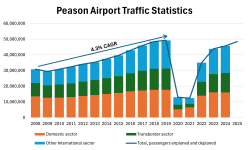
Just some context to consider. Pearson is packed and maxing out. Moving some of those domestic flights does free up some room.

1000054789.png

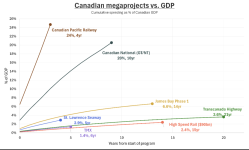
And on level of effort this is how it compares historically.

1000054797.png
 
Just some context to consider. Pearson is packed and maxing out. Moving some of those domestic flights does free up some room.
Pierre Elliot Trudeau is also running near capacity.
View attachment 99997

And on level of effort this is how it compares historically.

View attachment 99998
It's like I said, the economic activity between Quebec city and Windsor is something like 40-45 percent of our 3.25 trillion CAD GDP.

90b isn't cheap per say, but it's not that expensive stretched over years for the size of the economy of the region.
 
And on level of effort this is how it compares historically.
According to this, complete by 2043. 17 years, not 15. Comparing the project cost to completed projects is comparing an unknown quantity to known ones. Doesn't look good when the time is cheated a bit and the currently estimated cost is treated as if it's at all likely to be the true cost.
 
According to this, complete by 2043. 17 years, not 15. Comparing the project cost to completed projects is comparing an unknown quantity to known ones. Doesn't look good when the time is cheated a bit and the currently estimated cost is treated as if it's at all likely to be the true cost.

That's just ridiculous... How can one have an informed conversation if one doesn't look at historical data in comparison to future plans?

Placing the expected costs in the context of other major projects is entirely reasonable, and when looking at historical data, percentage of GDP is as useful as the "in today's dollars" comparisons.
 
How can one have an informed conversation if one doesn't look at historical data in comparison to future plans?

Look at historical data? Doesn't count. Don't look at historical data? Clueless about cost. Can't win. Typical bad faith BS. Can't expect better.
 
That's just ridiculous... How can one have an informed conversation if one doesn't look at historical data in comparison to future plans?
For the conversation to be informed, the assumptions have to be reasonable/realistic. As I wrote, the time and cost assumptions are neither.

I have no confidence in the numbers anyways. The 5-year construction period of the St Lawrence Seaway project shown in the graph presumably represents 1955-1959. Total GDP for those 5 years: $170B. Cost of project: somewhere under $500M. Cost as fraction of total GDP: 0.3%. Quite a bit lower than the 2.9% claimed. (I am interpreting "cumulative" as meaning the sum of GDP for the period and the sum of project cost.)

[Add: might just be a definitional or factor-of-10 thing. If HSR goes 15 years at current GDP and higher, it'd be somewhere below 0.24%, not 2.4%. Running the calculations also makes it clear that the longer a project drags on, the more affordable it looks in that chart.]

[Also add: and in case it isn't clear, allowing a project to drag on isn't a way of saving costs given the way costs currently escalate; it just creates an illusion of affordability.]
 
Last edited:
That's just ridiculous... How can one have an informed conversation if one doesn't look at historical data in comparison to future plans?

Placing the expected costs in the context of other major projects is entirely reasonable, and when looking at historical data, percentage of GDP is as useful as the "in today's dollars" comparisons.
so here are some figures: California HS estimated to cost 33 Bill. in 2008 now estimated at 126 Billion American and rising. Initial segment Merced to Bakersfield supposed to be complete by 2033. so far no track has been laid. Those two cities have a total population of 503,000. System to be complete by 2043 and is approximately 800 km long. Toronto to Quebec via Montreal without Ottawa included is 806 km. Adding OW adds I am guessing at another 100 km. You are not going to build for any less than California and it will likely be a whole lot more.
 
Look at historical data? Doesn't count. Don't look at historical data? Clueless about cost. Can't win. Typical bad faith BS. Can't expect better.
Sure, I live in ignorance and never ask questions. I thought to sanity check one of the numbers. The graph is off by an order of magnitude, or perhaps I misinterpret what the author meant by "cumulative spending as % of gdp". Can't know without the source. What's the source?
 
so here are some figures: California HS estimated to cost 33 Bill. in 2008 now estimated at 126 Billion American and rising. Initial segment Merced to Bakersfield supposed to be complete by 2033. so far no track has been laid. Those two cities have a total population of 503,000. System to be complete by 2043 and is approximately 800 km long. Toronto to Quebec via Montreal without Ottawa included is 806 km. Adding OW adds I am guessing at another 100 km. You are not going to build for any less than California and it will likely be a whole lot more.
I wasn't aware that the Toronto to Quebec route was beside one of the most active seismic faults in the world, and also at the same time in one of the most expensive locations in the world.
 
I wasn't aware that the Toronto to Quebec route was beside one of the most active seismic faults in the world, and also at the same time in one of the most expensive locations in the world.
The CA HSR boondoggle has been something I've noted over the years, but didn't think it's a useful comparison. Different geological and environmental challenges. CA HSR hopefully will end up being the worst-case example in NA. The useful point of comparison is the political pressure to finish the CA HSR instead of just ending the bleeding. HSR might sit above DND in a ranking of public spending preferences, but given its relatively limited population served, not by much - when the axes start falling.

Casting that aside, the outcomes of all the other major things done recently and still being done are not encouraging. What if it's TMX-level bad?
 
Why not HSR from Halifax to Vancouver ?

If we really want a nation building project. Lets rebuild the project that, arguably, started the whole nation.
 
I wasn't aware that the Toronto to Quebec route was beside one of the most active seismic faults in the world, and also at the same time in one of the most expensive locations in the world.

If you listen to opponents, one would get the impression that California is the only place that built HSR in world....

Weird how learning from all the failures of that project are discounted. There's a reason they're getting all the land now. That's something the Californians didn't do. Indeed, CalHSR is a case study in failure that is informing every other HSR project these days. Including Alto.

Using their logic we shouldn't build any pipelines. They could all turn out like TMX. The only pipeline that we should ever reference.
 
If you listen to opponents, one would get the impression that California is the only place that built HSR in world....

Weird how learning from all the failures of that project are discounted. There's a reason they're getting all the land now. That's something the Californians didn't do. Indeed, CalHSR is a case study in failure that is informing every other HSR project these days. Including Alto.

Using their logic we shouldn't build any pipelines. They could all turn out like TMX. The only pipeline that we should ever reference.
I kind of wished people made good arguments against this project as opposed to the poop on wall I've been seeing around the internet.

Would make for more interesting discussions
 
The West Coast of North America enters the chat ;)

I was posted in California when they started construction. That project is uniquely flawed. They set speed goals that are some of the highest in the world, without ever considering the budget. They didn't have decent access corridors into LA and SF. Imagine building Alto without GO to get into Toronto. They were forced to go into the central valley across two mountain ranges for political reasons. Design issues crossing the San Andreas fault. And then substantial mismanagement with sub contractors because they weren't all screened in advance.

Having attended Alto's consultations, it's obvious they've learned a lot from CalHSR and are trying to burn down as much risk as possible before getting shovels in the ground. I would have far less confidence if they weren't doing the things they are now to reduce risk.
 
I kind of wished people made good arguments against this project as opposed to the poop on wall I've been seeing around the internet.

Would make for more interesting discussions

They aren't interested in discussion. They want it cancelled. And will say or do anything to achieve their goals. I spend time on the opponent sites to see what actual issues there are. And it's like picking fly shit out of pepper. For every person who has a genuine concern there's like 10 conspiracy theories. After all, that is Randy Hillier country.....

I do think compensation, vehicle access, design for noise and vibration, etc are real concerns that should be properly addressed. I have less patience for the kooks.
 
Back
Top