Halifax Tar
Army.ca Legend
- Reaction score
- 20,520
- Points
- 1,260
Involved in the crew composition right now.
But not seeing much on messing or quarters. Will be interested to see that



But not seeing much on messing or quarters. Will be interested to see that
If it is based on the current RN arrangement and standards, you are probably looking at 9 person cabins as the largest quarter, with 4 person cabins for PO/CPO/ extra JO and 2 person cabins for COXN/CERA and officers generally and four single cabins for CO/XO/CBTO and LOGO. There may be some "austere" quarters for short term embark like Enhanced Boarding Parties, etc.
 you're ageing yourself shipmate
CERA
Those haven't been a thing in over a decade.

So that means in another decade they'll bring that position back in the name of "Transformation!"CERA
Those haven't been a thing in over a decade.

If it is based on the current RN arrangement and standards, you are probably looking at 9 person cabins as the largest quarter, with 4 person cabins for PO/CPO/ extra JO and 2 person cabins for COXN/CERA and officers generally and four single cabins for CO/XO/CBTO and LOGO. There may be some "austere" quarters for short term embark like Enhanced Boarding Parties, etc.
CBTOCERA
Those haven't been a thing in over a decade.
you're ageing yourself shipmate
So that means in another decade they'll bring that position back in the name of "Transformation!"
I contend that there are a finite number of ideas that are recycled every 30 years (the lifecycle of corporate lifers).
At least that is what I tell the youngsters!
CBTO
CERA is now CEng and CBTO is OpsO.


And its going to change all over again when Aegis shows up.CBTO
CERA is now CEng and CBTO is OpsO.
Fixer and Breaker?And its going to change all over again when Aegis shows up.
Nah, those nicknames will never change!Fixer and Breaker?

Any idea what 's in that semicircular radome forward of the mast? Some indication by a poster that it could be Next Generation Surface Search Radar (AN/SPS-73(V)18). Thoughts?
Is this the mount being offered for the RCDs?
....
The Mk38 Mod 4 30mm mount selected by the US Navy features dual ammunition feeds and an additional .50 calibre gun mounted on the top. (Right) The weapon is primarily guided by the off-mount MSI MK 48 MOD 2 EOSS, a fully stabilised, dual-axis EOSS director incorporating TV and infrared cameras, and a laser rangefinder.
My expectation is that the fire control radar will be the SPY 7. It's going to be able to track outgoing rounds and adjust fire. Though that math is more complicated as it won't be calculating it from a single parallax location. I don't expect EOIR to be a method for targeting the main gun.I would like to re-vist this.
One thing I am puzzling over is the apparent absence of any dedicated fire-control radar for the BAE Mk-45 5"/62 gun on the River-class.
The Congressional record that mentions Canada procuring the BAE Mk45 itemizes four (4) Next Generation Surface Search Radars, described only in generic terms as the U.S. Navy's multi-mission navigation, which is a surface search and periscope detection radar replacing multiple legacy surface radar systems — no AN/SPS designation given. I note though NGSSR is often associated in U.S. Navy documentation with the AN/SPS-73(V)18 program, although the Congressional notification does not actually identify a specific AN/SPS designation.
Unlike later-Flight-III Burkes, which are getting AN/SPQ-9B as a purpose-built track-while-scan (TWS) radar feeding the Mk 160 GCS for anti-ship-missile-defense gunnery, nothing in the public River-class documentation points to an SPQ-9B-class system. So is the Mk-45 BAE gun for the River Class not getting a dedicated FC radar?
The public sketches suggest that.
One possibility is in the past with the Mk 34 GWS baseline on the USN Arleigh Burke class it may have been shown that the older SPS-67(V)3 (which the NGSSR will replace) had a useful digital automatic target detection, track while scan, and moving target indicator capability from Arleigh Burke Flight I. It is plausible that SPS-67 contributed surface-target tracking data to the Mk 34/Mk 160 architecture, alongside the original SPY-1D, although the exact integration details are not well documented in open sources.
The Arleigh Burke’s current SPQ-9B fire control radar is a later-generation upgrade of that same architectural slot, not the introduction of a function that never previously existed.
If that assessment is correct, then the more interesting question may not be Mk 45 fire control at all, but what is lost—or what is not lost—in the ship's inner-layer anti-ship missile defense architecture by the apparent absence of an SPQ-9B-class firecontrol radar."
If NGSSR (whatever its exact AN/SPS designation turns out to be) is a software-defined, track-capable surface-search radar feeding the Gunnery Control system (GCS) the way I assume that SPS-67(V)3 may have done, then SPY-7(V)3/AEGIS + NGSSR may reproduce the original Burke gun fire-control chain reasonably faithfully — just without the SPQ-9B refinement that more recent Arleigh Burke hulls are getting.
The other half of the picture is the RCN procuring SPEIR and possibly procuring the Mk-20 EOSS (or whatever its CSC-specific successor turns out to be, as I state that noting the USN has an RFI out to replace the Mk20 EOSS ) to go with the BAE Mk45 gun. The Mk 34 Gun Weapon System (GWS) has always paired the radar/GCS chain with an optical sight — Mk 46 OSS on early Flights, Mk 20 EOSS on Flight III — for passive terminal tracking, visual target classification, and ECON-compatible engagement.
SPEIR, now confirmed for Canada (in US Congressional records), via the same FMS case as an electro-optic/infrared (EO/IR) system on surface ships that provides persistent detection and tracking of a wide variety of air and surface targets, in support of multi-mission surface ship operations and defense, looks like it might be filling that role — and may well be almost as capable as the legacy Mk 46/Mk 20 in many respects, particularly given SPEIR's panoramic, persistent-tracking design intent. So between SPY-7/AEGIS, NGSSR, and SPEIR/EOSS, the River Class Mk-45 likely does have a workable fire-control chain — it's just composed of systems that, individually, aren't labeled "gun fire control radar."
Possibly one open area of question is in the layered anti-ship-missile-defense picture, rather than the gun fire control question per se.
On an Arleigh Burke Class with SPQ-9B, I think its possible that radar isn't just feeding the 5" gun — I suspect its part of the ship's broader horizon/clutter anti-ship cruise missile (ASCM) detection layer, working alongside SPY, CIWS, and decoys.
In comparison, current unclassified information suggests the River-class is planned to carry aft two M38-Mod-4 (Bushmaster) 30mm guns, and also carry RIM-116 RAM (midships) and forward RIM-162-block-II ESSM (Mk-41 VLS) together with for ECM the LEED (the active decoy replacing Nulka) that engages further out in the engagement sequence.
With this in mind, if the River Class NGSSR's TWS performance (possibly the SPS-73(v)18 ) against a fast, low-RCS sea-skimmer near the horizon is closer to the original SPS-67(V)3 baseline than to SPQ-9B's enhanced ASMD-tuned performance, that could translate into a somewhat thinner inner-layer radar picture feeding both the 30mm and the Mk-45 in defending against an “attacking missile leaker scenario” — with SPEIR/EOSS picking up more of the terminal-engagement load, than it would had there also been a dedicated SPQ-9B fire control radar on the ship.
To be clear, all of this is massive speculation from a Congressional record (re: FMS), together with RCN River Class sketches/information, that doesn't actually describe combat-system integration — "NGSSR" could turn out to be a more capable system than its US Navy program description suggests, and SPEIR's panoramic IRST-like characteristics may compensate for a lot of this in practice.
It's not there because it hasn't been purchased yet. Its not a long lead item.Most defense forum posts suggest the Mk38 Mod 4 30mm is being procured by Lockheed Martin for the RCN River Class destroyer.
I can't , as of yet, find any US nor UK public records indicating its sale to Canada for the River Class. This is contrary to the BAE MK-45 5-inch gun where Congressional Record makes it clear such was approved. I note instead of the 30-mm Lionsfish (the previous planned 30mm which to all accounts the Lionfish is not being procured as Lionfish no longer mentioned) the RCN faq only states a 30mm. It does not state from whom comes the 30mm.
IMHO it makes sense for the Mk38 Mod 4 30mm for the River Class as I speculate with its MK 48 MOD 2 EOSS that it already has a functioning AEGIS interface.
I am puzzling as to why no US nor UK foreign sale records yet of the 30mm procurement, and I am speculating there may have been (and could still be) contractual aspects here? Perhaps with SPEIR being chosen for River Class (and an NFOV EOSS for targeting being a baseline part of SPEIR) ... that Lockheed Martin and the RCN are thus still evaluating if the Mk48 EOSS should also be procured with the Mk38 Mod 4 30mm?? Presumably such an EOSS (if also procured from MSI) affects the scope of the contract, and perhaps until that assessment is compete, the contract agreement, and subsequent US or UK approval of the Mk38 Mod 4 30mm can't be finalized as its scope is not yet known/decided.
This is all 100% speculation by me, trying to understand why I find no US nor UK public records indicating its sale to Canada for the River Class. Again - pure speculation reflecting my puzzlement.


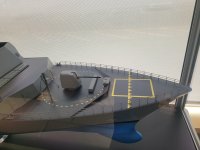
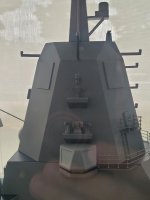
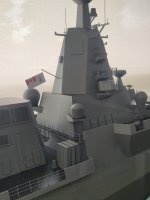
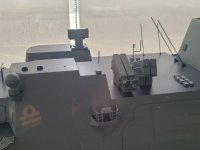
Wrong helicopterWas able to get some photos close up of the RCD model (the one bought by HMCS STAR somehow, I have no idea how they did that and got it approved. It costs about 40k).
View attachment 100994View attachment 100995View attachment 100996View attachment 100997View attachment 100998View attachment 100999View attachment 101000View attachment 101001
I got a message that the V1 model I presented to the CO in January needs a new helicopter....apparently someone wasWrong helicopter
Maybe sooner than later.Wrong helicopter
Plans to replace ageing warships will be scrapped in favour of building at least six new modern "hybrid" vessels equipped to deploy drones as part of the UK's upcoming defence strategy.
The Ministry of Defence (MoD) said the new vessels would be more suited to the "pace and nature of modern warfare", and a better investment than a "small number of large expensive ships".
Defence Secretary Dan Jarvis said the new equipment would be "designed and built for the increasing threats we face".
Outgoing Prime Minister Sir Keir Starmer has committed to publishing the long-delayed defence investment plan (DIP) before the Nato summit in Turkey on 7 July after months of talks over how to fund it.
The MoD had been exploring options to replace the Type 45, the Navy's fleet of destroyers, with the Type 83, a concept vessel which was at an early design phase.
Instead, investment will now go towards six new Common Combat Vessels, which the department said would be capable of "coordinating uncrewed systems in the air, on the surface and under the sea to deliver more resilient air defence".
It said the change in approach would extend "the Navy's reach, resilience and firepower without a proportional increase in crew or cost".

That's been running through my mind as well. The River-class conception and design goes back many years well before the current state of naval affairs.The River Class is planned to be built in batches. I wonder, if the quantity 15 might be at some point reduced to a smaller number, with a different capability warship procured instead for the remaining hulls? I am thinking of possibly a similar displacement warship that could be a drone carrier instead. This recent (29-June-2026) BBC article came to mind:
Navy to build drone-equipped warships instead of replacing ageing destroyers