• Thanks for stopping by. Logging in to a registered account will remove all generic ads. Please reach out with any questions or concerns.

The RCAF's Next Generation Fighter (CF-188 Replacement)

If the F-35 was all that and a bag of chips, Harper would have moved ahead with the buy when he had the chance.
I feel like the RCAF's game was exposed when the CBC carried a story about the GlobalEye maybe not working in NORAD because it doesn't have MADL like the F-35... Then the story went on to explain that no AEW&C aircraft had it, and neither did our F-18, or the USAF's F-22s...

So how much of the F-35's winning was based on a capability exclusive to the F-35? If even America didn't think it was worth adding MADL to their actual air superiority fighter, perhaps, it's not critical to NORAD operations...
 
You also (and several others here) tend to gloss over issues that have been brought up here repeatedly.

1) Creating a Gen4 Manufacturing facility in Canada isn’t going to be economically viable.

2) Saab has no Gen 5 Experience and at this point is an aimless orphan sitting around in the Gen 6 area (to be fair Canada is still sitting at the door).

3) At this junction in time no one is going to invest in a Gen 4 Fighter, as a new addition.

Those three points should be enough for anyone to get off the Gripen hype train.

The ship sailed, the only viable option is the F-35 for Canada.

Now, the future - the F-35 fleet won’t last forever, and the other aspect is those pesky ‘loyal wingman’ concepts.

If Canada wanted to be a serious player it would jump into GCAP (the realistically most viable 6 gen option at this point, beyond observer status and pony up as a full partner. - heck sell it as Elbows Up whatever for all I care.

That is a much more practical and effective use of Canadian Tax Dollars than throwing it on some sort of Saab Gripen boondoggle bonfire.

I’m not throwing shade at Saab as a whole, they do have a lot of products that are useful to Canada, and partnerships that can expand — but buying a new gen 4 aircraft at this juncture is just throwing money away to say F Trump and will hurt Canada in the long run.
I'll start by saying (yet again) that I am 100% in favour of an F-35 buy of at a minimum of the original planned 65 aircraft (and ideally the full 88). It is the only current aircraft available to Canada that is survivable in a non-permissive peer conflict. If open war were to break out between the West and Russia or China...or even a non-peer country with any significant AD system we will need the F-35. Full stop.

That being said, the most realistic requirement in the NORAD role is plenty of platforms that can cover as much airspace as possible to shoot down incoming cruise missiles. We will not be dog fighting SU-57's over Hudson Bay. A 4th generation fighter is fully capable of fulfilling that role as demonstrated by the USAF using F-16's and F-15's. Yes they would do well quarterbacked by F-35's (and other sensors) and yes, eventually we could likely replace them with CCV's but that technology is not quite there yet.

A split F-35/Gripen buy (of say 72 each) would do two things. It would give us a large enough fleet that we could deploy a significant number of F-35's to an expeditionary fight were the 5th Gen/Stealth capabilities are essential and still leave enough Gripens to patrol and defend our airspace.

The 2nd thing it would do would provide an advanced domestic combat aircraft production/assembly ecosystem. Combined with the R&D centre that Saab has included in its IRB offerings we could leverage that to the development of a CCV platform that meets the unique requirements of the defence of Canada (extreme range, arctic operations, etc.) that we could build domestically once we have completed our Gripen production (plus any possible foreign sales to non-G7 countries that can't afford F-35's).

At the same time we should look to partner with GCAP for the eventual 6th Generation replacement of the F-35's. So we start with an F-35/Gripen fleet and transition to a GCAP/CCV fleet.
 
I'll start by saying (yet again) that I am 100% in favour of an F-35 buy of at a minimum of the original planned 65 aircraft (and ideally the full 88). It is the only current aircraft available to Canada that is survivable in a non-permissive peer conflict. If open war were to break out between the West and Russia or China...or even a non-peer country with any significant AD system we will need the F-35. Full stop.

That being said, the most realistic requirement in the NORAD role is plenty of platforms that can cover as much airspace as possible to shoot down incoming cruise missiles. We will not be dog fighting SU-57's over Hudson Bay. A 4th generation fighter is fully capable of fulfilling that role as demonstrated by the USAF using F-16's and F-15's. Yes they would do well quarterbacked by F-35's (and other sensors) and yes, eventually we could likely replace them with CCV's but that technology is not quite there yet.

A split F-35/Gripen buy (of say 72 each) would do two things. It would give us a large enough fleet that we could deploy a significant number of F-35's to an expeditionary fight were the 5th Gen/Stealth capabilities are essential and still leave enough Gripens to patrol and defend our airspace.

The 2nd thing it would do would provide an advanced domestic combat aircraft production/assembly ecosystem. Combined with the R&D centre that Saab has included in its IRB offerings we could leverage that to the development of a CCV platform that meets the unique requirements of the defence of Canada (extreme range, arctic operations, etc.) that we could build domestically once we have completed our Gripen production (plus any possible foreign sales to non-G7 countries that can't afford F-35's).

At the same time we should look to partner with GCAP for the eventual 6th Generation replacement of the F-35's. So we start with an F-35/Gripen fleet and transition to a GCAP/CCV fleet.
So many nations including the USA run more than one fighter so its very confusing to me why its so contentious to discuss the possibility here.
 
why wouldn't we continue to partner with SAAB for their 6th gen program
Because Saab doesn't have a sixth gen program of their own. They are in talks with Airbus to start one after the collapse of FCAS.
Rafales, Eurofighters, F16s, Gripens are all still being purchased and built.
F-16 production ended in 2017. Anyone buying any at this point is buying used (which is the point of the Gripen, it's an alternative to the F-16 for countries that don't want to deal directly with the US).

Ok I'm going to attempt to weave this discussion into the NSS. I'm not going to say which partner we should necessarily be going with during this analysis.

I hear from quite a lot of people on here that Canada doesn't have, currently, the domestic ability to produce a 6th or a 5th or even a 4th generation fighter jet and that we shouldn't even bother considering doing so. That sounds a lot like the argument that has been put forward 15 or so odd years ago when the NSS was being slapped together. Let's put aside our ability to produce the fastest private corporate jet on the market today and let's also put aside the ability of CAE.

That we hadn't produced a modern warship in over 20yrs and that we'd be wasting our time in doing so was a thread that was loud and strong when the NSS was being cobbled together and it still has champions today. The solution that was taken, for all 3 classes of ships that the RCN has taken possession of, (AOPS), is about to take possession (JSS) and will take possession of in the future (River Class), was for Canada to buy an existing set of blueprints for the AOPS (Svalbard class), for the JSS (Berlin Class) and for the Rivers' (Type 26) and to add various 'Canadian' touches (needs/requirements) to each of these classes of ships. Today, though we have throughput constraints in my humble opinion, we have successfully commissioned the DeWolf class, are about to commission the Protecteur class and have had our first keel laying ceremony on the River class. Not bad for a country that hadn't produced a warship in 20 odd years.

But what did we 'really produce' in each of these classes of ships?

Engines:
  • Where the engines in the AOPS produced/manufactured in Canada? Yes, they were in Peterborough.
  • Where the engines in the JSS produced/manufactured in Canada? No, no they were not. Those engines were produced in Europe at MAN's facilities there and their CDN facilities provided the 'integration, training, testing and support' of these engines.
  • Where are the engines in the River's produced/manufactured in Canada? No, no they are not. Those engines are being produced in the UK by Roll Royce (gas turbines) and the diesel generators in Germany by Rolls Royce.
Armament:
  • AOPS - its 25mm was not produced in Canada - .50 cals I don't believe were produced in Canada
  • JSS - its CIWS (20mm) was not produced in Canada - .50 cals I don't believe were produced in Canada
  • Rivers - long, long list of items here, but the main 127mm guns will not be produced here in Canada, the mk41's will not be produced here in Canada, 30mm autocannons will not be produced here in Canada, the .50 cals aren't produced in Canada, etc, etc, etc
Radar/Electronics:
  • AOPS - Denmark played a role in the radar, LM Canada played a role, who else?
  • JSS - LM Canada, SAAB played a role, who else?
  • Rivers - LM Canada, LM US, Thales (France), who else?
Steel:
  • AOPS - Canada, China, who else?
  • JSS - Canada?, China?, who else?
  • Rivers - ??
So for each of these classes, we, Canada produced the 'shell' of the class and in 1 class, AOPS, we produced the engine. It sounds a lot like making a car. Ford, Chrysler, GM, Honda, Toyota, KIA, etc, don't make the radios/touch screens that go into their vehicles. They don't make the tires that go on their cars, They don't make batteries, they don't make headlights, they don't make the steering wheel, the windows, none of that. They focus on the design and the manufacturing of the vehicle frame (in most cases), and they farm out the specs to others and then they pull it altogether and assembly it.

In each of the above classes, Svalbard, Berlin and Type 26, someone designed them and sold them to us and we in turn added some 'Canadian' flavour to them and then we started manufacturing the frame and farmed out to others (mostly foreign companies), the production of the 'radio, tires, windows, engine, seats, floormats, etc, etc,' and then we pulled it altogether and assembled it all.

Where am I going with this? The US has said that the F-47 is a US only project, no partners, no foreigners will be a part of it.

So this means for us to team up with SAAB only, or SAAB, Germany & Spain or with GCAP (UK, Japan & Italy) or France, or go it completely alone, the reality is that in each of those scenarios certain key aspects of a 6th gen fighter will incorporate key pieces of its puzzle from 'vendor's most likely outside it set of partners. In NO situation do I see GCAP or SAAB/German/Spain (Canada), or France not having to incorporate outside partners.

Pulling this back to the discussion of potential 4-4.5th gen fighters assembled in Canada or even potential 6th gen fighters manufactured/assembled in Canada, I view it as pretty much the same situation as what the NSS was talking about 15ish years ago. Do we believe that the ability to manufacture parts of and have final assemble of, a 4.5, 5 or 6 gen fighter is needed within Canada? I would argue that this question is absolutely NO different than the question, 'Do we believe that Canada should have the ability to manufacture parts of and have final assembly of a modern warship within Canada?' They are 1 and the same question.

With all this being said, the need, the requirement, for us to have the F35 now and going forward into the future should be apparent to anyone rationally looking at the lay of the land. I do believe that 72+ are needed. Going forward, whatever path we chose, we need to look back at the same discussions around the NSS and make our decisions based off of those discussions. If we are to be an independent, sovereign nation into the future, then we must have to ability to produce some sort of fighter program at a scale where their numbers do make a difference in any future potential conflict.

NSS used Canadian shipbuilders with existing shipyards. It didn't require foreign shipbuilders to open assembly plants from nothing to have knockdown kits put together.
We have multiple scenario's here for 6th Gen:

1) Saab only
Saab will not be making a sixth gen plane on their own. They have no fifth gen experience, there is no possibility for them to bridge that gap. If the partnership with Airbus actually goes somewhere, Saab will be the junior partner.
 
NSS used Canadian shipbuilders with existing shipyards.
…that all needed significant capability upgrade to levels of production that never existed at any of the facilities before…which was actually one of the goals of NSS, so an ASS could have the same thing happen and be consistent with both the COC and LPC governments of the day.
 

Attachments

  • 1781775641042.gif
    1781775641042.gif
    61.5 KB · Views: 2
Why can't we have both the F35 and Grippens ?

Why does this have to be a binary choice ?

Give me 88 F35s, 100 Grippens and let's make the pilots mechanics and logistics train to support them.
 
So many nations including the USA run more than one fighter so its very confusing to me why its so contentious to discuss the possibility here.

Because those nations have air forces double the size of ours. Take a look at Spain, or Italy, or anyone else really. Then look at the RCAF and remember that uniquely we have an airforce that also does the rotary wing for the army ans navy.
 
The 22 M346’s will churn out 50-70 pilots a year.
It will take time, not necessarily something we have, but 50-70 new pilots a year will make a major impact.
 
Why can't we have both the F35 and Grippens ?

Why does this have to be a binary choice ?

Give me 88 F35s, 100 Grippens and let's make the pilots mechanics and logistics train to support them.
and forget about needing a degree to qualify. That requirement only limits your selection pool. Look for physically fit people who think on their feet, are readily adaptable, are self-confident and able to visualize 3 dimensionally. A high level of manual dexterity and good reflexes would help as well. But a degree is just a wasted 4 years unless it is provided at a military supervised academy and we don't have the facilities to train that number of officers per year, especially after getting rid of Rhodes.
 
NSS used Canadian shipbuilders with existing shipyards. It didn't require foreign shipbuilders to open assembly plants from nothing to have knockdown kits put together.

Saab will not be making a sixth gen plane on their own. They have no fifth gen experience, there is no possibility for them to bridge that gap. If the partnership with Airbus actually goes somewhere, Saab will be the junior partner.
1) We already have existing plane builders here in Canada, we just don't have an existing facility that's built a fighter in the last 40+yrs.
  • Irving hadn't built a warship since 1996 - and to be specific their Halifax location hadn't built a warship since when? - Answer, 1942. Irving's Halifax shipyard had not built a warship since 1942 when it built 10 Flower class corvettes.
  • All the Halifax's were built at Saint John (dead and gone) or at Davie. So, how many of those old Saint John Irving employees made the transition over to Halifax 20 odd years later?
2) Whether we partner with Saab, Germany and Spain, (or with GCAP) Canada will be a junior partner - but will that partnership be as small and insignificant as our current role is in building the F35? Remember, our production contribution amounts to 3% of the value of a finished F35. If we were to triple our contribution of a 6th consortium to 9% and that 9% results in greater IP, manufacturing and avionics within Canada, I'd call that a solid win.

3) Lastly, I'm not here knocking the F35 - I've said in plainly enough that I think a large, robust number of F35's is needed - whether that's 72-88, along with Gripen/M346's or a single fleet of 88 F35's - I'm in the camp that we have an unique position to be in right now and that we need to capitalize on that opportunity and grasp it firmly with 2 hands. Whether its GCAP and we become the smallest pillar of the 4 main participants or we pair up with Germany/Spain, along with possibly Sweden and maybe Poland or, heaven forbid, we sleep with France and see if she's possible to have a long term relationship with.

4) Finally - there is NO 6th gen option with the US - as a result we have to pair with someone and it WON'T be with the US. The sooner all of the USAF fanboys realize this, the better the RCAF and the country will be. This is NOT a knock against the US, its reality, the F47 will not have foreign partners, so accept this and move forward.
 
and forget about needing a degree to qualify. That requirement only limits your selection pool. Look for physically fit people who think on their feet, are readily adaptable, are self-confident and able to visualize 3 dimensionally. A high level of manual dexterity and good reflexes would help as well. But a degree is just a wasted 4 years unless it is provided at a military supervised academy and we don't have the facilities to train that number of officers per year, especially after getting rid of Rhodes.

That's outside my lane. But I could see some merit.
 
Because Saab doesn't have a sixth gen program of their own. They are in talks with Airbus to start one after the collapse of FCAS.

F-16 production ended in 2017. Anyone buying any at this point is buying used (which is the point of the Gripen, it's an alternative to the F-16 for countries that don't want to deal directly with the US).


NSS used Canadian shipbuilders with existing shipyards. It didn't require foreign shipbuilders to open assembly plants from nothing to have knockdown kits put together.

Saab will not be making a sixth gen plane on their own. They have no fifth gen experience, there is no possibility for them to bridge that gap. If the partnership with Airbus actually goes somewhere, Saab will be the junior partner.
F16 vipers block 70/72 are actively being built for Slovakia, Peru and Taiwan, no?
 
any and all
Internal - F35

External - comparable

Ferry - Gripen.

Considering Gripen doesnt really need to worry about stealth, i dont think tossing tanks on them matters that much, but i'll let the airheads speak to that one.
 
F16 vipers block 70/72 are actively being built for Slovakia, Peru and Taiwan, no?

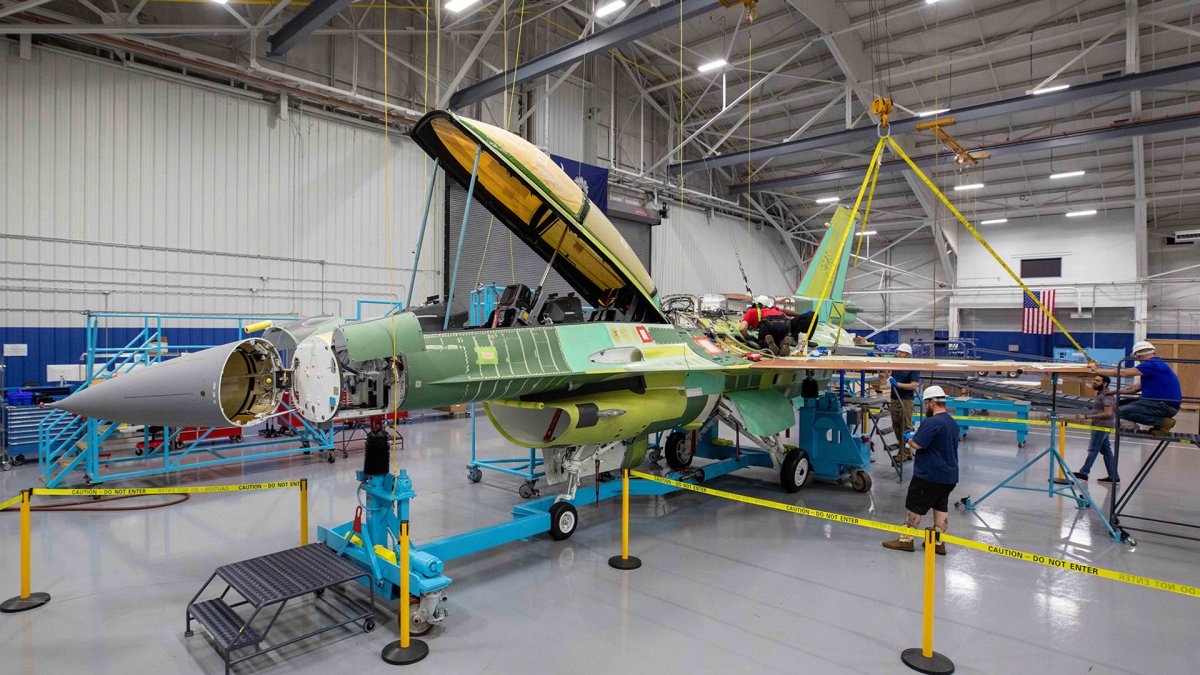
The sound of rivet guns pounding fasteners into place, a robot drilling thousands of holes in metal, cranes heaving pieces of yellow primer-painted fuselage into assembly jigs. The Lockheed Martin production facility in Greenville, South Carolina, is a hive of activity. Here, brand new F-16 fighter aircraft are being built on an assembly line that the manufacturer thought might never exist.
Yes Altair, to answer your question, F 16 block 70/72 fighters are being built, 128 or so on order between a half dozen nations.

Turns out there is a market for 4th Gen fighters. And utility for them as well.
 
Turns out there is a market for 4th Gen fighters. And utility for them as well.
If Canada had Gripens already, I would not be the negative nelly that I am on it.

But let’s be honest it is a near orphan aircraft, (and while we know the RCAF tends to love get stuck with orphans) it really isn’t a good option.


@Good2Golf You must see a lot more in Saab than I do, frankly I would be much more interested in wooing BAE, and also shoving money at Canadian Aerospace to join GCAP.

I’m worried you’re just going to end up with another GDLS, Irving type situation with a Saab Aerospace plant. The RCAF flying Gripens into the 2090’s…
 
  • Like
Reactions: JMK
Back
Top