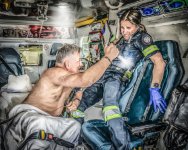
Toronto Community Crisis Service (TCCS) launched this year as a pilot program to take pressure off Toronto Paramedic Services.
TCCS is the fourth emergency service in Canada's largest city.
Toronto Paramedic Services received 21,400 9-1-1 "Mental Health -- Requests for Service" in 2021.
2025 Program Summary Toronto Paramedic Services:
Current strategies to address requests for service related to mental health include a collaborative partnership with the Toronto Community Crisis Service (TCCS).
Infantrymen are trained to provide indirect fire support using mortars. Artillerymen are trained to provide indirect fire support using guns/howitzers/missiles. Despite best efforts of the Canadian Army, they are not interchangeable.
Paramedics are trained to provide primary emergency care. Toronto Community Crisis Service (TCCS) "crisis workers are trained mental health professionals who work in pairs to support residents who are experiencing a mental health crisis. With over 200 hours of training, our crisis workers also have experience and/or education in areas such as social work, social services, nursing and peer support". Despite there being overlap in clientele, the methodology of response is not interchangeable.
It’s Okay to Ask for Help The Toronto Community Crisis Service (TCCS) provides free, confidential, in-person mental health supports city-wide from mobile crisis worker teams. TCCS supports Toronto residents 16 years of age or older and is available 24 hours a day, seven days a week. Call 211 to...
Infantrymen are trained to provide indirect fire support using mortars. Artillerymen are trained to provide indirect fire support using guns/howitzers/missiles. Despite best efforts of the Canadian Army, they are not interchangeable.
Paramedics are trained to provide primary emergency care. Toronto Community Crisis Service (TCCS) "crisis workers are trained mental health professionals who work in pairs to support residents who are experiencing a mental health crisis. With over 200 hours of training, our crisis workers also have experience and/or education in areas such as social work, social services, nursing and peer support". Despite there being overlap in clientele, the methodology of response is not interchangeable.
It’s Okay to Ask for Help The Toronto Community Crisis Service (TCCS) provides free, confidential, in-person mental health supports city-wide from mobile crisis worker teams. TCCS supports Toronto residents 16 years of age or older and is available 24 hours a day, seven days a week. Call 211 to...
Just wait till those newly trained TCCS workers starting wanting to claim PTSD or a physical injury associated with their work, leading to a life long disability claim.
I can see value in trained and experienced mental health crisis workers being available to attend low risk calls. If it helps free up paramedic and police resources for calls they’re better suited for, that can be a good thing.
Just wait till those newly trained TCCS workers starting wanting to claim PTSD or a physical injury associated with their work, leading to a life long disability claim.
So just like paramedics, police and firefighters (as well as nurses, social workers or any other occupation that provides direct services to sometimes challenging individuals) who are injured in the course of their employment. It would be interesting to see a comparison of job related injury rates of the "four" Toronto services in five/ten years. Not every "mental health" call will result in violence and a multidisciplinary approach will likely triage those responses that need a team to go in mob-handed as opposed to being more touchy-feely.
And in one study that looked at violence against paramedics
Background/Objectives: Violence is a significant occupational health issue for paramedics, yet underreporting limits efforts to identify and mitigate risk. Leveraging a novel, point-of-event violence reporting system, we aimed to identify ...
pmc.ncbi.nlm.nih.gov
Abstract
Background/Objectives: Violence is a significant occupational health issue for paramedics, yet underreporting limits efforts to identify and mitigate risk. Leveraging a novel, point-of-event violence reporting system, we aimed to identify characteristics of 9-1-1 calls associated with an increased risk of violence in a single paramedic service in Ontario, Canada. Methods: We retrospectively analyzed all electronic violence and patient care reports filed by paramedics in Peel Region and used logistic regression to identify call-level predictors of any violence and, more specifically, physical or sexual assault. Results: In total, 374 paramedics filed 974 violence reports, 40% of which documented an assault, corresponding to a rate of 4.18 violent encounters per 1000 9-1-1 calls. In adjusted models, the risk of violence was elevated for calls originating from non-residential locations (e.g., streets, hotels, bars), occurring during afternoon or overnight shifts, and involving young or working-age males. Presenting problems related to intoxication, mental health, or altered mental status were strongly associated with increased risk, with particularly high adjusted odds ratios for assault. Conclusions: These findings support the utility of near-miss and violence surveillance systems and highlight the need for multidisciplinary crisis response to high-risk calls, especially those involving mental health or substance use.
And from the conclusions
Taken together, our findings point to an urgent need for paramedic services to establish formal protocols to triage mental health and substance use-related calls for potential co-response by multidisciplinary mental health crisis teams. These teams may help de-escalate high-risk encounters and reduce the likelihood of violence. Integrated approaches like these, alongside broader violence prevention efforts, are essential to protecting the safety and mental health of paramedics while providing high-quality patient care.

So just like paramedics, police and firefighters (as well as nurses, social workers or any other occupation that provides direct services to sometimes challenging individuals) who are injured in the course of their employment. It would be interesting to see a comparison of job related injury rates of the "four" Toronto services in five/ten years. Not every "mental health" call will result in violence and a multidisciplinary approach will likely triage those responses that need a team to go in mob-handed as opposed to being more touchy-feely.
And in one study that looked at violence against paramedics
Background/Objectives: Violence is a significant occupational health issue for paramedics, yet underreporting limits efforts to identify and mitigate risk. Leveraging a novel, point-of-event violence reporting system, we aimed to identify ...
pmc.ncbi.nlm.nih.gov
Abstract
Background/Objectives: Violence is a significant occupational health issue for paramedics, yet underreporting limits efforts to identify and mitigate risk. Leveraging a novel, point-of-event violence reporting system, we aimed to identify characteristics of 9-1-1 calls associated with an increased risk of violence in a single paramedic service in Ontario, Canada. Methods: We retrospectively analyzed all electronic violence and patient care reports filed by paramedics in Peel Region and used logistic regression to identify call-level predictors of any violence and, more specifically, physical or sexual assault. Results: In total, 374 paramedics filed 974 violence reports, 40% of which documented an assault, corresponding to a rate of 4.18 violent encounters per 1000 9-1-1 calls. In adjusted models, the risk of violence was elevated for calls originating from non-residential locations (e.g., streets, hotels, bars), occurring during afternoon or overnight shifts, and involving young or working-age males. Presenting problems related to intoxication, mental health, or altered mental status were strongly associated with increased risk, with particularly high adjusted odds ratios for assault. Conclusions: These findings support the utility of near-miss and violence surveillance systems and highlight the need for multidisciplinary crisis response to high-risk calls, especially those involving mental health or substance use.
And from the conclusions
Taken together, our findings point to an urgent need for paramedic services to establish formal protocols to triage mental health and substance use-related calls for potential co-response by multidisciplinary mental health crisis teams. These teams may help de-escalate high-risk encounters and reduce the likelihood of violence. Integrated approaches like these, alongside broader violence prevention efforts, are essential to protecting the safety and mental health of paramedics while providing high-quality patient care.

Uh… If the perceived risk is assault to paramedics, then no, the appropriate partner service is going to be police, not, generally, a community based mental health provider.
Just wait till those newly trained TCCS workers starting wanting to claim PTSD or a physical injury associated with their work, leading to a life long disability claim.
Most MH calls intimately don’t need police and in some cases our presence makes things worse. Figuring out early on whether or not it’s such a call is challenging.
Okay, just curious as I remember an incident in England in 2020/2021(?) who when two MH workers were responding to a call were attacked by a guy with a baseball. Luckily, they a police officer with them who tased the guy before any serious injuries were incurred.
Now its possible that they had problems with this guy before and that's why they had a police escort.
Uh… If the perceived risk is assault to paramedics, then no,the appropriate partner service is going to be police, not, generally, a community based mental health provider.
So just like paramedics, police and firefighters (as well as nurses, social workers or any other occupation that provides direct services to sometimes challenging individuals) who are injured in the course of their employment. It would be interesting to see a comparison of job related injury rates of the "four" Toronto services in five/ten years. Not every "mental health" call will result in violence and a multidisciplinary approach will likely triage those responses that need a team to go in mob-handed as opposed to being more touchy-feely.
And in one study that looked at violence against paramedics
Background/Objectives: Violence is a significant occupational health issue for paramedics, yet underreporting limits efforts to identify and mitigate risk. Leveraging a novel, point-of-event violence reporting system, we aimed to identify ...
pmc.ncbi.nlm.nih.gov
Abstract
Background/Objectives: Violence is a significant occupational health issue for paramedics, yet underreporting limits efforts to identify and mitigate risk. Leveraging a novel, point-of-event violence reporting system, we aimed to identify characteristics of 9-1-1 calls associated with an increased risk of violence in a single paramedic service in Ontario, Canada. Methods: We retrospectively analyzed all electronic violence and patient care reports filed by paramedics in Peel Region and used logistic regression to identify call-level predictors of any violence and, more specifically, physical or sexual assault. Results: In total, 374 paramedics filed 974 violence reports, 40% of which documented an assault, corresponding to a rate of 4.18 violent encounters per 1000 9-1-1 calls. In adjusted models, the risk of violence was elevated for calls originating from non-residential locations (e.g., streets, hotels, bars), occurring during afternoon or overnight shifts, and involving young or working-age males. Presenting problems related to intoxication, mental health, or altered mental status were strongly associated with increased risk, with particularly high adjusted odds ratios for assault. Conclusions: These findings support the utility of near-miss and violence surveillance systems and highlight the need for multidisciplinary crisis response to high-risk calls, especially those involving mental health or substance use.
And from the conclusions
Taken together, our findings point to an urgent need for paramedic services to establish formal protocols to triage mental health and substance use-related calls for potential co-response by multidisciplinary mental health crisis teams. These teams may help de-escalate high-risk encounters and reduce the likelihood of violence. Integrated approaches like these, alongside broader violence prevention efforts, are essential to protecting the safety and mental health of paramedics while providing high-quality patient care.
Toronto Community Crisis Service (TCCS) is a community-based service. The crisis workers dispatched to mental health crisis calls work with four community anchor partners across Toronto:
Toronto Community Crisis Service (TCCS) is a community-based service. The crisis workers are trained mental health professionals who work are dispatched in pairs from the four community anchor partners across Toronto to support residents who are experiencing a mental health crisis. Findhelp |...
I see it as a way to devolve police and EMS from doing non-police/EMS functions. My experience of responding to MH calls is very limited and long, long ago. Military medics don't/didn't get many ambulance calls, so for me it was mostly responding to ruckuses in the mess that resulted in some drunk/stoned/agitated soldier getting the attention of the MPs/RPs who either called us to the scene to patch up obvious injuries or brought the miscreant to the MIR and subsequent inquiry brought to light underlying psych issues. @mariomike would likely have more experience with a wider range of scenarios.
On another level I see this as an improvement and wish something similar had been available to my brother who died last year. He had a long history of mental health issues and I think that such was related to his disruptive behaviour during his brief period of military service. Like many with his problems, they were exacerbated by alcohol, though he had been sober for many years prior to his death. Again, like many with his problems, he had previous encounters with the law and that made him hesitant to seek emergency response when he had legitimate physical medical problems. He died alone at home and was found after a neighbour had noticed he wasn't out and about; police entered and found him. If there had been an option of contacting an organization whose response wasn't limited to carting one off to a psych ward or jail (that is the thinking of many about EMS or police) then he might have been able to get the help he needed.
Toronto Community Crisis Service (TCCS) is a community-based service. The crisis workers are trained mental health professionals who work are dispatched in pairs from the four community anchor partners across Toronto to support residents who are experiencing a mental health crisis. Findhelp |...
This site uses cookies to help personalise content, tailor your experience and to keep you logged in if you register.
By continuing to use this site, you are consenting to our use of cookies.