• Thanks for stopping by. Logging in to a registered account will remove all generic ads. Please reach out with any questions or concerns.

Trust in our Institutions

Has your trust in our institutions changed?


  • Total voters
    55
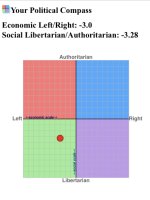
FYI I just did the political compass test on this page: The Political Compass


This is where i fell:

View attachment 98652

This is their assessment of Canadian Politics as of 2025.

View attachment 98653

Thx for this! As for me …
91735FDB-6011-4781-8BD6-D7423DB6469E.jpeg
While this puts me in NDP territory, I suspect my views on a strong military, pro-Israel and better gun rules over no guns at all would, at best, leave me hard to place at a Team Orange dinner party :)
 
Thx for this! As for me …
View attachment 98665
While this puts me in NDP territory, I suspect my views on a strong military, pro-Israel and better gun rules over no guns at all would, at best, leave me hard to place at a Team Orange dinner party :)
Did it too and much to my surprise found myself a smidgin to the right of where you are. The test is obviously flawed. :giggle:

🍻
 
Do you have any examples of where the SCC did something (i.e. made decisions) that you thought were partisan, ideological, illegal, or just patently wrong from a legal perspective? Not trying to throw shade at your opinion, but if you have such a negative opinion of the SCC, I would genuinely like to know what you've seen for my own edification.

Stinchcombe, Gladue, Jordan...just a few off the top of my head.

Don’t get me wrong, I’m not one of those who think the SCC is full of “woke progressive” types bent on turning the country into a gangsters’ paradise. And those decisions were probably the result of bad cases (I.e. bad cases make bad case law). But they have made some bone decisions that warrant parliamentary supervision, IMHO.
 
Stinchcombe, Gladue, Jordan...just a few off the top of my head.

Don’t get me wrong, I’m not one of those who think the SCC is full of “woke progressive” types bent on turning the country into a gangsters’ paradise. And those decisions were probably the result of bad cases (I.e. bad cases make bad case law). But they have made some bone decisions that warrant parliamentary supervision, IMHO.
Parliament chooses to fund some things and not others. The outcomes of those decisions land in court.

Jordan is an excellent example. Systemic underfunding of the courts. Either pay the cost of the system you want or deal with the consequences.
 
Parliament chooses to fund some things and not others. The outcomes of those decisions land in court.

Jordan is an excellent example. Systemic underfunding of the courts. Either pay the cost of the system you want or deal with the consequences.
Agreed. As much as Jordan and Stinchcombe are both the bane of my effing existence some days, Canadians charged with a crime need and deserve those rights, and the system should be held to account. The standards established in Jordan are still well beyond the time most straightforward cases should take to prosecute; mostly it’s pure backlog. An accused person has their life badly disrupted while waiting for their day in court. And while Stinchcombe still requires some counterbalance, IMO, I see from within the system the need for hard and fast rules to compel disclosure by the crown to prevent judicial abuses.

Just one cop’s opinion… But I spend my days right now dealing with major case disclosure, so it’s a pretty informed one.
 
Parliament chooses to fund some things and not others. The outcomes of those decisions land in court.

Jordan is an excellent example. Systemic underfunding of the courts. Either pay the cost of the system you want or deal with the consequences.

No disagreement with me! I’ve long said that the Feds can only fix legislation, but the provinces have to fund the infrastructure to use those fixes to put criminals away.

Having said that, the court has to realize that their decisions can cause real world problems not easily fixed by well crafted legislation or more resources.
 
Stinchcombe, Gladue, Jordan...just a few off the top of my head.

Don’t get me wrong, I’m not one of those who think the SCC is full of “woke progressive” types bent on turning the country into a gangsters’ paradise. And those decisions were probably the result of bad cases (I.e. bad cases make bad case law). But they have made some bone decisions that warrant parliamentary supervision, IMHO.
I'm not sure how I see any of those decisions as "partisan" within my understanding of the term.

You can never have enough HP. A 340 in the Dart would work very well.
The 1968 318 with a factory 2bbl carb produced 230 hp.
I had a 1975 Plymouth Duster 340. Very peppy.
 
Agreed. As much as Jordan and Stinchcombe are both the bane of my effing existence some days, Canadians charged with a crime need and deserve those rights, and the system should be held to account. The standards established in Jordan are still well beyond the time most straightforward cases should take to prosecute; mostly it’s pure backlog. An accused person has their life badly disrupted while waiting for their day in court. And while Stinchcombe still requires some counterbalance, IMO, I see from within the system the need for hard and fast rules to compel disclosure by the crown to prevent judicial abuses.

Just one cop’s opinion… But I spend my days right now dealing with major case disclosure, so it’s a pretty informed one.
Hard disagree but respectfully and with the admission your points are entirely reasonable. Canadians victims also deserve justice.

When they flip the system on its head. Which these decisions do- and we do nothing to build a timeline and machinery to handle the new reality all we do is let murderers and rapists go.

Really it’s the government that is not responding to the decisions properly I suppose so…maybe you’re right and I’m just surly.
 
Hard disagree but respectfully and with the admission your points are entirely reasonable. Canadians victims also deserve justice.

When they flip the system on its head. Which these decisions do- and we do nothing to build a timeline and machinery to handle the new reality all we do is let murderers and rapists go.

Really it’s the government that is not responding to the decisions properly I suppose so…maybe you’re right and I’m just surly.
Oh I’m surly as hell about it. It’s super annoying showing up to court to find it triple booked and now we’re adjourned and oh, surprise! Jordan, stay of proceedings… Or a stupidly generous plea deal. But that was the court signaling to the state that the total time A to B is too long to be called justice. The onus returns to the state to provide the system with the resources needed.

It’s not rocket surgery; talk to some senior judges, some senior crown, some defense counsel associations, and the senior administrators in the courts and identify where the choke points are in the judicial process… At the risk of exciting army.ca’s resident business consultants, this is the type of thing you hire process analysis consultants to write a Captain Obvious report that can be presented to provincial and federal cabinets to say “if you don’t want files getting tossed here are your choke points in ranked order of severity”.
 
Who would have thought you and I are so politically compatible. ;)

The Political Compass
That compass was interesting because it really peels the MOST absolute statements, leaving little room for grey zones and individual examples. Also, again, I don't know how NDP my wanting Canada to have a decent military that can fight if needed is :)
 
Yeah no, Kenney’s misrepresenting this one disappointingly. This is another one of those judicial review cases that found administrative decision makers did a shoddy job and ignored certain stuff they were supposed to consider, so they have to do it again. Administrative decision makers have to show their work. I’ve spoken on this before back in November after another immigration judicial review became rage bait:

Yeah I knew this would get posted… It’s rage bait.

The court’s decision: https://canlii.ca/t/kg9mq

He was convicted. He was deemed inadmissible and he was ordered deported. Nine of those things are being argued.

He filed an appeal on humanitarian and compassionate grounds, a ‘hail Mary’ last step in the deportation process.

What happened here is that the Immigration Appeal Division - the administrative decision maker - reached a decision that’s within their authority but failed to show their work. Because their work was sloppy, the court has told them to do it again. The court has NOT reversed the final decision and ordered that he gets to stay in Canada no matter what immigration says.

When someone wants to challenge and administrative decision from a tribunal, once administrative appeals are exhausted they ask for “judicial review”. That’s the court taking a look at the situation. The court gives a lot of deference to the administrative decision maker. Courts don’t decide “what decision would we make?” but rather “is the decision be they could reasonably have made on the evidence?” There can be a wide range of reasonable decisions.

But, for the court to decide that, the decision maker has to show their work in the written decision and has to articulate their reasoning enough for the court to see why they reached the decision they did. This includes visibly engaging with all the relevant considerations. In this case the decision maker failed to do that. Because they couldn’t say “we considered the best interests of the children” and “we considered the parole board assessment”, and then explain their engagement with those two things, the court is unable to conclude the decision itself was reasonable- the receipts aren’t there. As federal court says in concluding the introduction: “While the IAD may have come to the same determination after considering the above-noted evidence, it is not for this Court to speculate as to the outcome. The matter is therefore remitted to the IAD for redetermination.”

The IAD now gets to reassess its decision, and will have to better articulate the “why?” it arrives at the decision it makes. Administrative decision makers need to ‘court proof’ their decisions in large part by showing their work.

Incidentally, for CAF members, this is the same sort of process when a grievance goes all the way past all administrative levels and goes to judicial review- same decision for the courts to make on “the as the decision reasonable, and was it arrived at with a reasonable process?” This is why for instance a CAF leader making decisions on remedial measures or release needs to take good notes and create a good written record of how each decision is reached.

Now, I’m not an administrative law guy and maybe our army.ca in house counsel will be along to correct some or all of this, but from looking at the decision I’m pretty sure I got it right.

 
Last edited:
Yeah no, Kenney’s misrepresenting this one disappointingly. This is another one of those judicial review cases that found administrative decision makes did a shoddy job and ignored certain stuff they were supposed to consider, so they have to do it again. Administrative decision makers have to show their work. I’ve spoken on this before back in November after another immigration judicial review became rage bait:

Ok.
 
Yeah no, Kenney’s misrepresenting this one disappointingly. This is another one of those judicial review cases that found administrative decision makes did a shoddy job and ignored certain stuff they were supposed to consider, so they have to do it again. Administrative decision makers have to show their work. I’ve spoken on this before back in November after another immigration judicial review became rage bait:
Sort of like some unions who may not like defending DF'ers, but if management doesn't follow all the steps of due process, DF'er's gotta be defended?
 
Sort of like some unions who may not like defending DF'ers, but if management doesn't follow all the steps of due process, DF'er's gotta be defended?
More like if a CAF vet applies for VAC benefits, gets rejected, and the decision maker doesn’t show their work. With a few other steps along the way it can be challenged in court.

Canada has delegated a ton of administrative decision making to officials and tribunals who work as experts in specific subjects. Immigration. Landlord/tenant. Veterans’ benefits. Grievance reviews. Healthcare professional complaints. There are many dozens if not hundreds of them. But for this system of delegation to work those with delegated authority have to use that authority correctly, and that means telling someone how a decision was reached. When they fail to show their work someone else gets to do it again.

In the immigration case referred to in the article I’m sure he’ll end up losing again, but the decision will be reached and written more competently so it stands up to scrutiny.

We want courts to strike administrative decisions that aren’t adequately justified or explained. That due process protects all of us. Anyone who’s successfully appealed a VAC decision to VRAB has benefitted from the same protections.
 
Back
Top