• Thanks for stopping by. Logging in to a registered account will remove all generic ads. Please reach out with any questions or concerns.

High Speed Train Coming?-split from boosting Canada’s military spending"

Why focus on the train notion? The last few years has seen a massive development in Halton county from Milton east through to Mississauga. Whilst all that mud was flying would have been the perfect time to construct a dual track interurban system parallel to Derry Road and meeting up with the GO at some point enroute. Every one of these new subdivisions you have mentioned in whatever city should have a transit system as part of its construction strategy. Something like this. Flat fare of 3 Euros, it travels at 70 kmh between stops and has a neat gadget that allows the driver to call up a green light at an intersection so there is very little delay.


strategy. View attachment 101832
Still sounds like a provincial issue.
 
  • Like
Reactions: ytz
Still sounds like a provincial issue.
Going by definition, Toronto to Ottawa is also a provincial issue. The only section that makes it a national one is the little bit between Ottawa and Montreal. In reality, travel should be of concern on all levels but since Ottawa has and continues to ignore the interests of the vast majority of Canadians in their planning the provinces should pool their markets and devise a interurban system that could be applied throughout all of the major residential blocks if it fits and amplified if appropriate between urban centres. The larger scale should provide for lower building costs and reduce the duplication of effort. As others have pointed out our market is spread out over a huge territory with numerous concentrations of people but nothing that would call out for attention on its own. The Tri-city area constructed almost 40 km of surface light rail through two major downtown cores for about 3 billion with a daily ridership of 17000 and a goal of 25000. That is a lot of buses and a whole slew of cars that are remaining in the garage. For both Quebec and Ontario, putting the provincial tithe for the HSR and combining resources would be a far better use of scarce transit money.
 
or work with the province to develop a harmonized system. It was the feds who created VIA by allowing the two majors to divest themselves of their passenger obligations. From what I have read, carrying passengers was the price they paid for receiving the huge land grants that went with the license to build a railway. Rode both CN and CP across Canada and much preferred the CP route. North of Superior was spectacular. I liked the stainless coaches and accommodations too but that is neither here nor there. But it seems that VIA was only half a system. It had no trackage of its own and the issue of scheduling should have been resolved at that time. The way it was written made it doomed to fail. Now as YTZ gleefully points out if they build the HSR local travel via train will primarily devolve upon the province. How is Ontario going to go up against CN in the corridor and develop a service that probably would be used if it actually existed. I have talked to a lot of Trenton bound personnel who would be delighted to traipse down to union and catch the next train to Trenton (or Belleville) if that train wasn't 18 hours from departure.
One would have to get into the original charters to know that (hint: you would have to review the charters of CN's precedent railways).

I don't think we can single out VIA as only being "half a system". The vast majority of Amtrak is operated on host railways (about 97%). I don't know enough about Amtrak's operations, relations with its landlords or their legislation to know whether it fares any better, but at least they have enabling legislation, which is more than what VIA has, which is part of the problem; nothing "is written".

VIA and the government have stated that corridor 'local' service will the maintained after HSR is implemented; I guess we'll have to wait. Even if it does devolve to GO/Metrolinx, they have fared reasonably well in their dealings with CN and CP. All of their network was once on host corridors. They now own about 80% of their network's trackage (most of the rest is on CN, only the Milton service is on CPKC).

Going by definition, Toronto to Ottawa is also a provincial issue. The only section that makes it a national one is the little bit between Ottawa and Montreal.
I think you are overly parsing words. The service is (will be) interprovincial. That's like saying a federally-regulated interprovicial transport truck is only truly interprovincial when it momentarily straddles the Ontario-Manitoba border.

The Tri-city area constructed almost 40 km of surface light rail through two major downtown cores for about 3 billion with a daily ridership of 17000 and a goal of 25000.
If you are talking about Waterloo Region's ION system, that system was built with roughly equal funding from the Region, Province and the federal government.
 
If you are talking about Waterloo Region's ION system, that system was built with roughly equal funding from the Region, Province and the federal government.

Regarding funding municipal transit , what percentage does Queen's Park pay?

TTC , including Wheel-Trans, is only funded 9% by Queen's Park.

The rest comes from the farebox, and municipal property tax.

January 7, 2026


About 42% of the Operating Budget is funded through TTC own source revenues, including approximately 39% from passenger fare and ancillary revenues and 3% from TTC Stabilization Reserve and TTC Long-Term Liability Reserve funding. Provincial Funding contributions make up approximately 9% of the budget,
 
Regarding funding municipal transit , what percentage does Queen's Park pay?

TTC , including Wheel-Trans, is only funded 9% by Queen's Park.

The rest comes from the farebox, and municipal property tax.

January 7, 2026

Operating costs are different than capital. Without looking it up, I believe the Eglington Crosstown LRT was built by Metrolinx and turned over to the TTC, and I believe the Ontario Line under construction will be the same.
 
Economic Case Study from Alto:


And the notable bit for those who keep pushing the previous HFR:

The most frequently cited alternative, a dedicated “high-frequency” rail system, would still require largely new, grade-separated, and electrified infrastructure, at a capital cost of $45 to $75 billion, close to the $60 to $90 billion estimated for high-speed rail. Yet it would generate one fifth of the economic impact: a 0.2% GDP uplift, versus 1.1% for high-speed rail. The relevant question is not which option costs less. It is why Canada would spend nearly as much for a fraction of the benefits.
 
Economic Case Study from Alto:


And the notable bit for those who keep pushing the previous HFR:
This is why Alto might fail.

The LPC is terrible at defending their ideas.

They let the opposition frame the debate. And by the time they get around to defending their ideas, its too late.

The LPC, Carney, should be out, in public, defending the case for Alto, the need for Alto, the spreading out of the cost for Alto, the economic argument for Alto, and why HSR is objectively better than HFR.

Instead crickets. Alto is more popular than not, but allowing critics to hammer away at it for years with no response, no public campaign to sell the benefits of it, will slowly degrade that support over time.

Because stuff like this should be being blasted out for all to hear, repeatedly, by every MP along the route, including Mark Carney.

 
This is why Alto might fail.

The LPC is terrible at defending their ideas.

They let the opposition frame the debate. And by the time they get around to defending their ideas, its too late.

The LPC, Carney, should be out, in public, defending the case for Alto, the need for Alto, the spreading out of the cost for Alto, the economic argument for Alto, and why HSR is objectively better than HFR.

Instead crickets. Alto is more popular than not, but allowing critics to hammer away at it for years with no response, no public campaign to sell the benefits of it, will slowly degrade that support over time.

Because stuff like this should be being blasted out for all to hear, repeatedly, by every MP along the route, including Mark Carney.

See my post above about letting opponents define the narrative and missing opportunities.

Alto is going to go through my riding. It is a hot topic for many people in and around my community. My riding is held by a Liberal MP. Received her latest householder last week. Mention of Alto? Not a peep.

I repeat my point that not everyone goes to open houses but every household gets the householder.

Now I know the householder is essentially a package of canned feel good content and grip and grins and that the vast majority of them get binned immediately but it still seems to me like a missed opportunity to at least try to shape the narrative.
 
And just remember, the last we heard of HFR, they were saying Toronto-Montreal in 5 hrs. The current train is scheduled at 5.5 hrs and with delays is often pushing 6 hrs. Imagine spending $45-75B and still taking 5 hrs for that trip.
 
And just remember, the last we heard of HFR, they were saying Toronto-Montreal in 5 hrs. The current train is scheduled at 5.5 hrs and with delays is often pushing 6 hrs. Imagine spending $45-75B and still taking 5 hrs for that trip.
what would the difference in cost be if you left it as diesel-electric? Also at 120 mph or less it doesn't have to be graded separated except crossing major routes. 120 mph and a dedicated line would reduce your end to end to perhaps 4 hours as the turbo back in 1970 or so was supposed to deliver. The longer HSR takes to produce facts and figures the greater the chance of it crashing in flames: witness California and unfortunately it requires two major undertakings simultaneously. The first of course is the land accumulation. But the second stumbling block is going to be developing the electrical infrastructure. Quebec currently has some hydro surplus but that won't last long which is why they are pushing for the Churchill expansion. AI is currently the flavour of the month and it is going to be eating up every KW available to the grid. Constructing at least two reactors to feed these two monsters, if history is any indicator, will require a minimum of 10 years and that is supposing that everything has been signed off and any litigation is finished. And the cost will be significantly higher than 90 Billion.
 
what would the difference in cost be if you left it as diesel-electric?

The electrification part isn't the cost driver. When HFR was planned, I believe electrification was like $5-6B. And it almost always pays back inside 10-15 years because of fuel and maintenance savings when you're running an hourly train in each direction. It's the exact same math at why GO was looking to electrify every line that is hourly or better.

Also at 120 mph or less it doesn't have to be graded separated except crossing major routes. 120 mph and a dedicated line would reduce your end to end to perhaps 4 hours as the turbo back in 1970 or so was supposed to deliver.

The Turbo Train hit its much vaunted speed on one scheduled run per day. Was slower on the rest. And it operated at a time when there was a fraction of the freight traffic and far shorter freight trains (less conflict). This is why I keep saying this is like trying to resurrect the Avro Arrow.

Your entire suggestion here is exactly what we have now. VIA's current trains are diesel-electric capable of 125 mph running speed. And they take 6 hrs from Toronto to Montreal because they run on tracks that aren't grade separated that they don't own. You know the popular definition of insanity right? Applies here.
 
The electrification part isn't the cost driver. When HFR was planned, I believe electrification was like $5-6B. And it almost always pays back inside 10-15 years because of fuel and maintenance savings when you're running an hourly train in each direction. It's the exact same math at why GO was looking to electrify every line that is hourly or better.


The Turbo Train hit its much vaunted speed on one scheduled run per day. Was slower on the rest. And it operated at a time when there was a fraction of the freight traffic and far shorter freight trains (less conflict). This is why I keep saying this is like trying to resurrect the Avro Arrow.

Your entire suggestion here is exactly what we have now. VIA's current trains are diesel-electric capable of 125 mph running speed. And they take 6 hrs from Toronto to Montreal because they run on tracks that aren't grade separated that they don't own. You know the popular definition of insanity right? Applies here.
I believe the reason for the slower speeds is more because CN won't authorize it. Dedicated trackage is definitely required to achieve consistency but just as important is frequency. I would say that the route is well-used and it is actually used a lot by families travelling 60 miles or less. That surprised me a little but it shouldn't because that is what trains are for. You are adamant that we need this HSR: maybe so but we have a greater requirement for a network to blend in with it; otherwise it is simply a shuttle service for business because no one else has need of it and they have the money to fly or the technology to meet electronically. To refurbish 3 units at Pickering is estimated to cost 26 Billion. You say the total power cost will be 6 Billion. Doesn't seem likely because it won't be a stand alone but will require significant upgrades or new generation at a guess every few hundred miles. Many of the towns along the route are at max. now to where they are limiting people upgrading to 200 amps.
 
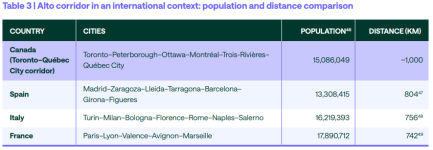
Population and distance in the proposed corridor and how it compares to similar lines abroad:
1788386350986.png

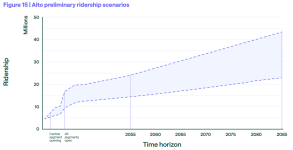
Ridership projections:
1788386398665.png

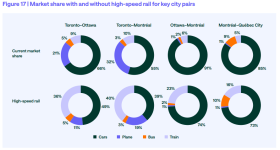
Market share forecasts:
1788386427970.png

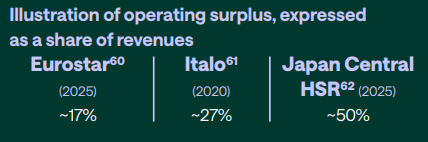
Profitability:

While the capital cost is substantial, it must be assessed in the context of the long-term value it creates. Unlike most transportation projects (such as highways, transit or bridges), the project is expected to operate on a self-sustaining basis. Once in service, operating revenues are expected to fully cover operating and maintenance costs.
1788386464241.png

Fare strategy:
1788386540199.png


1788386559734.png


Source:


Analysis was based on data from 2024. Updated report expected in 2027.
 
It is the frequency of service that will generate its use. If you put a VIA on the same route at 120 miles per hour with a departure from either end every 30 minutes or even every hour and 3.5 hours on route including stops you would achieve the same results as the HSR at half the price and half the disruption. HSR is a glamourous vision but for travelers on trip lengths of 300 miles or thereabouts it is a luxury and not a necessity. There just isn't enough distance to make the time savings worth the investment. Now if Montreal was located where Quebec City is you would have a valid argument but as it stands there are only 6 non-stop domestic flights per day between Toronto and Quebec City so you are only talking of at the most 1500 customers. 90 billion is a lot cash to provide 1500 each way an alternative to Porter or Air Canada. The argument being made is that lots of others will use it and that is true but a frequent VIA service on a dedicated line will provide the same service albeit a little longer. But then again it will also let you off in Sherbrooke or carry you between Sherbrooke and Trois Rivieres: frequency is the key and a dedicated track is essential.
 
It is the frequency of service that will generate its use. If you put a VIA on the same route at 120 miles per hour with a departure from either end every 30 minutes or even every hour and 3.5 hours on route including stops you would achieve the same results as the HSR at half the price and half the disruption. HSR is a glamourous vision but for travelers on trip lengths of 300 miles or thereabouts it is a luxury and not a necessity. There just isn't enough distance to make the time savings worth the investment. Now if Montreal was located where Quebec City is you would have a valid argument but as it stands there are only 6 non-stop domestic flights per day between Toronto and Quebec City so you are only talking of at the most 1500 customers. 90 billion is a lot cash to provide 1500 each way an alternative to Porter or Air Canada. The argument being made is that lots of others will use it and that is true but a frequent VIA service on a dedicated line will provide the same service albeit a little longer. But then again it will also let you off in Sherbrooke or carry you between Sherbrooke and Trois Rivieres: frequency is the key and a dedicated track is essential.
At the speed you are suggesting, I’m assuming that is the average speed per hour. That would have to take into account slower speeds entering/leaving a station, all level crossings and any ‘service’ adjustments to freight rail traffic, unless a complete ‘end to end’ new rail line is built.
In order to achieve 120miles/hr, 200km/hr across the entire hour, I would think that ‘running speed’ would be closer to 150-170miles/hr or pushing 275-280km/hr. Is that not the definition of HSR?
 
At the speed you are suggesting, I’m assuming that is the average speed per hour. That would have to take into account slower speeds entering/leaving a station, all level crossings and any ‘service’ adjustments to freight rail traffic, unless a complete ‘end to end’ new rail line is built.
In order to achieve 120miles/hr, 200km/hr across the entire hour, I would think that ‘running speed’ would be closer to 150-170miles/hr or pushing 275-280km/hr. Is that not the definition of HSR?
It would also exceed the track safety classification for the CN Kingston sub (assuming that is what is being talked about because it is the route of the current VIA corridor service). Top speed for Class 5 track is 95mph (153kph) and there are all sorts of locations where it is lower. Increasing the track classification requires changes in geometry, signally and grade crossing rules. Without dedicated tracks, any passenger service has to weaved in and out of slower freight traffic, and I believe mainline turnouts (switches) are rated for 45mph (72kph).

There are also limits to how fast a diesel electric locomotive can go, certainly with what is available on the market. Getting into real high speed requires electrification, and both CN and CPKC have indicated they want no part of it - and they own the property.
 
At the speed you are suggesting, I’m assuming that is the average speed per hour. That would have to take into account slower speeds entering/leaving a station, all level crossings and any ‘service’ adjustments to freight rail traffic, unless a complete ‘end to end’ new rail line is built.
In order to achieve 120miles/hr, 200km/hr across the entire hour, I would think that ‘running speed’ would be closer to 150-170miles/hr or pushing 275-280km/hr. Is that not the definition of HSR?
120 mph did it in those times 40 plus years ago but as Lenatich says it has to be a dedicated line. With the constraints imposed by CN and CPKC it would have to be a new route; possibly following the proposed Toronto Peterborough idea. Don't misunderstand what I am trying to say. I am not opposed to bringing a new passenger service into being in fact I believe it is long overdue. I am opposed to routing across over 400 productive farms and causing a 20 or 30 km. detour to get a wagon load of alfalfa from the field to the barn that is only 200 yards as the crow flies. If technology requires that it be electrified in order to sustain between 100 and 120 then that is the way to go. But building a mile of track through Southern Ontario is only 3 to 4 million dollars times 2 if you are going to twin it plus land. The cost of the HSR being built in California is 100 million per mile. Is saving an hour (at most) worth 82 million dollars a mile at least? That's roughly 22,796,000,000. That will pay the purchase costs of all of the new subs.
 
Population and distance in the proposed corridor and how it compares to similar lines abroad:
View attachment 102055

Ridership projections:
View attachment 102056

Market share forecasts:
View attachment 102057

Profitability:

View attachment 102058

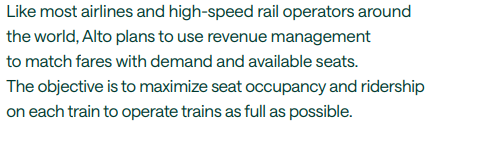
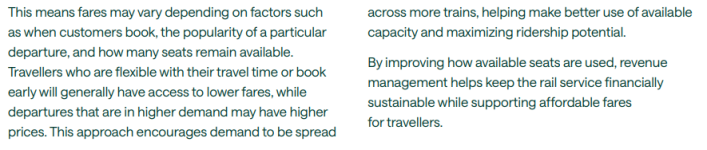
Fare strategy:
View attachment 102059


View attachment 102060


Source:


Analysis was based on data from 2024. Updated report expected in 2027.

Looks like the goal of reducing air travel in and out of Toronto would be met.
 
Back
Top