• Thanks for stopping by. Logging in to a registered account will remove all generic ads. Please reach out with any questions or concerns.

40 Maps That Will Help You Make Sense of the World

Edward Campbell

Army.ca Myth
Subscriber
Donor
Mentor
Reaction score
6,324
Points
1,260
Maybe this is really just Radio Chatter but there are some useful and interesting data here.
 
Very cool. We are a bunch of metric beer and coffee drinkers with lots of water and great maternity leave.
 
And here, from the McKinsey Global Institute is an interesting map which shows an approximation of the shift of the global economic centre of gravity over the last 1,000 years and projects it into the near future.

BZ7xr0pCQAA0r69.png:large


A map from the "Holy Sh!t" category in this article which is reproduced under the Fair Dealing provisions of the Copyright Act from the Washington Post:

http://www.washingtonpost.com/blogs/the-fix/wp/2014/02/19/you-might-not-like-big-cities-but-you-need-them/
17-Washington-Post-Logo.jpg

The case for big cities, in 1 map

BY CHRIS CILLIZZA
February 19

New Yorkers who don't live in New York City hate the Big Apple.  Missourians outside of St. Louis and Kansas City are skeptical about the people (and politicians) who come from the two biggest cities in the state.
Politicians from the Chicago area (and inner suburbs) often meet skepticism when campaigning in downstate Illinois. You get the idea.  People who don't live in the big cities tend to resent those who do.

Fair enough. Growing up in semi-rural southeastern Connecticut, I always hated Hartford. (Not really.) But, this map built by Reddit user Alexandr Trubetskoy shows  -- in stark terms -- how much of the country's economic activity (as measured by the gross domestic product) is focused in a remarkably small number of major cities.

GDPMAP-1024x791.gif


In a 2011 analysis by the Brookings Institution, the think tank put hard data to just how critical big cities are to the state -- and national -- economy. Wrote Alan Berube and Carey Anne Nadeau:

    In 15 states, one large metropolitan area alone accounts for the bulk of economic output. These states are located in every region of the country, from Massachusetts (Boston) and New York (New York) in the Northeast, to Georgia (Atlanta)
    in the South, to Illinois (Chicago) and Minnesota (Minneapolis-St. Paul) in the Midwest, to Colorado (Denver) and Washington (Seattle) in the West. In a further 16 states, just two metropolitan areas generate the majority of GDP,
    including California (Los Angeles and San Francisco), Michigan (Detroit and Grand Rapids), Oklahoma (Oklahoma City and Tulsa), and Texas (Dallas and Houston).

Consider that. In 31 states, one or two metro areas account for the vast majority of economic output in the state.  Those numbers make clear that while you may like to hate on big cities, you -- and we -- need them.



I'm going to guess that the data will be very similar for Canada.

It makes one think about farm subsidies ~ the productive people in big cities pay to keep unproductive "family farms" going: Why?  ~ and "regional development" projects. (I understand the politics; it's the economic argument that puzzles me.)
 
Things that make you go hmmmm:

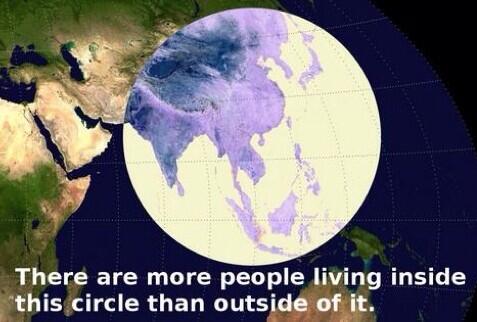
the-worlds-population-concentrated-small.0.png

Source: http://www.vox.com/2014/9/23/6829399/23-maps-and-charts-that-will-surprise-you

Sorry for the image quality. The crux of it is that is the whole world's population was concentrated as densely (on the map) as:

    Paris            San Francisco

    New York    London

    Singapore    Houston

... then the whole world's population would fit into the areas shown. Thus if the whole world's population was packed together as densely as people are packed n New York City then the whole world would fit into Texas.

 
Yes, Rosling is great ...

Here's another one that makes me go hmmmm:

ByjdbP4IcAAPpaI.jpg


Ian Bremmer, professor at NYU and president of the Eurasia Group, tweets that "Hard to be a Balt"
 
Most important map: http://lotrproject.com/map/#zoom=3&lat=-1315.5&lon=1500&layers=BTTTTT
 
dapaterson said:
Most important map: http://lotrproject.com/map/#zoom=3&lat=-1315.5&lon=1500&layers=BTTTTT

Can't wait for the Street View. ;D
 
An interesting "map" from Ian Bremmer, CEO of the Eurasia Group:

81335288-bb0d-4a73-a202-d3f88d5baaff-original.jpeg

Source: http://howmuch.net/
 
E.R. Campbell said:
This video from dailymotion is interesting and well produced.

See you and raise you 5000 years - https://www.youtube.com/watch?v=uxDyJ_6N-6A

Keep your eye on the bottom right hand corner. 

"Borders? Which borders?"  [:D
 
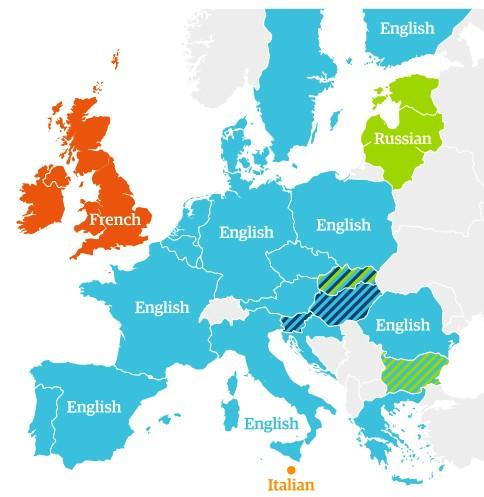
Washpo-graphic4.jpg


4. Many popular languages are spoken in more than just one country

The reason why English, French and Spanish are among the world's most widespread languages has its roots in the imperial past of the nations where they originate.

They forgot some.  Arabic is an imperial language as well.  As is Persian.  As is Chinese, but that is more arguable.
 
E.R. Campbell said:
A map from the "Holy Sh!t" category

I'm going to guess that the data will be very similar for Canada.

It makes one think about farm subsidies ~ the productive people in big cities pay to keep unproductive "family farms" going: Why?  ~ and "regional development" projects. (I understand the politics; it's the economic argument that puzzles me.)

The vast vast majority of farm subsidies go to Dairy and Poultry with the marketing boards. Grain and Beef producers get very little of that subsidy pie.

As for the "family farms" there are no longer any places that raise a family on a 1/4 section (160 acres) like they were doing 50 years ago, but that still seems to be the opinion of the highly uninformed mainstream media these days. Today's family farm can range from 3,000 to 50,000 acres, and is a highly mechanized and technologically advanced entity but is stilled owned by a family corporation.
 
A very interesting map, again from Ian Bremmer, CEO of the Eurasia Group, who says it's the best map he's seen that shows just how big Africa really is:

4c7ab9ef-2372-4738-9138-d6b7c277c8b2-original.jpeg
 
Well, that's a bloody useless map: Comparing countries to continent.

Try the same map, but put the US, Canada and Mexico into Africa, it's about equal in size, Whoops, we just compared two continents with one another, and funny enough, they come out about the same (N.A.= 25 millions Km2 to Africa 30 millions Km2). Woopdy do.
 
Back
Top