• Thanks for stopping by. Logging in to a registered account will remove all generic ads. Please reach out with any questions or concerns.

Arctic/Offshore Patrol Ship AOPS

If lighterng works and it is the least cost solution then Normandy looks pretty good to me.

And don't forget mulberry.


The bigger issue, I would think, is having adequate storage on hand so that you can skip a shipment or two. And an alternate supply route for when that isn't the answer.
I would say design a floating and floatable modular dock. Build it at offshore construction platform sites in Newfoundland and tow it to the preselected site in the Arctic.
 
No. Refueling alongside one another in a sheltered bay or inlet. No underway capability, and no extra stuff like dry stores or ammunition. KISS.


A 12500 DWT tanker. It also complies with the BC tanker ban limits.

...

At risk of derailing.

Plan B for western pipeline.

Using these as shuttles to transfer points in Alaskan waters to fill up VLCCs at sea.

Back to regularly scheduled discussion.
 
Funny you mentioned Asterix. While our new JSS will be able to go above 60 degrees, Asterix or civilian run vessels like her cannot due to insurance and liability issues.
So Oldgateboatdriv is suggesting an ice-rated supply vessel using lightering to transfer cargo including fuel to shore-based supply depots?
 
I would say design a floating and floatable modular dock. Build it at offshore construction platform sites in Newfoundland and tow it to the preselected site in the Arctic.
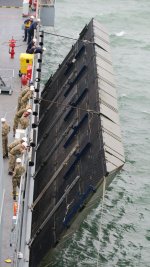
1778428893353.jpeg

With Mexeflote you are half way there.

Lighter, barge or floating dock.
 
What this really highlights is that Canada has never lacked ways to move fuel into the Arctic. What we have lacked is a coherent and sustained logistics strategy. Fuel has historically come north by rail to Churchill, by barge through the Mackenzie system, via shuttle tankers from Atlantic Canada, from CCG icebreakers, from allied facilities at Pituffik Space Base (formerly Thule), from Nuuk, and even from support ships like MV Asterix staging below 60 and fueling ships at anchor. The RCN and CCG have been improvising Arctic logistics for decades because there was never one silver bullet solution. There are already multiple proven methods.


Frankly, partnering more closely with Denmark and Greenland makes increasing sense strategically and politically. Investing in fuel infrastructure in Nuuk would give Canada and allied navies a reliable western Greenland logistics node far closer to many Arctic operating areas than trying to push everything from Halifax or Montreal. Couple that with several modest shuttle tankers operated by a mix of civilian mariners, Naval Reserve personnel, and Regular Force detachments, and you suddenly have a flexible mobile fuel network that does not rely entirely on expensive permanent northern mega projects. Ships can fuel safely at anchor which is already routinely done. It is cheaper, scalable, and far less vulnerable than concentrating everything into one fixed site.


People also forget that Canada’s environmental regulations and operational restrictions already heavily limit alongside replenishment and peacetime RAS operations north of 60. So the idea that we need massive southern style naval fueling infrastructure everywhere in the Arctic does not necessarily align with how operations are actually conducted. Anchor fueling, shuttle tankers, allied cooperation, and mobile support have worked in practice for years. Permanent shore storage at places like Iqaluit could still follow later if operational demand justified it, but mobility and redundancy are probably the smarter first investment.

 
So Oldgateboatdriv is suggesting an ice-rated supply vessel using lightering to transfer cargo including fuel to shore-based supply depots?
Civilian tankers can go above 60 if they meet all the class requirements and have the proper insurance. Asterix didn't have the insurance and the RCN didn't want them above 60. No point if they can't support a RAS.
 
I was thinking something more robust that could be floated in, sank and left in place.

Seen.

My issue is how sturdy a build is necessary to create a structure that will handle the rigours of wave action, freeze-thaw cycles and ice movement over a multi-year period.

It would require a Churchill or Iqaluit style investment I think.
 
What this really highlights is that Canada has never lacked ways to move fuel into the Arctic. What we have lacked is a coherent and sustained logistics strategy. Fuel has historically come north by rail to Churchill, by barge through the Mackenzie system, via shuttle tankers from Atlantic Canada, from CCG icebreakers, from allied facilities at Pituffik Space Base (formerly Thule), from Nuuk, and even from support ships like MV Asterix staging below 60 and fueling ships at anchor. The RCN and CCG have been improvising Arctic logistics for decades because there was never one silver bullet solution. There are already multiple proven methods.


Frankly, partnering more closely with Denmark and Greenland makes increasing sense strategically and politically. Investing in fuel infrastructure in Nuuk would give Canada and allied navies a reliable western Greenland logistics node far closer to many Arctic operating areas than trying to push everything from Halifax or Montreal. Couple that with several modest shuttle tankers operated by a mix of civilian mariners, Naval Reserve personnel, and Regular Force detachments, and you suddenly have a flexible mobile fuel network that does not rely entirely on expensive permanent northern mega projects. Ships can fuel safely at anchor which is already routinely done. It is cheaper, scalable, and far less vulnerable than concentrating everything into one fixed site.


People also forget that Canada’s environmental regulations and operational restrictions already heavily limit alongside replenishment and peacetime RAS operations north of 60. So the idea that we need massive southern style naval fueling infrastructure everywhere in the Arctic does not necessarily align with how operations are actually conducted. Anchor fueling, shuttle tankers, allied cooperation, and mobile support have worked in practice for years. Permanent shore storage at places like Iqaluit could still follow later if operational demand justified it, but mobility and redundancy are probably the smarter first investment.


One of Prince Rupert's prime functions from WW2 was as a fuel storage facility to support Gulf of Alaska operations.
 
So Oldgateboatdriv is suggesting an ice-rated supply vessel using lightering to transfer cargo including fuel to shore-based supply depots?

No. Go back and read my posts.

GoC owned and operated (CFAV) ice-rated tanker for anchorage refueling. Delivery of dry goods, ammunition and food for the depot(s) is a civilian function done either by air or by Arctic maritime resupply during the navigation season, whichever way they chose to do it. Lightering by the RCN would be to get their supplies from the depot.
 
Seen.

My issue is how sturdy a build is necessary to create a structure that will handle the rigours of wave action, freeze-thaw cycles and ice movement over a multi-year period.

It would require a Churchill or Iqaluit style investment I think.
We would have to engineer that into any structure I would think, as well as being able to remove it easily enough for environmental regulations and remediation.
 
We would have to engineer that into any structure I would think, as well as being able to remove it easily enough for environmental regulations and remediation.

Agreed. The question of cost then raises the next question of if we want to make this solution available to each arctic coastal community or do we manage it in a manner similar to the Maritime Ports Authority. There are something like 586 recognized harbours in Canada but only 17 are recognized as fully functional trade ports.
 
Back
Top