• Thanks for stopping by. Logging in to a registered account will remove all generic ads. Please reach out with any questions or concerns.

Arctic/Offshore Patrol Ship AOPS

RHG can go from NUUK to home port in Esquimalt normally without refueling. It all depends on what their doing. I'm not sure why they didn't get fuel in NUUK as we usually do. It also sounds like they didn't top up in Halifax before deploying. Generally speaking we usually get fuel in NUUK and often refuel from CCG ships. Normally they stop into Dutch Harbour and get fuel as well.
Maybe they are avoiding diesel fuel taxes by filling up on the high seas.
 
RHG can go from NUUK to home port in Esquimalt normally without refueling. It all depends on what their doing. I'm not sure why they didn't get fuel in NUUK as we usually do. It also sounds like they didn't top up in Halifax before deploying. Generally speaking we usually get fuel in NUUK and often refuel from CCG ships. Normally they stop into Dutch Harbour and get fuel as well.
It was part of their operations to do the refueling in the high north, to basically prove it can be done. It was always part of the plan. None of the other AOPS have done it yet AFAIK.
 
It was part of their operations to do the refueling in the high north, to basically prove it can be done. It was always part of the plan. None of the other AOPS have done it yet AFAIK.
I suspected something like that as the contract was let some months ago. Very surprised that RHG didn't have a boom out though, part of SEMS to have one out.
 
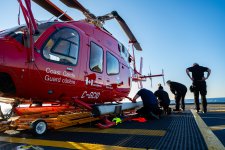
The Canadian Coast Guard Bell 429 embarked in HMCS Robert Hampton Gray raises a practical question. For routine AOPV operations, why are we so focused on embarking a Cyclone, even if it could embark one?

From what I understand, the Coast Guard helicopter is operating with a pilot and an aircraft maintenance engineer and everything is working out well. A full Cyclone air detachment can take eight to ten people. That difference matters when bunk space is already under pressure.

The AOPVs may have been designed around a relatively small ship’s company, but they are increasingly being asked to carry extra people for force generation, training and other tasks. I understand that some are sailing with more than 90 people, occasionally approaching 100, with personnel sleeping on cots in storerooms and other spaces. As Halifax class availability tightens and the Kingston class draws down, that pressure is unlikely to disappear.

A Cyclone brings capabilities a Coast Guard utility helicopter cannot, particularly for missions requiring its military sensors and systems but really what missions are those? Personnel transfers, reconnaissance, logistics and other routine support, the Bell 429 appears to be giving an AOPV useful aviation capability with a much smaller embarked team.

The question should be driven by the mission and the bunks available. If the Coast Guard helicopter is meeting the task, we should take a serious look at what this arrangement can offer the rest of the AOPV fleet.

55474518424_cb187b15ce_o.jpg
 
The Canadian Coast Guard Bell 429 embarked in HMCS Robert Hampton Gray raises a practical question. For routine AOPV operations, why are we so focused on embarking a Cyclone, even if it could embark one?

From what I understand, the Coast Guard helicopter is operating with a pilot and an aircraft maintenance engineer and everything is working out well. A full Cyclone air detachment can take eight to ten people. That difference matters when bunk space is already under pressure.

The AOPVs may have been designed around a relatively small ship’s company, but they are increasingly being asked to carry extra people for force generation, training and other tasks. I understand that some are sailing with more than 90 people, occasionally approaching 100, with personnel sleeping on cots in storerooms and other spaces. As Halifax class availability tightens and the Kingston class draws down, that pressure is unlikely to disappear.

A Cyclone brings capabilities a Coast Guard utility helicopter cannot, particularly for missions requiring its military sensors and systems but really what missions are those? Personnel transfers, reconnaissance, logistics and other routine support, the Bell 429 appears to be giving an AOPV useful aviation capability with a much smaller embarked team.

The question should be driven by the mission and the bunks available. If the Coast Guard helicopter is meeting the task, we should take a serious look at what this arrangement can offer the rest of the AOPV fleet.

View attachment 102399

What's old is new again, when first designed the Flower class corvette had a crew of 75-85 by midwar it well over 125 . And just about every class of ship saw an increase in manning numbers, some of them massive increases in some cases.
 
What's old is new again, when first designed the Flower class corvette had a crew of 75-85 by midwar it well over 125 . And just about every class of ship saw an increase in manning numbers, some of them massive increases in some cases.
It’s not really the same. Flower class crews grew during a world war because the ships gained weapons, sensors and the people needed to operate them. That was a change to their fighting capability.

Back then, far less attention was paid to crew comfort, occupational health and safety, and environmental considerations such as blackwater treatment we have today. We should not use wartime living conditions as a yardstick for an AOPV today. Sailing extra riders on cots in storerooms does not create more accommodation. If we want to embark a full Cyclone air detachment, its people need proper bunks and facilities. The Flower class comparison does not solve that problem.
 
The Canadian Coast Guard Bell 429 embarked in HMCS Robert Hampton Gray raises a practical question. For routine AOPV operations, why are we so focused on embarking a Cyclone, even if it could embark one?

From what I understand, the Coast Guard helicopter is operating with a pilot and an aircraft maintenance engineer and everything is working out well. A full Cyclone air detachment can take eight to ten people. That difference matters when bunk space is already under pressure.

The AOPVs may have been designed around a relatively small ship’s company, but they are increasingly being asked to carry extra people for force generation, training and other tasks. I understand that some are sailing with more than 90 people, occasionally approaching 100, with personnel sleeping on cots in storerooms and other spaces. As Halifax class availability tightens and the Kingston class draws down, that pressure is unlikely to disappear.

A Cyclone brings capabilities a Coast Guard utility helicopter cannot, particularly for missions requiring its military sensors and systems but really what missions are those? Personnel transfers, reconnaissance, logistics and other routine support, the Bell 429 appears to be giving an AOPV useful aviation capability with a much smaller embarked team.

The question should be driven by the mission and the bunks available. If the Coast Guard helicopter is meeting the task, we should take a serious look at what this arrangement can offer the rest of the AOPV fleet.

View attachment 102399

I have advocated for this for a long time. Add more helicopters to the CCG fleet so they can give more support, or even buy the same helicopter and paint them grey and run them the same way, maybe have TC rent the crew and airframe to the RCN, like they did with the CCG for decades.
 
The Canadian Coast Guard Bell 429 embarked in HMCS Robert Hampton Gray raises a practical question. For routine AOPV operations, why are we so focused on embarking a Cyclone, even if it could embark one?

From what I understand, the Coast Guard helicopter is operating with a pilot and an aircraft maintenance engineer and everything is working out well. A full Cyclone air detachment can take eight to ten people. That difference matters when bunk space is already under pressure.

The AOPVs may have been designed around a relatively small ship’s company, but they are increasingly being asked to carry extra people for force generation, training and other tasks. I understand that some are sailing with more than 90 people, occasionally approaching 100, with personnel sleeping on cots in storerooms and other spaces. As Halifax class availability tightens and the Kingston class draws down, that pressure is unlikely to disappear.

A Cyclone brings capabilities a Coast Guard utility helicopter cannot, particularly for missions requiring its military sensors and systems but really what missions are those? Personnel transfers, reconnaissance, logistics and other routine support, the Bell 429 appears to be giving an AOPV useful aviation capability with a much smaller embarked team.

The question should be driven by the mission and the bunks available. If the Coast Guard helicopter is meeting the task, we should take a serious look at what this arrangement can offer the rest of the AOPV fleet.

View attachment 102399

If the fleet performs a CCG function, transfer the fleet to the CCG and focus the RCN on warfighting.
 
I have advocated for this for a long time. Add more helicopters to the CCG fleet so they can give more support, or even buy the same helicopter and paint them grey and run them the same way, maybe have TC rent the crew and airframe to the RCN, like they did with the CCG for decades.
Way before the first AOPV was in the water they signed a MOU with the CCG to have CG helos operate on AOPV's. Given CCG is under DND makes sense even more. HMCS Labrador had utility helos for the Arctic, so we have a history of doing this. If we allowed the RCAF to take this over we'd probably be back up to a full air det again. That's why I think this works and should continue.
 
Back
Top