• Thanks for stopping by. Logging in to a registered account will remove all generic ads. Please reach out with any questions or concerns.

Canada's tanks

the fact that it has a tracked resupply vehicle?
Armoured and automated. You can't look at just the gun but the entire system. Tracked vs. wheeled. ROF. Rounds on board. Re-loading system.
K9 has 48 rounds on board (vs 21 for Archer) and K10 carries 104 additional rounds (and 504 charges) and can transfer 12 rounds per minute (automated under armour)
 
what do you like about the K9?
Its L52 barrel. (Same as Archer and RCH.); Its 48 rds onboard storage (Archer 21; RCH 30); The K10 armoured limber vehicle with 104 rds onboard storage (Archer and RCH no equivalent yet - Boxer variant under development but limited to 38 rds); tracks and my personal experience with tracked mobility in deep snow and extreme terrain; Number built - around 1,900 (Archer 40-60, RCH several dozen with 150 or so on order); IP and technology transfer very liberal (Archer - unknown; RCH very restrictive.)

One point is that K9 is mostly manual loading with an auto loader expected in the very near future with the K9A2 Block-1. I personally have no problem with manual systems as they have significantly less points of mechanical failure. I don't have a problem with autoloaders either as long as they have a good track record on reliability. IMHO, none of them have a proven track record yet so to me the issue is a neutral one at this point.

🍻
 
Last edited:
the fact that it has a tracked resupply vehicle?
Armoured and automated. You can't look at just the gun but the entire system. Tracked vs. wheeled. ROF. Rounds on board. Re-loading system.
K9 has 48 rounds on board (vs 21 for Archer) and K10 carries 104 additional rounds (and 504 charges) and can transfer 12 rounds per minute (automated under armour)
So does the M109: the M992.
1071px-M992A2_FAASV.jpg

I think this should be a two horse race between the K9/K10 and M109/M992, considering the similarities.
 
So does the M109: the M992.
1071px-M992A2_FAASV.jpg

I think this should be a two horse race between the K9/K10 and M109/M992, considering the similarities.
Currently the M109 does not have an L52 gun. It's still just an L39 - I expect the next generation will have an L52 and maybe an autoloader.

The M992 is my second choice after the K10. The M992 originally came with a small conveyor that stuck out of the ass end of the M992 to transfer ammo from vehicle to vehicle like this.

faasv-8.jpg

The troops hated it because of having to back the vehicle into place and most of them have been disassembled and the transfer is just done manually from one to the other. Which is fine on peacetime exercises but . . .

The K10 has its conveyor built into the front which makes it easier to drive up behind the K9 and extend the beam and continue to resupplie while under armour.

K10_loader_ammunition_K9_self-propelled_howitzer_South_Korea_South_Korean_Army_003.jpg

k10_kjsdhdkj5.jpg


🍻
 
It would be interesting to see if the K9/K10 could re-arm while moving during a road march….sort of like ships at sea.
 
It would be interesting to see if the K9/K10 could re-arm while moving during a road march….sort of like ships at sea.

First thing I notice is the simple MG pintle and shield on the limber. I reckon a C-UAS RWS would be the order of the day.

Which is the higher value target? The 48 rounds on the cannon or the 104 rounds in the limber?
 
First thing I notice is the simple MG pintle and shield on the limber. I reckon a C-UAS RWS would be the order of the day.

Which is the higher value target? The 48 rounds on the cannon or the 104 rounds in the limber?
Cannon. Rounds on a resupply vehicle don't count for much if the firing platform is gone and if all your resupply vehicles are dead you can still load them onto other vehicles.

Currently the M109 does not have an L52 gun. It's still just an L39 - I expect the next generation will have an L52 and maybe an autoloader.

The M992 is my second choice after the K10. The M992 originally came with a small conveyor that stuck out of the ass end of the M992 to transfer ammo from vehicle to vehicle like this.


The troops hated it because of having to back the vehicle into place and most of them have been disassembled and the transfer is just done manually from one to the other. Which is fine on peacetime exercises but . . .

The K10 has its conveyor built into the front which makes it easier to drive up behind the K9 and extend the beam and continue to resupplie while under armour.


🍻

The US signed a deal with Hanwha to explore integrating a 58 caliber barrel onto the K9. Maybe the M109A8 will simply be a rebadged K9. I believe they're looking at optional crewing for the A3 model as well.

58 caliber SPHs that move to firing positions uncrewed, with the crews away from the vehicle and returning to the gun (or gun returning to them) for problem solving/resupplying?
 
58 caliber SPHs that move to firing positions uncrewed, with the crews away from the vehicle and returning to the gun (or gun returning to them) for problem solving/resupplying?
In which everything becomes remotely piloted/driven...
 
The US signed a deal with Hanwha to explore integrating a 58 caliber barrel onto the K9. Maybe the M109A8 will simply be a rebadged K9. I believe they're looking at optional crewing for the A3 model as well.

58 caliber SPHs that move to firing positions uncrewed, with the crews away from the vehicle and returning to the gun (or gun returning to them) for problem solving/resupplying?
It's an interesting idea. The M109 has been converted to the Bradley chassis as of its A7 version. The same for the AMPV. As a result there is much standardization of the automotives as between the M2, M3, M109A7 and AMPV fleet. My guess is that the US is interested in the K9s turret and the K9A3s unmanned technology innovations since the demise of the M1299. I don't think they'd want to see the K9 chassis.

Note thought that the M109A7 has a US specific inertial navigation, gun laying and communications system. The US also uses quite a different fire direction system from Canada's. Effectively data can be and frequently is produced for the batteries from the battalion FDC. Effectively that data can now be passed from battalion (or even higher) direct to the gun.

The problem I see with such automation is that artillery can all too often be fired extremely close to our own troops. Having men in the loop at the sharp end and at the gun and CP itself provides for the various "double-checks" that gunners live by to ensure that rounds go to, and only to, where they are expected to go. We can talk about machine precision all we want, but my guess is that there are places along the chain where we want a human with the responsibility to check the data and the lay of the gun and push a big red "stop" button if required.

🍻
 
Tank tactics

Russia trying to get its tanks back into the game two at a time. The purpose is to try to speed up infantry assaults which have been reduced to section infiltrations over periods of hours and days.

The prescribed solution is leap-frogging, one in over-watch supplying covering while the other advances with both being covered by drones.

The problem is that the tanks are being killed by drones operated outside of the direct fire range of the advancing tanks. And rounds spent in the advance are not available on the objective. Also the act of firing makes it easier to spot the tanks.


Europe's new ask

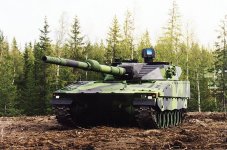
"The vehicle is expected to have a maximum combat weight of up to 60 tons, incorporate so-called "green technologies," employ smart ammunition, and feature dedicated protection against drones."

"the gun caliber is not specified, the main armament must support a wide range of ammunition types, including programmable rounds. Overall, the tank should be capable of defeating enemy armored vehicles, preferably with a first-round hit, even in their most heavily protected zones."

"barrel life must exceed that of existing systems, such as the Leopard 2, whose barrel life is estimated at around 1,500 rounds.
"An autoloader is also mandated, with ammunition capacity reportedly sufficient for "20 engagements," although this requirement is not further clarified.
"The fire control system must be capable of detecting, tracking, and distributing multiple targets simultaneously among the tank's onboard weapons."

"resilient against chemical and so-called "energy weapons," cyberattacks, improvised explosive devices, rocket-propelled grenades, third-generation and more advanced anti-tank guided missiles, and loitering munitions, including FPV drones. In terms of kinetic protection, the tank should withstand at least 125 mm armor-piercing fin-stabilized discarding sabot (APFSDS) rounds."

"An active protection system (APS) is considered mandatory and must be capable of intercepting a large number of threats before reloading.
"In addition, the tank must feature rapid concealment measures, such as smoke-screen systems,
"as well as supplementary protection solutions, including reactive or passive armor. The latter requirement is particularly notable and could potentially include anti-drone nets or slat armor."

"Mobility requirements specify a maximum road speed of at least 60 km/h and no less than 40 km/h cross-country. Operational range should average around 600 km on the march across mixed terrain and approximately 350 km under combat conditions, with the option to use additional external fuel tanks."

"compliance with environmental standards and reduced reliance on fossil fuels during peacetime. At the same time, the design must allow these restrictions to be bypassed in wartime if necessary."

"the baseline configuration envisions a 60-ton tank with a growth margin of up to 15 percent. Length without the gun must not exceed 8 meters, width is limited to 3.8 meters, and height to 2.5 meters. This would make the vehicle slightly shorter and significantly lower than the Leopard 2, whose latest variants can reach a height of around 3 meters and a length of 8.05 meters, with a combat weight of approximately 69.5 tons."


So Iron Trophy APS might manage fast moving bullets and missiles but struggle with drones while the French can kill slow moving drones with an RCWS but struggles with fast ones.

That, to me, suggests a sensor tuning issue as much as anything. In turn, that would suggest there is some hope of restoring vehicle mobility to the field. But it is likely to be expensive.
 
Last edited:
Back
Top