• Thanks for stopping by. Logging in to a registered account will remove all generic ads. Please reach out with any questions or concerns.

Canadian River Class Destroyer Megathread

My old-school whole-house diesel generator enters the chat to say “ simplicity and core basics have advantages all their own.”
True that, when you have a single source and a single load. The power grid is necessarily much more complex, as both sources and loads are continuously fluctuating. Yes, the used to manual balance loads, but in Canada alone the generating capacity is around 150,000MW and the average use is around 80,000MW. That's a lot of electrons to manage...
 
apropos of nothing nautical, every time that I read the expression plug and play I shudder. Up until very recently I still had my old Windows 5 computer complete with WordPerfect (still the best word processing programme I have found for creative writing). We are now on Windows 11 yet if you compare the two, most of the improvements have been designed to create obsolescence not ease of function. Yes it is faster but the computer's taking over certain functions from me have made me dumber not more efficient. The same is true of many of the more recent auto improvements to the point where care mfg. is going back to more basic installations. Perhaps our military purchases are reflecting the same trend: adding tech. where it isn't really necessary that will make maintenance and repair more difficult and make the equipment more vulnerable to failure.
Except there is a balance. If you add tech that is needlessly complex and can't be supportable than you've disadvantaged yourself. Conversely, if you don't add tech that your potential foes successfully do, which gives them an edge in combat, then you've also disadvantaged yourself.

This is one of the basic problems of military requirements. There are three significant drivers of change (which are factors both for yourself and your adversaries):
  • pure research (academic and practical) driving what could we do
  • current operators driving what do we do now, and where are the shortfalls
  • manufactures driving what can we actually build and at what cost.
Those need to be continuously learning from each other in a properly functioning military-industrial complex. Unfortunately, Canada has let the historic structures that support that wither on the vine.

As an example of what happens if you don't get this right, look to the outsized impact of the Dreyse Needle Gun and the Battle of Königgrätz (Sadowa) on July 3, 1866. Oversimplification is that the Austrians (and many others) had dismissed the Dreyse as being too complex and hard for soldiers to master, but it allowed the Prussians to fire 5 times for every Austrian single shot, while prone, and two Prussian Divisions "destroyed 38 out of 49 infantry battalions of four Austrian corps at the Swiepwald and Chlum at the centre of the battlefield." A naval similarity might be HMS Dreadnaught, usering in the age of the modern battleship, forcing everyone to replace their now obsolete fleets, and ushering in a arms race only the RN could win (until the realities of the Western front meant the couldn't).
 
I predict our fancy and expensive munitions, stores and equipment will get chewed up at rates that are unreplaceable. And we (everyone really) will be looking for easy (or easier) to produce, in volume solutions.

In essence we will need to create the modern iteration of the Flower Class corvette.

Or we just withdraw from the fight and go home.
Does the modern iteration of the Flower Class necessarily need to be a single ship...or could it be a combination of cheap UAV/USV/UUV detection nodes backed by air and surface-launched long range munitions?
 
Does the modern iteration of the Flower Class necessarily need to be a single ship...or could it be a combination of cheap UAV/USV/UUV detection nodes backed by air and surface-launched long range munitions?

No idea, that's for people paid much more than me to figure out.
 
I find that an interesting observation. The question to be asked is who operates the equipment, who fixes the equipment and who makes the decisions? The Officers bring the information together and make the decisions. I would not say they have any more knowledge then the Sonar operators, Rad Techs etc.

Each has their own set of expertise, so yes a CANTSA operators is going to know more about the specifics of CANTAS, and a armament tech is going to know more about the in-and-outs of CIWS, but, and I will probably get POUNCED on for saying this, but I would argue that officers (specifically the OROs) know the most overall. They need to know a little bit about every weapon and sensor, they need to know all Air, Surface, and Sub-Surface tactic thoroughly, they need a full understanding of task group coordination and operations, and no one else on board is as well trained in CMS doctrine management than OROs. Plus, anecdotally, I've seen plenty of frustrated officers walk over and "teach" a fully qualified Fire Control operator how to use their kit... I even saw it happen once with HMS.

This statement is worrying in some respects but also sends some assurance that we are getting well trained Officers. From the website it takes four plus years to turn out a MARs Officer. Are there streamlines that can be done? Can we and do we have a modified training plan in case of major war where we can train Merchant Marine Officers and Crew in a shorter timeline?

Depends on what level your are talking about. From basic training to the completion of NWO Basic (what used to be called NWO 3 and 4) is a little as 1-1.5 years (if everything lined up perfectly) to 3-4 years (because of back-logs in training or inability to line up courses leading to time on PAT platoon). Once that's done, they are only considered qualified to be a "2nd Officer of the Watch". They are the "assistant" to the Office of the Watch. To get fully qualified as an Officer watch, they have to two things. First they have to stand a minimum of 600 hours of watch on the bridge. Once that's done, they have to go attend the NWOPQ course. This course refines their basic OOW skills, and also teaches them advanced topics like AAW and ASW manoeuvring. Once they graduate this course, they will be promoted to Lt(N) and considered a fully-qualified Bridge Watch Keeper (BWK). The length of time it takes to complete those 600 hours and the NWOPQ course really depend on platform availability. Getting 600 hours of bridge time could take between 75 and 100 sea-days depending on the watch rotation (1 in 4 vs 1 in 3). And, depending on how much the ship that you're assigned to is actually sailing, getting those 75-100 sea days could take a long time. I would say low end 1 year, high end 2 years. So combining these numbers, you have a low of 2.5-3 years from enrolment to qualified BWK, to a high end of 5-6 years, so 4 years is probably about right. Regardless, once you've achieved this, you still just BWK. Next you have to go onto your Director level/WarfareOfficer course and tour to be a "junior" ops room watch officer (meaning running the ops room, but not actually "fighting" the ops room). Call that 2-3 more years. Then you go ashore for 2-5 years before coming back to the ship as an ORO (the one who's really "fighting" the ops room).

It's not a quick process. Could it be shortened? Maybe a bit. For training "warfighting" officers, you could skip all the lessons on constabulary ops, counter piracy, boardings, etc, but that wouldn't shave off much time. The real bottle neck is sea time and platform availability.

The Navy as a whole is built bureaucratically with all the force readiness, logistics, training, development, and administrations organizations needed to support (and justify, really) a fleet of 33+ ships, and so they hire and "aim" to train enough officers to continue to fill all the billets of all those "2nd line" organizations. Part of their career before getting to those "staff" jobs involves training and serving in those "1st line" positions (i.e. on ships) but unfortunately, we don't actually have 33 ships, and the ships we do have aren't sailing anywhere near as much as they need to.


Have we have made operations/ expectations so complicated that they are unrealistic for sustainment in operations?
 

Your future is here.

For the RN it is the Type 91 missile barge

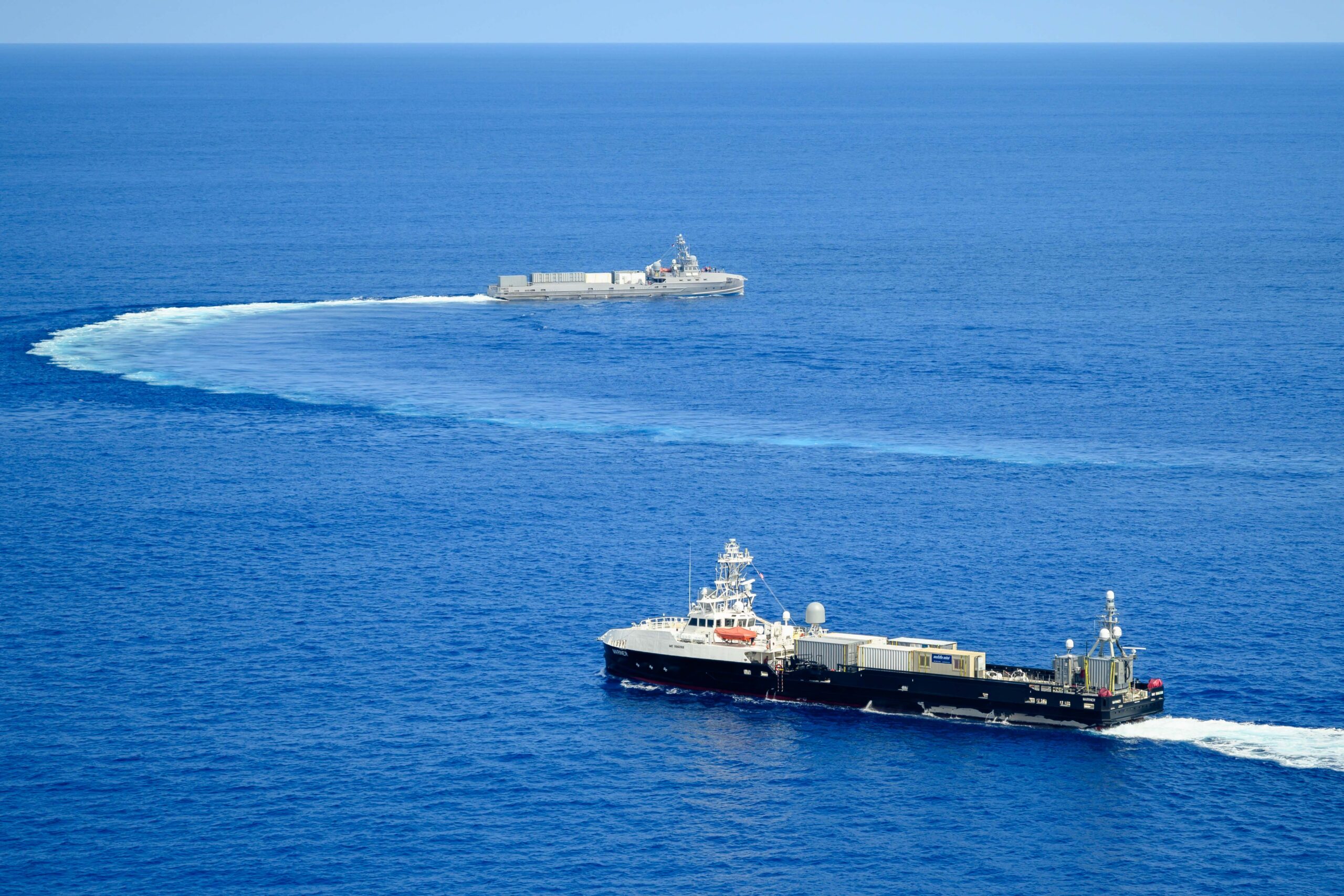
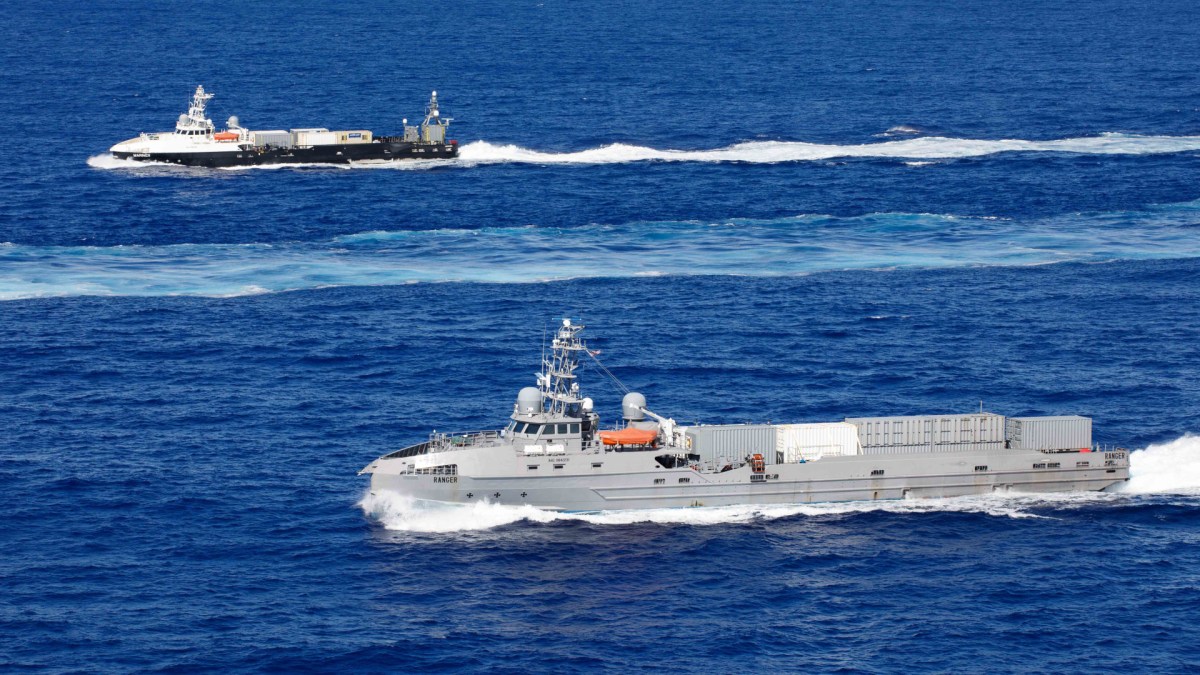
For the USN it is the MASCs that they want delivered in 18 months so they can buy them by the dozen.


And yes. They are looking for a simple commercial hull on to which they can bolt weapons systems, exactly like a pre-WW2 whaler.

And one which will have no crew on board to supply security. Presumably security will come from mutual support and Man-in/on-the-loop supervision.

Presumably comms issues are deemed manageable.
 
And these are the types of sensor systems that the RN is contracting for in the North Atlantic as part of the Atlantic Net phase of their Bastion plan.

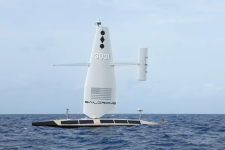
A 30 m towed array based on a zero emitting fibre optic line dragged by a 20 m craft, the Saildrone Surveyor, powered by sails, solar power and wave action.

"Thales BlueSentry array operated continuously for 26 days with uptime exceeding 96%, autonomously detecting and classifying undersea and surface threats. Detections were transmitted in real time via Starlink and Iridium satellite links, enabling rapid response to decision-makers worldwide.

"The Surveyor’s ultra-quiet wind propulsion created a near-zero self-noise environment, significantly enhancing the acoustic performance of the BlueSentry sonar system."

The RN isn't buying the system. It is buying the information. The system will be supplied and operated by civilians.


1773870446069.png

They also act as comms nodes and RRBs that can connect the underwater domain with the air domain.

20 meters, 15 tonnes and 7.5 MUSD with standard sensor package.
 
They are about 1000 tons bigger than the Halifax class and about 20 feet longer.
And about 20 feet wider, coming in at 7000 tons.

Something else interesting to note: it’s been 9 years since HMS Glasgow was laid down.
It’s still fitting out and waiting on some last minute changes before trials next year. The ship has so far had 3 Captains assigned during its construction. The basic design will be 18 years old after acceptance. Certainly hope it turns out to be everything that it has been promised.


Compared to that, the T31 has moved like a rocket.
 
Each has their own set of expertise, so yes a CANTSA operators is going to know more about the specifics of CANTAS, and a armament tech is going to know more about the in-and-outs of CIWS, but, and I will probably get POUNCED on for saying this, but I would argue that officers (specifically the OROs) know the most overall. They need to know a little bit about every weapon and sensor, they need to know all Air, Surface, and Sub-Surface tactic thoroughly, they need a full understanding of task group coordination and operations, and no one else on board is as well trained in CMS doctrine management than OROs. Plus, anecdotally, I've seen plenty of frustrated officers walk over and "teach" a fully qualified Fire Control operator how to use their kit... I even saw it happen once with HMS.

Depends on what level your are talking about. From basic training to the completion of NWO Basic (what used to be called NWO 3 and 4) is a little as 1-1.5 years (if everything lined up perfectly) to 3-4 years (because of back-logs in training or inability to line up courses leading to time on PAT platoon). Once that's done, they are only considered qualified to be a "2nd Officer of the Watch". They are the "assistant" to the Office of the Watch. To get fully qualified as an Officer watch, they have to two things. First they have to stand a minimum of 600 hours of watch on the bridge. Once that's done, they have to go attend the NWOPQ course. This course refines their basic OOW skills, and also teaches them advanced topics like AAW and ASW manoeuvring. Once they graduate this course, they will be promoted to Lt(N) and considered a fully-qualified Bridge Watch Keeper (BWK). The length of time it takes to complete those 600 hours and the NWOPQ course really depend on platform availability. Getting 600 hours of bridge time could take between 75 and 100 sea-days depending on the watch rotation (1 in 4 vs 1 in 3). And, depending on how much the ship that you're assigned to is actually sailing, getting those 75-100 sea days could take a long time. I would say low end 1 year, high end 2 years. So combining these numbers, you have a low of 2.5-3 years from enrolment to qualified BWK, to a high end of 5-6 years, so 4 years is probably about right. Regardless, once you've achieved this, you still just BWK. Next you have to go onto your Director level/WarfareOfficer course and tour to be a "junior" ops room watch officer (meaning running the ops room, but not actually "fighting" the ops room). Call that 2-3 more years. Then you go ashore for 2-5 years before coming back to the ship as an ORO (the one who's really "fighting" the ops room).

It's not a quick process. Could it be shortened? Maybe a bit. For training "warfighting" officers, you could skip all the lessons on constabulary ops, counter piracy, boardings, etc, but that wouldn't shave off much time. The real bottle neck is sea time and platform availability.

The Navy as a whole is built bureaucratically with all the force readiness, logistics, training, development, and administrations organizations needed to support (and justify, really) a fleet of 33+ ships, and so they hire and "aim" to train enough officers to continue to fill all the billets of all those "2nd line" organizations. Part of their career before getting to those "staff" jobs involves training and serving in those "1st line" positions (i.e. on ships) but unfortunately, we don't actually have 33 ships, and the ships we do have aren't sailing anywhere near as much as they need to.

Excellent post. The training NWOs go through to get to ORO level and higher is demanding and highly competitive.

And you're 100% correct that a lack of available sailing platforms is a massive bottle neck, not just for NWOs but for all trades TBH.
 
Sure, then we'll get a ship 2042 instead of 2032. Too far down the rabbit hole now. Already have the LBT Facility being built, the trade changes are being implemented and the first sets of radars and equipment purchased.
AEGIS is also a well proven and top of the line system, allowing us to be very interoperable with a lot of our equipment and allies abroad.
 
Interesting, I wonder how TBS would take to this form of accounting and how it works when a government changes?


Your future is here.

For the RN it is the Type 91 missile barge

For the USN it is the MASCs that they want delivered in 18 months so they can buy them by the dozen.


And yes. They are looking for a simple commercial hull on to which they can bolt weapons systems, exactly like a pre-WW2 whaler.

And one which will have no crew on board to supply security. Presumably security will come from mutual support and Man-in/on-the-loop supervision.

Presumably comms issues are deemed manageable.

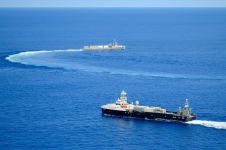
These are the models for MASC and the Type 93 Missile Barge

In the 53 m and 1000-2000 tonne displacement range with room for 2 to 4 40 foot containers


View attachment 99063


And these are the types of sensor systems that the RN is contracting for in the North Atlantic as part of the Atlantic Net phase of their Bastion plan.

A 30 m towed array based on a zero emitting fibre optic line dragged by a 20 m craft, the Saildrone Surveyor, powered by sails, solar power and wave action.

"Thales BlueSentry array operated continuously for 26 days with uptime exceeding 96%, autonomously detecting and classifying undersea and surface threats. Detections were transmitted in real time via Starlink and Iridium satellite links, enabling rapid response to decision-makers worldwide.

"The Surveyor’s ultra-quiet wind propulsion created a near-zero self-noise environment, significantly enhancing the acoustic performance of the BlueSentry sonar system."

The RN isn't buying the system. It is buying the information. The system will be supplied and operated by civilians.


View attachment 99064

They also act as comms nodes and RRBs that can connect the underwater domain with the air domain.

20 meters, 15 tonnes and 7.5 MUSD with standard sensor package.

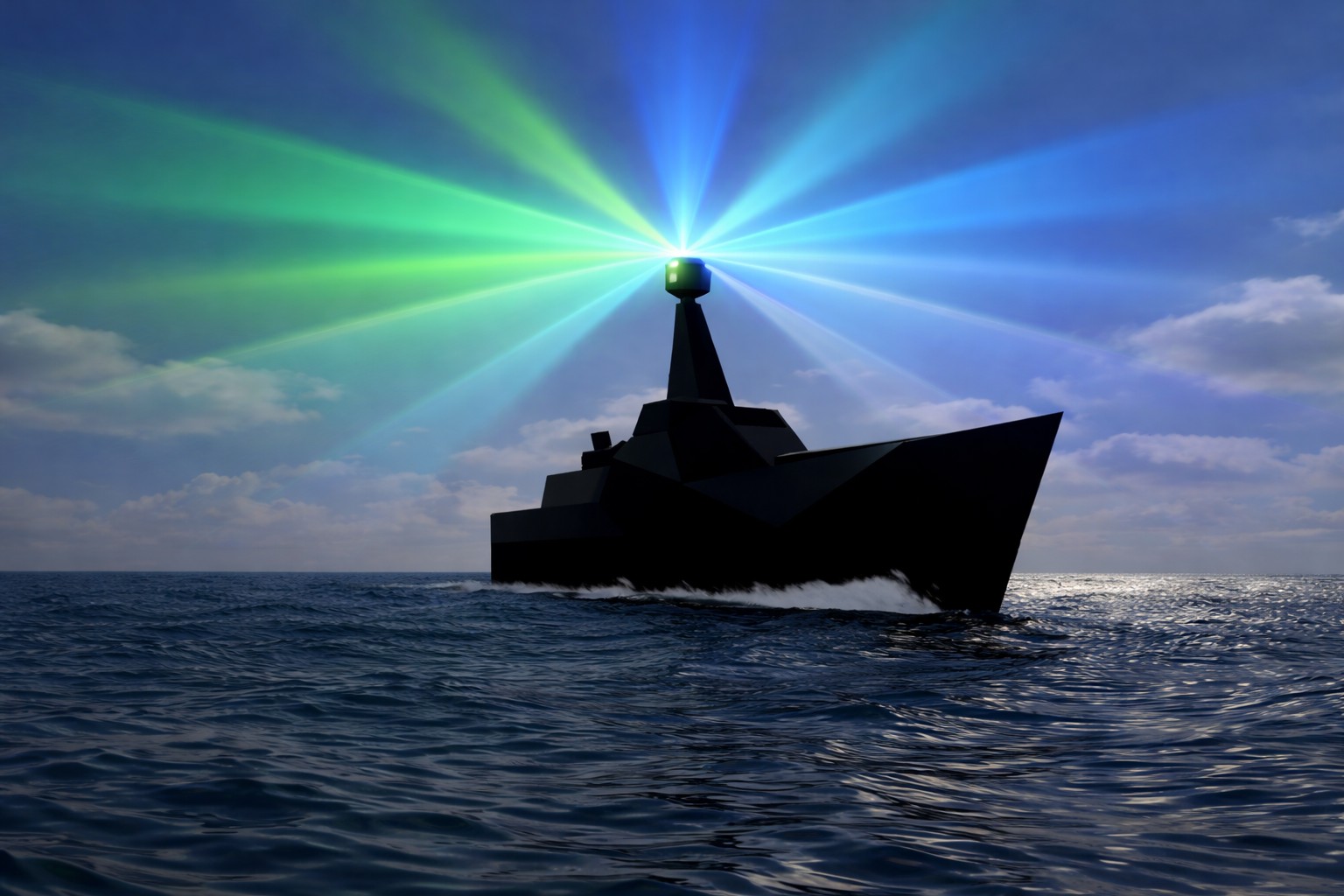
Royal Navy could finally be sunk by drastic budget cuts …. Pretty depressing times for the RN.

(Nice image of the proposed Type 83, which will likely never be built…)


.....

What if all of the above are linked?

What if UK Treasury is refusing/unable to pony up new money to meet the old shopping list and the new shopping list?
The old shopping list wasn't meeting the new time line in any event, even with new money.

Since the First Sea Lord has deemed the need is for Project Cabot/Atlantic Net/Atlantic Bastion and a new menagerie of UxVs in the next 2 years, then it might mean a pause in delivering the old shopping list is justified to rush the hybrid plan into commission.

All the money in the world wouldn't get the problem faced in two years so needs must and they are trying the other thing. The one the Ukrainians have pointed to.

...

In two years time they will have a sense of whether or not the hybrid switch has a future and what the demand for the old shopping list looks like then.
 
9Et0NsH.jpeg


SEA released a "new" rendering of the River class destroyer with some uh.....very strange and interesting traits. I'll preface this with the obvious point that this is a very questionable and rough model, but I think going over some of the things present are worth discussion.

  • It looks like the Italian Lionfish 30mm mounts have been replaced by Mark 38 30mm mounts.
  • There is some kind of EO/IR targeting camera present just above the autocannon mount.
  • Phalanx mounts are present, something not seen on renders/models of the RCD since 2017~.
  • Harpoon two shot launchers are present and placed strangely towards one side of the ship, very likely placeholders for NSM launchers.
  • The 'step down' below the primary exhaust that previously held the ExLS cells seems to still be present.
  • A RAM launcher is present behind the Harpoon launchers, it is unsure if there is another mount on the other side of the ship but this arrangement seriously limits the firing angles and usability of the system. This is also only the second time we have seen a public facing render with the RAM launcher present at all.
  • The boat bay is on the wrong side of the ship.
  • The torpedo launchers seem to be in the wrong place, being present ahead of the mission bay when the spaces are aft behind the boat bay from what I can gather.
  • The mast is an entirely different shape and structure, missing array faces and a substantial amount of detail.

I'm not sure who made this monstrosity but the combination of very outdated design traits, incorrect placements and new/rumored additions makes me scratch my head. Almost looks like some poor intern threw this together on a Friday at 4:29pm.
 
Concur - there are egregious errors in that image - you've touched on most of them.

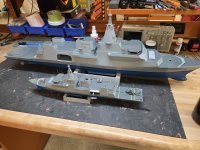
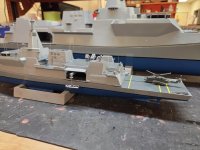
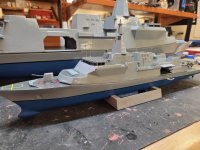
I'm aware that my 'model' of the T26 is pretty close. I was given some 'that doesn't go there' info from a couple of folks....

CIWS is definitely a nope....the RAM is the right type (21 cell) but wrong location - they've forgotten to put the LSO compartment on the flight deck, they've put two RADARs on the aft end of the hangar top - there's probably only one there, and they missed the horizon bars...boat bay and mission bay doors are messed up...boat bay is on the wrong side...and mission bay...yeah....from what I can tell it's an upward/outward bifold door not a garage door like in the hangar. There's gaps missing in the railings on the bridge wings and RAS deck areas that should be there. Antennas are....very open for discussion....and the main mast has no resemblance to what I've heard is going on.

In short...that's as f-d up as a football bat.
 
Back
Top