• Thanks for stopping by. Logging in to a registered account will remove all generic ads. Please reach out with any questions or concerns.

Canadian River Class Destroyer Megathread

The 127mm gun has substantially more range even with unguided ammunition, and said ammunition has a much larger payload capability to actually destroy the targets. 57mm guns have a far higher rate of fire and magazine capability however, it's more focused on closer range engagements and putting up massed fire.
I guess in that hypothetical TG I was referring to, you’d have the option to go with whatever seemed appropriate in any given scenario. No doubt it’ll be a leap forward to have that kind of layering in place.
 
I always remember the Italian DDG that had 2 127 mm guns and I believe 3 or 4 76 mm guns.
Basically a light cruiser for armament, although I have to question the listed DWT (4500). Seems they paid heavily for that much armament in such a small hull. Audace class Guided Missile Destroyer DDG Italian Navy MMI

the-italian-destroyer-audace-the-first-to-have-the-famous-v0-shhnyb8ecssb1.jpg
 
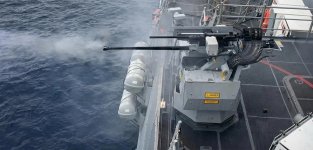
Is this the mount being offered for the RCDs?


1775162664710.jpeg


MK38-MOD4-MK-48-MOD-2-EOSS.webp
(left) The Mk38 Mod 4 30mm mount selected by the US Navy features dual ammunition feeds and an additional .50 calibre gun mounted on the top. (Right) The weapon is primarily guided by the off-mount MSI MK 48 MOD 2 EOSS, a fully stabilised, dual-axis EOSS director incorporating TV and infrared cameras, and a laser rangefinder.


P960-Autonmous-RIB-2-1024x526.jpg
P960 autonomous RIB with Seahawk MWS on display at DSEI 2021 (Photo: Navy Lookout).
 
My R/C Type 26 is now officially R/C.

She floats, she moves, she needs more sea room for her next time in the pond.

I also need the lake behind the house to thaw out the rest of the way so I can use it instead!

Alright now, for the VLS, glue a spring to the bottom of each cells and line their sides with sandpaper. Then tape/glue a strike anywhere match to a fire cracker with a really short fuse. Load the cells with these firecracker/match combos. All you need then is a way to open the cells on demand and you have SAWS launch!
 
Alright now, for the VLS, glue a spring to the bottom of each cells and line their sides with sandpaper. Then tape/glue a strike anywhere match to a fire cracker with a really short fuse. Load the cells with these firecracker/match combos. All you need then is a way to open the cells on demand and you have SAWS launch!
My good man. I already have SAWS Launch capability....

 
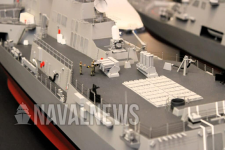
Version 4 is a work in progress....Looking at the details, I still have a bunch of work to do. A number of small platforms to add on both the 'fin' and the superstructure, as well as creating a number of assorted antenna bits and such.

I am generally pleased with how this is looking.

I did note that the superstructure I have installed right now feels a mite bit heavy - so I did some lightening to the V4 you see below.
 

Attachments

  • T26 RC V4 - work in progress.jpg
    T26 RC V4 - work in progress.jpg
    75 KB · Views: 12
21 engagements might be 1-2 swarms attacking the taskforce and if you are on the edge getting the brunt of it, that 21 shots is not much.
I believe that those quad-packed JAGM launchers could be mounted behind the stack, where the EXLS VLS were originally placed. 3+3 launchers, total 24 JAGM, would help.
There was also an interesting picture of a rotating mounting for easy reload.

Might be that a few more, of the "below deck" type, could be installed in front of the Mk41 VLS.
 

Attachments

  • 1775275046974.png
    1775275046974.png
    542.7 KB · Views: 25
I believe that those quad-packed JAGM launchers could be mounted behind the stack, where the EXLS VLS were originally placed. 3+3 launchers, total 24 JAGM, would help.
There was also an interesting picture of a rotating mounting for easy reload.

Might be that a few more, of the "below deck" type, could be installed in front of the Mk41 VLS.
For sure, there is certainly upper deck space above the mission deck for that.
 
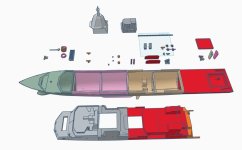
The Images seem to show more pre fitting than I was expecting for a first of Class. What might our more experienced commenters say? Might there be some very close BAE supervision for Fraser?
What do you mean by prefitting? Can you educate us on that? What in the image indicates prefitting? And what are the implications of "more than expected"?

This is why I love this site, opportunities to learn!
 
What do you mean by prefitting? Can you educate us on that? What in the image indicates prefitting? And what are the implications of "more than expected"?

This is why I love this site, opportunities to learn!
There seems to my very untrained eye to be more plumbing already installed in the lower right Image. It looks to be pretty intricate work and ready for connection for other blocks.
What do you mean by prefitting? Can you educate us on that? What in the image indicates prefitting? And what are the implications of "more than expected"?

This is why I love this site, opportunities to learn!

I was hoping to learn from you.
 
What do you mean by prefitting? Can you educate us on that? What in the image indicates prefitting? And what are the implications of "more than expected"?

This is why I love this site, opportunities to learn!
I believe it's a reference to the piping you can see in the blocks (vice just being steel). Other blocks will have full bits of equipment pre-installed, but the RCD design isn't that fully completed to allow that yet. You'll see more of that from ships 2 onwards, but that's part of the assumed 'inefficiencies' you get with first of class when you are building before the design is 100% finalized and all the equipment is selected/purchased.

In the old style of laying the keel you would build the shell, bring the piping, cabling etc in and put it all together sequentially, which is basically how they still build houses. The prebuilt homes do the same kind of modular building and assembly because it saves time, and you don't have the normal thing with plumbers, electricians and drywallers all messing up each others work if the GC isn't managing it closely.

With the modular building you do a lot more installation at the block before you assemble them together. This includes breaking the equipment down into modules you can drop in, so you can preassemble things like compressors, engines etc and drop them into the blocks that already have the piping and other connection points built in.

Some things, like pulling the cabling through the water tight bulkheads still has to wait until the mega blocks are together, but for a lot they just bolt/weld pipe flanges together after you put the blocks together. For the electrical, you can do a lot of local runs from panels to equipment inside major compartments, so really just left with pulling extended cable runs that go through sections,.

That lets you do a lot of work concurrently, and also means you can setup the module and assembly lines much more efficiently, so saves a huge amount of work and actual labour hours. The later you do it in the build, the more work it takes to get things into place, and something like 7-10 times more labour hours to install things when the ship is together than doing it at the block/mega block level.

A pretty easy to visualize example is a big diesel engine; doing it as a module you can fully assemble the engine pretty much where ever you want, so you can easily stage it to make it easier, crane it into a mega block, bolt a few things in and connect some cabling and be more or less done. If you wait until the ship is together, you usually have to bring the engine in in pieces, assemble it in place, try and do final fitup of piping in situ, etc so basically the same as an inservice job where people are contorting themselves in the bilge to try and get to things.

Just in the piping side it saves a lot of rework, by letting you do it in a pipe line where you can jig things up without interference items; that's way easier for the welders, so aside from being faster, the quality is better and much higher pass rate the first time.

Splitting off where the work is done also avoids all the interference work, where you have 3 trades trying to all do work in the same area, so just generally makes workflows easier and cuts down on a lot of the planning/deconfliction you get with normal ship repairs.

Edit:

Not sure these are the right papers, but FMI is the company that does this kind of support to our NSS, and also in the US and other countries for improving shipbuilding efficiency. That's all part of the 'Target state' that is built into the NSS to develop the shipyards to be efficient at it (and competitive). One of those things that takes decades to develop it, as a lot requires experienced people. All of their SMEs worked in shipbuilding (including in the UK German and American shipyards that did warships and subs), so learned a lot shadowing them.

https://www.nsrp.org/wp-content/uploads/2015/08/FMI-First_Benchmarking.pdf

https://apps.dtic.mil/sti/citations/ADA466922


 
Back
Top