• Thanks for stopping by. Logging in to a registered account will remove all generic ads. Please reach out with any questions or concerns.

Canadian River Class Destroyer Megathread

Germane to the state of the North Atlantic defences.


Another Type 23 out of service, and this one after not going to sea after a five year refit. Stripped for sensors and weapons.

Contemporary with our Halifaxes.

RN down to 5 frigates on their side of the Atlantic.

The first of their 5 Type 31s is due in service in 2027.

Their 8 Type 26s are due between 2028 and 2035 at which point we will start receiving our Rivers from then until 2050.
 
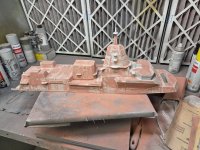
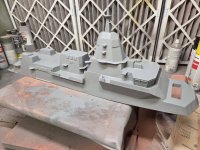
My lightweight superstructure has been given it's first sand and a layer of primer to see what still 'needs some love'.

This is the 270 gram ASA Aero print.
 

Attachments

  • Type 26 ASA Aero Sanded.jpg
    Type 26 ASA Aero Sanded.jpg
    522.3 KB · Views: 9
  • Type 26 ASA Aero Primed.jpg
    Type 26 ASA Aero Primed.jpg
    394.6 KB · Views: 9
And, we have a test-float. She works!

Needs some ballast adjustment, but I'm quite pleased with how she runs. Of note, the RC Controller lets me limit the speed automagically, and it's set to 35% of maximum. I bumped it up to 40% but the motors were warming up, so I went back to 35%.

She stops on a dime too.

 
And, we have a test-float. She works!

Needs some ballast adjustment, but I'm quite pleased with how she runs. Of note, the RC Controller lets me limit the speed automagically, and it's set to 35% of maximum. I bumped it up to 40% but the motors were warming up, so I went back to 35%.

She stops on a dime too.


SO cool!

It looks like she's riding low. Could that just be the camera ?
 
Ballasting was a bit off - she was sitting a bit down by the bow, and moving the battery astern helped a bit on the second run. She was also a beast to trim for steering - one of them is off a bit and so she was maxed out on trim and just barely sailing a straight line.

The twin shaft twin rudder makes her VERY maneuverable, but notably faster turning to Stbd vs port - not sure why. Probably an 8 foot vs a 12 foot turning circle.

She stops - within her own ship-length. VERY responsive to throttle inputs.
 
Ballasting was a bit off - she was sitting a bit down by the bow, and moving the battery astern helped a bit on the second run. She was also a beast to trim for steering - one of them is off a bit and so she was maxed out on trim and just barely sailing a straight line.

The twin shaft twin rudder makes her VERY maneuverable, but notably faster turning to Stbd vs port - not sure why. Probably an 8 foot vs a 12 foot turning circle.

She stops - within her own ship-length. VERY responsive to throttle inputs.
Do the propellors counter rotate or both go the same direction? I could be paddle wheel effect if the latter.
 
Do the propellors counter rotate or both go the same direction? I could be paddle wheel effect if the latter.
Counter-rotate. I have left and right turning props installed. 28mm 5 blade. I have since seen an image showing 6 blades....but...that's a rendering rather than reality...so....who knows if I'm right, or wrong again...(still?) LOL. There's been lots of changes I've had to make to get her 'closer' to the real thing. (That still doesn't exist.)
 
Once I sort out the ballast, this may just solve itself then. Thank-you.

Not quite. Your topweight also has to be balanced at the top. Remember when turning, ships first lean into the turn, then gravity takes hold of the weight above the center of gravity and lean the ships away from the turn. If you have more top weight on one side of the ship, it will make it lean away more when turning in the opposite direction of the extra weight, shortening the turning radius, while it will keep the ship more upright when turning towards the side of the extra weight, thus lengthening the turning radius.
 
Since I did not notice this elsewhere on this thread, I thought useful to post a tidbit of information from this source where in January the US :

That link is to a US Congressional document (6-Jan-2026) listing some equipment approved to be provided to Canada for the River Class Destroyer. For example, most of the equipment is already known about and debated, however note the mention of SPEIR:

  • four (4) Next Generation Surface Search Radars;
  • four (4) Rolling Airframe Missile Guided Missile Launcher Systems;
- four (4) Shipboard Panoramic Electro-Optic Infrared (SPEIR) systems;
  • three (3) MK-45 5-inch gun mounts; and
  • five (5) command and control processors.
The following non-MDE items will also be included: MK-34 Gun Weapon Systems.
...
Rolling Airframe Missile (RAM) MK-31 Guided Missile Weapon System, including the Guided Missile Launcher System (GMLS), supports all variants of the RAM all-up-round for launch support and integration to multiple combat system configurations, providing terminal shipboard air defense on surface combatants.
.
Shipboard Panoramic Electro-Optic Infrared (SPEIR) is an electro-optic/infrared (EO/IR) system on surface ships that provides persistent detection and tracking of a wide variety of air and surface targets in support of multi-mission surface ship operations and defense.
.
The MK-45 gun mount is a fully automatic gun firing a 5- inch shell. It is the U.S. Navy's primary anti-surface gunnery capability also used for anti-air warfare as part of layered defense. It is controlled by the MK-160 Gun Computing System (GCS).
.
The command and control processor is a shipboard system that provides real-time control and management of Tactical Digital Information Links (TADILs) through interfaces with the host combat system and tactical data link terminals. TADILs include Link-16, Link-22, Satellite TADIL J, and Joint Range Extension.
.
The MK-34 Gun Weapon System is comprised of the MK-45 gun mount, MK-160 GCS, and MK-20 EO/IR gun sight system (EOSS). The system supports anti-air and antisurface warfare and Naval Gunfire Support through the use of 5-inch rounds and integration to the combat system. The Sensitivity of Technology Statement contained in the original notification applies to additional items mentioned. The highest level of classification of defense articles, components, and services included in this potential sale is SECRET.
.
Date Report Delivered to Congress: December 23, 2025.


In particular in this post I wanted to point to SPEIR. This is more than just a single basic EOSS device. Rather according the marketing brochures and some naval press articles, it is a scaleable system adjustable to warship size, consisting of multiple EOSS device inputs (typically Narrow Field of View EOSS and also Wide Field of View EOSS), where such is processed and combined to provide both superior optical detection and tracking.

SPEIR is provided by L3 Harris and its been known for sometime L3 Harris is to provide the EOSS for the River Class Destroyer.

What has not been described further, to the best of my knowledge, is exactly what that EOSS the L3 Harris EOSS might consist of. This US congressional report provides more hints as to the RCN intent, via its mention of SPEIR.

One can find an L3 Harris specification sheet on SPEIR here: https://www.l3harris.com/sites/default/files/2025-07/L3Harris-SPEIR-SPATIAL-sell-sheet-hr.pdf

I see this as a very important surveillance piece of equipment, to go together with Radar and ESM, for above water surveillance. Decades ago for visual surveillance, one pretty much relied on only the OOW and on the bridge wing lookouts. For those individuals, experience, motivation and fatigue played a key factor. I see SPEIR as being a step up to help in optical surveillance. Further SPEIR claims to provide optical tracking. Being scalable suggests it could be considered for even more than just the River Class.
 
Since I did not notice this elsewhere on this thread, I thought useful to post a tidbit of information from this source where in January the US :

That link is to a US Congressional document (6-Jan-2026) listing some equipment approved to be provided to Canada for the River Class Destroyer. For example, most of the equipment is already known about and debated, however note the mention of SPEIR:


In particular in this post I wanted to point to SPEIR. This is more than just a single basic EOSS device. Rather according the marketing brochures and some naval press articles, it is a scaleable system adjustable to warship size, consisting of multiple EOSS device inputs (typically Narrow Field of View EOSS and also Wide Field of View EOSS), where such is processed and combined to provide both superior optical detection and tracking.

SPEIR is provided by L3 Harris and its been known for sometime L3 Harris is to provide the EOSS for the River Class Destroyer.

What has not been described further, to the best of my knowledge, is exactly what that EOSS the L3 Harris EOSS might consist of. This US congressional report provides more hints as to the RCN intent, via its mention of SPEIR.

One can find an L3 Harris specification sheet on SPEIR here: https://www.l3harris.com/sites/default/files/2025-07/L3Harris-SPEIR-SPATIAL-sell-sheet-hr.pdf

I see this as a very important surveillance piece of equipment, to go together with Radar and ESM, for above water surveillance. Decades ago for visual surveillance, one pretty much relied on only the OOW and on the bridge wing lookouts. For those individuals, experience, motivation and fatigue played a key factor. I see SPEIR as being a step up to help in optical surveillance. Further SPEIR claims to provide optical tracking. Being scalable suggests it could be considered for even more than just the River Class.
Speaking of which, who made the .50cal RWS systems currently on the Halifax Class? It would seem they would be a good addition to the RCD, AOP's and even the new Orca class and the JSS.
 
Since I did not notice this elsewhere on this thread, I thought useful to post a tidbit of information from this source where in January the US :

That link is to a US Congressional document (6-Jan-2026) listing some equipment approved to be provided to Canada for the River Class Destroyer. For example, most of the equipment is already known about and debated, however note the mention of SPEIR:


In particular in this post I wanted to point to SPEIR. This is more than just a single basic EOSS device. Rather according the marketing brochures and some naval press articles, it is a scaleable system adjustable to warship size, consisting of multiple EOSS device inputs (typically Narrow Field of View EOSS and also Wide Field of View EOSS), where such is processed and combined to provide both superior optical detection and tracking.

SPEIR is provided by L3 Harris and its been known for sometime L3 Harris is to provide the EOSS for the River Class Destroyer.

What has not been described further, to the best of my knowledge, is exactly what that EOSS the L3 Harris EOSS might consist of. This US congressional report provides more hints as to the RCN intent, via its mention of SPEIR.

One can find an L3 Harris specification sheet on SPEIR here: https://www.l3harris.com/sites/default/files/2025-07/L3Harris-SPEIR-SPATIAL-sell-sheet-hr.pdf

I see this as a very important surveillance piece of equipment, to go together with Radar and ESM, for above water surveillance. Decades ago for visual surveillance, one pretty much relied on only the OOW and on the bridge wing lookouts. For those individuals, experience, motivation and fatigue played a key factor. I see SPEIR as being a step up to help in optical surveillance. Further SPEIR claims to provide optical tracking. Being scalable suggests it could be considered for even more than just the River Class.
why 4 of this and 3 of that and 5 of another?
Is not the first batch going to be 3?
for the stone frigate at Hartlen Point?
 
Since I did not notice this elsewhere on this thread, I thought useful to post a tidbit of information from this source where in January the US :

That link is to a US Congressional document (6-Jan-2026) listing some equipment approved to be provided to Canada for the River Class Destroyer. For example, most of the equipment is already known about and debated, however note the mention of SPEIR:


In particular in this post I wanted to point to SPEIR. This is more than just a single basic EOSS device. Rather according the marketing brochures and some naval press articles, it is a scaleable system adjustable to warship size, consisting of multiple EOSS device inputs (typically Narrow Field of View EOSS and also Wide Field of View EOSS), where such is processed and combined to provide both superior optical detection and tracking.

SPEIR is provided by L3 Harris and its been known for sometime L3 Harris is to provide the EOSS for the River Class Destroyer.

What has not been described further, to the best of my knowledge, is exactly what that EOSS the L3 Harris EOSS might consist of. This US congressional report provides more hints as to the RCN intent, via its mention of SPEIR.

One can find an L3 Harris specification sheet on SPEIR here: https://www.l3harris.com/sites/default/files/2025-07/L3Harris-SPEIR-SPATIAL-sell-sheet-hr.pdf

I see this as a very important surveillance piece of equipment, to go together with Radar and ESM, for above water surveillance. Decades ago for visual surveillance, one pretty much relied on only the OOW and on the bridge wing lookouts. For those individuals, experience, motivation and fatigue played a key factor. I see SPEIR as being a step up to help in optical surveillance. Further SPEIR claims to provide optical tracking. Being scalable suggests it could be considered for even more than just the River Class.
The SPEIR system was probably what allowed the USN to one shot the Iranian Tanker engine out of commission a couple of weeks ago
 
Back
Top