• Thanks for stopping by. Logging in to a registered account will remove all generic ads. Please reach out with any questions or concerns.

curious about the C5

Shrek1985

Full Member
Reaction score
2
Points
180
Hi, I'm looking to pester some of the Old-Timers on here about the C5 machineguns.

I'm having a real hard time finding many pictures of them online, but mainly i'm looking to know how the infantry used them and what they were like. I've heard some stories about holding the barrels with thick gloves, using improvised slings and firing from the hip as is, in the GPMG role, but the only pics i've found look more like it was just used as a medium machinegun.

I have found a few contradictory and very light sources. some say we used the american M1919A6 bipod and buttstocks, others make no mention and of course, no pics. Did we use a heavy (A4?) or lighter (A6) barrel? Did we vary it for the role?

What was the cyclic rate like with the 7.62x51mm NATO ammo? being a recoil-operated design, I should think it would be different than for the old .30-06 calibre M1919A4s.

 
When I used it I was part of a 2 man team, i carried the tripod and ammo and the gunner carried the actual weapon.  When we had to fire it the weapons det commander would tell us where he wanted the gun I would sprint to the location set up the tripod and the gunner would put it on. As for nomenclature I can not remember numbers just C5 GPMG.
 
AFAIK the model was m1919a4. There was a rumour floating around that these were originally US Navy designed weapons. Being Armoured I rarely fired them from a tripod, only from a veh mount or on co-ax mount  on a Cougar. You have to understand its been over 20 years since I fired one, but I seem to remember that the rate of fire was 550/650 rpm. And yes there was an asbestos glove for barrel changes and of course a head-space and timing gauge to keep the beast firing. All I can remember was pouring motor oil into an OPEN hot gun to keep it firing. Hope I've been of some help! Any other questions will have to be answered by someone else.

Cheers,

tango22a
 
Canadian C1 and later C5 GPMGs were Browning (Wartime) Infantry M1919A4 MGs, originally USA manufactured by various companies to 1945. One I remember was Borderline Industries, and of course GM. Conversion was done at Long Branch in Kitchener Ontario.

I have no idea where the parts were manufacted, or the barrels, but the barrels were covered in Cdn proofs, so LB may have made these, along with the specific conversion parts.

During the Cold War (1960s-early 70s), the Cdn's converted the guns to 7.62 x 51mm NATO from US .30 (7.62 x 63mm) AKA .30-06. As seen in the 1969 movie Kelly's Hero's, humped by Don Rickles  :nod:

The noticeable difference was the Cdn 'T bar' cocking handle. The gun fired from a closed bolt and there was no safety bar as on the Aust and UK L3A3/A4 MGs. These L series guns remained in .30, but a safety bar and open bolt firing mods were added.

The original .30 could use cloth belts or .30 metalic link (similar in style to .303 link for aircraft Browning .303s - these guns were even made by Inglis of Toronto), the new gun used the new 7.62mm metalic link.

Both standard US .30 tripods and grey metal butt stocks were used, but I had never seen any bi-pods.

Tripods the Aussie system were always wartime dated, and some even pre-war. These were later honed and converted with an adapter for the 5.56mm F89A1-P LSW Minimi, adn are currently in the system. Its freaky to see a tripod with a data plate dated 1940! Thats almost 70 yrs in the system!

The Canadian conversion was not the best design (IMHO), and turned the once 110% reliable .30 gun into a tempermental 7.62mm nightmare, but once it got going, it was known to hum. South Africa also toyed with the 7.62 x 51mm conversion. Seen these in Australia as trials, and they were later sent to smelt.

Only the heavier barrel design was used. The .30 light type barrels were for originally aircraft use and the A6 role. ROF was higher with the lighter barrel.

After the 7.62mm conversion, .30 parts were sold to Australia. I later seen many 'C broad arrow' post war packaging on various parts (NSN 21 designators) when I was on the conversion project from M1919A4 to L3A3/A4 (fixed/flex) MGs.

Quantiities of L3A3/A4 .30 guns remain in the Australian system. Its only been recently they were removed from front line service, seeing plenty of time in Timor L'Este from 1999. The last big Australian .30 ball ammo buy was Privi-Partizan out of the FRY.  The guns now are in LTS in western Sydney, pending disposal.

The Cdn gun had no issue sling, but a rifle sling off the FN C1 was placed on the barrel jacket, and on the tube of the pistol grip. Yes and remember there was NO safety. The gun could then be slung via the hip.

The ROF was about the same as the original .30 calibre. Recoil operated w/gas booster/assist, using the flash suppressor or the standard muzzle attachment as the gas booster.

The USN dabbled in the 7.62mm converted gun also, fitting it with a freaky prong type flash suppressor, and calling it the Mk21 Mod O 7.62mm MG (if I remember right). The Cdn conversion was basically done to come in line with the NATO cartridge. IMHO, they should have stuck with the original calibre like the English and Aussies did. However, the Aussies and English were NOT using this gun in an infantry role (only armoured), so there is some method to the madness of the conversion.

OWDU
 
OWDU - wow. That was like, right outta Janes!! I know nothing of the "C5" other that I thought it was a knife we tied to our webbing!! Sounds eerily like a C6 though?
 
Shamelessly stolen from another forum:

I had the 1919 out on the weekend for Shilos Battle of the Bulge, and during the first match the gun worked fairly flawlessly. My team finished in 6 minutes, and I had one round left in the chamber and 4 rounds on the belt, out of a belt of 250 rounds. That 6 minutes included running up to the start point, waiting for my sniper to countersnipe the opening target (1 minute), clear the first lane, move to the second lane through the obstacle course, reset up the gun, and continue firing. So 245 rounds in that amount of time was pretty good. (This is why gunasaurus fears this gun so much.  )

But the second match was not so good. I couldn't even get the gun to accept a round initially, and then when it would shoot, it was sporadic, with lots of jams. I tried opening up the headspace using my trusty Enfield bayonet, but alas, too little too late and the match was lost, and we had to settle for second place. During a bit of fun shooting afterwards, a ruptured case ended the day.

A quick check once I was home showed that the screw holding the "cam, lock, breech" had worked itself loose. I had this happen once before, and thought I had peened it in place good enough to do the job. But after only a few thousand rounds, the problem had come back to haunt me in the final of a match.

Extracting the broken 8mm case proved to be a bit of a challenge as well. My 303 and 308 extractor tools were both a bit short or a bit small to do the job. But a 7/16 bolt threaded nicely into the ruptured case and a whack in the vice knocked it out.

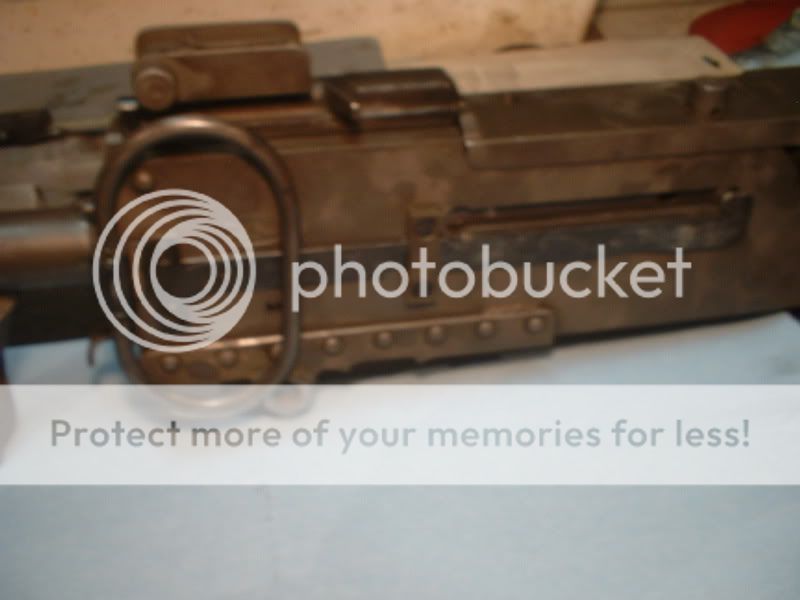
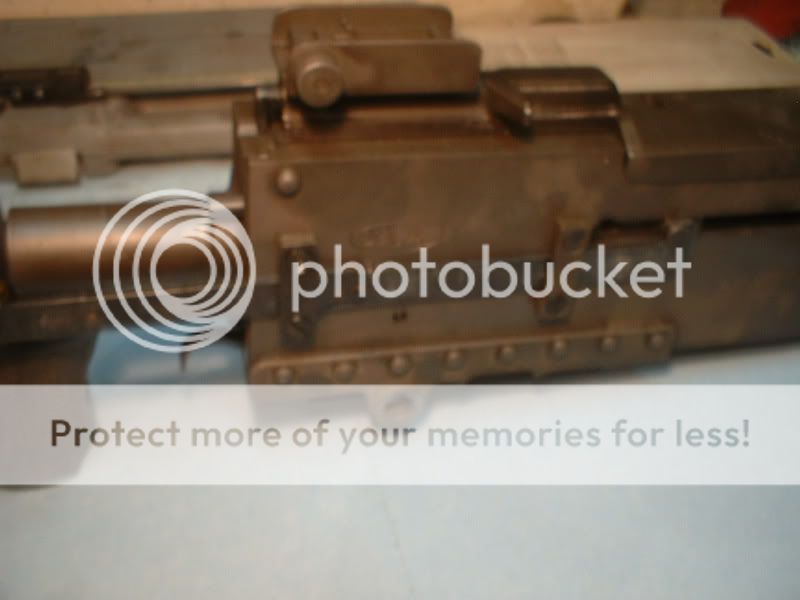
The gun was filthy, and since I was going to run it out to the shop anyway, I decided it was time to add the one thing that this gun was really missing to remind me of my youth: install the Canadian cocking handle.

I had first worked with the C1 GPMG when I was in the militia at 16. The Canadian guns all had a rather large ring on the side of the gun which allowed you to cock the gun with the arctic mitts on. The cocking handle also acts as a hold open device, a feature missing on the US version of the gun.

Before anyone else starts drilling holes in the sides of their M1919, best have a look at the diagram below. If you can't read some of the measurements, just ask and I'll be happy to read them off to you.

DSCF0004-1.jpg


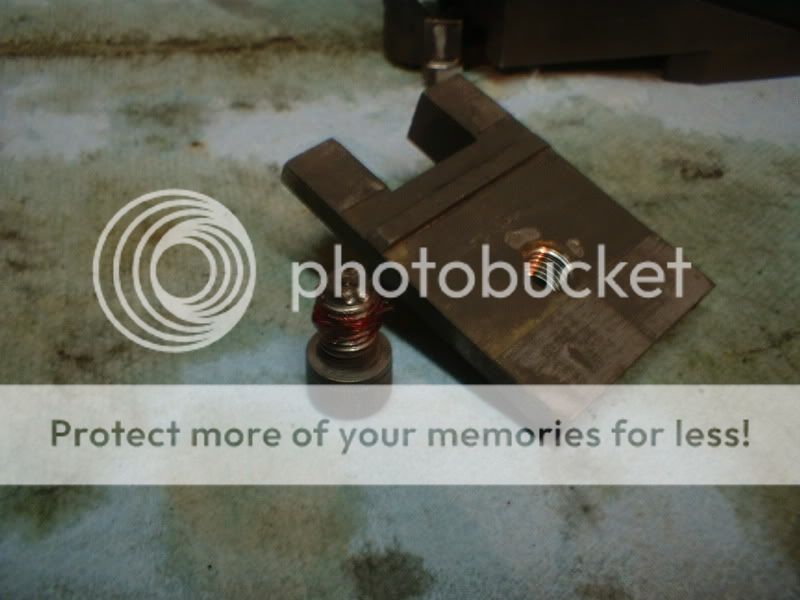
This next photos a bit dark, but here i am threading the 10-32 holes in the sideplate that I drilled out with a #21 drill bit.

DSCF0001-2.jpg


Below are the components required for the Canadian cocking handle. I had to do a bit of searching around town to find the slot head screws. Everybody sells Robertson these days, and even the military NSN converted over to phillips. I actually found them at Cdn tire, believe it or not.

DSCF0007-2.jpg


Note that the screws were plated. This would not do so I heated them to red, and quenched them in oil. Then I heated them again and rubbed them against a woolen sock. They come out nice and black.

DSCF0008-2.jpg


Next came the repair to the cam. I cleaned the parts with brake cleaner, and applied loctite to the screw.

DSCF0010-1.jpg


Note that this screw does not get tightened right down. The screw should float, with about .020 (+-.005) clearance between the bottom plate and the cam. Stake the heck out of this screw from the inside, never the bottom. TNW failed to do this on my gun in the first place.

DSCF0013-1.jpg


Now, with the gun assembled, here is the cocking handle in the stowed position. The Canadian latest style (C5A1) top cover latch can be seen, which has an independant rear plate latch.


DSCF0017.jpg
 
Shrek1985 said:
I've heard some stories about holding the barrels with thick gloves,

The gloves were used to change the barrel after firing since it was so bloody hot.
 
WOW

OWDU that was bang on the money, just was I was looking for. Many thanks.

Had no idea the aussies kept a .30-cal gun in service for so long against standardization. Haha, we couldn't even keep two different gas regulators in the system for the C6, but thats a different story isn't it? Gotta wonder why the Austrialians made the effort though? Or contrariwise, did not make the effort.

Too bad we never do the fun shoots some of the older guys talk about, anymore. With old and exotic weapons.
 
I know the guy who owns that gun! Small world. As of last year, he has both 7.92mm, and 7.62mm barrels and is searching for the .30 barrel ( or vice versa, can't remember if he has the .30 looking for the 7.62mm  ;D. Its not a CA, its factory SA, and not restricted.

That Battle of the Bulge shoot is sponsored by Wolverine of Virden, and has been conducted at CFB Shilo.


Cheers,

Wes
 
Wes,

It's a small world....I've not met him personally, but we've bantered across the web a bit.

I'm borrowing someone's C-5 bolt to take some measurements and study it's function for a bit.

Have you seen the mini .30's that Lakeside guns makes?  Ever consider a 2/3 scale FN-Mag?  With the barrel extending to the rear of the feed ramp, and using the 1919 style feed mech (closed bolt semi only) it would be an 18.5" barrel, and with .22 rimfire, there would be no mag/belt limit.

That's one of my projects that's on the semi-side burner....I have to get a couple of other ones clear of the work-bench first.  My son's 1/5 scale Tiger 1 ride-in toy is first....

Feb%2009%20008%20(Small).jpg
 
Classic tank mate!

He has a vast superior collection, really has his heart into it, is a wealth of knowledge, and a wife who supports him to the fullest too. He and his Missus hope to make it out here in the next year or two.

I've known him for over 20 years, and I really enjoyed my visit with him again in Aug 08.

Ya, seen the mini .30 in SAR, and on the web.

My claim to .30 fame is I have a 1/6 metal miniture, with metal rds and link, with an opening feed cover, and moving bolt. Sights come up, etc, even a min metal ammo tin. Yes with tripod and T&E mech.

Here is a few pics of the M1919A4, and the M2 HB .50. The M2 is plastic, but the detail is excellent. The M4 Sherman is a Franklin Mint in 1/24.

Cheers,

Wes

 
Here is the M2 HB, again 1/6 scale. Great little conversation piece, and both MGs are the closet I'll ever come to owning one, ha!

Cheers,

WEs
 
I have the belt-fed bug ever since I had these two beauties built:

Feb%2008%20001%20(Medium).jpg


Feb%2008%20014%20(Small).jpg


Both are really just dressed up .22 rifles, but now that I'm setup for a proper machine shop (Bench mill that weighs 800 lbs and a 10"x4.5' lathe) I'm able to progess what I'd like in my own time.

Oh, and, it'd be of interest to you, I just saved another FN from oblivion.  I'm one of the 12(5) owners here, and last fall at CFSAC, I arranged to save a FNC1A1 from the welder/wall-hanger, and just this week I picked up the Lithgow L1A1 from another gent who was heading that direction.

Means I now have a complete set of the Inch pattern FAL's....Brit, Aus, and Can.  Along with the "other pattern" 1A1 from India....it's mostly Inch pattern.

NS
 
Still got my headspace & timing gauge around here on a key ring somewhere. ;D In a pinch a nickle and dime sufficed quite adequately. ;)
 
recceguy said:
Still got my headspace & timing gauge around here on a key ring somewhere. ;D In a pinch a nickle and dime sufficed quite adequately. ;)

Oh my god!!! You are probably one of those guys who conducted meatball surgery on the trigger bar.  ;)
 
recceguy said:
Still got my headspace & timing gauge around here on a key ring somewhere. ;D In a pinch a nickle and dime sufficed quite adequately. ;)

Someone gave me a set of 'em too the other year, figured I might know what they were....makes a nice accessory for the mini-1917.  I'm going to make a little spot in the transit chest I'm building for it.

NS
 
kkwd said:
Oh my god!!! You are probably one of those guys who conducted meatball surgery on the trigger bar.  ;)

It wasn't meatball surgery. It was finessing the fire control system 8)
 
Back
Top