


- Reaction score
- 35
- Points
- 560
Doctors Remove Ammunition From Soldier’s Head

WASHINGTON — The patient arrived in critical condition last month at the Bagram Air Base
hospital in Afghanistan, with what American military doctors at first thought was an all too
typical war injury: metal shrapnel from an improvised bomb lodged in his head. A CAT scan
showed that the piece of metal, about two and a half inches long, was probably a cartridge
fragment — again, not at all unusual.
But as the patient, an Afghan soldier in his 20s, was prepared for surgery, the chief radiologist,
Lt. Col. Anthony Terreri, took a closer look at the CAT scan. Stunned, he realized the object
was an explosive round, primed to go off.
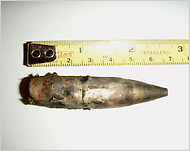
14.5 millimeter high explosive
incendiary round
“It looks like we have a problem here,” he announced.
To say the least.
In a joint telephone interview from Bagram on Friday, members of the Air Force medical team
recounted the tense hours that followed Dr. Terreri’s discovery. Maj. John Bini, a trauma surgeon
and a veteran of homemade-bomb injuries from two previous deployments in Iraq, immediately
evacuated the operating room. Only the anesthesiologist, Maj. Jeffrey Rengel, who put on body
armor, was left to watch the patient.
The surrounding hallways were secured, and a bomb disposal team was urgently summoned.
All electrical monitoring devices in the operating room were turned off for fear of detonating
the round. To keep track of the patient’s vital signs, doctors turned to manual blood pressure
cuffs and a battery-operated heart monitor, and they began counting drips per minute to estimate
the amount of the intravenous anesthesia they were giving the patient. “It was taking anesthesia
back about 30 years,” Dr. Rengel said. Within a half-hour, the bomb disposal team arrived and
confirmed, based on the CAT scan, that the patient indeed had unexploded ordnance in his head.
“They said, the way these things are set up, this type of round has an impact detonator on the
front of the charge,” Dr. Bini said. “They just said, ‘Don’t drop it.’ ” With that for reassurance
Dr. Bini put on body armor as well, and he began the process of surgically removing the round
from the patient’s head, joined in the operating room only by Dr. Rengel and a member of the
bomb team. He cut through scalp tissue and made a large incision encircling the round, which
was lodged under a piece of skull bone and jutted down the right side of the patient’s head.
Within 10 minutes, he pulled out the live round.
With care, he handed it to the bomb technician, who put it in a bag and left.
Did Dr. Bini breathe a sigh of relief before handing off to a neurosurgeon?
“I didn’t even think about breathing a sigh of relief,” Dr. Bini said. “Technically, it wasn’t a very
complicated procedure, and I had the confidence that I wasn’t going to drop it on the floor. This
is something we train for — although it’s a very uncommon event.”
In fact, Dr. Bini had taught students how to remove live ordnance from patients in sessions at
Wilford Hall Medical Center at Lackland Air Force Base in Texas, where he is stationed when not
at war. He just had never expected to have to do it in real time. Dr. Bini said that in the nearly
nine years of war in Iraq and Afghanistan, if someone else had removed an unexploded round
from a patient, he had not heard of it. He said that a quick review of the medical literature
found fewer than 50 cases over the last half-century.
The patient, who was not named by the doctors, has since been discharged from the Craig Joint-
Theater Hospital at Bagram and is recovering. Although the patient has brain injuries from bone
fragments, Dr. Bini said the Afghan was able to walk, to talk and to eat on his own. “The patient
did quite well,” he said.
Dr. Bini said he was unaware that an unexploded bomb embedded in a patient’s chest had been
the plot of a television show — a two-part episode of “Grey’s Anatomy” on ABC in 2006. “None
of that stuff you see on TV approximates reality,” he said.
WASHINGTON — The patient arrived in critical condition last month at the Bagram Air Base
hospital in Afghanistan, with what American military doctors at first thought was an all too
typical war injury: metal shrapnel from an improvised bomb lodged in his head. A CAT scan
showed that the piece of metal, about two and a half inches long, was probably a cartridge
fragment — again, not at all unusual.
But as the patient, an Afghan soldier in his 20s, was prepared for surgery, the chief radiologist,
Lt. Col. Anthony Terreri, took a closer look at the CAT scan. Stunned, he realized the object
was an explosive round, primed to go off.
14.5 millimeter high explosive
incendiary round
“It looks like we have a problem here,” he announced.
To say the least.
In a joint telephone interview from Bagram on Friday, members of the Air Force medical team
recounted the tense hours that followed Dr. Terreri’s discovery. Maj. John Bini, a trauma surgeon
and a veteran of homemade-bomb injuries from two previous deployments in Iraq, immediately
evacuated the operating room. Only the anesthesiologist, Maj. Jeffrey Rengel, who put on body
armor, was left to watch the patient.
The surrounding hallways were secured, and a bomb disposal team was urgently summoned.
All electrical monitoring devices in the operating room were turned off for fear of detonating
the round. To keep track of the patient’s vital signs, doctors turned to manual blood pressure
cuffs and a battery-operated heart monitor, and they began counting drips per minute to estimate
the amount of the intravenous anesthesia they were giving the patient. “It was taking anesthesia
back about 30 years,” Dr. Rengel said. Within a half-hour, the bomb disposal team arrived and
confirmed, based on the CAT scan, that the patient indeed had unexploded ordnance in his head.
“They said, the way these things are set up, this type of round has an impact detonator on the
front of the charge,” Dr. Bini said. “They just said, ‘Don’t drop it.’ ” With that for reassurance
Dr. Bini put on body armor as well, and he began the process of surgically removing the round
from the patient’s head, joined in the operating room only by Dr. Rengel and a member of the
bomb team. He cut through scalp tissue and made a large incision encircling the round, which
was lodged under a piece of skull bone and jutted down the right side of the patient’s head.
Within 10 minutes, he pulled out the live round.
With care, he handed it to the bomb technician, who put it in a bag and left.
Did Dr. Bini breathe a sigh of relief before handing off to a neurosurgeon?
“I didn’t even think about breathing a sigh of relief,” Dr. Bini said. “Technically, it wasn’t a very
complicated procedure, and I had the confidence that I wasn’t going to drop it on the floor. This
is something we train for — although it’s a very uncommon event.”
In fact, Dr. Bini had taught students how to remove live ordnance from patients in sessions at
Wilford Hall Medical Center at Lackland Air Force Base in Texas, where he is stationed when not
at war. He just had never expected to have to do it in real time. Dr. Bini said that in the nearly
nine years of war in Iraq and Afghanistan, if someone else had removed an unexploded round
from a patient, he had not heard of it. He said that a quick review of the medical literature
found fewer than 50 cases over the last half-century.
The patient, who was not named by the doctors, has since been discharged from the Craig Joint-
Theater Hospital at Bagram and is recovering. Although the patient has brain injuries from bone
fragments, Dr. Bini said the Afghan was able to walk, to talk and to eat on his own. “The patient
did quite well,” he said.
Dr. Bini said he was unaware that an unexploded bomb embedded in a patient’s chest had been
the plot of a television show — a two-part episode of “Grey’s Anatomy” on ABC in 2006. “None
of that stuff you see on TV approximates reality,” he said.


