
- Reaction score
- 8,715
- Points
- 1,360
Good idea - done!Maybe all the discussion on Canadian highways & railways belongs in a thread about Canada?
Army.ca Staff


Good idea - done!Maybe all the discussion on Canadian highways & railways belongs in a thread about Canada?

Just because Canada hasn't done big things in decades does not mean it's impossible. In the 1880s we built a railroad to the Pacific in 4 years, that we take a decade to make 52km highways now is a choice.If you have a way to twin about 1900 km of highway (Renfrew to Kenora) with the workforce and economy we have inside a lifetime I'm sure they would love to hear from you. New highway 413 in southern Ontario will be 52 km long and take at least a decade for about $10Bn.

If you have a way to twin about 1900 km of highway (Renfrew to Kenora) with the workforce and economy we have inside a lifetime I'm sure they would love to hear from you. New highway 413 in southern Ontario will be 52 km long and take at least a decade for about $10Bn.
 news.ontario.ca

There's a lot of real estate between "impossible" (which I didn't claim) and reasonable. It's pretty difficult to compare building a 19th century railway where, in the prairies, wasn't even ballasted - ties just laid on graded earth, with a highway built to modern standards. I'm not sure killing approximately 4000 unskilled labourers can easily compare as well. I'm not sure we would the skilled labour capacity to built it at a speed some would desire. A lot of the funding for the CPR was in the form of land grants which they, in turn, sold to pioneers. Most of land in northern Ontario isn't particularly arable and that which is, is already owned by someone.Just because Canada hasn't done big things in decades does not mean it's impossible. In the 1880s we built a railroad to the Pacific in 4 years, that we take a decade to make 52km highways now is a choice.
You're viewing it from the perspective of what is being done currently, not what could be done if Canada was serious about creating redundancy in critical infrastructure. There are areas that could be relatively quickly twined, while the more difficult bits get picked away at over time. Quebec has managed it for the 185/85 from Rivière du Loup to Edmunston.

Just because Canada hasn't done big things in decades does not mean it's impossible. In the 1880s we built a railroad to the Pacific in 4 years, that we take a decade to make 52km highways now is a choice.
You're viewing it from the perspective of what is being done currently, not what could be done if Canada was serious about creating redundancy in critical infrastructure. There are areas that could be relatively quickly twined, while the more difficult bits get picked away at over time. Quebec has managed it for the 185/85 from Rivière du Loup to Edmunston.
Would be better (maybe) to twin either or both the trans-Canada rail lines and encourage more intermodal traffic. Establish unidirectional traffic cross Canada with a transshipping point every 180 to 240 miles. Transport companies could switch to day runners rather than long haul and would if they could guarantee a position leaving any city 3 or 4 times a day.There's a lot of real estate between "impossible" (which I didn't claim) and reasonable. It's pretty difficult to compare building a 19th century railway where, in the prairies, wasn't even ballasted - ties just laid on graded earth, with a highway built to modern standards. I'm not sure killing approximately 4000 unskilled labourers can easily compare as well. I'm not sure we would the skilled labour capacity to built it at a speed some would desire. A lot of the funding for the CPR was in the form of land grants which they, in turn, sold to pioneers. Most of land in northern Ontario isn't particularly arable and that which is, is already owned by someone.
Taking a decade to build a short piece of highway might be a choice; I doubt the $10Bn part is. Realizing it's a really poor comparison, to use the projected Hwy 413 cost, twinning the TCH would only be about $380Bn. Pocket change. Maybe it should have been identified as a 'nation building project'. Who needs pipelines.
Ya, I don't know enough about the economics of rail vs road for the various types of commodities over distances. Certain loads, like online (Amazon), courier (FedEx) and foodstuffs need overnight/quick turnaround that the handling from road>rail>road simply can't provide. I had a buddy who hauled for Steinberg's grocery (remember them) overnight from Toronto to Montreal every night.Would be better (maybe) to twin either or both the trans-Canada rail lines and encourage more intermodal traffic. Establish unidirectional traffic cross Canada with a transshipping point every 180 to 240 miles. Transport companies could switch to day runners rather than long haul and would if they could guarantee a position leaving any city 3 or 4 times a day.
I hope you're not using that 100km as a shining example of rapid highway construction. It seems Quebec has been building that out of petty cash. They started twinning it in 2002 and are scheduled to be finished until sometime later this year. The argument I read from the government was it benefited non-Quebecers more so they wanted the feds to pay for the bulk of it.Quebec has managed it for the 185/85 from Rivière du Loup to Edmunston.
All valid points, but the construction itself wasn't done over a lifetime, which was my key point.But it took a decade (or more) of political wrangling; diplomatic negotiations with non-Canadian countries/colonies; the fall of at least one government due to accepting rail company bribes; trying to find a private company that would undertake this as a "business case"; raising the capital to start construction; planning, surveying and designing the route(s); at least one rebellion (that helped impetus to getting a railroad across the country); before the 'first spike' was struck. And all it cost the Canadian government over that process was the annual spending of 25% of the federal budget, accepting that it would be the largest factor in increasing the national debt, giving the rail company a monopoly, granting title of 25,000,000 acres of land to the railroad (plus the actual land and easement for track and yard) and accepting that they (the government) would be required to continue subsidizing the railways or that they would have to bail them out when they failed.
While the tale of taking four years to complete "The National Dream" may be the stuff of legend (or at least a CBC miniseries) there's more to the timeline.
I brought it up as an example of a section of Trans-Canada highway twinning through somewhat difficult terrain that was done by completing the "easy" parts first, then working on the more complex sections.I hope you're not using that 100km as a shining example of rapid highway construction. It seems Quebec has been building that out of petty cash. They started twinning it in 2002 and are scheduled to be finished until sometime later this year. The argument I read from the government was it benefited non-Quebecers more so they wanted the feds to pay for the bulk of it.
of course it is uneconomical and for the reason you stated: it sits in a yard for half a day or longer before eventually making it onto an eastbound train. If I log onto Amazon and order a box of batteries it is delivered the next day. Their computer system simply locates the order in the system and then dispatches a robot fork lift to fetch it and deliver it to packaging where it is packed labelled and the system sends it to the correct truck for my address. If CN or CPKC did the same thing for cans or even better, a 53 ft. trailer with the dispatcher assigning a train on contact so the shipper would know the departure and arrival time, and as I say, 3 or 4 times a day you would soon seen a lot fewer trucks on the 401. Stop in at an enroute one evening sometime and just count the number of trucks sitting idle for 8 hours or more. Each of those parking lots would make up a complete train if loading and dispatching were done right. And before you say it can't be done, go down to any major container port and watch how quickly they off-load and dispatch.Ya, I don't know enough about the economics of rail vs road for the various types of commodities over distances. Certain loads, like online (Amazon), courier (FedEx) and foodstuffs need overnight/quick turnaround that the handling from road>rail>road simply can't provide. I had a buddy who hauled for Steinberg's grocery (remember them) overnight from Toronto to Montreal every night.
Canadian rail has the highest modal share for freight in the world and we are 5 or 6 in total freight rail tonnage. Horsepower, better signalling and traffic management has enabled them to do that while actually eliminating a lot of the double track section they had (esp. CPKC). A lot of the pan-Canada trains now are nothing but intermodal, a couple kilometers worth. Our two Class Is do have what is called 'directional running agreements' for unidirectional traffic in certain areas (Fraser/Thompson canyons in BC and Sudbury-Parry Sound), but it would be difficult to mandate. These are private, for-profit companies who are in competition. It's pretty difficult to have common node points when the mainlines (not branchlines) only come together in a few places (nearest east from Kamloops is Winnipeg, then not again until Sudbury).
Their money and business interest is in long distance bulk commodity and intermodal, preferably lots of them like Canadian Tire. By the time a small shipper sends a seacan of widgets to an intermodal yard in Toronto it will sit there until enough are assembled that the railway has determined is economical to send to Montreal, and it won't be 3 or 4 times a day. Both railways tried the scheduled semi-trailer on a flatcar (I think CP called it 'roadrailer') and both abandoned it because it was uneconomical.

Every Intermodal container shipped by rail is tracked by GPS and tagged. Data is available in real-time to customers.of course it is uneconomical and for the reason you stated: it sits in a yard for half a day or longer before eventually making it onto an eastbound train. If I log onto Amazon and order a box of batteries it is delivered the next day. Their computer system simply locates the order in the system and then dispatches a robot fork lift to fetch it and deliver it to packaging where it is packed labelled and the system sends it to the correct truck for my address. If CN or CPKC did the same thing for cans or even better, a 53 ft. trailer with the dispatcher assigning a train on contact so the shipper would know the departure and arrival time, and as I say, 3 or 4 times a day you would soon seen a lot fewer trucks on the 401. Stop in at an enroute one evening sometime and just count the number of trucks sitting idle for 8 hours or more. Each of those parking lots would make up a complete train if loading and dispatching were done right. And before you say it can't be done, go down to any major container port and watch how quickly they off-load and dispatch.
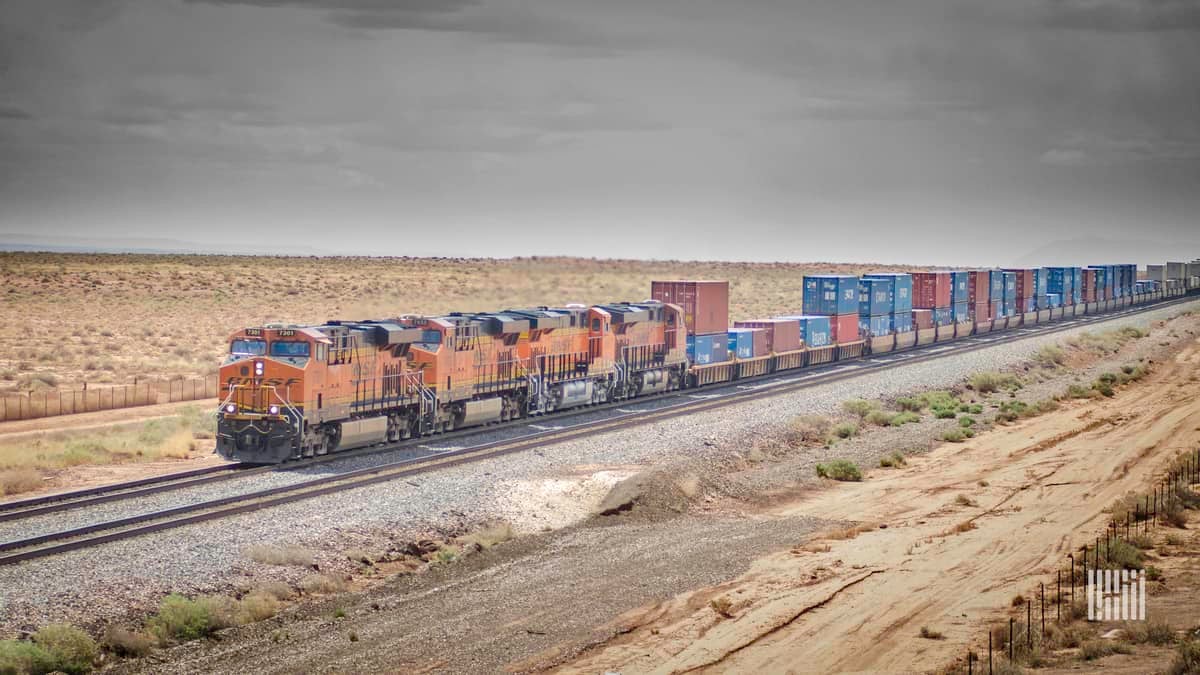
 www.freightwaves.com
Experimented, yes.... and none have been able to make a go of it.Railroads have experimented with the concept of road trailers assembled into trains for a number of decades. Low take-up by industry, weight problems with rail bogies and labour issues were some of the issue that led to a slow death.
Roadrailer - Wikipedia
en.wikipedia.org
been done in Europe. They have developed a system for side-loading trailers using a forklift much as they do cans. That allows freedom to load a train without having to sequence the drive-on. I think the standard trailer is shorter than our 53's but it shouldn't be hard to scale up if the system works as advertised and I am guessing the sweet spot for short haul is anything over a single day's drive; say around 750 miles.Every Intermodal container shipped by rail is tracked by GPS and tagged. Data is available in real-time to customers.
There is also a schedule for containers:
Short-haul intermodal just isn't a sound business model though. The sweet spot for rail is anything over 750 miles and 500 miles in certain situations. Anything less and the drayage and associated labour make it not worth the effort or cost efficient. If someone could invent a new type of railcar, able to rapidly load and unload a semi-trailer, that might change.
Commentary: Will short-haul intermodal rail ever work?
Jim Blaze writes about the potential of short-haul intermodal traffic on the North American Class 1 railroads.

With perhaps additional appeal even within a day's drive depending on weather and geography? Who wants to pay a driver to chance the Coquihalla/Hwy 1, maybe get delayed, maybe end up in the ditch, etc. if there's a more reliable option at a comparable price?I am guessing the sweet spot for short haul is anything over a single day's drive; say around 750 miles.

Just a thought but if weather is a concern just don't send him or her.With perhaps additional appeal even within a day's drive depending on weather and geography? Who wants to pay a driver to chance the Coquihalla/Hwy 1, maybe get delayed, maybe end up in the ditch, etc. if there's a more reliable option at a comparable price?
for the same reason that pilots push limits on approach. More times then I care to remember we would advise the inbound that previous traffic called the braking action very poor or approaching nil yet they would still try it. Gotta get there syndrome has killed a lot of people on our roads and in the air. Quadrapiper raised a great point.Just a thought but if weather is a concern just don't send him or her.
Alaska-Canada Highway (Dawson Creek AB to Delta Junction AK) 2700 km, 8 months in 1942, 134 MUSD (>2 BCAD Present Year)
Not an accurate comparison. Amazon is processing an order on their own platform and shipping their own product from their own facilities. I have ordered stuff from them that took six weeks to show up because it was a third party seller. Railways are common carriers; they own nothing of what they move.of course it is uneconomical and for the reason you stated: it sits in a yard for half a day or longer before eventually making it onto an eastbound train. If I log onto Amazon and order a box of batteries it is delivered the next day. Their computer system simply locates the order in the system and then dispatches a robot fork lift to fetch it and deliver it to packaging where it is packed labelled and the system sends it to the correct truck for my address. If CN or CPKC did the same thing for cans or even better, a 53 ft. trailer with the dispatcher assigning a train on contact so the shipper would know the departure and arrival time, and as I say, 3 or 4 times a day you would soon seen a lot fewer trucks on the 401. Stop in at an enroute one evening sometime and just count the number of trucks sitting idle for 8 hours or more. Each of those parking lots would make up a complete train if loading and dispatching were done right. And before you say it can't be done, go down to any major container port and watch how quickly they off-load and dispatch.
Wartime urgency.Alaska-Canada Highway (Dawson Creek AB to Delta Junction AK) 2700 km, 8 months in 1942, 134 MUSD (>2 BCAD Present Year)
Privately built. Also not a common carrier.Schefferville Railway (Schefferville to Sept-Iles) 572 km, 1950 to 1954, cost not available but a 2013 replication study suggested 5 BCAD
I don't know where that dollar figure comes from. It's not a single highway; it's a bunch of connected provincial highways, many of which largely already existed in some form. Maybe that's what the feds kicked.Trans Canada Highway (Atlantic to Pacific) 7821 km, 1950 to 1971, 1.4 BCAD actual dollars at the time - some spent in 1950, some in 1971.
Trans Canada Pipeline (Alberta to Montreal) 3500 km, 1956 to 1958, 245 MCAD (2.4 BCAD - Present Year Dollars)
James Bay Route du Nord (Matagami to Radisson) 700 km, 1971 to 1974, 450 MCAD in 1970s dollars (3 BCAD - Present Year Dollars)
Not an accurate comparison. Amazon is processing an order on their own platform and shipping their own product from their own facilities. I have ordered stuff from them that took six weeks to show up because it was a third party seller. Railways are common carriers; they own nothing of what they move.
Wartime urgency.
Privately built. Also not a common carrier.
I don't know where that dollar figure comes from. It's not a single highway; it's a bunch of connected provincial highways, many of which largely already existed in some form. Maybe that's what the feds kicked.
OK. Also, as far as I know, no property acquisition/expropriation; easements only.
Only quasi-government. Hydro Quebec. Also, it's gravel.
Maybe private industry should own and built our highways and toll them.


