And he emerged as a result of the 'Marshall Purge', which we would do well to emulate in the run up to readiness for our next war - promote based on merit and get rid of the dead wood ...
The Genius Decision That Won World War II
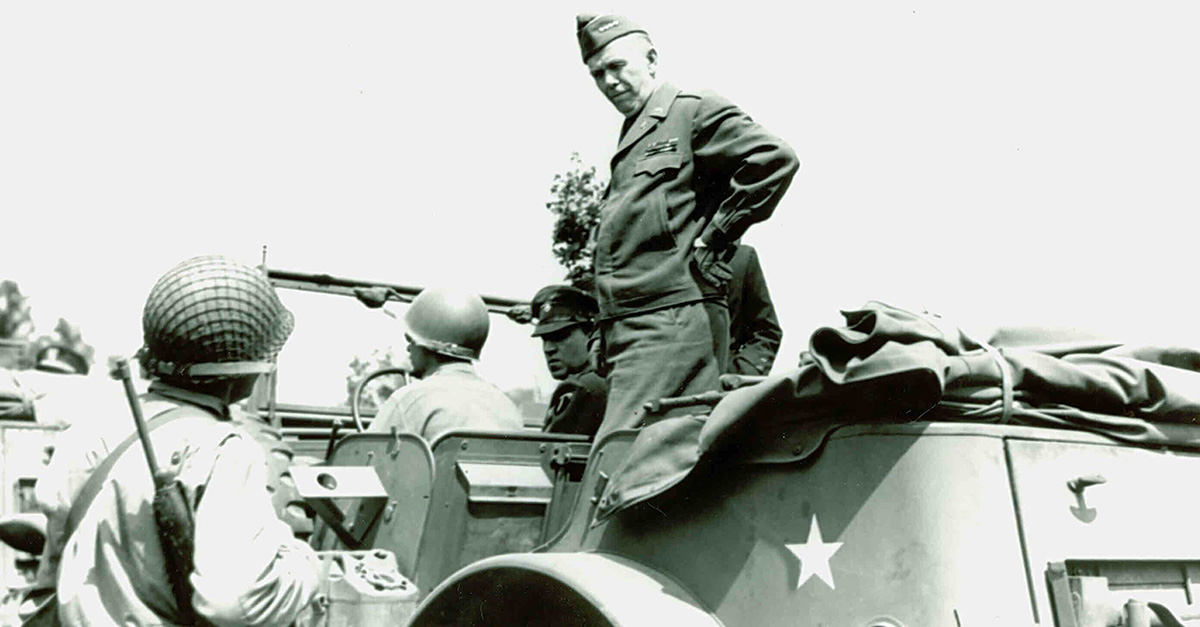
Gen. George C. Marshall broke the Army’s stale traditions by elevating commanders on merit rather than seniority and, in so doing, transformed the U.S. military into the world’s greatest fighting force.
Among the steps he took was to convince a very skeptical and isolationist Congress to not only give him a sizeable chunk of cash for recruitment and training but also to authorize the first peacetime draft in American history. He pushed to federalize the National Guard. And he worked with his staff to streamline the Army’s structure to make it more efficient and effective.
He also eliminated the Army’s antiquated seniority system and established a new standard for promotion and assignment: “Today’s performance.” In other words, merit. Who was best able to do the job at that moment in a way that would benefit the soldiers, the mission, and the country?
As Marshall himself bluntly put it,
“I do not propose to send our citizen-soldiers into action, if they must go into action, under commanders whose minds are no longer adaptable to the making of split-second decisions in the fast-moving war of today, nor whose bodies are no longer capable of standing up to the demands of field service. They’ll have their chance to prove what they can do. But I doubt that many of them will come through satisfactorily.”
Marshall
set up a “Purge Board” of six retired officers to carefully review aging and underperforming active-duty officers and to cut all “dead wood” who didn’t measure up. The committee ultimately ousted more than 1,000 officers, including 500 colonels, some of whom had been long-time friends and colleagues of Marshall.
That moved opened room at the top for the kind of younger, vigorous junior officers that Marshall had been observing and keeping notes on in his little black book for the past 15 years. However, nobody got to skate in on their reputation, past performance, the number of medals on their chest, or who they knew.
They would all be forced to prove their worthiness according to the very high standards of Gen. Marshall.
Most of them would get their chance to do just that in the spring, summer, and fall of 1941, when Marshall and his staff put on the “Louisiana Maneuvers,” the largest series of training exercises in the history of the U.S. Army. It would be, one historian noted, “the anvil on which the U.S. Army was shaped.”
The largest of the three exercises saw nearly 500,000 troops, 50,000 wheeled and tracked vehicles, and 32,000 horses spread out across the swamps, open fields, small towns, and mud of the Deep South to partake in war games that would realistically simulate likely battle scenarios against the Nazi blitzkrieg.
The exercises were designed to stress-test the Army’s communications, structure, logistics, communications, and leadership and help it learn “to fight as a team.” But equally important, they offered a
good look at what the cadre of up-and-coming officers could do under pressure. Among those who excelled were then-Col. Dwight Eisenhower, Lt. Col. Omar Bradley, and Lt. Col. Mark Clark, all of whom would later be rewarded with high command positions after the U.S. formally joined the war effort just months later.
The biggest beneficiary, though, was Patton. Then 54 years old and still a colonel, he came under the Purge Board’s review, but his youthful energy and charisma won him a reprieve; in Louisiana, assigned as a tank commander, Patton brilliantly demonstrated his knack for tactical innovation and adaptability that would soon make him a battlefield legend. Marshall personally chose him to lead the Army’s Third Division.
Gen. George C. Marshall broke the Army’s stale traditions by elevating commanders on merit rather than seniority and, in so doing, transformed the U.S. military into the world’s greatest fighting force. On September 1, 1939, two world-changing decisions were made: One officially started World...

www.standingforfreedom.com



 www.19fortyfive.com