• Thanks for stopping by. Logging in to a registered account will remove all generic ads. Please reach out with any questions or concerns.

Emergency Response Times

See above
True, I guess they weren't pointing out an article that might be of interest, or asking for your opinion on the matter, which I guess you gave - Toronto EMS better.
A wall of text from a totally irrelevant contact was what was requested.
 
I just thought the post might be of interest. I didn't mean start a fight or compare service delivery models.
 
Toronto EMS better.

If you say so.

I would say different.

As in, different Call Volumes require different service delivery models.

They get a lot of out of town applicants.

So does TFS.

I found it interesting that fire fighters with many years experience with a full-time fire department elsewhere were willing to leave to pursue their “dreams” as they put it and work for Toronto Fire. It made me feel a little bit special that I have been a part of an organization that others envy and want to be a part of as well.

Frank Ramagnano Secretary - Treasurer,Toronto Professional Fire Fighters’ Association I.A.F.F. Local 3888
 
While Toronto EHS and TFS offer commendable benefits packages, the ROC can not compete, nor should they. Toronto is struggling with a budget crisis, despite having an ideal population density and defined geographical area, compared to the ROC. More than 80% of Canadian firefighters are volunteers. In an effort to control costs, more than a third of provinces have contracted out their EHS services.
 
While Toronto EHS and TFS offer commendable benefits packages, the ROC can not compete, nor should they.

Municipal taxpayers, in Ontario, get what they pay for.

Readers can argue if that is fair / unfair.

In Ontario, don't know about ROC ( Rest of Canada? ) paramedic funding is a mixed formula.

A maximum of fifty percent comes from the provincial government.

Provincial funding is based upon the census population, not business day population.

Municipal taxpayers ante up the other fifty percent.

They can pay more than fifty percent, if they want a different, not necessarily better, service delivery model.

Response times and Unit Hour Utilization ( UHU ) may be included in the calculation.


The Ministry ( Ontario Ministry of Health) continues to set standards, fully funds air ambulance, dispatch and base hospital programs, and through an approved funding template, provides a maximum of 50% of required land ambulance service funding.
 
This data pleases my internal management consultant ;)

Effects of Emergency Medical Service Response Time on Survival Rate of Out-of-Hospital Cardiac Arrest Patients: a 5-Year Retrospective Study​


A maximum response time of 8 minutes significantly enhances survival outcomes, including survival at the scene, survival to ED, and survival to hospital discharge. Furthermore, each 1-minute increase in response time is associated with a 6% reduction in the likelihood of survival to hospital discharge.

 
Readers with an interest in the challenges faced by Superior North EMS ( SNEMS ) - which includes their station in the Township of Nipigon, may, or may not, find their Master Plan of interest.

Their challenges are complex and significant.

The City of Thunder Bay and the surrounding District will experience a no-growth population from 2021 to 2030. However the “aging tsunami” imbedded in the existing population will drive SNEMS call volumes across the coming decade.

No growth in population, but,

An aging tsunami and growing willingness to call 9-1-1

It discusses municipal property tax, and Ability-to-pay,


The property tax funded portion of SNEMS operating costs is apportioned among the City and District municipalities based on their relative ability-to-pay. The ability-to-pay formula uses a given municipality’s percentage of taxable weighted assessment to establish that same municipality’s share of the SNEMS property tax supported budget

"Suitcase Paramedics",

Many of the District paramedics are “suitcase medics” that reside in Thunder Bay but travel to remote stations across the District for the duration of their shifts.

This results in SNEMS schedules designed to accommodate long “suitcase medic” commutes to the worksite - where paramedics living in Thunder Bay travel to a District station and reside there for 4 to 7 days depending on the particulars of the schedule.

"Travel across the District" to remain On-Duty and On-Call for "4 to 7 days".

District schedules require paramedics to be “on-duty” for part of a given day and then “on-call” for the remainder of the day. In practical terms this means medics must reside at or near the District station to maintain after-hours response times. To address difficulties in obtaining short-term accommodationsfor suitcase medics, SNEMS has provided space in District stations to serve as bedrooms, or where space does not allow, has rented or purchased off-site accommodations for paramedics to use. The quality of these accommodations has an impact of willingness of staff to work in particular District station locations (see District Station functional assessments in this plan).

The overnight accommodations required for SNEMS suitcase medics that are provided on-site are for the most part “bare bones”, making adaptive reuse of previous offices to meet fire regulations. One District station has no washroom in the sleeping trailer used. Three stations feature off-site owned/rental accommodations. Only one of these housing sites has separate washroom facilities.

The property tax base experiencing no significant growth in taxable assessment cannot absorb the budget impacts generated by the annual 5-6 percent call volume increases featured in the base case demand forecast.

Taxpayers cannot afford to add a $500,000 12-hour ambulance crew every second year with no end in sight.

Analytics confirm the station is not performing well from a value-for-money perspective.

See also Report from Association of Municipalities of Ontario, if interested,

Escalating Emergency Services Labour Costs and the Ontario Taxpayers’ Ability to Pay
 
Readers with an interest in the challenges faced by Superior North EMS ( SNEMS ) - which includes their station in the Township of Nipigon, may, or may not, find their Master Plan of interest.

Their challenges are complex and significant.


No growth in population, but,


It discusses municipal property tax, and Ability-to-pay,


"Suitcase Paramedics",


"Travel across the District" to remain On-Duty and On-Call for "4 to 7 days".


See also Report from Association of Municipalities of Ontario, if interested,
I don't know the business that well but the funding model must be different in the north. A municipal/provincial 50/50 split doesn't work when a lot of your territory has no municipal tax base.
 
I don't know the business that well but the funding model must be different in the north. A municipal/provincial 50/50 split doesn't work when a lot of your territory has no municipal tax base.

Don't know the SNEMS Funding Model that well either.

For reference,

SUPERIOR NORTH EMS

2021-2030 Paramedic Services Master Plan

Section 2.3.2 SNEMS Funding Model

( Goes into the details, including Nipigon, if interested. )

Municipality of Nipigon levy payments and assessments and percentages are itemized in the SNEMS Budget Apportionment .
 
Don't know the SNEMS Funding Model that well either.

For reference,

SUPERIOR NORTH EMS

2021-2030 Paramedic Services Master Plan

Section 2.3.2 SNEMS Funding Model

( Goes into the details, including Nipigon, if interested. )

Municipality of Nipigon levy payments and assessments and percentages are itemized in the SNEMS Budget Apportionment .
Which is great - where municipalities exist, but most of the District (admittedly not most of the population base) is unorganized with no tax base.
 
Which is great - where municipalities exist, but most of the District (admittedly not most of the population base) is unorganized with no tax base.

According to their Master Plan, SNEMS is "unique" among Ontario paramedic services.

This silo-based delivery model is unique among Ontario paramedic services.

The SNEMS delivery model uses part-timers and Standby.

Ours did not.

Not to suggest one delivery model was better , or worse, than the other. Just different.

The Ministry continues to set standards, fully funds air ambulance, dispatch and base hospital programs, and through an approved funding template, provides a maximum of 50% of required land ambulance service funding.
 

Effects of Emergency Medical Service Response Time on Survival Rate of Out-of-Hospital Cardiac Arrest Patients: a 5-Year Retrospective Study​


Obviously, 9-1-1 Response Time is a priority with municipal taxpayers.

How much are they willing to pay vs how long are they willing to wait?

Nipigon is served by SNEMS, whose HQ is in Thunder Bay, ON.

The Province of Ontario shares half the costs of paramedic services with municipalities.

The residential property tax rate for 2025 in Thunder Bay is 1.856303% .

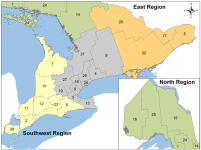
Now, there is the Ontario "Learn and Stay Grant" in Northern, Southwestern and Eastern Ontario.

The good news,

The Ontario Learn and Stay Grant provides funding for students studying in priority postsecondary programs in underserved and growing communities in Northern, Southwestern and Eastern Ontario.

The not so good news,

requires you to work in the region where you studied

This prevents, or at least delays, Paramedics from "doing a lateral" from the Green, Yellow and Orange Regions of Ontario to the Grey Region.


mcures-olsg-regional-map-2025-26-en-20250715.png


You want either an overpass or an underpass. You don't need to do every single one but certainly the public crossings through urban areas should all be level grade with an overpass or underpass for vehicle/pedestrian traffic.

That Turbotrain I mentioned earlier had an accident with a truck on its very first trip might I add.

Saw the above in Politics. Will reply in Emergency Services, as it concerns an MCI which put a significant strain on our Response Time.

And, the Ontario Highway Traffic Act amended requiring all public transit and school buses to stop at all level rail crossings before proceeding.

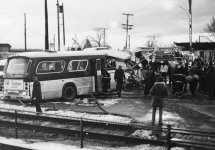
Exactly half a century ago, almost to this day, on December 12, 1975, during the evening rush hour, an eastbound Toronto Transit Commission (TTC) bus from Warden subway station with approximately 65 passengers on board became disabled on the GO commuter train tracks near St. Clair and Midland Avenues in Scarborough.

A westbound GO Train approaching at 70 mph collided with the bus causing the deaths of ten passengers, and seriously injuring 21 others.

The subsequent investigation and coroner's inquest would lead to widespread changes in the way rail lines interact with busy arterials.

While subways and underpasses had been built to separate downtown traffic from busy train tracks, in the suburban boroughs, the same lines regularly crossed major roads at grade.

The legacy of the tragedy was increased urgency for grade separations on major roads. Five days later, Ottawa pledged the $5.2 million needed to build underpasses on St. Clair Avenue East and Midland Avenue, just down the tracks. Funds for similar bridges at Eglinton East, Kennedy Road, and Islington Avenue were also sought.

The Ontario Highway Traffic Act was amended after the accident to require buses to stop at railway crossings.

The cause of the accident was the - hidden - emergency brake over-ride switch on the bus. It was not the driver's fault.

The accident spooked bus operators. In spite of the new law, operators were refusing to stop at the crossing due to poor visibility and the unusual width of the tracks. Starting a bus from stopped and getting it across the five sets of rails took too long.

The bus involved was a 40 foot GM New Look aka 'Fisbowl". Our dept. operated the same make and model, with a - not hidden from the operator - emergency brake over-ride switch. In case the rear doors failed to close, thus locking the brakes. As happened in this case. ( pic. )

This tragedy led to a mandatory provincial law requiring all public transit and school buses to stop at all level rail crossings before proceeding. It also resulted in the installation of override switches for door interlocks on future buses.

597396532_10173055355720297_7336326399904484082_n.jpgG8BJOZqXsAIBtBZ.jpeg
 
Back
Top