• Thanks for stopping by. Logging in to a registered account will remove all generic ads. Please reach out with any questions or concerns.

ID This Weapon

tomahawk6

Army.ca Legend
Inactive
Reaction score
67
Points
530
orig.jpg
 
The gas booster looks almost 'Vickers', but its not.

The design looks more Maxim than Revelli.

Crikey, I thought I knew my MGs!

Regards,

OWDU
 
The sights look purpose built for how he is holding it.

I was thinking aircraft, but that looks water cooled, yet it might have some air inlets behind the booster. Then there is the 'sling' thing.

Who bloody knows what it is.

Overall I think we can agree that the Italians were lovers not fighters (or MG designers), ha!


Cheers,

OWDU
 
I wonder if there is any significance to the weapon being held by an Alpini (a member of the Italian mountain troops)?
 
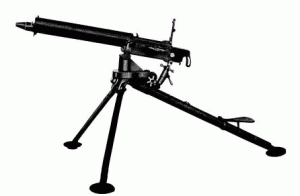
In WW1 the Italians used the Vickers. This is the closest photo I can find.

http://www.ima-usa.com/popup_image.php/pID/1508/image/0
 
This might be out in left field but it looks like it should be mounted on an aircraft (aerodynamic barrel tip and extra large aiming sights?)...
 
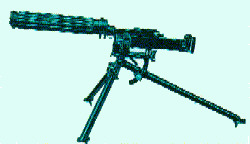
Walrus on LF solved the mystery I think. It looks like the Mitragliatrice Perrino o Perino mod.1908.

http://www.cimeetrincee.it/mitra.htm

mit9.gif
 
I noticed the Alpini variant has a much shorter cooling jacket, possibly an 'experimental/trial' variant of the above?

Cheers,

Wes
 
The original question was posed at one of my fav milblogs. So maybe Monday the answer will be revealed.Thanks for helping out :)

http://www.thedonovan.com/archives/2009/04/a_whatziss_1.html

 
Translation from the web site.

"Designed in 1901 by engineer Joseph Perrino artillery, was the first automatic weapon Italian design (weighing 27 kg). In 1910, as amended and referred to as "lightweight" (17 kg), after some good tests, was adopted by the Savoy with the Maxim model used since the same size. In this way it was intended to reward a national patent and the Italian production. It was powered by shippers metal plate 25 shots each (a particular stock hopper could hold five shippers ready for the shot, add down to achieve a continuous fire. The circulation of the cooling was ensured by pumping from long-recoil movement of the barrel within the sleeve. The theoretical rate of fire was 450 strokes per minute. It was distributed in very limited quantities, while the quality far superior to any other machine gun adopted."

 
Back
Top