• Thanks for stopping by. Logging in to a registered account will remove all generic ads. Please reach out with any questions or concerns.

Indirect Fires Modernization Project - C3/M777 Replacement

I think that when one starts to address the issue of air defence at the scale we now have to deal with it then there is no longer a need to have air defence gunners keep their hand in mud gunnery.

AD has a need to develop skills all of its own from command and control to sensors to effectors to tactical deployments and airspace management/coordination to force integration (even around an air field). Modern mud gunnery has the same issues but in quite a different manner. They both need to be experts in their own right and there isn't much room or time for cross-training.

You are right that CUAS is the entry-level and it is also a field which will exist organic to manoeuvre units as well as in air defence units. The same could be true for fire-and-forget small AD VSHORAD missiles although I think Canada will limit VSHORAD missiles to AD units. I'm a fan of mixed batteries where 30-35mm guns and VSHORAD missiles and other CUAV systems (such counter-drone drones) work in conjunction as the lowest AD layer. I'd very much like to see a comprehensive article on how Ukrainian AD resources are structured on the macro and micro level. So far all that I have seen are bits and pieces.

🍻
I see basic "Mud Gunnery" in DP1 as place to assess where people should go. It does not take long to train the basic bits of being a gun crew and working as team. Digging in, camouflage, ammunition handling will all be cross speciality skillsets. I think AD is going to take Gunners with more awareness, self-motivation and will need to be more independent thinking than your typical gunline gunner. You don't want to place the wrong people in your AD Troop or your Drone Troop.
 
This is what happens when you become complacent and don't take enough defensive measures.

If drones can kill tanks then they can kill anything on the battlefield that can be found and which isn't adequately defended.

I've long ago come to the conclusion that close support artillery regiments should have at least a 3 to 1 ratio of gun batteries to loitering munition launcher batteries. I'm not far away from saying a 2 to 2 ratio but a lot of that depends on the survivability of drones in the field. The technology is progressing in both attack and defence fields so the future is, and probably will remain, unpredictable.

I support the current IFM plan. There ought to be enough SPs to support 4 full 18-gun regiments. Unfortunately the LM component inside IFM or outside of it is opaque to me but I just don't see "launcher batteries" in the cards. I think it would be foolish on the part of the artillery - and the army - to leave the field to just within the armoured and infantry units. Incidentally, I feel the same about any HIMARS regiment. It should have even longer range LM launch batteries than the close support regiment. 3 to 1 or 2 to 2.

This latest example from Ukraine makes it clear that there needs to be a bigger LM strike capability at brigade and division level. If we did form LM strike batteries and integrated them in field regiments on a 2 to 2 ratio, we could probably form some 7 to 8 field regiments which would provide both a proper divisional artillery brigade plus a second brigade for a second deployable division (or as a theatre general support capability). You can never have too much artillery.

🍻

Shouldn't each CS Regiment have a Self-Defence / CUAS Battery before it has an LM Battery?
Or should the correct CS Regiment structure be a 7 Battery Structure?

RHQ and Adm
ISTAR
CUAS
LM
3x Guns
 
I see basic "Mud Gunnery" in DP1 as place to assess where people should go. It does not take long to train the basic bits of being a gun crew and working as team. Digging in, camouflage, ammunition handling will all be cross speciality skillsets. I think AD is going to take Gunners with more awareness, self-motivation and will need to be more independent thinking than your typical gunline gunner. You don't want to place the wrong people in your AD Troop or your Drone Troop.


I think that we are missing the point entirely on local air defence, or for that matter area defence.

The systems are not manpower intensive. Especially as we move towards containers of ready to fire missiles and interceptor drones.

A duty "fire team" of four can provide coverage within their Area of Interest until the run out of boxes of missiles.

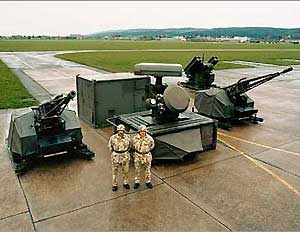
Take this one for example.


Oerlikon Skynex Control Node
Up to 4 x Active Electronically Scanned Array (AESA) Multi-Mission Radar (AMMR) surveillance and tracking radars
Up to 4 x SkyKnight Missile Launcher Units (MLU)
60 x SkyKnight Missile Rounds (MR) per MLU
Up to 4 x Oerlikon Revolver Guns (RG) Mk3 with AHEAD airburst ammunition

That is 240 engagements before having to rely on the last ditch defence by the 4 guns.

And I don't see any reason why 4 boxes of missiles can't become 8, or 12.

...

Add in the AI turreted C6s, M3s and M230LFs as well as the multi-tube launchers for interceptor drones.

This is not about camouflage. It is about dispersal, connectivity and redundant mass.
 
I think the systems are manpower intensive, the men need to move it, emplace it, camouflage it, reload it, fix it, transport it to theatre, find the parts to fix it, make the parts which they can't access for whatever reason. What you are seeing is a split in skillsets, the mud gunners move it, emplace, camouflage and reload and bring up the ammunition. The technical guys do the fixing and ordering parts. The logistical guys try to have ammunition and parts near enough to keep it operational, without getting killed themselves.
 
I see basic "Mud Gunnery" in DP1 as place to assess where people should go. It does not take long to train the basic bits of being a gun crew and working as team. Digging in, camouflage, ammunition handling will all be cross speciality skillsets. I think AD is going to take Gunners with more awareness, self-motivation and will need to be more independent thinking than your typical gunline gunner. You don't want to place the wrong people in your AD Troop or your Drone Troop.
I agree that a degree of selection is required but even in mud gunnery there are skill tiers. Not everyone is cut out to be an OP or FSCC tech or less a det commander. There are recruiting selection tests (assuming they are back in vogue now) that will determine who has the skills. And not everyone in AD will be the one doing the high-end stuff. A lot of it is driver, or missile handling which, like much of the army, is drills and modules based. Considering how much of a problem throughput of training is these days, can we really afford to run AD folks through working the guns.

I think the stove piping issue goes far beyond field and AD. STA with both sensor and strike functions is getting big enough to be run as a separate career silo at the base level. And that's no big problem at the DP1 to DP 2 level but starts to become an issue as you start to merge silos at the DP 3 and 4 levels.

Shouldn't each CS Regiment have a Self-Defence / CUAS Battery before it has an LM Battery?
Or should the correct CS Regiment structure be a 7 Battery Structure?

RHQ and Adm
ISTAR
CUAS
LM
3x Guns
There are arguments pro and con. Back in the 1970/80s each CS regiment in Canada had an AD battery (troop in the case of 2 RCHA). Doctrinally, however, AD was a specialty (rather than just local air defence) and was a divisional resource by way of an AD Regt.

I'm on the side of a division with two AD components: 1) organic self defence - i.e AD, especially but not limited to CUAS, systems within all units in the division - guns and drone interceptors and the like to create a small and tight bubble over the unit and its components. 2) layers of ever larger bubbles to cover formations. - i.e an AD regt that can deploy a battery of VSHORAD and SHORAD to cover each of the div's two manoeuvre brigades and the division's deep and rear areas - so basically four batteries that operate within an even larger corps or theatre AD bubble.

The size of those batteries and their number should vary depending on the size of the division's other assets and the size of territory it is doctrinally expected to cover. There is no sense even discussing the types of weapons and the number of weapons/troops until the doctrine is set. That's our bloody problem. We create SORs for capabilities without a firm doctrine to base them on.

I'm dead set against AD batteries in the division's CS or GS field regiments. IMHO, strike functions- whether by guns or LMs plus their essential TA sensor systems - belong to a division's CS regiment designed to fight in priority: a manoeuvre brigade's close battle; followed by a secondary ability to participate in the divisions' deep battle. The same is true for the division's GS regiment except that from the start it is organized to fight in priority: the division's deep battle; followed a secondary priority to participate in the brigades' close battles.


🍻
 
I agree that a degree of selection is required but even in mud gunnery there are skill tiers. Not everyone is cut out to be an OP or FSCC tech or less a det commander. There are recruiting selection tests (assuming they are back in vogue now) that will determine who has the skills. And not everyone in AD will be the one doing the high-end stuff. A lot of it is driver, or missile handling which, like much of the army, is drills and modules based. Considering how much of a problem throughput of training is these days, can we really afford to run AD folks through working the guns.

I think the stove piping issue goes far beyond field and AD. STA with both sensor and strike functions is getting big enough to be run as a separate career silo at the base level. And that's no big problem at the DP1 to DP 2 level but starts to become an issue as you start to merge silos at the DP 3 and 4 levels.


There are arguments pro and con. Back in the 1970/80s each CS regiment in Canada had an AD battery (troop in the case of 2 RCHA). Doctrinally, however, AD was a specialty (rather than just local air defence) and was a divisional resource by way of an AD Regt.

I'm on the side of a division with two AD components: 1) organic self defence - i.e AD, especially but not limited to CUAS, systems within all units in the division - guns and drone interceptors and the like to create a small and tight bubble over the unit and its components. 2) layers of ever larger bubbles to cover formations. - i.e an AD regt that can deploy a battery of VSHORAD and SHORAD to cover each of the div's two manoeuvre brigades and the division's deep and rear areas - so basically four batteries that operate within an even larger corps or theatre AD bubble.

The size of those batteries and their number should vary depending on the size of the division's other assets and the size of territory it is doctrinally expected to cover. There is no sense even discussing the types of weapons and the number of weapons/troops until the doctrine is set. That's our bloody problem. We create SORs for capabilities without a firm doctrine to base them on.

I'm dead set against AD batteries in the division's CS or GS field regiments. IMHO, strike functions- whether by guns or LMs plus their essential TA sensor systems - belong to a division's CS regiment designed to fight in priority: a manoeuvre brigade's close battle; followed by a secondary ability to participate in the divisions' deep battle. The same is true for the division's GS regiment except that from the start it is organized to fight in priority: the division's deep battle; followed a secondary priority to participate in the brigades' close battles.

🍻

But your CS and GS gunners routinely prepared themselves to defend their guns and their positions, learning to employ small arms, MGs, CGs and ATGMs as well as canister and HEAT.

My sense is that the AI turrets, of which we both seem enamoured, fit somewhere around entrenched 50s. And I suspect that those 50s would have been employed on any incoming aircraft.

So let me offer a name change. Rather than a CUAS Battery how about a Defense Battery capable of defending the guns against all targets, air or ground?

Or how about a Defence and Duties Troop in each battery?
 
Back
Top