
OldSolduer
Army.ca Relic
- Reaction score
- 23,372
- Points
- 1,260
Canada and its Army need artillery systems, AD systems and a concerted effort to recruit not just combat arms but logistics types



Your gunner math continues to suffer. Don't get overly impressed by glossy brochure advertising that fails to account for the 24/7 care and feeding required by all these modern systems.
Why do you want to free up people for the CQB when most of the killing takes place well forward of CQB range? Do you think that little of your infantry that you want them to bear the brunt of the burden? Or are you once again wanting to equip every rifleman with a 20 km nuclear slingshot?
Honestly, if you sit back and think about it, the Canadian army could put a pause on infantry growth while it builds up all the CS and CSS folks necessary to give proper support to the CQB folks we already have. After that we can build them up apace.
You are right about one thing; we will need much more, very expensive air defence kit and people than our CQB-centric military will admit. - Oh! and long range ground-based strategic strike kit. The Ukrainians have it right. Being purely defensive is for losers. You need to be able to hurt the enemy seriously in its homeland.


It's the reduction in manpower equation where the problem comes in. Unless you jump to a Terminator world where every weapon system is autonomous, then the math will always be (T x P = E) where T = technology; P= personnel and E = effect. In short where where there is a doubling in T then the formula becomes 2T x P = 2E. But if you simultaneously reduce P by 50% then it becomes 2T x 0.5P = E. In other words the advantage that the increase in tech has produced is reduced by the reduction in manpower resulting in effect being unchanged. The aim is always to increase E through an increase in T. You do not want to settle on status quo. On top of that every increase in T has its own demands. While there may be less P required at the gun, more are required at other points along the chain.The artillery (including the Air Force and Space Force) represents the greatest opportunity for increases in productivity, lethality and reductions in manpower.
Nobody ever said anything about "instant".It's the reduction in manpower equation where the problem comes in. Unless you jump to a Terminator world where every weapon system is autonomous, then the math will always be (T x P = E) where T = technology; P= personnel and E = effect. In short where where there is a doubling in T then the formula becomes 2T x P = 2E. But if you simultaneously reduce P by 50% then it becomes 2T x 0.5P = E. In other words the advantage that the increase in tech has produced is reduced by the reduction in manpower resulting in effect being unchanged. The aim is always to increase E through an increase in T. You do not want to settle on status quo. On top of that every increase in T has its own demands. While there may be less P required at the gun, more are required at other points along the chain.
Let me give you a simple example. If you replace a dug-in M777 with a 10 man crew with an RCH 155 with a crew of 2 then the illusion is that you have a five-fold reduction in manpower - but you don't. The RCH works differently. It flits around from hide to hide to shooting positions. At each hide you need an ammo resupply crew, local defence, CUAV etc. All things that your ten man crew would have accomplished. That alone will eat up over half of your imagined personnel savings. On top of that, with its small on board ammo supply, the RCH is "out of action" more than the M777 and unable to immediately respond to calls for fire (and I wouldn't trust its fire on the move function as much as the glossy brochures state) - it needs to take the time to deploy. Then there is 24/7 operations. Your two man crew and some of your ammo folks need to rest or rotate which again takes your gun out of action for some of the time unless there is a replacement crew available. The result is a slower response to calls for fire and increased time out of action to rearm and rest means you need backup teams/stand-by systems.
The trick with all of these systems is that you have to closely evaluate how the changes in T can be used to maximize E. That rarely happens by simultaneously reducing P. Just as important, changes in T also occur on the enemy's side. You need to be immediately ready to compensate for the enemy's increase in E against you which usually requires more T and P on your side to provide countermeasures and to replace casualties.
I really have no problem with the numerous introductions to technological changes that you bring to the forum. I generally welcome the information. My problem is with the conclusion that we can instantly reduce the number of people needed in a given function or move them to another function based on only a very small part of all the factors involved with introducing such a system.


I hate carrying a manpack. Love a manpack. What if create new doctrine for placing radio a little bit away from the soldier before transmi...
It's impossible.
It's actually pretty much "instant." When new capital equipment is acquired there is an accompanying evaluation of how that acquisition effects both existing equipment, doctrine, TTPs, manning levels, ammo stockpiles, maintenance requirements, etc. If there are offsets - such as existing equipment being divested and existing PYs available by virtue of that divestment then you have a start, but the sharp pencil folks will look very closely at any new requests for PYs as well as any PYs that might be gleaned for reallocation.Nobody ever said anything about "instant".
Trends.
It's actually pretty much "instant." When new capital equipment is acquired there is an accompanying evaluation of how that acquisition effects both existing equipment, doctrine, TTPs, manning levels, ammo stockpiles, maintenance requirements, etc. If there are offsets - such as existing equipment being divested and existing PYs available by virtue of that divestment then you have a start, but the sharp pencil folks will look very closely at any new requests for PYs as well as any PYs that might be gleaned for reallocation.
The last few decades have been an ongoing struggle - especially in the army - to establish relevance and protect PYs and establishments. From a gunner point of view one of the most significant transformations was the remaining 400 some odd PYs belonging to 4 AD Regt when the ADATS was thrown under the bus around 2011. If it hadn't been for the relevance which STA had proven during Afghanistan then the arty would have lost about a fifth of its strength. As it was turning 4 AD into 4 Regt RCA (GS) and using it to provide ASCC, SUAV, MRR and other functions for the army allowed those PYs to remain in the gunner fold. Some of these are now proving useful to the GBAD resurgence.
Long story short - when new equipment is introduced, the manning levels to support it are already determined and will take effect concurrent with the equipment. If you are thinking long-term planning to account for future trends respecting the class of equipment that might come then you are thinking about someone else's military; not Canada's.
I'm not sure that it does. See this for example.I am saying that no matter what decisions are taken at any given moment, over time new tools will result in new procedures and new manning requirements.
The net tendency, in my view, over time, has been towards equipment that requires fewer people and applies effect more precisely over longer ranges and larger areas.
This trend continues.
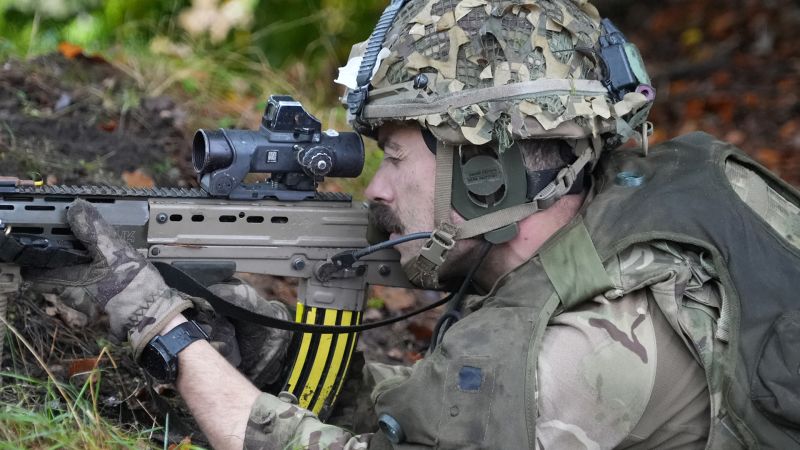
Troops must be the best at killing their enemy at short distances, head of the Army says
The Chief of the General Staff provided insight into the changing nature of battlefield doctrine as he addressed personnel in Catterickwww.forcesnews.com
It's a tendency to be resisted fiercely when its obvious that people will die needlessly. Change is inevitable. It must be addressed. But always with caution. For an example where the budget is ruling common sense, see the UK's Boxer decision re the modules being eliminated. Folks will die unnecessarily because of that.Certainly, when a new tool is procured, there is a plan for employment and manning. But then circumstances intervene and the plan needs to be adjusted. As time goes by those circumstances will change and the employment and manning will be adjusted again. Also, ancillary equipment, purchased over time, will also impact the employment and manning.
The key element though is that financial pressures always result in pressure to do more with less. And that tendency is irresistible.

I'm not sure that it does. See this for example.
It's a tendency to be resisted fiercely when its obvious that people will die needlessly. Change is inevitable. It must be addressed. But always with caution. For an example where the budget is ruling common sense, see the UK's Boxer decision re the modules being eliminated. Folks will die unnecessarily because of that.


