• Thanks for stopping by. Logging in to a registered account will remove all generic ads. Please reach out with any questions or concerns.

Pipelines, energy and natural resources

  • Thread starter Thread starter QV
  • Start date Start date
Three words to rehabilitate the reputation of nasty, stinking, polluting old coal?

Sounds like you know what you're talking about when it comes to the industrial use of coal.

You'll also probably know, then, that we'll be using coal forever because that's how much of it there is. Canada rakes in billions annually from our metallurgical coal sales, mainly to China.

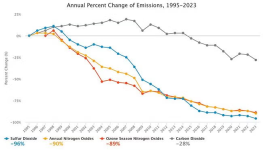
The technology now used to scrub the emissions is resulting in a huge drop in CO2 and other pollutants.

It's by no means perfect, and there are ongoing struggles with various regulatory regimes (India, we're looking at you) , but it's getting better.

And even China's on board, implementing whole of sector AI managed processes optimizing production and emission controls, which is good because they're building dozens more coal fired power facilities to build our cheap stuff.

It's the environmental success story no one hears about because: 'ew, coal' ;)


1775436610694.png

1. According to the U.S. Environmental Protection Agency (EPA), power plant emissions in the U.S. continued to decline in 2023, with sulfur dioxide (SO2) down 24%, nitrogen oxides (NOx) down 15%, mercury down 17%, and carbon dioxide (CO2) down 7% from 2022 levels—even as power generation fell just 2%. Compared to 1995, SO2 and NOx emissions have dropped by 95% and 89%, respectively. Source: EPA

 
Have you been to any of the central African states such as Kenya or Uganda? The primary cooking fuel is home-cooked charcoal. The sulfur and nitrogen levels are through the roof. Supplying them with coal from Cape Breton would be a godsend and would reduce pollutants significantly. All these talks about wind and solar and even gas are great for those of us who can afford the luxury but the rest of the world would be getting a step up if we would only send them coal.
 
Pressure is mounting to start enriching for Darlington's 4 new reactors (and other Provinces looking at nuclear) and for export abroad due to Russia having almost half of the total global enriching capacity, and the only commercial supplier of High-Assay Low-Enriched Uranium (HALEU).

Archive
 
Have you been to any of the central African states such as Kenya or Uganda? The primary cooking fuel is home-cooked charcoal. The sulfur and nitrogen levels are through the roof. Supplying them with coal from Cape Breton would be a godsend and would reduce pollutants significantly. All these talks about wind and solar and even gas are great for those of us who can afford the luxury but the rest of the world would be getting a step up if we would only send them coal.

Energy desalinates sea water and makes it potable.

Cheap energy is everything. Too bad that windmills aren't cheap.
 
Not in canada but....Canadian crude

but at a significant discount; Alberta's crude remains hostage to a single customer's whims.
 
Not in canada but....Canadian crude


36"
1050 km
1.13 million barrels per day

$50 USD per barrel = $79,000,000 CAD per day to Canada
$29 BCAD per year

$100 USD per barrel per day
$58 BCAD per year

Even with the US commission that is still a hefty chunk of change to add to the economy annually.

....

$1.96 BUSD for 456 miles in Montana
$2.73 BCAD for 734 km
370 MCAD / 100 km

$50 USD payback = 35 days
$100 USD paybaCK = 17 DAYS

....

TMX added 994 km of new pipe to twin the existing 1150 km system.
34.2 BCAD for 994 km
3,441 MCAD / 100 km

....

Costal Gas Link
$14.5 BCAD for 670 km
2,164 MCAD / 100 km

...

Northern Gateway - 1180 km
 
Have you been to any of the central African states such as Kenya or Uganda? The primary cooking fuel is home-cooked charcoal. The sulfur and nitrogen levels are through the roof. Supplying them with coal from Cape Breton would be a godsend and would reduce pollutants significantly.

Who cares? They certainly don't.

All these talks about wind and solar and even gas are great for those of us who can afford the luxury but the rest of the world would be getting a step up if we would only send them coal.

A big mistake is always assuming that this is about the environment and not energy security or economic impacts driven by importing fuel. Importing things you literally burn, is a substantial economic drag and massive vulnerability. A huge part of why countries are moving to renewables, is so that they aren't: 1) vulnerable to random geopolitical events they don't have control over, and 2) not sending a chunk of their GDP up in smoke.

I would expect more example like Ehiopia:


Gift link.

Developing countries are starting to leapfrog and go straight to EVs. Largely because of the aforementioned concerns.


Gift link.

Anybody who keeps thinking this is about the environment is in for a real shock in a few years.
 
I have always believed that the cure for high prices is high prices. The current unpleasantness in Straits of Hormuz will likely create demand for petroleum supply creation in other parts of the world.

But I also wonder if it might not create some permanent demand destruction?

Unlike 1973, this time, there are some pretty viable alternatives to petroleum. Suddenly in a lot of places hybrids, EVs and solar panels might not just become economically viable, they might be the only game in town. We are lead to believe that China has this stuff stockpiled, in spades.

Once those are in place, that demand is not coming back.
 
YTZ - I saw your thumbs up. This is clearly your area of interest, based on previous posts. I would be interested in your thoughts.
 
1973 led to policies that eventually drove oil prices down to single digits in the 80s through both recession and efficiency.

I fully expect this will put every electrification and renewable policy in every importing nation into overdrive. Already seeing reports of countries like Singapore and Thailand seeing EV sales at 50% marketshare. Trump is going to go down as the greenest POTUS in history!

Talking with Canadians about renewables is like talking to a horse breeder or buggy maker after the launch of the Model T. They'll give you every excuse of why that contraption won't work. They can't imagine it any other way. And they don't dare. But people are ultimately motivated by economics and security. And they'll adapt the tech to their needs. The charging you see in developing countries is some janky shit. But they make it work because of economics. We'll be one of the last countries on Earth to electrify because incumbent interests will make sure of it. But that doesn't mean any importing country is obligated to follow us.
 
1973 led to policies that eventually drove oil prices down to single digits in the 80s through both recession and efficiency.

I fully expect this will put every electrification and renewable policy in every importing nation into overdrive. Already seeing reports of countries like Singapore and Thailand seeing EV sales at 50% marketshare. Trump is going to go down as the greenest POTUS in history!

Talking with Canadians about renewables is like talking to a horse breeder after the launch of the Model T. They'll give you every excuse of why that contraption won't work. They can't imagine it any other way. And they don't dare. But people are ultimately motivated by economics and security. And they'll adapt the tech to their needs. The charging you see in developing countries is some janky shit. But they make it work because of economics. We'll be one of the last countries on Earth to electrify because incumbent interests will make sure of it. But that doesn't mean any importing country is obligated to follow us.
Speaking of horses, here's a fun fact - Flint MI (60miles from Detroit), was the world's largest manufacturer of horse drawn carriages in 1900. That company was the Durant-Dort Carriage Company.

Do you know who William Durant and Dallas Dort were?


The 2 guys who founded GM - General Motors.
 
It's interesting to see how the world is being re-ordered. Anybody catch the statement by the CEO of Honda of the Japanese auto sector on the brink?


Gift link.
There's a dividing line clearly between Toyota, and to a lessor extent, Honda, and all the others. The Japanese car industry is ripe for consolidation. EV's might very well be the catalyst that brings it on.

Toyota is leading the way with their EV approach - which is the Hybrid vehicle - and the others are playing catch up.
 
Speaking of horses, here's a fun fact - Flint MI (60miles from Detroit), was the world's largest manufacturer of horse drawn carriages in 1900. That company was the Durant-Dort Carriage Company.

Do you know who William Durant and Dallas Dort were?


The 2 guys who founded GM - General Motors.

It's always good when executives can smartly pivot their companies. But there's more Kodaks in the world than GMs. And in today's auto sector? The legacy OEMs are all on track to be Kodaks. The only question now is which one of them might be the last.

Ask yourself why none of the legacy OEMs, with all that auto experience, IP and supply chains built an EV brand like Tesla? Or Rivian right after that. Tesla was literally an EV company from a bunch of Silicon Valley nerds who had no experience building cars. Detroit should have been able to crush these guys.
 
It's always good when executives can smartly pivot their companies. But there's more Kodaks in the world than GMs. And in today's auto sector? The legacy OEMs are all on track to be Kodaks.

Ask yourself why none of the legacy OEMs, with all that auto experience, IP and supply chains built an EV brand like Tesla?
Toyota's path is the way forward - a mixture of the old ways with the new, until it becomes apparent which one wins in the end.
 
Back
Top