Yeah...but not true:
Track the progress of Canada's government initiatives
www.buildcanada.com
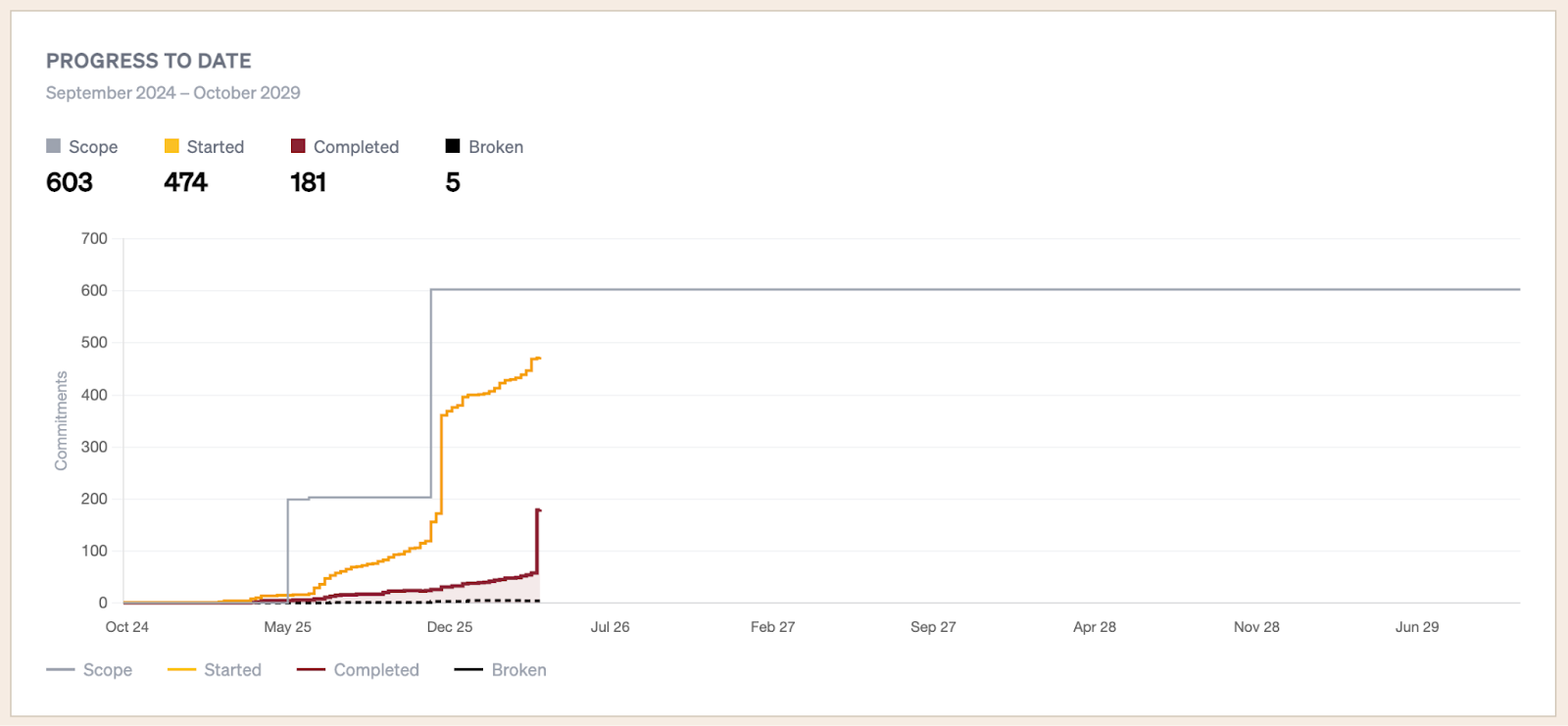
Of 603 commitments, the government has started some sort of action on 474 (78%) of them, while completing 181 (30%) of them. Take issue with what was promised, but saying the current government is doing nothing is not backed by the facts.
Quoting numbers on a graphic doesn't give a real and substantial picture of what is going on. Here's the accompanying article that explains those numbers.
A Report on Carney’s First Year in Government
Proposed by
Build Canada
Article
Progress is real, but it's mostly groundwork: 77.7% of commitments are In Progress or Completed. But most of that movement looks like consultations launched, early funds deployed, and line items in departmental plans, not outcomes Canadians can see or feel.
Execution has not caught up to rhetoric: Legislation bottlenecks stalled a significant chunk of the agenda. Healthcare and Justice have seen just six completions each, and 5.9 million Canadians still don't have a family doctor. Bill C-15 passing clears some of the logjam, but a full year in, the government still is not implementing at the speed voters urgently called for.
The low hanging fruit has been picked. The big-ticket items have yet to break through: The 181 completed items were largely things that needed only a ministerial signature or a tax change. The commitments that would reshape daily life, from housing and healthcare to export credit, are still in progress or not started. Year two needs to look different.
Build Canada reviewed all 603 commitments the government made and assessed them against timelines and promises it set for itself. Our report is as objective as possible, however you may notice a builder's lens appear throughout.
Last year, Prime Minister Mark Carney told Canadians that the country was in a time of national
crisis. He promised to build at speeds not seen in
generations. What’s happened since?
Build Canada’s outcomes tracker investigated all 603 commitments made by the Carney government. Its purpose: to make accessible to the public precisely what’s been promised, view the progress so far, and locate the sources behind every update from a single dashboard. The tool evaluates the government against the commitments and timelines it set for itself, not through the quality or wisdom of them or any partisan lens.
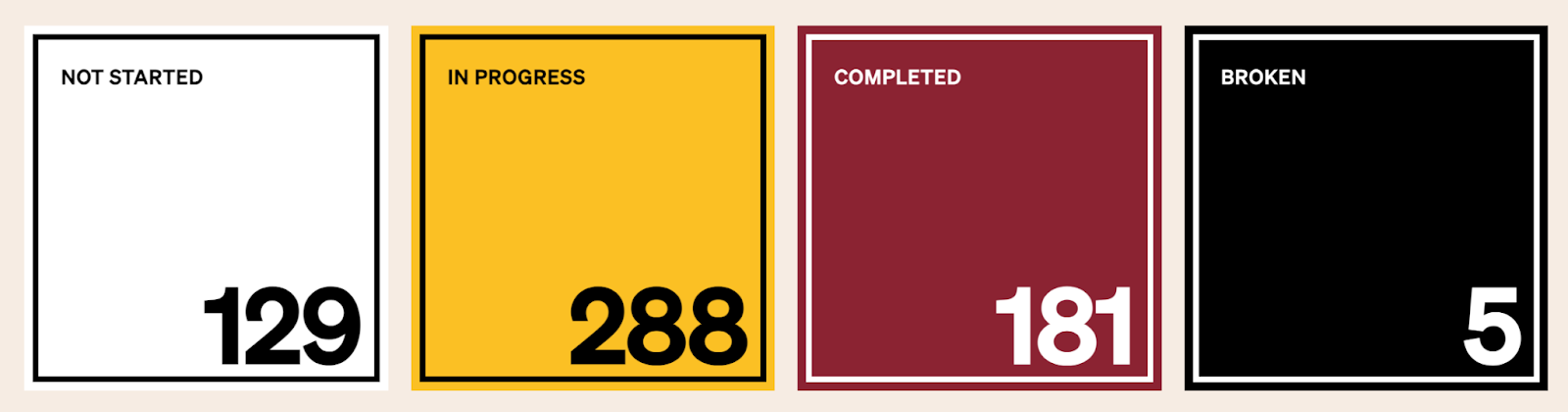
Across all commitments as of March 30, 2025: 288 are in progress, 129 have not started, 181 are completed, and 5 were abandoned. Much of the progress so far is either ground work or incremental.
The data we have collected points to a first year spent consulting, planning, and beginning to deploy funds, mainly through small initial tranches from multi-year spending envelopes.
Some items reflect completion of earlier or previous government promises, and Budget Bill C-15 was a massive piece of legislation that took much time and energy within the House of Commons. And several of the biggest-ticket items that affect Canadians’ daily lives — from housing and health infrastructure to export credit — are still waiting to transition from ideas to plans to delivery.
However their work is not without merit. A handful of files stand out: the Defence Investment Agency is up and running, with
nearly $1.4 billion in domestic ammunition contracts supporting new factories and jobs. The interprovincial trade legislation
removed barriers to goods, services, and workers having their licences and certificates recognized across provinces. And Canada this week
reached NATO’s 2% spending target, marking the first time since the end of the Cold War and coming
six years ahead of the previous government’s schedule.
Canada is no longer standing on the sidelines. But it now needs to pick up pace with the policy boldness, regulatory clarity, and permitting speed that a crisis calls for. The tracker’s findings show where momentum is overdue.
Finding 1: Modest progress across files
One of the most significant patterns in the data: 469 of 603 commitments (77.7%) currently register as "In Progress" or “Completed”. That’s encouraging. Much of the movement takes one of a few limited forms: preliminary consultations have been launched, initial fund deployments from multi-year spending envelopes have been made, or a line item now appears in a departmental plan.
These are necessary steps, and some of the investments are long-term by design. This includes
rebuilding the Canadian Armed Forces (CAF), standing up new
defence procurement systems, and deploying
$115 billion in infrastructure over five years. These are multi-generational bets that were never going to show results in year one. That’s a good thing: a government is thinking in five- to 15-year windows, rather than just the next election cycle.
While Bill C-15 passed last week, the work needed to carry them through to completion is still substantial, and the tangible outcomes that would change Canadians’ everyday lives remain out of reach. Bold, decisive steps are needed to match the scale and urgency of the crisis Canada is in.
Examples from the data:
- Provide $617.7 million over five years to support CBSA core operations and increase recruit stipends: The weekly payment was increased from $125 to $525 and a benefits expansion was announced. However, the full $617.7 million allocation hinges on the Budget Implementation Act, Bill C-15.
- Launch a Trade Diversification Strategy to open new export markets: Trade missions were carried out and diplomatic engagement stepped up. Over the same period, Canada’s exports diversified slightly away from the U.S.: non‑U.S. goods exports grew 17.2% while the U.S. share of Canadian goods exports fell to 71.7% in 2025. Still, no formal strategy document has been published, and some of the activity cited predates the current government’s term.
- In Defence and Security, 25 of 30 commitments are “In Progress”: Massive investments were made: $56.6 billion to rebuild and rearm the CAF, $19 billion to establish a sovereign space launch capability, and $20.4 billion for CAF recruitment, retention, and pay. But the actual disbursement of that funding and its real-world effects will take years to materialize.
Finding 2: Execution has not caught up to Rhetoric
Our methodology was strict: a commitment was not counted as started simply because it appeared in a budget document. The distinction matters because announcements and tabled bills do not change outcomes for Canadians until they become law.
It's worth acknowledging the effort to clarify intent. However, the data shows a persistent pattern: deliberation on critical policy categories dragged on, and several files were held up. Bills had either been tabled, were in committee, or were awaiting Royal Assent.
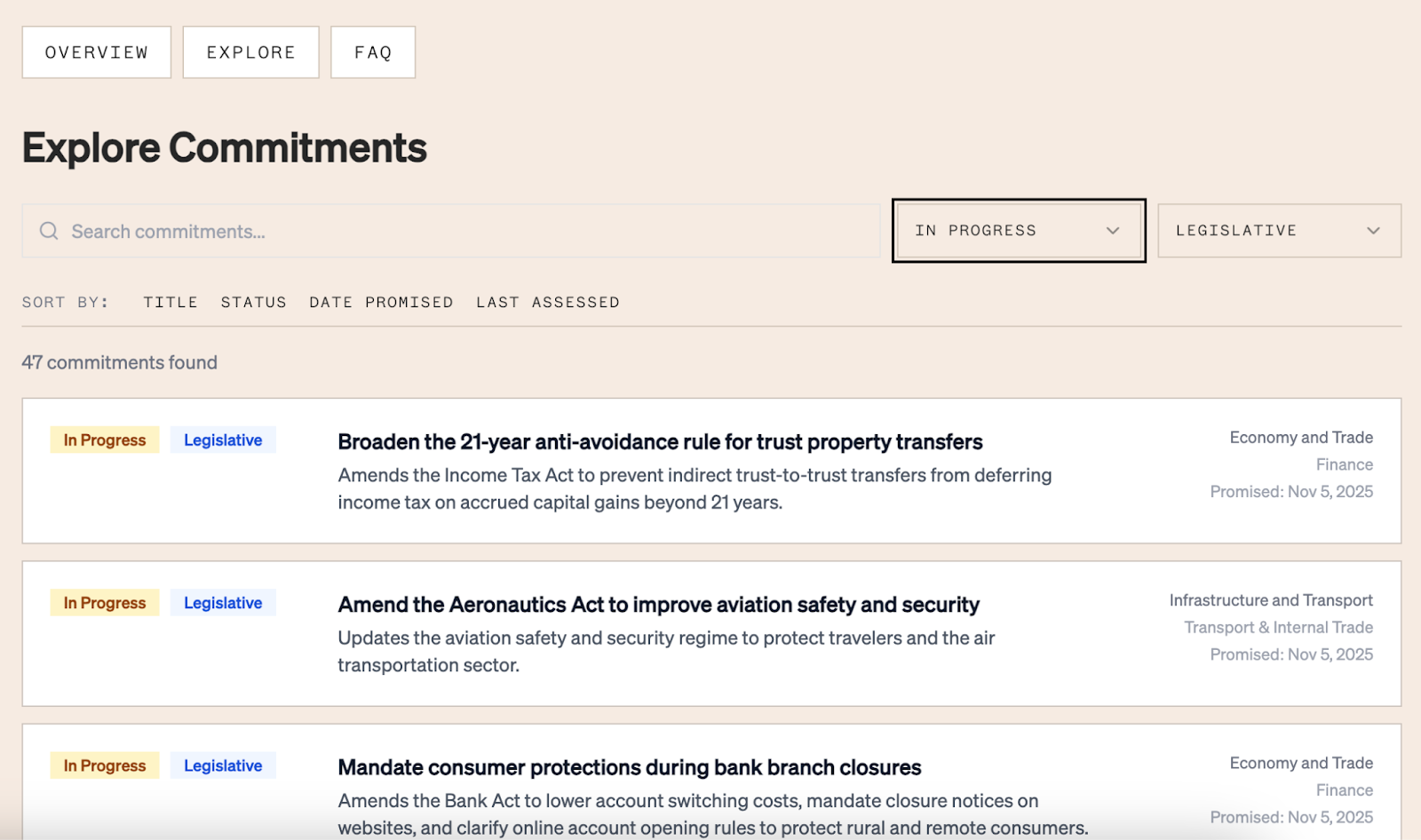
Leading up to Bill C-15 passing last week, a significant portion of the government's agenda was stalled by legislation. Of the 165 commitments that require a bill to pass, 130 were marked "In Progress." With the passage of Bill C-15, that number has since fallen to 47. Until those remaining bills pass, those files do not move and Canadians do not see or feel results.
That gap is especially visible in Healthcare and Justice. These areas were central to the public conversation heading into the last election. Canadians were promised action on
family doctors,
health infrastructure, justice corrections, and
firearms. Yet in both Healthcare and Justice, there have been six completions to date, and an estimated
5.9 million adults do not have a family doctor, nurse practitioner or primary care team.
A full year in, the government still is not implementing at the speed voters urgently called for.
Examples from the data:
Finding 3: The low hanging fruit has been picked, and the big-ticket items have yet to break through
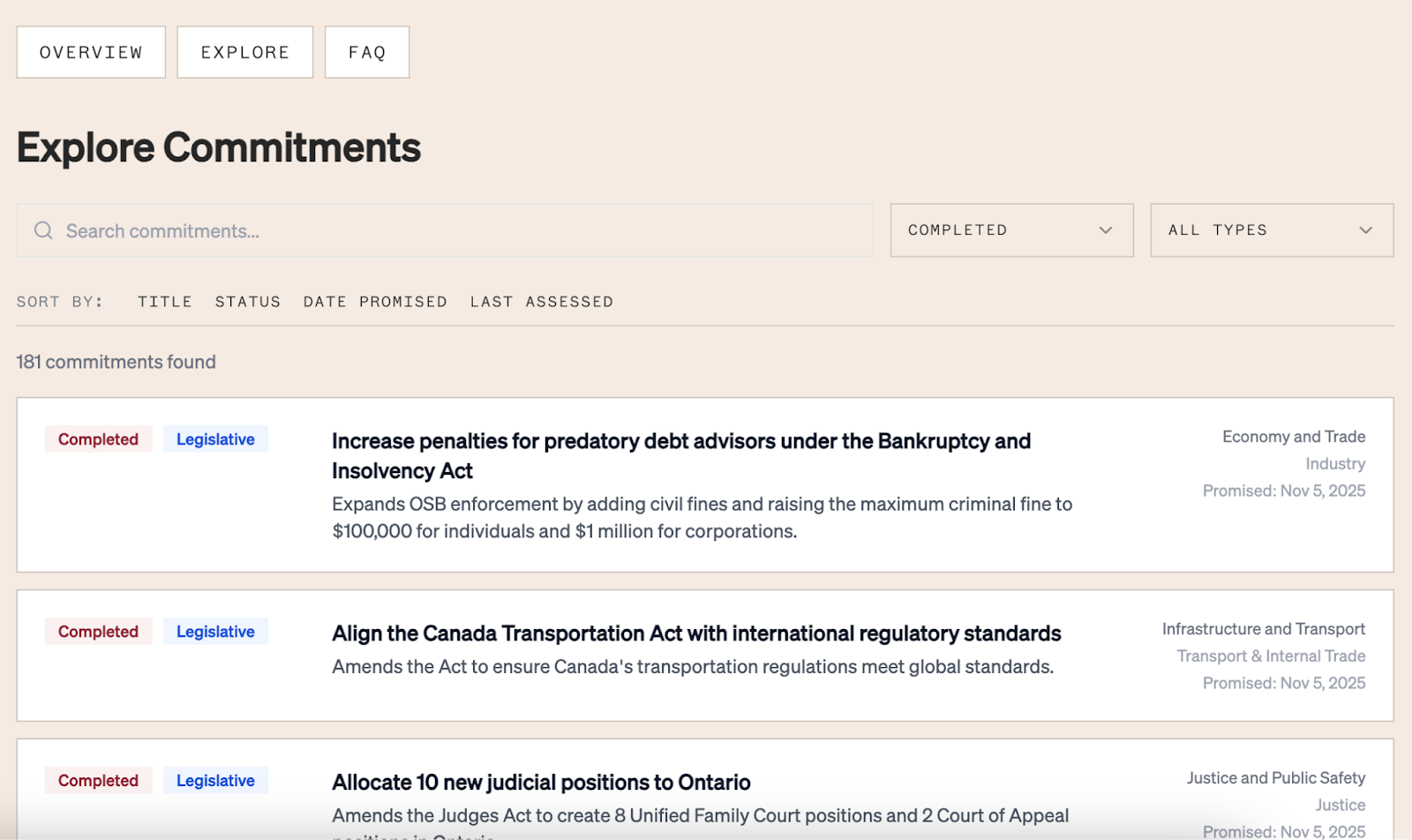
Our review of the 181 commitments marked as completed revealed another telling pattern: the government acted first on measures that required only a ministerial signature, a tax change, or action through existing programs.
That was the right place to start. But the commitments that would most directly reshape daily life in Canada are still largely unfinished — housing, healthcare, and the economy.
The files that require new institutions, new legislation, new programs, and sustained political will are still on the drawing board. That’s understandable in year one, but year two needs to look different. The groundwork has been laid on many of these files. Now the big-ticket items need to move.
Examples of what got completed:
- Tax cuts and financial relief: cancel the capital gains inclusion rate hike, cut the lowest income tax bracket by 1 percentage point, cut GST for first-time homebuyers, waive tariff-related interest and penalties.
- Emergency economic response: launch a $10 billion Large Enterprise Tariff Loan facility, defer $940 million in corporate income taxes, provide $700 million in forestry loan guarantees.
- Initial administrative actions: shift to fall budgeting, establish the Major Federal Project Office, continue the Apartment Construction Loan Program, require departments to report on red tape within 60 days.
- Program renewals: renew the Canada Strong Pass, reduce camping fees, improve Confederation Bridge affordability.
- Carbon pricing rollback: cease the federal fuel charge, remove provincial and territorial consumer-facing carbon pricing requirements
Examples of what hasn’t been completed:
- Housing: $13 billion Build Canada Homes program in progress, $1.5 billion Canada Rental Protection Fund in progress, expand the Housing Accelerator Fund not started. A Canada Mortgage and Housing Corporation report found that Canada needs 430,000–480,000 new units annually through 2035 to restore affordability.
- Healthcare: $5 billion Health Infrastructure Fund not started, create a new-practice fund for family doctors not started, establish an IVF program providing up to $20,000 per cycle not started.
- Economy: $25 billion export credit facility in progress, $1 billion Venture Capital Catalyst recapitalization in progress, $10 billion annual transition bond issuance not started, the Canada Patent Box to retain IP not started.
Conclusion
Taken together, the findings tell a clear story: real progress has been made, and it should be recognized. But much of what has happened so far has followed the path of least resistance: quick wins, low-risk spending, procedural check-boxes. Canadian democracy has a long record of moving on what is easiest and deferring what is hardest.
This government has the mandate, the agenda, and the stated ambition to break that pattern. And while the data shows it hasn’t yet, it also points to a breakthrough within reach. We imagine they will do so over the next year
Progress is real, but it's mostly groundwork: 77.7% of commitments are In Progress or Completed. But most of that movement looks like consultations launched, early funds deployed, and line items in departmental plans, not outcomes Canadians can see or feel.

www.buildcanada.com
Completing paperwork, making promises, completing previous government’s projects and doling out cash isn't shovels in the ground.