• Thanks for stopping by. Logging in to a registered account will remove all generic ads. Please reach out with any questions or concerns.

Railgun Alternative

tomahawk6

Army.ca Legend
Inactive
Reaction score
66
Points
530
As I thought the power intensive rail gun isnt practical,at least for warships.Instead the hyper velocity shells it would fire can be fired out of existing cannon which would open up an entirely new option for ground forces commanders.

http://www.defenseone.com/technology/2016/06/can-navys-electric-cannon-be-saved/128793/

The Navy’s futuristic electric cannon, or railgun, received yet more hype this week for its ability to fire a shell at up to 5,600 miles per hour, and do it far more cheaply than a missile. But there’s a daunting reality behind the hype: the Pentagon is already looking past the railgun to a less power-intensive, more easily deployable alternative.  The railgun rounds can be fired from more conventional cannons, giving the same capability sooner and cheaper.
 
tomahawk6 said:
As I thought the power intensive rail gun isnt practical,at least for warships.Instead the hyper velocity shells it would fire can be fired out of existing cannon which would open up an entirely new option for ground forces commanders.

http://www.defenseone.com/technology/2016/06/can-navys-electric-cannon-be-saved/128793/

The Navy’s futuristic electric cannon, or railgun, received yet more hype this week for its ability to fire a shell at up to 5,600 miles per hour, and do it far more cheaply than a missile. But there’s a daunting reality behind the hype: the Pentagon is already looking past the railgun to a less power-intensive, more easily deployable alternative.  The railgun rounds can be fired from more conventional cannons, giving the same capability sooner and cheaper.

Basically, we are now talking about what we already have in our tank ammunition: SABOT rounds.
 
Given how long sabots rounds have been around in the army, I feel like this has got to be something that someone at sometime considered for employment aboard warships and just though, no...

Sabot rounds are mainly anti-tank rounds, no? Can they be used as an artillery round to destroy hard/soft targets from a high angle? Or would they loose too much of their kinetic energy with an arcing trajectory?

Sabot rounds wouldn't be useful for AA. We have a hard enough time hitting planes/missiles with fragmentary rounds that create 7m round clouds of death; do you think you're going to hit a missile with a dart?

Sabot rounds wouldn't be very useful for ASuW. Ship's aren't armoured, so you don't need the penetrating power. What you want is something guided that will explode inside the ship causing as much damage as possible, and hopefully starting a fire.
 
The new twist for me is the use of hypervelocity rounds fired from conventional tube artillery.The round can acheive Mach3 so the kinetic effect on the target would be devastating and if the rounds can be guided to the target you wouldnt need rocket artillery.
 
George Wallace said:
Basically, we are now talking about what we already have in our tank ammunition: SABOT rounds.

Not exactly George.

While they are both called sabot, they are different and serve a different purpose:

Unless I am mistaken, my understanding of tank sabot rounds is that the sabot encases the warhead of the shot so that it fits in the actual gun and provide the original aerodynamic shape for stable firing. Then in flight, the sabot falls off and the shot goes on.

In a rail gun, the metal sabot's purpose is not to encase the war shot or give it temporary aerodynamic qualities. It is there to provide a metallic casing with the proper electro-magnetic properties to be propelled by he magnetic field generated by the gun. In effect it is there to "push" the war shot along: It is the system's propellant - so to speak.
 
tomahawk6 said:
The new twist for me is the use of hypervelocity rounds fired from conventional tube artillery.The round can acheive Mach3 so the kinetic effect on the target would be devastating and if the rounds can be guided to the target you wouldnt need rocket artillery.

I'm thinking of it from a Naval Gunfire perspective, where ship's would have to "lob" the round on arcing trajectory at the target. My physics really isn't up to snuff, but at what speed and with what kinetic energy would a sabot round have if fired at Mach 3 at a target 60nm inland? My understanding was that sabots was for line-of-sight use.
 
I really can't see a hypervelocity artillery round being much use.  I would think that the arc would be so small as to make it more a direct fire application as opposed to indirect fire.  I'll leave that debate to the Arty Gods.

I can see it employed in anti-aircraft/anti-missile if it is employed in a high rate of fire gun system.  That would stretch out its range quite a bit, and provide improved protection.
 
No need for advanced physics, Lumber: The kinetic energy, which is totally unrelated to distance, is equal to mass times terminal velocity.

But again, don't confuse the two types of sabot here. The Army "line-of-sight" sabot shots are just casing (made of wood, I think) around the round shaped charge - like a depleted uranium ball - that you are firing and is meant to make it fit the barrel and have some aerodynamically stable shape at firing.

In rail guns, the actual charge is already aerodynamically shaped for hyper-velocity throughout the flight. The "sabot" is akin to the old steel wire strop we used for catapult shot of airplanes off aircraft carriers: It connected the plane to the catapult and just fell off in the water as soon as the plane passed the fore deck edge. Same here: The sabot propels the charge along in the "gun barrel" and then just falls off as soon as it comes off at the end of the rails.
 
Oldgateboatdriver said:
While they are both called sabot, they are different and serve a different purpose:

Actually, they are exactly the same.  As you describe below, the SABOT is what drives the round up the barrel.  In typical tank ammo, the explosion of the propellant is forcing the SABOT encased round up the barrel, and discarding from the round once free of the barrel.  In the Railgun, the SABOT is as you describe, the agent encasing the round, as a magnetic conduit, to drive it up the barrel and discarding on exit of the barrel.  No difference other than one is using an explosive force to drive the round up the barrel and the other an electro-magnetic force.


Oldgateboatdriver said:
Unless I am mistaken, my understanding of tank sabot rounds is that the sabot encases the warhead of the shot so that it fits in the actual gun and provide the original aerodynamic shape for stable firing. Then in flight, the sabot falls off and the shot goes on.

In a rail gun, the metal sabot's purpose is not to encase the war shot or give it temporary aerodynamic qualities. It is there to provide a metallic casing with the proper electro-magnetic properties to be propelled by he magnetic field generated by the gun. In effect it is there to "push" the war shot along: It is the system's propellant - so to speak.

I believe in both cases, the "shot" is fin stabilized. 
 
This is an outdated site, but it gives you an idea what 120 mm Tank ammo looks like and its characteristics.  The Tank SABOT round is a "long rod penetrator" of a dense metal (Carbon Tungsten, Depleted Uranium, etc.) with a metal SABOT encasing it:

http://www.oocities.org/timessquare/tower/8926/m1tank/weapons/weapons.html
 
I stand by my position however: The purpose of the sabots in tank ammunition is NOT to propel the actual dart or whatever, it's to make it fit the barrel of the gun that fires it. If it was of the proper caliber to start with, it wouldn't need sabots. They would just fit it at the end of the casing like any other regular ammunition of the right caliber. The sabots are not required to "propel" the bullet: A regular charge and propellant does that.

In rail gun, the actual projectile is already of the proper caliber - or can easily be made of any regular caliber, and does not rely on the "sabot" to fit in anything. The sabot IS the propellant. Without it the rail gun cannot propel the projectile.

And here is how it now makes a difference, based on the article: The projectile of the rail gun (that is without sabot - which is not part of the projectile) has been found to be able to just fit - like any ordinary ammunition - at the regular end of a 5 inch gun's casing. Now, that projectile - without sabot - can be fired like any other round from the 5 inch guns of the fleet. You could not do that with a tank "sabot" round as the projectile (dart) is of much smaller caliber than the gun and would bounce all over the place inside the barrel.

 
The problem is that for the distances you want, it's no longer LOS, but some sort of arc is needed to get from your ship to target. I am assuming that the velocity is variable and that may be the way to create the arc needed, but that limits kinetic effect. Talking elsewhere, at lower velocities you could likely use regular shells encased in the "sabot" in the railgun, that would reduce wear, heat and speed up reloads.
 
I recall the USN using sabot rounds to significantly increase the range on their 16" guns on the NJ class battleships.

http://www.navweaps.com/Weapons/WNUS_16-50_mk7.php

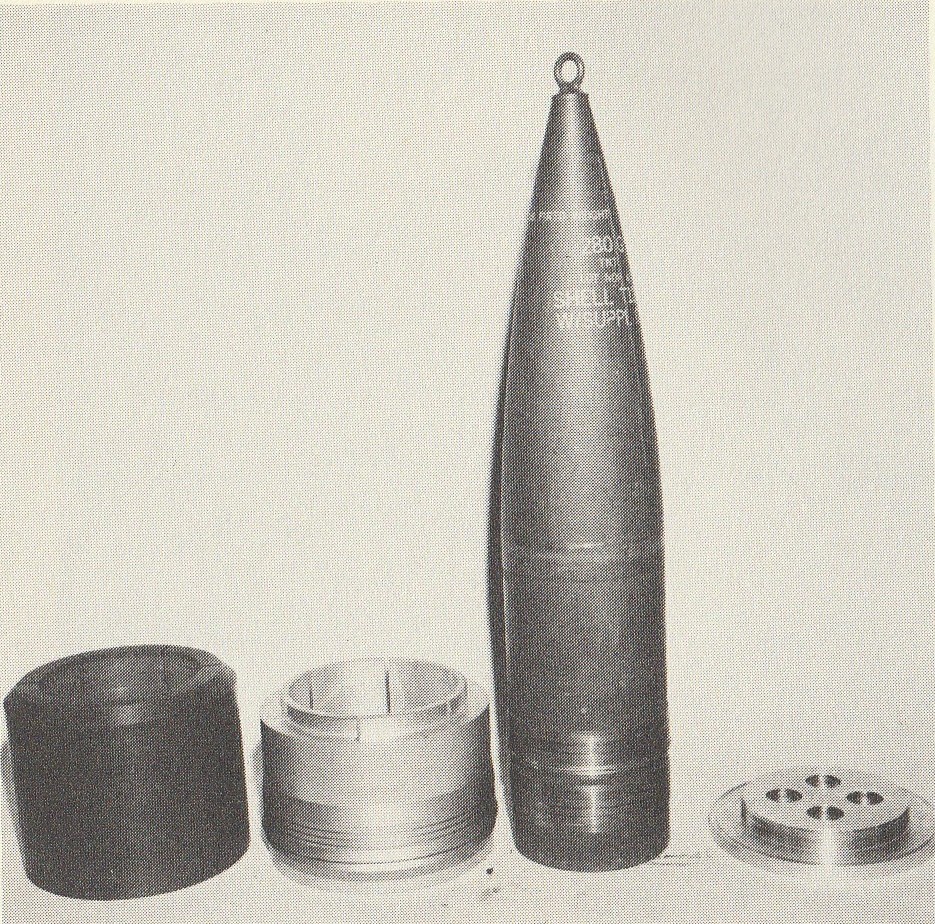
"4.In the spring or summer of 1967 when USS New Jersey (BB-62) was being activated for Vietnam, Indian Head Naval Ordnance Station proposed taking 23,000 non-nuclear 280 mm (11") shells left over from the Army's "atomic cannon" program and converting them via a sabot and obturator to be used in 16" (40.6 cm) guns.  This was apparently a part of or in conjunction with the "Gunfighter" program for developing Long Range Bombardment Ammunition (LRBA) projectiles.  Test shots were fired in 1968 and 1969 at Yuma and at Barbados, with the latter location using two 16"/45 (40.6) cm guns welded end-to-end and achieving ranges out to 83,850 yards (76,670 m) with a 745 lbs. (338 kg) shell fired at a muzzle velocity of 4,550 fps (1,387 mps).  The program was apparently halted when New Jersey was decommissioned in 1969.  An image of the disassembled saboted round is on the additional pictures page."

HE-ER Mark 148 (Planned)
13 in (33 cm) extended-range (ER), sub-caliber projectile with sabot.  ET-fuzed with a payload of submunitions.  Experiments with this projectile were conducted during the 1980s, but development was cancelled in FY91 when the battleships were decommissioned.  Projectile weight without the sabot was about 1,100 lbs. (500 kg) and range was to be in excess of 70,000 yards (64,000 m) at a muzzle velocity of 3,600 fps (1,097 mps).

HE-ER Mark ? (Planned)
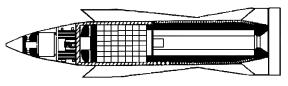
Advanced Gun Weapon Systems Technology Program 16/11-Inch Long Range GPS Concept with Sabot.
Another sub-caliber projectile with sabot, this one 11 inches (28 cm) in diameter.  This project was also cancelled about FY91.
A sketch of this projectile may be seen below in the Additional Pictures section.
Data below courtesy of United States Naval Fire Support Association (USNFSA):
    Range: 100 nm
    Launch Weight: 650 lbs. (295 kg)
    Fly Away Weight: 525 lbs. (238 kg)
    Launch Length: 69 in (175 cm)
    Payload: 248 M46 Submunitions, total weight of 175.2 lbs. (79.5 kg)
    Guidance Modes: GPS and INS

Disassembled "Gunfighter" saboted projectile of the late 1960s. From left to right:  Front Rider, supporting sabot, 280 mm (11") projectile and obturator.

WNUS_16-50_mk7_LRBA_pic.jpg


Advanced Gun Weapon Systems Technology Program 16/11-Inch Long Range GPS Concept with Sabot. This projectile did not enter service.

WNUS_16-50_mk7_Sabot_pic.jpg


I think the query is not about the range, nor the pusher that's necessary for a sabot round, but the terminal effectiveness of a round that is not going at the same speeds as are attained in the rail gun.

Note that both the planned sabot'd rounds from the 16" guns had an explosive component to them. 

As far as I've noted, the rounds for the rail gun has no such explosive component, and relies on the kinetic energy alone. 

If fired from a non-rail-gun platform, the initial energy is much less, therefore the terminal kinetic energy will be much less....unless there's an HE payload, I see that as a problem.

Or am I missing something?

NS
 
No I don't think you are. Hence why I think being able to use conventional rounds in a rail gun is the way to go. Tests would have to be done can the round and fuses deal with the heat/stresses of a higher velocity? Will the electro-magnetic pulses muck up the fuses?

Long range kinetic rounds are going to require guidance to hit a mobile target like a ship, can they build one that works? Shooting at static targets like bunkers and buildings would work with a long range kinetic dumb round with really good targeting information.
 
Question for those who may know, wouldn't the rail gun system itself create a tell-tale EM signature which would give away its position, similar to a muzzle flash, or the flare of a rocket engine igniting?
 
If you're firing the gun at something, you've probably got it locked up with a FC radar, so there will be a considerable EM signature anyhow.

That said, the EMI shielding of the Railgun is a question I'm concerned about.  How hardened will systems have to be that are in close proximity to it?  Obviously cameras are OK nearby.

NS
 
Back
Top