Articles found 31 August 2006
Home, with healing parts and heavier hearts
CHRISTIE BLATCHFORD
http://www.theglobeandmail.com//servlet/story/LAC.20060831.BLATCHFORD31/TPStory/Front
EDMONTON -- Yesterday came the moment that the magnificent Ian Hope was most dreading, when he would be face to face with his wounded men, in their wheelchairs and on their crutches and with their healing broken parts and hearts, and see the holes in the ranks where once, some of the 19 Canadian soldiers who have been killed in Afghanistan this year would have stood, but are now gone forever.
The moment arrived at the Edmonton Garrison at a welcome home and medals parade for the just-returned soldiers of the 1st Battalion Princess Patricia's Canadian Light Infantry, the regiment whose soldiers were the core of the battle group there and bore the brunt of the casualties until they were replaced during August by the Royal Canadian Regiment.
For so long as young warriors have gone into battle, the commanders who send them there have wrestled with the beast that is at its healthiest responsibility and at its most gnawing guilt.
A student of military history, Lieutenant-Colonel Hope knew well what was coming.
It was not long ago that his Regimental Sergeant Major, Randy Northrup, received an e-mail from one of those badly injured in March, Master Corporal Mike Loewen, Lt.-Col. Hope's first crew commander.
MCpl. Loewen wrote that for all that he had been practising with his shattered elbow, he feared the only kind of salute he would be able to muster might land him in jail because it was pretty much indistinguishable from an awkward flip of the finger.
"Tell him," Lt.-Col. Hope said to the RSM, "I don't care what he musters, I'll be honoured to take his salute."
And thus did the CO and the men, each wanting to make things easier for the other, manage with grace and humour the day that marks the end of their exhausting and life-changing time in that
faraway land and which, after a
period of leave, soon will see many of them move on to new jobs or new postings across Canada.
As Lt.-Col. Hope, who now has handed over the regiment to incoming CO Lt.-Col. Dave Anderson, remembered yesterday in his farewell speech, that seminal tour -- seven months and 1,500,000 kilometres long at a cost of 19 dead and 75 wounded -- by its end saw the young troops put in three months of the most ferocious and sustained combat Canadians have seen since the Korean War.
These soldiers won 100 gun battles; they were beset by improvised explosive devices and suicide bombers at every turn; they literally rode to the rescue of British paratroopers and stranded U.S. Army forces; they made it sufficiently safe that Dutch troops could make their way to Uruzghan Province without taking a hit.
On this, the last time they will ever be together in their desert camouflage, not intact but as close to that as is possible now, the occasion was solemn and joyful, sweet and bitter, the way life at its furthest edges is always.
The regiment's gorgeous Colonel-in-Chief, 82-year-old Lady Patricia herself, flew from England to present some medals, meet the injured and tell them all how proud she is of them. The 1PPCLI colours, which Lt.-Col. Hope took to Kandahar against pointed suggestions he leave them at home, were proudly marched in. The wounded struggled to rise from their wheelchairs. Babies squawked, young wives and family members took pictures.
On the faces of the soldiers, skinny from weeks at a stretch of baking sun and hard rations and the great appetite-suppressants that are adrenalin and fear, was a look civilians might recognize.
Most of us have seen a version of it during that curious lull on Christmas morning, when the presents under the tree all have been opened and youngsters realize the grand adventure is suddenly over, and the sensitive ones struggle to hide from their parents the disappointment, if there is any, and the relief, if there is any, and the funny loneliness which is so often present.
So the boys got their medals, the South-West Asia Service Medal, which is a beauty, and gave various salutes (royal, regimental, general), and listened to the speeches. I expect that aside from Lady Patricia's remarks, which meant a great deal to these men and women who are such saps for tradition, two other speeches mattered most.
The informal one came when the ceremonies were over, when Chief of the Defence Staff Rick Hillier gathered them around in the middle of the parade square, and spoke to them privately, away from reporters' ears. His remarks always count because he is a Newfoundlander with the unique gift for plain talk that stamps that group of Canadians, and because it is under his leadership that the Canadian Forces have entered a new era.
The formal one was the address from Lt.-Col. Hope.
He matters because he led from the front, if not the front lines only because there are none of these in an insurgency. He matters because even when he probably should not have been in the thick of it, in the thick of it he was. And though he is not a Newfoundlander, he talks so bluntly he might as well be.
He thanked them for what they accomplished, for the "three months of hard pounding, hard fighting" that was their lot in the second half of the tour. He exhorted them not to fall victims, either to the political winds that swirl about the Afghanistan mission or to their memories, but to make the choice to become better citizens because of what they saw and learned. He spoke of seeing their wounded, and some of the families of the dead (including Corporal Tony Boneca's dad, who was enveloped by the members of his dead son's platoon and taken into all that warmth), then said, "The cost has been great, and you need to know why it happened," and urged anyone with questions to e-mail him.
He told them to stay in touch with one another, asked them to talk everywhere they go in order to "educate every single person we can of the importance to Canada of this fight."
He went to bed the night before, he said, with no words written, and woke up at 2:16 yesterday morning, to the alarm "that is not an alarm that anyone else can hear or see," but that always wakes him now.
From a Dolby-sound, Technicolor dream, he wakes, and woke yesterday, to the steady beat of the 25 mm cannon of the light armoured vehicle, the justly famous LAV.
"Boom-boom-boom," Lt.-Col. Hope said. "Boom-boom-boom." He said it in the way that anyone whose ears have ever welcomed the rolling thunder of the cannon would know in an instant.
He wakes, and woke yesterday, to the "zip-zip-zip of the .762 guns," to the tremendous boom of rocket-propelled grenades, to vivid colours and to, "thank God, the soft dark green of the LAV."
"I know you have it too," he told his soldiers. "The dream was better last night. It woke me up to find some words . . . dreams fade. The sounds will fade."
With his wife Karen and two youngsters, Ian Hope moves on to serve as a Canadian liaison officer to U.S. Central Command headquarters in Tampa, Fla., where perhaps the ocean, the muffled roar of moving tides, will fill his head.
[email protected]
End
Toys for Afghan children
Aug, 30 2006 - 6:50 AM
http://www.630ched.com/news/news_local.cfm?cat=7428545912&rem=46416&red=80154523aPBIny&wids=410&gi=1&gm=news_local.cfm
EDMONTON/630 CHED - Employees of an Edmonton company want to build wooden toys to ship to Afghanistan in memory of Canadian soldiers killed over there.
The idea was hatched earlier this month after the death of Master Corporal Raymond Arndt, a reservist with the Loyal Edmonton Regiment. Artistic Stairs service manager Trevor Klein saw Shop Foreman Chuck Howe making a wooden cross for Arndt.
Klein already had permission to make wooden toys out of shop leftovers and now he has bigger plans.
With full support of Artristic Stairs management and the blessing of Ray Arndt's family, Klein and Howe hope to make wooden toys and dolls for children in Afghanistan to preserve the memories of our fallen troops. Each toy will be branded with a Canadian flag and a heart. The military will ship them and you can help by making a donation to buy additional supplies or by making clothing for the wooden dolls.
You can contact Artistic Stairs at 489-5591 or stop by at 17320 - 108th Avenue.
End
Defence minister promises to boost Afghan forces
Updated Thu. Aug. 31 2006 8:39 AM ET CTV.ca News Staff
http://www.ctv.ca/servlet/ArticleNews/story/CTVNews/20060813/afghan_oconnor_060831/20060831?hub=TopStories
Defence Minister Gordon O'Connor said Thursday that Canada needs to do more to help rebuild Afghanistan's army and police, and the federal government is prepared to put more military equipment into their hands.
"This contribution will help the Afghan government take control of their own security," said O'Connor, on the last day of his two-day visit with Canadian forces in Kandahar.
He also said Ottawa intends to increase its contribution to the provincial reconstruction team in Kandahar in an effort to win over hearts and minds in the war-ravaged region.
"Canada can do more," said the defence minister.
"I've asked (the army) to develop a plan to increase Canada's contribution to the provincial reconstruction team."
O'Connor said the army will draft recommendations for both plans, and he didn't specify Thursday whether the boost would be in the form of troops, money, or both.
He also didn't elaborate on exactly what kind of military equipment would be given to Afghan forces.
O'Connor's visit comes amid a security situation in southern Afghanistan that has rapidly deteriorated. Eight Canadian soldiers have died in August alone. Twenty-eight Canadian soldiers have died since 2002.
More on link
Afghanistan mission must be questioned
The News-Record Wednesday August 30, 2006
http://www.clintonnewsrecord.com/story.php?id=251565
Clinton News-Record — As a general rule of thumb, it's never a good idea for a student to question a music teacher when it comes to reading music.
Yet, and sadly too often, the same tact is often taken by duly elected politicians when it is time to face questions they'd rather not answer.
Take, for instance, Prime Minister Stephen Harper's ongoing refusal to open up the issue of Canada's role in Afghanistan to proper debate in the House of Commons.
Instead, Harper seems to be employing the tactics honed by leaders before him by either accusing or insinuating those who question the effort of having less than noble intentions.
Fortunately, Harper has not gone so far as U.S. President George Bush Jr. Specifically, he is not repeatedly questioning the character of those who question the Afghanistan mission. Perhaps more tellingly though, he is not addressing the issue either.
Recent media reports reveal the Prime Minister's Office has received thousands of letters from ordinary Canadians, pleading for an end to Canada's involvement in Afghanistan. Given the fact most of those are Canadians acting on their own, and are not being organized by any one lobbying group, it is easy to discern the public is less than keen on the seemingly never-ending Afghanistan mission.
It's true Canada did the right thing when it stepped up following the terrorist-driven attacks on the eastern U.S. seaboard on Sept. 11, 2001. But, times have changed. It is interesting to note, for example, that the U.S. has called off its search for Osama Bin Laden.
As Canadian servicemen and women continue to fight, with what is often called inadequate equipment, and some of them are killed in the line of duty, it is important and necessary for the country's leaders to justify why Canadians are there in the first place.
Anything less pays a disservice to the men and women in uniform who were ostensibly sent there on a peacebuilding mission but are finding themselves in ever increasingly hostile environment.
In the interim, Canada is continuing in a capacity that has drastically changed since it first landed on Afghanistan’s soil five years ago.
Simply put, Canada, with approximately 30 million people in a vast country that is the world’s second largest, does not have the resources -- or the will -- to engage in an never-ending war with terrorists.
As history has shown, Afghanistan is not inclined to become a democracy, and democracy, as a rule, cannot be forced upon a country.
End
Scientist studies soldiers 'outside the wire'
Updated Sun. Aug. 27 2006 CTV.ca News Staff
http://www.ctv.ca/servlet/ArticleNews/story/CTVNews/20060826/military_anthropologist_060827/20060827?hub=QPeriod
It's important for Canadians to know what our soldiers are going through in Afghanistan, says a University of Calgary anthropologist who just finished spending three months with Canadians in a combat platoon.
News reports, although they present accounts of specific battles or dramatic events, can't depict what life is like for a soldier in a war theatre, Dr. Anne Irwin told CTV's Question Period in Montreal on Saturday.
More on link
Afghanistan's "Devil's Garden" Blooms Again
Unexploded land mines, munitions cleared from former battlefield
30 August 2006 By Lea Terhune Washington File Staff Writer
http://usinfo.state.gov/xarchives/display.html?p=washfile-english&y=2006&m=August&x=20060830164954mlenuhret0.8767359
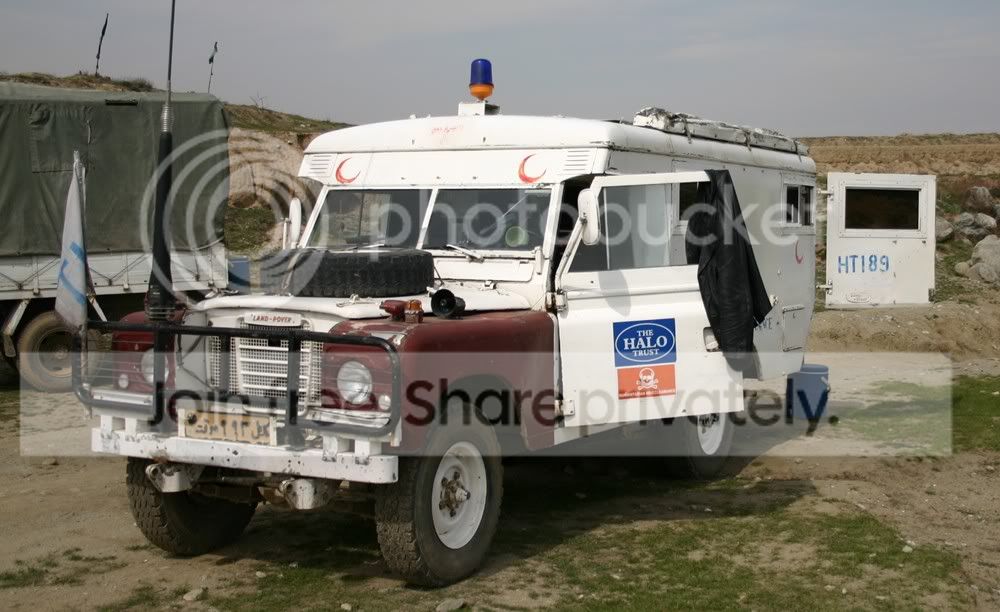
Washington – It was called “The Devil’s Garden.” Planted with land mines, booby traps and unexploded ordnance, leftovers from fierce battles that raged there for more than two decades, the fertile lands around Bagram, Afghanistan, were considered the most dangerous minefields in the world. A walk through it could cost a life or limb.
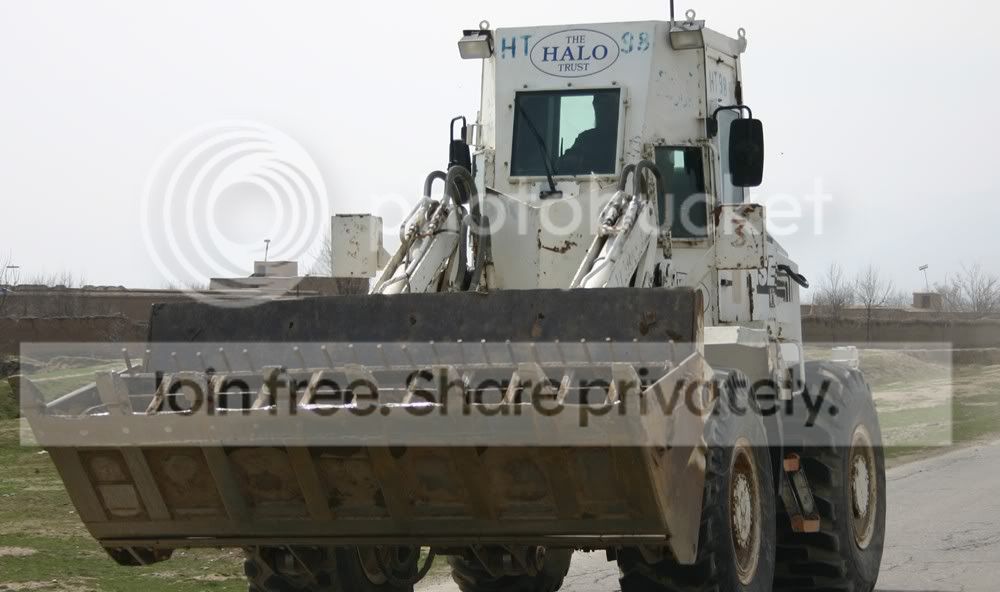
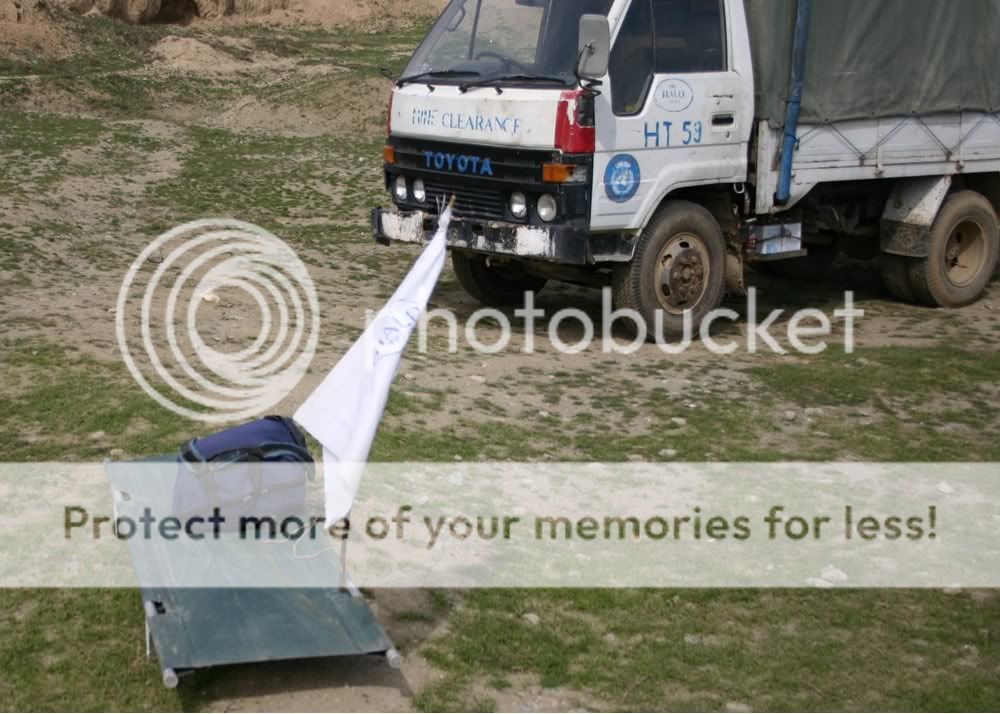
Now, after five years of painstaking work by HALO Trust, thousands of the deadly weapons have been cleared from a significant stretch of land, once a section of the front line between Northern Alliance and Taliban forces.
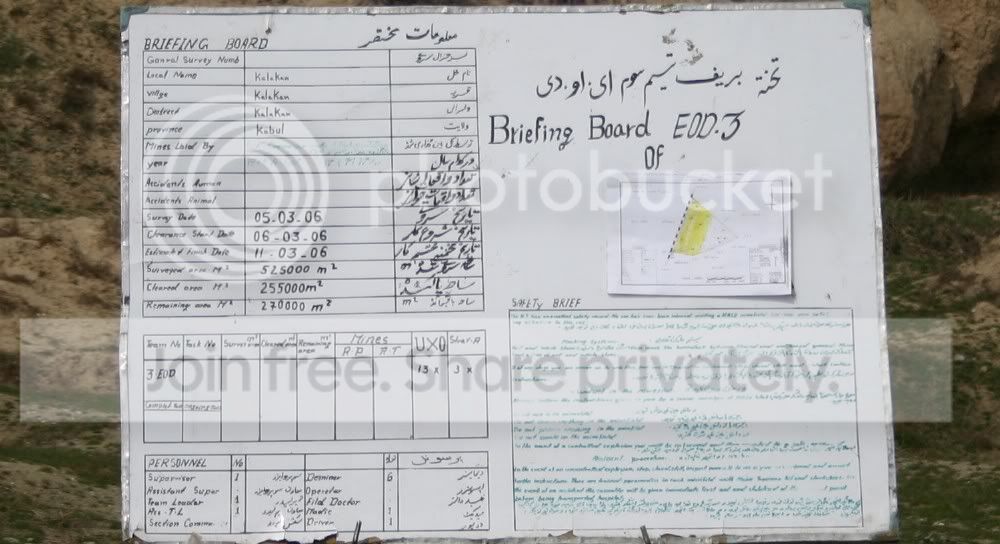
According to Cameron Inber, Central Asia desk officer for HALO Trust, 4.9 million square meters of Bagram Junction have been made safe. He told the Washington File that 9,140 mines and 12,180 pieces of unexploded ordnance and other explosive remnants of war have been removed from the land.
That makes at least part of the Shomali Valley, famous for its vineyards, safe to farm. But there is more work to do. While the Bagram clearance is an important success, “This isn’t the end of mine clearances,” Inber said. “We are still talking about another decade at current levels of funding.”
More on link
U.S. officials grapple with worsening narcotics trade in Afghanistan
By Philip Dine Wed, Aug. 30, 2006 St. Louis Post-Dispatch
http://www.mercurynews.com/mld/mercurynews/news/politics/15400252.htm
WASHINGTON - The illicit Afghan narcotics trade is taking a sharp turn for the worse despite major efforts by U.S. and Afghan forces over the past year, continuing to fuel an insurgency that is increasingly killing American soldiers and destabilizing the country.
In light of dramatic figures expected to be announced in Saturday by the United Nations, U.S. officials plan a shift in policy including getting tougher with regional Afghan officials who fail to meet new goals for destroying poppy fields in their areas, the St. Louis Post-Dispatch has learned.
The United States could urge that local Afghan officials who don't act aggressively enough be fired, while those who reduce poppy cultivation would get money for economic development. The U.S. action is spurred by concerns that a record of 375,000-400,000 acres might be under cultivation, up from 267,000 acres last year.
And a push is likely in Congress next week for aerial spraying of poppy fields - a highly sensitive matter bitterly opposed by Afghan President Hamid Karzai because it recalls the specter of the Soviet occupation and could spark social unrest among impoverished farmers.
Opium extracted from Afghan poppies is turned into the bulk of the world's heroin supply, with profits helping fund the Taliban resurgence, four years after its U.S.-led overthrow. The tyrannical regime provided a haven for Osama bin Laden to train al-Qaida terrorists and plan the Sept. 11 attacks.
More on link
Terror suspect 'was trapped in Afghanistan after 9/11 attacks'
AP Australia Published: 08/31/2006 12:00 AM (UAE)
http://www.gulfnews.com/world/Australia/10063882.html
Canberra: The first suspect to have his movements restricted under tough new Australian counterterrorism laws said he had trained with the Taliban out of curiosity, but had been trapped in Afghanistan after the September 11, 2001 attacks on the United States.
In an exclusive interview broadcast yesterday, Joseph Thomas, nicknamed "Jihad Jack" by Australian media, told Seven Network TV that curiosity led him to Afghanistan, where he had seven months of weapons training before the attacks.
"It was a Taliban training camp. That was where the Taliban took soldiers to fight the Northern Alliance," said Thomas, 33.
By the time of the attacks he'd "had enough," he said.
"I was trapped and basically stranded," he said.
A Victoria state court in February convicted Thomas of accepting $3,500 and a plane ticket to Australia from an Al Qaida agent in Pakistan, and of having a false passport. He was sentenced to five years in prison.
More on link
Musharraf to visit Afghanistan next week for talks
Islamabad, Aug 31:
http://www.zeenews.com/znnew/articles.asp?aid=319216&sid=SAS
Pakistani President Pervez Musharraf will travel to Afghanistan next week for talks with his counterpart, Hamid Karzai, an official said.
Pakistan Foreign Ministry spokeswoman Tasnim Aslam confirmed Musharraf's trip to Kabul, but refused to go into further details.
Pakistan and Afghanistan are allies of the United states in its war on terror, but Kabul often accuses neighboring Pakistan of not doing enough to prevent the Taliban and other militants from sneaking into Afghanistan.
Pakistan, which used to support the Taliban but switched sides after the Sept 11, 2001, attacks in America, has deployed about 80,000 troops in its tribal regions near the Afghan border and says it is doing everything possible to curb militancy.
Bureau Report
More on link
Taliban Militants Attack Southern Afghanistan Town
Thursday, August 31, 2006
http://www.foxnews.com/story/0,2933,211429,00.html
KABUL, Afghanistan — Taliban militants attacked a southern town Thursday, sparking intense fighting with Afghan troops that left two insurgents dead, the defense ministry said.
A NATO airstrike pushed back the militants, who used mortars, rocket-propelled grenades and heavy machine guns in the morning attack on Naw Zad, in volatile Helmand province, said Defense Ministry spokesman Gen. Zahir Azimi.
He said that the fighting between the Taliban and Afghan army troops was "intense."
CountryWatch: Afghanistan
In Zabul province, a suicide attacker plowed his explosives-filled car into a police convoy traveling on the main road, wounding three officers, said Jailan Khan, provincial police chief.
A purported Taliban regional Zabul commander, Mullah Nazir, claimed responsibility for the blast and said the bomber was an Afghan man from Khost province. His claim could not be independently verified.
More on link
Bombs kill civilian, 2 police in Afghanistan
Associated Press
http://www.wilmingtonstar.com/apps/pbcs.dll/article?AID=/20060830/NEWS/608300467/-1/State
Kandahar, Afghanistan | A suicide bomber in a car struck a NATO-Afghan military convoy Tuesday, killing one civilian and wounding two others, a day after a bomb at a market left 21 civilians dead and 43 wounded, officials said.
The dead civilian was driving near the convoy.
Another bomb, detonated by remote control, killed two police on patrol in Helmand province, an official said.
More on link
Suicide attack wounds three policemen in Afghanistan
AFP August 31, 2006
http://www.metimes.com/articles/normal.php?StoryID=20060831-090251-6592r
KANDAHAR, Afghanistan -- A suicide blast in Afghanistan wounded three policemen Thursday while NATO forces reported that they had bombed rebel strongholds after a base was attacked.
Police blamed the suicide attack in the southern province of Zabul on Taliban fighters, who have been waging an increasingly sophisticated insurgency since being driven from government in late 2001.
The attacker rammed his vehicle into a police convoy on the highway linking the capital Kabul and the main southern city of Kandahar, provincial police said.
"The initial reports we have is three police were wounded after a suicide attacker hit his explosives-laden car into an Afghan police convoy," deputy provincial police chief Ghulam Jailani Khan said.
More on link
'Try not to kill people. You will feel better'
Kandahar doctor dispenses medicine along with a dose of the surreal, GRAEME SMITH reports
GRAEME SMITH From Wednesday's Globe and Mail
http://www.theglobeandmail.com/servlet/story/RTGAM.20060830.wafghanclinic30/BNStory/Afghanistan/home
KANDAHAR, AFGHANISTAN — Abdul Rahim Halimyar, 48, runs the only psychology clinic in Kandahar. He sits in a barren room with concrete walls and listens to the noises wafting up from the ancient bazaar at the heart of the city.
He hears terrible stories from the people who climb the narrow staircase to his office. The market is quieter these days, as people flee the fighting in southern Afghanistan, and nearly every visitor to Dr. Halimyar's clinic is suffering the effects of the renewed war.
"Day by day, it gets worse," he says.
Many of his visitors say they don't understand why they feel anxious or depressed. But the reasons emerge as they describe how their lives have been destroyed by this year's rising insurgency: dead relatives, smashed homes, harrowing escapes. Some patients would be unstable at the best of times, he says, but in a city rife with threats, conspiracies and rumours of violence, it's hard to distinguish sensible caution from paranoia.
More on link
What happens to the wounded when they come home?
On the long road to recovery
KATHERINE HARDING From Saturday's Globe and Mail
http://www.theglobeandmail.com/servlet/story/RTGAM.20060826.wxsoldiers26/BNStory/Afghanistan/home
EDMONTON — While the country has stopped to mourn 27 young Canadian soldiers killed in Afghanistan, the sacrifices of dozens more quietly continue at home, as they slowly recover from their battle wounds.
Edmonton has emerged as a key hub for treating the returning wounded: The University of Alberta and Glenrose Rehabilitation hospitals are becoming this country's version of the Walter Reed Army Medical Center, the U.S. military hospital that treats hundreds of soldiers.
A small army of military and civilian medical staff in Edmonton have had to come to terms with this new reality very quickly due to the jump in battlefield casualties since Canada's combat duties increased earlier this year.
Doctors say those who return on stretchers are also coming back with devastating head injuries and damaged or lost limbs -- wounds more severe than military medical staff have seen in previous conflicts. Modern body armour is saving the lives of soldiers who would have died in battles of yesteryear.
More on link