• Thanks for stopping by. Logging in to a registered account will remove all generic ads. Please reach out with any questions or concerns.

The Great Gun Control Debate- 2.0

Good for you. I can fire 30 rounds in about 6 seconds from a semi-auto, and there's less chance of me coming off aim from taking my hand off the trigger to cock the bolt. Also, you've got tons of experience. Can someone with less experience and practice pull off the same?

Oh well I guess since we cant stop someone from using a knife or a car for mass kurder, we shouldn't bother trying to stop them from using a gun! While we're at it, let's bring back fully automatics and hand grenades for public use. Sure, they could be used to cause mass casualties, but people are still commiting those atrocities anyways, so what's the point?
Your missing my point. If the argument is those items are too dangerous for the public to own why are you not going after items shown to be equally dangerous if not more (even if the public doesn’t perceive them as such)?

Nice showed that having a firearm doesn’t matter. You would be hard pressed to equal the damage caused by that as a single person with any type of firearm, be it full auto, semi, manual, etc.

Lots of things can be used to commit mass casualty situations. Going after specific technology which has been publicly available for over 100 years and imagining it will change much in the grand scheme of things is asinine.

What makes sense to control is who has access to what, not what exactly is being accessed. A firearm is a firearm. If you can’t ‘trust’ them with a semi-auto you can’t trust them with a manual either. You also can’t trust them with a vehicle.

Making legislation around ‘preventing damage’ in a mass casualty situations is poor legislation which really doesn’t actually target your primary issue which is people trying to do mass casualty situations.
 
Does it matter? If my intent is to kill I have the means.
To the public it does. You don't get to define what does and does not matter to the public. You do get to abdicate your voice by trying.
You need to address why people want to kill or who has access not the type.
Who gets to decide who has access and why? Which affiliations and comments trigger the flags that have rights/priviledges restricted?
Again I can do more damage with a truck yet you’re refusing to discuss banning them.
Explicitly addressed in the conceptual discussion of risk vs utility.
 
Caveat- this is what I see as a best case forward, not what I would like in a vacuum.

  1. Accept that there will be increased regulation compared to pre 2020.
  2. Use the legislative definition in C-21 as a jump off point to define what that is going to look like
    1. Engage meaningfully with said definition and try to improve it, future proof it against encroachment, and create codified carveouts to protect as much as possible as NR (SKS etc)
    2. Codify Protection against future executive regulatory encroachment above and beyond said definition (Ban banning by OIC)
  3. Reverse all OIC's and reissue classification list based solely on the definition established in 2.1, no name or furniture based classification
    1. Have firearms that run contrary to the definition (that don't meet the pre bill C21 prohib threshold) be classed as restricted rather than prohibited, provide 5 year amnesty period for current owners to up their license. Make eligible for sale and transfer and use as Restricted class firearms.

In my opinion you don't change the conversation with Poly, you provide the more reasonable, informed voice and engage meaningfully with government so that they (Poly) seem completely unreasonable to the electorate at large and get tuned out.

No. Lots. See above.

Nope- but I don't think papering over the capability difference is the path forward. I don't think you can win long term by telling people the sky is purple.

Your point 1 is dead on arrival for most firearms owners now. Provinces, municipalities, police forces, and individuals don’t buy into it and are simply refusing to comply.


The rest of your arguments have been tried repeatedly by individuals, groups, and provinces in the last 40 years. They have made zero progress with the LPC as it’s idealogically captured by Poly and Poly’s Quebec supporters ( as admitted by the current Public Safety minister).

Best of luck with your approach.
 
To the public it does. You don't get to define what does and does not matter to the public. You do get to abdicate your voice by trying.

Who gets to decide who has access and why? Which affiliations and comments trigger the flags that have rights/priviledges restricted?

Explicitly addressed in the conceptual discussion of risk vs utility.
The public doesn’t get to arbitrarily restrict rights and freedoms just due to their own ignorance.

Canadians have the right to ‘Life, Liberty, and security of the person’. All these laws in my opinion violate that as they have no data supporting any of their gun control measures being effective. My rights don’t end because a majority wants it to.
 
You need to address why people want to kill or who has access not the type. I am as safe with a full auto as I am with my single shot musket as I don’t intend to use them on people.

Bingo!

Your missing my point. If the argument is those items are too dangerous for the public to own why are you not going after items shown to be equally dangerous if not more (even if the public doesn’t perceive them as such)?

If the Gov was actually concerned about public safety and needless deaths it would ban alcohol, speed govern all cars, get rid of motorbikes, ban fatty processed foods and fast foods, and enforce daily fitness regimes nation wide.

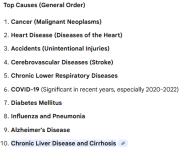
We'd probably also do something about this:

But that not what this is about at all.

Murder, or firearms dont crack the top 10:
1765967699658.png
link

This is political punishment.
 
Canadians have the right to ‘Life, Liberty, and security of the person’. All these laws in my opinion violate that as they have no data supporting any of their gun control measures being effective. My rights don’t end because a majority wants it to.
None of those rights are being violated, just like they aren't when they/we banned tipped lawn darts and three wheelers.
 
The public doesn’t get to arbitrarily restrict rights and freedoms just due to their own ignorance.

Canadians have the right to ‘Life, Liberty, and security of the person’. All these laws in my opinion violate that as they have no data supporting any of their gun control measures being effective. My rights don’t end because a majority wants it to.
Ok, data it is:

There were 109 public mass shootings in the United States and 35 public mass shootings in 35 other economically and politically comparative countries between 2000 and 2022. The United States makes up 33 percent of the combined population of these 36 countries; however, it also accounts for 76 percent of public mass shooting incidents and 70 percent of victim fatalities in these countries.

While there are a multitude of factors contributing to these attacks, studies find the higher rate of public mass shootings in America is associated, at least in part, with less restrictive firearm laws and higher rates of civilian firearm ownership relative to many other countries.

Abstract from above link

Objective: Model the global distribution of public mass shooters around the world. Method: Negative binomial regression is used to test the effects of homicide rates, suicide rates, firearm ownership rates, and several control variables on public mass shooters per country from 1966 to 2012. Results: The global distribution of public mass shooters appears partially attributable to cross-national differences in firearms availability but not associated with cross-national homicide or suicide rates. Conclusion: The United States and other nations with high firearm ownership rates may be particularly susceptible to future public mass shootings, even if they are relatively peaceful or mentally healthy according to other national indicators.

Take, for example, China and Japan. China had three public mass shootings and Japan had no incidents between 2000 and 2022, despite having some of the largest populations. These low rates are likely because China and Japan have some of the strictest gun control measures in the world.

Of importance to note, China and Japan in turn have had higher rates of public mass stabbings. This suggests that deeply troubled and isolated individuals, who violently lash out and attempt to kill indiscriminate victims, exist around the world. To this end, there is a concern that restricting firearm access will not fully prevent mass murder, and if policymakers enact "responsible" firearm legislation, those driven to engage in attacks will simply turn to other weapons. However, while perpetrators using either firearms or knives may aim to incur high victim counts, stabbing attacks are often much less deadly than shooting attacks. Take for example, two attacks that occurred on the same day in 2012: the Sandy Hook Elementary School shooting in the United States, which involved 27 casualties (fatalities and injuries), and the Chenpeng Village Primary School stabbing in China, which involved 24 casualties. While the Sandy Hook shooting resulted in 26 fatalities and one injury, all 24 Chenpeng Village stabbing victims survived.

Still, public mass shootings in the 35 comparison countries similar to the United States have also increased and the rise in attacks across countries emphasizes the need for further consideration of the phenomenon as a whole. The number of attacks has more than doubled from 2000–10 to 2011–22, and the greatest number of incidents occurred in 2019 and 2020. Eight of the comparison countries had their first public mass shooting incident after 2010, including Australia, Austria, Belgium, Canada, Czech Republic, Netherlands, New Zealand, and Norway. This illuminates a concerning prospect raised in recent research: the potential globalization of American public mass shootings. In other words, as American media and entertainment culture continue to be exported to foreign countries, it appears to be accompanied by the idolization of American mass shooters as well as international contagion and copycat effects.

So what do you think is the reason for so many mass shootings in the us (accompanied by such high fatality rates?).

Is it simply because there are more guns? There certainly are more guns per capita in the US than any other country on the planet by a huge margin.
Is it because of a national mental health crisis that is far worse than other comparable countries, and that without guns there would be just as many mass casualty events, just that they would involve knives or vehicles? Data would say that mental health in the US is not drastically any different than the other comparable countries, and data would suggest guns cause the most casualties (Las Vegas).
Or is it because of a gun culture that idolizes gun ownership, gun use, violence, and even idolizes mass shootings (at least, among those that are mentally unfit).
A combination of all three?

 
If the Gov was actually concerned about public safety and needless deaths it would ban alcohol, speed govern all cars, get rid of motorbikes, ban fatty processed foods and fast foods, and enforce daily fitness regimes nation wide.

This is political punishment.
The government isn't concerned about public safety, you're right. It's concerned with the perception of public safety. You're never truly safe; while walking down the road, you could be killed in an instant without any warning by a driver.

However, we function better as a society if we feel safe. Hypothetically, if a country was gripped by such fear that societal norms and efficiencies were breaking down, and the government saw a way to alleviate that fear, but it involved arbitrary regulations/laws, would that government have a fiduciary responsibility to it's population to enact such laws?
 
Ok, data it is:

There were 109 public mass shootings in the United States and 35 public mass shootings in 35 other economically and politically comparative countries between 2000 and 2022. The United States makes up 33 percent of the combined population of these 36 countries; however, it also accounts for 76 percent of public mass shooting incidents and 70 percent of victim fatalities in these countries.

While there are a multitude of factors contributing to these attacks, studies find the higher rate of public mass shootings in America is associated, at least in part, with less restrictive firearm laws and higher rates of civilian firearm ownership relative to many other countries.


Take, for example, China and Japan. China had three public mass shootings and Japan had no incidents between 2000 and 2022, despite having some of the largest populations. These low rates are likely because China and Japan have some of the strictest gun control measures in the world.

Of importance to note, China and Japan in turn have had higher rates of public mass stabbings. This suggests that deeply troubled and isolated individuals, who violently lash out and attempt to kill indiscriminate victims, exist around the world. To this end, there is a concern that restricting firearm access will not fully prevent mass murder, and if policymakers enact "responsible" firearm legislation, those driven to engage in attacks will simply turn to other weapons. However, while perpetrators using either firearms or knives may aim to incur high victim counts, stabbing attacks are often much less deadly than shooting attacks. Take for example, two attacks that occurred on the same day in 2012: the Sandy Hook Elementary School shooting in the United States, which involved 27 casualties (fatalities and injuries), and the Chenpeng Village Primary School stabbing in China, which involved 24 casualties. While the Sandy Hook shooting resulted in 26 fatalities and one injury, all 24 Chenpeng Village stabbing victims survived.

Still, public mass shootings in the 35 comparison countries similar to the United States have also increased and the rise in attacks across countries emphasizes the need for further consideration of the phenomenon as a whole. The number of attacks has more than doubled from 2000–10 to 2011–22, and the greatest number of incidents occurred in 2019 and 2020. Eight of the comparison countries had their first public mass shooting incident after 2010, including Australia, Austria, Belgium, Canada, Czech Republic, Netherlands, New Zealand, and Norway. This illuminates a concerning prospect raised in recent research: the potential globalization of American public mass shootings. In other words, as American media and entertainment culture continue to be exported to foreign countries, it appears to be accompanied by the idolization of American mass shooters as well as international contagion and copycat effects.

So what do you think is the reason for so many mass shootings in the us (accompanied by such high fatality rates?).

Is it simply because there are more guns? There certainly are more guns per capita in the US than any other country on the planet by a huge margin.
Is it because of a national mental health crisis that is far worse than other comparable countries, and that without guns there would be just as many mass casualty events, just that they would involve knives or vehicles? Data would say that mental health in the US is not drastically any different than the other comparable countries, and data would suggest guns cause the most casualties (Las Vegas).
Or is it because of a gun culture that idolizes gun ownership, gun use, violence, and even idolizes mass shootings (at least, among those that are mentally unfit).
A combination of all three?

That is data of America. To counter your argument I bring Switzerland which has a military issued rifle in most households yet has next to no crime.

Therefore firearms don’t have a effect on crime, positively or negatively.

Most gun crime in the States is in a few specific ghettoized areas. You remove those from the stats and they generally are around the same amount as Canada.

I am not against some levels of gun control, but the stupidest parts are when they focus on what you own, not who owns it.

Measures that have a positive effect are preventing criminals and the mentally ill from owning, registration of handguns (thereby preventing straw buying), and basically thats it. Everything else has no real effect on crime and if your goal is ‘minimizing damage’ in a mass casualty situation it doesn’t change anything. Again a truck is deadlier than a rifle in those cases.

The 2016 Nice attack killed and injured (87 dead 458 wounded) more with a lorry than the deadliest mass shooting in history (2011 Norway attack, 77 dead 320 wounded, most the wounded were by bomb, 8 of the dead were by that same bomb).
 
Ok, data it is:

There were 109 public mass shootings in the United States and 35 public mass shootings in 35 other economically and politically comparative countries between 2000 and 2022. The United States makes up 33 percent of the combined population of these 36 countries; however, it also accounts for 76 percent of public mass shooting incidents and 70 percent of victim fatalities in these countries.

While there are a multitude of factors contributing to these attacks, studies find the higher rate of public mass shootings in America is associated, at least in part, with less restrictive firearm laws and higher rates of civilian firearm ownership relative to many other countries.


Take, for example, China and Japan. China had three public mass shootings and Japan had no incidents between 2000 and 2022, despite having some of the largest populations. These low rates are likely because China and Japan have some of the strictest gun control measures in the world.

Of importance to note, China and Japan in turn have had higher rates of public mass stabbings. This suggests that deeply troubled and isolated individuals, who violently lash out and attempt to kill indiscriminate victims, exist around the world. To this end, there is a concern that restricting firearm access will not fully prevent mass murder, and if policymakers enact "responsible" firearm legislation, those driven to engage in attacks will simply turn to other weapons. However, while perpetrators using either firearms or knives may aim to incur high victim counts, stabbing attacks are often much less deadly than shooting attacks. Take for example, two attacks that occurred on the same day in 2012: the Sandy Hook Elementary School shooting in the United States, which involved 27 casualties (fatalities and injuries), and the Chenpeng Village Primary School stabbing in China, which involved 24 casualties. While the Sandy Hook shooting resulted in 26 fatalities and one injury, all 24 Chenpeng Village stabbing victims survived.

Still, public mass shootings in the 35 comparison countries similar to the United States have also increased and the rise in attacks across countries emphasizes the need for further consideration of the phenomenon as a whole. The number of attacks has more than doubled from 2000–10 to 2011–22, and the greatest number of incidents occurred in 2019 and 2020. Eight of the comparison countries had their first public mass shooting incident after 2010, including Australia, Austria, Belgium, Canada, Czech Republic, Netherlands, New Zealand, and Norway. This illuminates a concerning prospect raised in recent research: the potential globalization of American public mass shootings. In other words, as American media and entertainment culture continue to be exported to foreign countries, it appears to be accompanied by the idolization of American mass shooters as well as international contagion and copycat effects.

So what do you think is the reason for so many mass shootings in the us (accompanied by such high fatality rates?).

Is it simply because there are more guns? There certainly are more guns per capita in the US than any other country on the planet by a huge margin.
Is it because of a national mental health crisis that is far worse than other comparable countries, and that without guns there would be just as many mass casualty events, just that they would involve knives or vehicles? Data would say that mental health in the US is not drastically any different than the other comparable countries, and data would suggest guns cause the most casualties (Las Vegas).
Or is it because of a gun culture that idolizes gun ownership, gun use, violence, and even idolizes mass shootings (at least, among those that are mentally unfit).
A combination of all three?
Cultural
 
Eight of the comparison countries had their first public mass shooting incident after 2010, including Australia, Austria, Belgium, Canada, Czech Republic, Netherlands, New Zealand, and Norway.
This illuminates a concerning prospect raised in recent research: the potential globalization of American public mass shootings.
Australia, Austria, Canada, New Zealand, and Norway had public mass shootings prior to 2010.
 
Guns aren't the real problem.

People are the problem and since we can't jail anyone for what the MIGHT do mass murder etc will continue.

Victor Hoffman murdered nine people in Shell Lake, Sask with .22, and was found NCR (in 1968/69). There was no out cry to ban firearms.

A few years later IIRC a man butchered seven people with an axe in Buffalo Narrows.

So anyone bent on causing a mass casualty situation has the means - guns, sharps, vehicles etc.
 
However, we function better as a society if we feel safe. Hypothetically, if a country was gripped by such fear that societal norms and efficiencies were breaking down, and the government saw a way to alleviate that fear, but it involved arbitrary regulations/laws, would that government have a fiduciary responsibility to it's population to enact such laws?

Is that what's happening ?
 
I am not against some levels of gun control, but the stupidest parts are when they focus on what you own, not who owns it.

Bro! You are knocking it out of the park.

Reaction Applause GIF
 
Australia, Austria, Canada, New Zealand, and Norway had public mass shootings prior to 2010.
This study focused on the period between 2000 and 2022, and by "public" mass shootings they limited it to circumstances where there was the intent to simply cause mass murder of random people, as opposed to say, a target gang shooting that killed a bunch of people. However, you're right; I was able to find one public mass shooting in the 2000-2010 period in Canada, the Dawson College shooting n 2006.
 
Is that what's happening ?
No. Like I said it's hypothetical. But I abhore "absolute" statements, and as much as I think arbitrary laws are frustrating, are they truly "unethical" if there is potentially a real benefit to society writ large, even if its effects are entirely "perceptual"? (i.e. if a new gun law never actually reduced the frequency and severity of gun violence, but had a measurable and significant effect on the emotional state of the population (i.e. made them feel safer and happier), then would that actually be an unethical thing for the government to do? Would it actually be something they have a responsibility to do as a moral obligation to provide prosperity to the people?)
 
Back
Top