• Thanks for stopping by. Logging in to a registered account will remove all generic ads. Please reach out with any questions or concerns.

The low productivity of Canadian companies threatens our living standards

And yet the Danes beat us in productivity and happiness.
When you don't have to build 100 km of road and power grid to service a town of 15,000, it gives you extra money for other stuff. Comparing Denmark and Canada is the Ultimate in Apples and Oranges.
 
Something I’ve been harping on. Don’t expect capitalists to save capitalism.


Archived here:


But there’s more behind the push to increase regulation than mere necessity. A basic error behind the assumption that everyone hates red tape is to assume that capitalists love capitalism. In fact, as soon as a business succeeds, the temptation to protect its position by freezing out new entrants grows stronger. A large recent study in the U.S. found a strong tendency among incumbent firms to lobby for regulations that raise fixed costs, thereby making it hard for new firms to enter the market.
The same protectionist tendency exists among workers as well, since one of the most common barriers to entry has become occupational licensing, something Canadian professionals and tradespeople who have ever contemplated changing provinces know all too well. Similar drawbridge-raising is ubiquitous in the housing sector, with property owners using planning meetings to block new developments that would effectively increase supply and lower prices.
 
Something I’ve been harping on. Don’t expect capitalists to save capitalism.
Crony capitalism is a political problem. Every entrepreneur works every possible angle; he isn't really doing his "duty" if he doesn't. If politicians create opportunities for lobbying, of course corporations are going to lobby - to fail to do so would be to yield an opportunity to competitors.

All that has to happen is for politicians to say "no".
 
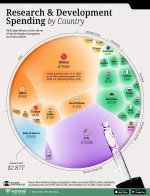
Related to productivity is Research and Development


1770302374372.jpeg

Canada - 33 BUSD (41,000,000 people) $804
Sweden - 20 BUSD (10,000,000 people) $2000
S. Korea - 126 BUSD (52,000,000 people) $2423
UK - 87 BUSD (70,000,000 people) $1242

$/capita investment in R&D

And thus we buy South Korean TVs, Cars, Smartphones and Subs.
 
GDP with R&D %

Canada - 2,390 BUSD (1.4%)
Sweden - 620 BUSD (3.2%)
S. Korea - 1,870 BUSD (6.7%)
UK - 4,255 BUSD (2.0%)

S.Korea spends 475% of what we do on R&D.
That funds a lot of mistakes.

Development includes commissioning new plants. Getting them to work to spec and getting them to work optimally, not necessarily the same things. One of the most challenging aspects I found when commissioning, or trialling, a plant was getting the client to commit enough raw material to the cause to permit adequate testing.

If I had my way a full scale commissioning would require enough raw material to run the plant at designed capacity for at least 6 hours a day for two weeks with no saleable product being produced. But my clients were usually reluctant to make that kind of commitment. Most wanted to jump straight into production for market.

Available government support programs are slow, cumbersome and stingy.
 
GDP with R&D %

Canada - 2,390 BUSD (1.4%)
Sweden - 620 BUSD (3.2%)
S. Korea - 1,870 BUSD (6.7%)
UK - 4,255 BUSD (2.0%)

S.Korea spends 475% of what we do on R&D.
That funds a lot of mistakes.

Development includes commissioning new plants. Getting them to work to spec and getting them to work optimally, not necessarily the same things. One of the most challenging aspects I found when commissioning, or trialling, a plant was getting the client to commit enough raw material to the cause to permit adequate testing.

If I had my way a full scale commissioning would require enough raw material to run the plant at designed capacity for at least 6 hours a day for two weeks with no saleable product being produced. But my clients were usually reluctant to make that kind of commitment. Most wanted to jump straight into production for market.

Available government support programs are slow, cumbersome and stingy.

When your country's unofficial motto is: well that looks a little too risky for me..

... then this stuff happens...


Canada falling behind in R&D, report warns

Universities provide one of the few bright spots, according to the Council of Canadian Academies.

A new study of Canada’s science, technology and innovation (STI) landscape warns that the country’s future is under threat as it falls further behind its international counterparts in the world of research and development. Calling Canada “an innovation laggard on multiple fronts,” the report released this week by the Council of Canadian Academies (CCA) says its analysis found ample evidence that the country needs to improve its research and development efforts — and ensure that the results are put to better use — if Canadians are going to preserve their place on the world stage.

“Canada’s greatest natural resource is its talented, well-educated and diverse population,” it says, pointing out that 63 per cent of Canadians between ages 25 and 64 have a post-secondary degree. But it warns that an educated population needs the opportunity to fulfill its promise.

“Our greatest weakness is an economy that consistently underuses and undervalues the capacity of Canadians to create prosperity for future generations.”

 
When your country's unofficial motto is: well that looks a little too risky for me..

... then this stuff happens...


Canada falling behind in R&D, report warns

Universities provide one of the few bright spots, according to the Council of Canadian Academies.

A new study of Canada’s science, technology and innovation (STI) landscape warns that the country’s future is under threat as it falls further behind its international counterparts in the world of research and development. Calling Canada “an innovation laggard on multiple fronts,” the report released this week by the Council of Canadian Academies (CCA) says its analysis found ample evidence that the country needs to improve its research and development efforts — and ensure that the results are put to better use — if Canadians are going to preserve their place on the world stage.

“Canada’s greatest natural resource is its talented, well-educated and diverse population,” it says, pointing out that 63 per cent of Canadians between ages 25 and 64 have a post-secondary degree. But it warns that an educated population needs the opportunity to fulfill its promise.

“Our greatest weakness is an economy that consistently underuses and undervalues the capacity of Canadians to create prosperity for future generations.”


One of our problems is we seem to associate all research with universities, and that research isn't often perceived as having real world benefits for industry. The D in R&D is the part that routinely gets disregarded and yet that is where successful commercialization happens. That is where we learn how to make money out of bright ideas.
 
When your country's unofficial motto is: well that looks a little too risky for me..

... then this stuff happens...


Canada falling behind in R&D, report warns

Universities provide one of the few bright spots, according to the Council of Canadian Academies.

A new study of Canada’s science, technology and innovation (STI) landscape warns that the country’s future is under threat as it falls further behind its international counterparts in the world of research and development. Calling Canada “an innovation laggard on multiple fronts,” the report released this week by the Council of Canadian Academies (CCA) says its analysis found ample evidence that the country needs to improve its research and development efforts — and ensure that the results are put to better use — if Canadians are going to preserve their place on the world stage.

“Canada’s greatest natural resource is its talented, well-educated and diverse population,” it says, pointing out that 63 per cent of Canadians between ages 25 and 64 have a post-secondary degree. But it warns that an educated population needs the opportunity to fulfill its promise.

“Our greatest weakness is an economy that consistently underuses and undervalues the capacity of Canadians to create prosperity for future generations.”


That's an unfortunate acronym.
 
Labour laws can militate against productivity improvement. In particular, higher costs of releasing employees deters change and innovation.

"According to a rough estimate by Olivier Coste and Yann Coatanlem, a corporate restructuring in Germany and France costs companies the equivalent of 31 and 38 months of salary per employee laid off, putting all of the above costs together. In Italy, this is 52 months. In Spain, it is 62 months. In the United States, the cost per employee is just 7 months."

There is no obvious reason to disbelieve that the same phenomenon exists in both private and public work spaces.
 
We are officially a productivity 'basket case' it seems.

When banks start lecturing you about how to improve productivity, you know you're really in trouble... ;)


Toward a virtuous circle for productivity

While labour productivity can be measured for a given quarter, looking at data over a longer period is generally more revealing. A lot of different factors can affect output and labour in the short term. But they may not have much to do with the long-term trend in productivity.

That said, Canada’s productivity has been lagging for the past 25 years at least. The data are clear. For example, the average annual growth in labour productivity in Canada was about 3% in the 1960s and 1970s but fell to 1% between 2000 and 2019 (Chart 1). This decline continued through the pandemic and persists today. And it’s not one or two sectors that are causing the poor performance. Nor is it caused by differences in industrial structure. It’s a widespread problem across the economy.

Even worse, over the past five decades, Canada’s productivity has deteriorated compared with that of other G7 countries (Chart 2). In 1971, Canada’s productivity was, on average, higher than that of its peers. By the early 1980s, the situation had reversed. And the average productivity gap between Canada and other G7 countries has continued to widen since the start of the 2000s, particularly with the United States.

Deep down, Canada’s affordability problem is really a productivity problem. Inflation has come back down after spiking in 2022, but just about everything still costs more than it did before. Everyone is feeling this. If we want to make things more affordable, we need to raise our income.

And the way to grow our income is by increasing productivity. Even modest improvements can make a big difference. To give you an idea, if our productivity growth since 2000 had been similar to that of other G7 countries, our GDP in Canada today would be about 9% higher, which translates to almost $7,000 per person.4 And as I mentioned earlier, income growth linked to an increase in productivity would come with little or no inflationary pressure. So it would represent real growth in our purchasing power.

 
We are officially a productivity 'basket case' it seems.
Not enough wannabe technocrats have ever played a game of Sid Meier's "Civilization".

Growth compounds; over time, differences matter. 1825, 1925, 2025. What were countries' respective economies - and in particular, their residents' respective lifestyles - like at those different points in time?
 
Back
Top