• Thanks for stopping by. Logging in to a registered account will remove all generic ads. Please reach out with any questions or concerns.

The Sandbox and Areas Reports Thread February 2009

Articles found February 15, 2009


US to include Afghans in review, BBC News

Afghanistan will send a team to the US to take part in a major policy review of the region,
Afghan President Hamid Karzai has announced. In a joint news conference with the new
US envoy in the region, Richard Holbrooke, Mr Karzai said he was "very thankful" to be
involved in the talks.

In recent weeks US officials have been critical of Mr Karzai's leadership. US President
Barack Obama, who regards Afghanistan as a priority, accused his government of being
"very detached".

The BBC's Martin Patience, in Kabul, says Mr Karzai and Mr Holbrooke appeared keen
to smooth over any apparent discord at the news conference on Sunday. But our
correspondent says it is widely thought that Mr Karzai is no longer popular in the White
House - and it may take more than a news conference to change that perception.

Civilian deaths

Mr Holbrooke said he hoped at least one senior US official would be in Afghanistan every
month "to find ways to improve our joint effort". Meanwhile, Mr Karzai said he had
requested permission to send a delegation to the US as part of Obama government's review.
"I'm very very thankful that President Obama has accepted my proposal of Afghanistan
joining the strategic review of the war against terrorism in the United States," Mr Karzai said.
The Afghan leader also said that "very specific measures" had been agreed between Nato,
the US and his government to prevent civilian casualties.

According to UN figures 1,800 civilians died in the conflict between January to October last year.
Taleban militants and local warlords were blamed for about 1,000 of the fatalities. US and Nato
forces were held responsible for 700 deaths, mainly through air strikes.

Inherited 'mess'

Mr Holbrooke, the new envoy to Afghanistan and Pakistan, has also visited Pakistan as part of
his tour - but has so far made only brief statements. He said earlier he was in the region to
"listen and learn". Before his trip, Mr Holbrooke said Afghanistan would be "much tougher"
than Iraq and he had not "seen anything like the mess we have inherited". During talks with
Pakistani leaders, reports say the envoy stressed Washington's financial commitments to the
country but underlined the need to purge militant safe havens in the north-west region, along
the Afghan border.

Analysts say Mr Holbrooke will be a key player in a renewed effort to reverse the deteriorating
security situation on both sides of the Pakistan-Afghanistan border.

Mr Holbrooke has now arrived in India.


Afghanistan to take part in U.S. review of mission, CTV.ca News Staff

Afghan President Hamid Karzai says his government will participate in a review of the war
in Afghanistan currently being conducted by U.S. officials, a move that signals a new spirit
of co-operation between the two countries.

Karzai said Sunday that his foreign minister, Dadfar Rangin Spanta, would lead the Afghan
delegation. However, it is unclear which review Afghan officials would join, as the U.S. has
several reviews open into the Afghan mission.

Karzai had recently sent a letter to U.S. President Barack Obama proposing Afghan involvement
in a review of the mission. On Sunday, U.S. special envoy to Afghanistan and Pakistan, Richard
Holbrooke, said Obama "welcomed the suggestion." "I am very, very thankful that President
Obama has accepted my proposal of Afghanistan joining the strategic review of the war on
terror in Afghanistan," Karzai said Sunday.

The U.S. government is reviewing its Afghan mission, during which troops have faced increasing
numbers of violent attacks from Taliban militants. Militants have also consolidated their influence
across rural areas that the Afghan government has failed to put under its control.

Obama has announced that he would like to pull back U.S. military involvement in Iraq while
boosting troop levels in Afghanistan by about 30,000. However, some Afghans fear that a
stronger U.S. presence in the country will lead to greater violence from Taliban militants,
said the Globe and Mail's Graeme Smith.

"So just about everybody's predicting that the upcoming fighting season, which you can expect
to see starting in April in the north and then sweeping down to the south around May, will bring
higher levels of violence than we have seen so far in Afghanistan," Smith said Sunday during an
interview on CTV Newsnet from Afghanistan. However, Smith also pointed out that Afghan
security personnel may appreciate greater U.S. troop strength in the country.

Officials are increasingly concerned about the security situation in Afghanistan, Smith said,
particularly after a team of suicide bombers attacked government buildings in Kabul last week,
killing 20 people.

Speaking on Sunday after a visit by Holbrooke, Karzai also expressed his gratitude for the U.S.
decision to allow Afghan forces to participate in the planning and execution of military maneuvers.
The move is an attempt to reduce civilian casualties during U.S. missions in the country. Karzai
would like to see the number of nighttime raids conducted by U.S. troops, which repeatedly cause
civilian deaths, reduced. However, U.S. officials have not said whether they will order a halt to
overnight raids.

Karzai's recent criticism of the raids has ratcheted up tensions between the two countries.
In an interview on Friday, Karzai confirmed that he had not spoken on the telephone with Obama
since his inauguration last month. In contrast, Karzai was very close to former president George
W. Bush, with whom he spoke regularly.

Smith said that during Holbrooke's visit, the U.S. envoy seemed unwilling to conduct a joint press
conference with the Afghan leader, signalling a change in attitude toward the Afghan government.
"What's really changed here is the Americans are re-thinking their strategy towards this country
in a very dramatic way and trying to decide wither the president is the right person to be working
with," Smith said.

With files from The Associated Press
 
Article posted February 12, 2009


US 'lost track of Afghan weapons', BBC News

_45470332_006722444-1.jpg

The Pentagon admits that there are
failures tracking weaponry

The US military has failed to keep track of thousands of weapons shipped to Afghanistan,
leaving them vulnerable to being lost or stolen, a report says.

The report has been compiled by congressional auditors, the US Government Accountability
Office (GAO). It found that, in the four years up to June 2008, the US military failed to keep
complete records on some 222,000 weapons entering the country. The report will be
discussed in the US House of Representatives on Thursday. It states that weapons supplied
by the US to the Afghan military "are at serious risk of theft or loss".

The report says:

    * US military officials failed to keep proper records on about 87,000 rifles, pistols, mortars
      and other weapons sent to Afghanistan between December 2004 and June 2008 - about
      a third of all the weapons sent
    * There was a similar lack of management of a further 135,000 light weapons donated to
      Afghan forces via the US military by 21 countries
    * The military failed even to record the serial numbers of some 46,000 weapons, making it
      impossible to confirm receipt of weapons or identify any which had fallen into the hands
      of militants
    * The serial numbers of 41,000 weapons were recorded, but US military officials still had no
      idea where they were

"Lapses in accountability occurred throughout the supply chain," concludes the report, which is
due to be discussed on Thursday at a panel hearing of a House Oversight and Government
Reform subcommittee.

In response, the Pentagon agreed that it needed more people to help train the Afghanistan
government to track the weapons, the AP news agency reported. It said it had made attempts
to address the problems with registering serial numbers and monitoring weapon locations.

The report's findings came just a day after an audacious attack on three government buildings
in the Afghan capital Kabul left 28 people, including eight attackers, dead. The report is
reminiscent of an August 2007 study, also by the GAO, which found the US military could not
account for some 190,000 rifles and pistols given to security services in Iraq.

One of the US lawmakers who will discuss the report findings on Thursday, Democratic
Representative John Tierney, suggested the report could prompt Congress to legislate on
weapons-handling in Afghanistan. "The challenges here are immense, but this is just too
important not to get it right," he said.


Article posted February 5, 2009

Nosedive in Afghan-US relations, BBC News

_45444954_006700286-1.jpg

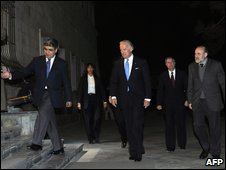
Joe Biden's meeting with President
Karzai reportedly did not go well

Relations between President Karzai's Afghan government and Washington are at an all-time low.
As Richard Holbrooke - President Obama's envoy to Afghanistan and Pakistan - prepares to make
his first visit to the region since being appointed, the BBC's Ian Pannell in Kabul looks at why the
relationship has soured.

Hamid Karzai has become increasingly vociferous in his criticism of American military tactics and
has been making half-hearted threats to shift his allegiance to Moscow if he does not get his way.

Washington has yet to publicly declare its hand but a series of well-placed leaks, briefs and snubs
have raised the prospect that it could move its support elsewhere in this year's presidential election.

One Afghan newspaper spoke of "a new cold war". A senior Afghan government official says the
new Obama administration has insulted President Karzai and one prominent MP accuses America
of "running a shadow-government".

'Narco-state'

The decline in relations began with a visit last year by Joe Biden, now the vice-president, to Kabul.
At the time, as the Democratic vice-presidential candidate, he attended a private meeting with
Mr Karzai. A well-placed source describes Mr Biden, exasperated at not getting "straight answers"
on drugs and corruption, launching into a verbal tirade and storming out of the meeting. In a country
where honour and decorum are second only to God and country, this was less than tactful.

On the campaign trail and more recently in confirmation hearings, senior members of President
Barack Obama's team have questioned the effectiveness and honesty of Hamid Karzai's government.
Secretary of State Hillary Clinton's written statement to Congress during her confirmation hearing
called Afghanistan a "narco-state" that was "plagued by limited capacity and widespread corruption".
She may have been wise enough not to use the phrase in her public testimony but by the time it was
reported on the front page of the newspapers in Kabul, it did not really make much difference.

'Potential impediment'

Earlier in January the Nato secretary-general wrote an opinion piece about the lack of leadership in
the country, laying the blame not at the feet of the Taleban but the lack of governance. Then there
was a recent article in the New York Times. Quoting anonymous "senior administration officials", it
said Washington planned to take a tougher-line with Kabul and that Hamid Karzai was now regarded
as "a potential impediment to American goals" in the country.

Hamid Karzai is an avid reader of the Western press and is known to be highly sensitive to criticisms
they may have of him. Publicly he has not responded but he is now under considerable pressure. His
government's writ is limited to Kabul, the north and a few urban spots elsewhere in the country. His
own popularity has fallen and some whisper privately and mischievously about his "state of mind".
When asked whether the country was heading towards a crisis, one senior political figure responded
that the country was already in one.

Old Afghan hand

President Karzai has been holding a series of meetings with former Mujahedeen commanders in the
past few weeks amid suggestions that he is trying to align the country with Russia. That has certainly
been his public stance. As well as a deliberately leaked "letter of understanding" with Moscow, President
Karzai publicly warned America that unless it supplied the military hardware he wanted, he would look
to other countries for support.

No-one was in a moment's doubt who this meant. The Russian ambassador, Zamir Kabulov, an old
Afghan hand, was seen strutting around parliament last week. He has warned that the US and Nato are
repeating the same mistakes of the Soviet occupation of Afghanistan. As he was posted to the Soviet
Embassy at the time, his opinion is worth considering.

Now President Karzai has sent a document to Nato outlining new "rules of engagement". If implemented
they would substantially alter the mandate for foreign forces in the country. It seems inconceivable that
there could be a real and lasting schism between Kabul and Washington. It will be the job of Richard Holbrooke,
the US Special Envoy for Afghanistan and Pakistan, to ensure that does not happen.

But the date has been set for Afghanistan's presidential election and the West's disappointment with Hamid
Karzai can no longer be disguised. A number of challengers are jostling for American support and in the
current climate, their chances are starting to improve.
 
Articles found February 17, 2009

Airstrike in Afghanistan kills Taliban commander
By HEIDI VOGT and AMIR SHAH – 1 day ago
Article Link

KABUL (AP) — A coalition airstrike has killed a powerful Taliban commander who broke a promise to renounce violence after village elders persuaded President Hamid Karzai to free him from prison, officials said Monday.

The Sunday night attack destroyed a building housing Ghulam Dastagir and eight other militants in the village of Darya-ye-Morghab, near the Turkmenistan border, the U.S. military said in a statement.

Dastagir was responsible for a surge in violence in the province in recent months, including a November attack on an Afghan army convoy that killed 13 soldiers, the statement said.

"He was like the shadow governor of Badghis," said Gen. Mohammad Ayub Nizyar, the former police chief of the province.

Dastagir had previously been captured and imprisoned in Herat province, but he was released about four months ago after elders of his home district pleaded with Karzai and high-level officials to let him go, saying he would not return to violence, according to provincial police spokesman Noorhan Nekzad. Karzai issued a decree ordering his release.
More on link

Newest US troops in dangerous region near Kabul
By JASON STRAZIUSO – 18 hours ago  Article Link

LOGAR PROVINCE, Afghanistan (AP) — Close to 3,000 American soldiers who recently arrived in Afghanistan to secure two violent provinces near Kabul have begun operations in the field and already are seeing combat, the unit's spokesman said Monday.

The new troops are the first wave of an expected surge of reinforcements this year. The process began to take shape under President George Bush but has been given impetus by President Barack Obama's call for an increased focus on Afghanistan.

U.S. commanders have been contemplating sending up to 30,000 more soldiers to bolster the 33,000 already here, but the new administration is expected to initially approve only a portion of that amount. White House press secretary Robert Gibbs said Monday the president would decide soon.

The new unit — the 3rd Brigade Combat Team of the 10th Mountain Division — moved into Logar and Wardak provinces last month, and the soldiers from Fort Drum, N.Y., are now stationed in combat outposts throughout the provinces.

Militants have attacked several patrols with rifles and rocket-propelled grenades, including one ambush by 30 insurgents, Lt. Col. Steve Osterhozer, the brigade spokesman, said.
More on link

US train formed in Latvia to head for Afghanistan
23 hours ago
Article Link

RIGA (AFP) — A US supply train for NATO troops in Afghanistan, due to transit via Russia, is being formed in Latvia, an official from the Baltic state's defence ministry told AFP Monday.

The official, speaking on condition of anonymity, declined to give further details of the shipment, which Moscow has said could leave within days.

A US embassy official said supplies were being shipped into Riga for loading onto the train, which would carry 100 containers across Russia and other countries to Afghanistan.

If successful, 20-30 trainloads per week could eventually be sent, the embassy said.

Russian Foreign Minister Sergei Lavrov said Saturday the United States had asked about shipments to Afghanistan, and that he had ruled out weapons or ammunition being carried.

"We have clearly stated we were ready to do it, because it corresponds completely to the agreements we have concluded with NATO and this transit will literally take place in the coming days," Lavrov said.
More on link

Pakistan Agrees to Enforce Islamic Law in Violent Region
Article Link

PESHAWAR, Pakistan — Pakistan government officials said they struck a deal on Monday to accept a legal system compatible with Shariah law in the violent Swat region in return for peace.

The agreement contradicted American demands for the Pakistan authorities to fight harder against militants, and seemed certain to raise fears in Washington that a perilous precedent had been set across a volatile region where U.S. forces are fighting Taliban militants operating in Afghanistan and Pakistan.

The latest sign of the battle came early on Monday when a suspected United States drone fired four missiles into another area of northwestern Pakistan, close to the Afghan border, killing 31 people, according to a government official and a resident.

The deal on the Swat region was conditional on both sides fulfilling their side of the bargain, government officials said.

They said the authorities agreed to a legal system rejecting any law that did not comply with the teachings of the Koran and the sayings and teachings of the prophet Muhammad, known as the Sunnah.

“After successful negotiations, all un-Islamic laws related to the judicial system, those against the Koran and the Sunnah, would be subject to cancellation and considered null and void,” said Mian Iftikhar Hussain, the information minister of the North West Frontier Province, according to Reuters.

The region’s Swat Valley was once one
More on link
 
Afstan: US surge for real
The Torch, Feb. 17
http://toyoufromfailinghands.blogspot.com/2009/02/afstan-us-surge-for-real.html

Mark
Ottawa
 
Articles found February 18, 2009

Australia could bolster Afghanistan troop numbers
The Associated Press Wednesday, February 18, 2009
Article Link

CANBERRA, Australia: Australia welcomed a U.S. troop surge in Afghanistan and could also send more soldiers if European allies agreed to do the same, Defense Minister Joel Fitzgibbon said Wednesday.

Fitzgibbon told Australian television he looked forward to discussing details of the plan to deploy an additional 17,000 U.S. troops to battle al-Qaida and Taliban insurgents with U.S. Defense Secretary Robert Gates at a NATO forum in Krakow, Poland, this week.

President Barack Obama's administration has not yet requested a larger Australian contribution, but such a request would be considered, Fitzgibbon said.

"We'll of course always consider any request from our closest ally, but we've been determined not to do more until under-committed NATO countries are prepared to do more," Fitzgibbon told Sky TV by telephone from Dubai.

"The announcement is welcome, however not unexpected, so it doesn't really change the dynamic for us at this stage," Fitzgibbon added.

With 1,000 troops in Afghanistan, Australia is the biggest contributor of any country outside NATO. Eight Australian soldiers have died in the conflict since 2001
More on link

Drug abuse hampers Afghan police
By Martin Patience BBC News, Kabul
Article Link

Sixty per cent of the Afghan police in the country's southern province of Helmand use drugs, it is claimed.

The estimate, made by a UK official working in the province, was contained in emails obtained by the BBC.

International forces are fighting a fierce counter-insurgency campaign against Taleban militants and other insurgents in Helmand.

But British officials are clearly worried about the reliability of the Afghan police.

"We are very concerned by the levels of drug abuse among the police," the British Foreign Office said in a statement.

"The police are poorly paid, do high risk work and are poorly trained. There are high levels of corruption in the police as well as drug use and supporting counter-narcotics is a key priority for the UK," it said.

Meanwhile, 700 British and Afghan troops were involved in raids on four factories in Helmand, seizing heroin and drug-making chemicals with an estimated street value of more than £50m.
More on link

Mini-surge to test out US strategy in Afghanistan
Some 3,000 US troops recently deployed to insurgent-heavy provinces near Kabul.
By Anand Gopal | Correspondent of The Christian Science Monitor
from the February 18, 2009 edition
Article Link

Maydan Shahr, Afghanistan - The 3,000 new American troops who arrived in recent weeks in Logar and Wardak provinces, both of which border Kabul, face a formidable challenge: establishing control in areas with little government presence and where insurgents operate freely.

In Band-e-chak, for example, a district capital in Wardak, gun-toting Taliban fighters regularly come into town on their motorbikes to do some shopping. They buy their produce and go home, driving past government offices unmolested.

These provinces could be a key testing ground for the Obama administration's Afghan strategy, which may include a surge of thousands of US forces countrywide.

"Policymakers in Washington will be watching the progress there closely," says Habibullah Rafeh, political analyst with the Afghan Academy of Sciences. "If [the US] can turn things around there, they can create the momentum to turn around the whole war."

The strategy in Logar and Wardak will be to push the insurgents out of their strongholds and eliminate their contact with locals, and to emphasize development and reconstruction, says Col. David Haight, commander of the newly arrived troops.
More on link

Afghan militia gears up to fight the Taliban
GRAEME SMITH From Wednesday's Globe and Mail February 17, 2009 at 11:14 PM EST Article Link

KABUL — The first stages of a plan to raise militias against the Afghan insurgency will involve giving 1,200 assault rifles to local men with little training, according to documents that reveal fresh details about the controversial program.

The Afghan Public Protection Force was cloaked in secrecy when its existence was announced last month, as government officials refused to confirm even the location where the new units are being recruited. The few details released so far have raised concerns that the APPF will repeat previous failed experiments with tribal militias in Afghanistan, where hired gunmen have a long history of stoking disarray and rebellion.

But with the number of Taliban attacks this winter reaching twice the levels seen last year, the United States is moving quickly to sponsor new security forces that have drawn comparisons with the Awakening Councils that have helped quell the violence in Iraq.

A 23-page PowerPoint briefing obtained by The Globe and Mail suggests the Afghan government wants the new militiamen in some districts to vastly outnumber the police.
More on link
 
ARTICLES FOUND FEB. 19

Kandahar residents feel less safe, says Canada's outgoing commander
CP, Feb. 18
http://www.google.com/hostednews/canadianpress/article/ALeqM5gI6vvRZ03bqmC0pvuvwienqiSqbg

The sense of security among people right across Kandahar province has "absolutely plummeted," the outgoing commander of Canadian troops in Afghanistan said Wednesday [Feb. 18] in a brutally frank summation of the war during his nine months on the ground.

Public opinion surveys conducted by the Canadian military suggest confidence has evaporated in the face of what Brig.-Gen. Denis Thompson described as a "twisted and extreme" insurgency that thinks nothing of "brainwashing" a 12-year-old boy into becoming a suicide bomber.

"It should come as no surprise to any here that these past nine months have not been sufficient to win the war," Thompson said at the outset of his farewell statement to journalists at Kandahar Airfield.

Ultimately, the war is up to the Afghans to win, Thompson said, who also praised the courage and tenacity of his own troops...

"Afghans are frustrated by the lack of progress of their own government and the international community, that is true," Thompson said. "But they are even more horrified by the atrocities committed on a daily basis by the insurgents."..

In the end, all of the bloodshed has won the Taliban nothing and only served to isolate them from the Afghan people, Thompson declared.

Over the last 18 months, the Canadian military has conducted several public opinion surveys in the war-ravaged city of Kandahar, asking residents about their level of support for the Afghan government, the Taliban and their perception of public safety.

Surveys conducted in late 2007 and early 2008 found 55 per cent of respondents saying they lived in a secure environment, but Thompson said that figure is now down to about 25 per cent.

Support for both Karzai's government and the Taliban have remained largely static, he added: Roughly 70 per cent of those asked said they support the government, while the Taliban pulls down between 15 and 20 per cent support at any given time [emphasis added].

Thompson's candid assessment was a reflection of the changing face of the war in southern Afghanistan, where the ranks of local militants have been depleted by three years of heavy fighting.

Increasingly, those local commanders are being replaced by hard-line Islamists, such as those with the Haqqani network - full-throated terrorists with no connection to the communities they remorselessly attack...

He said reconstruction activities have made gains - especially in the building of roads, where progress is measured metre by metre - but in the end conceded that development remains "painfully slow by Western standards."..
http://forums.milnet.ca/forums/threads/49908/post-812946.html#msg812946

U.S. troop buildup no threat to Canada's Kandahar accomplishments: general
CP, Feb. 19
http://www.google.com/hostednews/canadianpress/article/ALeqM5jwbBAbgeFGomWKhNsClKtjbZctmQ

Brig.-Gen. Jon Vance officially took charge of the 2,850 soldiers, aircrew and support staff in Kandahar today and he said he welcomed the influx of fresh American troops.

With so much Canadian blood, sweat and treasure poured into Kandahar over the last three years, Vance said Canadians back home shouldn't view the U.S. buildup as the Americans taking over.

"I see no threat at all to Canada's pride of accomplishments and pride of place in the future as long as we're here," Vance said following a ceremony where he formally took over from Brig.-Gen. Denis Thompson, who ended a nine-month tour Thursday [Feb. 19].

U.S. President Barack Obama announced this week that 17,000 extra American soldiers and marines would be sent to Afghanistan this year to bolster the fight against the Taliban.

Although details have yet to finalized, Thompson said it's expected a new U.S. combat brigade will be deployed in Kandahar province...

Vance said he believes the incoming U.S. troops will not overshadow the Canadian contingent and will likely operate in their own area of the province - in places where it's been impossible to station NATO troops.

They will "definitely be an addition," he said...

Vance said he expects the new American soldiers will report independently to NATO's southern command and not fall under Canadian command [emphasis added].

As part of the bargain that saw Canada get some relief and Parliament extend the country's mission to 2011, the U.S. agreed to place one infantry battalion under Canadian control last year.

That unit will remain as part of the Canadian task force, said Vance.

Mark
Ottawa
 
ARTICLES FOUND FEB. 20

Canada to focus on protecting Kandahar city
Globe and Mail, Feb. 20
http://www.theglobeandmail.com/servlet/story/RTGAM.20090220.wafghan20/BNStory/Afghanistan/home

KANDAHAR, AFGHANISTAN — The coming influx of American troops will allow Canada to focus on protecting the gateways to Kandahar city, a new senior commander says, leaving U.S. forces to disrupt the insurgency in the dangerous outlying districts.

“Our turf will be the populated approaches to the city,” said Brigadier-General Jonathan Vance, after assuming command of Canadian forces in a ceremony at Kandahar Air Field yesterday.

Previous commanders have proudly declared that Canadian soldiers patrol 50,000 square kilometres, securing Kandahar and beyond to the edges of neighbouring provinces.

But after years of suffering higher casualty rates than other NATO forces in the country, the Canadians appear to be anxiously waiting for U.S. reinforcements, hoping the new arrivals will shoulder the task of aggressive operations in far-flung Taliban strongholds.
Brigadier-General Jonathan Vance meets Afghan officials during his first day on the job at Kandahar Air Field.

“The inflow of American forces will help as we get stronger on the peripheries of the province,” Brig.-Gen. Vance said...

Britain 'has no plans' to deploy more soldiers to Afghanistan
The Times, Feb. 19
http://www.timesonline.co.uk/tol/news/uk/article5762298.ece

David Miliband applauded yesterday the deployment of 17,000 extra US troops to Afghanistan but said that Britain had no plans to increase its military presence in the country.

“I think there is a recognition that these extra American troops can and will play an important and positive role,” the Foreign Secretary said in the Afghan capital after a visit to British Forces in the south.

Britain has almost 9,000 troops in Afghanistan This month Mr Miliband announced the deployment of a further 300 soldiers, mostly specialists to counter Taleban roadside bomb attacks, amid reports that the US Government was pressing Britain for an additional 1,500 troops.

“We represent about 12 per cent of the troops in Afghanistan,” the Foreign Secretary said. “At the moment we have had no request to increase the number of our troops. We always keep the number under review [emphasis added].”..

US demands for more troops in Afghanistan ignored
US demands for Nato allies to send more troops to Afghanistan have been met with a cool response at a summit in Poland.

Daily Telegraph, Feb. 19
http://www.telegraph.co.uk/news/worldnews/asia/afghanistan/4699949/US-demands-for-more-troops-in-Afghanistan-ignored.html

Washington had hoped to persuade European allies to contribute more in the wake of the President Barack Obama's election and the announcement this week of the deployment of 17,00 extra American soldiers.

American defence secretary Robert Gates condemned their failure to do so far as "disappointing" with European states promising to deploy no more than just a few hundred extra troops.

Speaking before a meeting of Nato defence ministers in the Polish city of Kraków, Mr Gates said member states must send reinforcements in preparation for the Afghan presidential elections in August.

However in a sign commanders had resigned themselves to receiving few extra combat troops, the Nato chief stressed the need for help in less controversial and safer police training missions.

Jaap de Hopp Scheffer, Nato's secretary general, refrained from calling for more combat troops, explaining that the organisation should play a greater role in nation building...

Nato members offer Afghan support
BBC, Feb. 20
http://news.bbc.co.uk/2/hi/europe/7901078.stm

Up to 20 Nato countries have offered to boost their civilian, military or training commitments to Afghanistan, US defence secretary Robert Gates says.

At an meeting of Nato defence ministers in Poland, he said the alliance faced a tough test in Afghanistan but he was convinced it could meet the challenge.

The US is sending an extra 17,000 troops to Afghanistan and has been pressing its allies to do more.

Afghanistan is facing a growing insurgency from Taleban militants.

Mr Gates ended the two-day meeting in Krakow in an upbeat mood, says the BBC's defence correspondent Caroline Wyatt, as he announced the offers of increased commitments.

"Over the last couple of days, 19 or 20 countries announced at one point or another in the meetings that they would be increasing their contribution, either on the civilian or the military or the training side," Mr Gates told reporters...

Standing NATO force for Europe proposed
Reuters, Feb. 19
http://uk.reuters.com/article/topNews/idUKTRE51I2CS20090219

KRAKOW, Poland (Reuters) - Britain will propose creating a NATO rapid deployment force to defend mainland Europe while alliance troops serve further afield, in an effort to persuade member states to do more in Afghanistan.

Defence Secretary John Hutton will propose the 3,000-strong force on Thursday at a meeting of fellow NATO ministers in the Polish city of Krakow, his spokeswoman said.

Hutton told Thursday's edition of the Financial Times that the force would reassure NATO's East European members, in particular the Baltic states, which were alarmed by Russia's incursion into Georgia last year.

"I hope it might make it easier for NATO to do more in Afghanistan, certain in the knowledge that there is a dedicated homeland security force that will have no other call on its priorities (other) than European homeland security," Hutton was quoted as telling the paper.

"Hopefully, that will make it easier for other member states to do more in Afghanistan [emphasis added]."..

Mark
Ottawa
 
ARTICLES FOUND FEB. 21

Obama Widens Missile Strikes Inside Pakistan
NY Times, Feb. 20
http://www.nytimes.com/2009/02/21/washington/21policy.html?_r=1&th&emc=th

With two missile strikes over the past week, the Obama administration has expanded the covert war run by the Central Intelligence Agency inside Pakistan, attacking a militant network seeking to topple the Pakistani government.

The missile strikes on training camps run by Baitullah Mehsud represent a broadening of the American campaign inside Pakistan, which has been largely carried out by drone aircraft. Under President Bush, the United States frequently attacked militants from Al Qaeda and the Taliban involved in cross-border attacks into Afghanistan, but had stopped short of raids aimed at Mr. Mehsud and his followers, who have played less of a direct role in attacks on American troops.

The strikes are another sign that President Obama is continuing, and in some cases extending, Bush administration policy in using American spy agencies against terrorism suspects in Pakistan, as he had promised to do during his presidential campaign. At the same time, Mr. Obama has begun to scale back some of the Bush policies on the detention and interrogation of terrorism suspects, which he has criticized as counterproductive.

Mr. Mehsud was identified early last year by both American and Pakistani officials as the man who had orchestrated the assassination of Benazir Bhutto, the former prime minister and the wife of Pakistan’s current president, Asif Ali Zardari. Mr. Bush included Mr. Mehsud’s name in a classified list of militant leaders whom the C.I.A. and American commandos were authorized to capture or kill.

It is unclear why the Obama administration decided to carry out the attacks, which American and Pakistani officials said occurred last Saturday and again on Monday, hitting camps run by Mr. Mehsud’s network. The Saturday strike was aimed specifically at Mr. Mehsud, but he was not killed, according to Pakistani and American officials...

The Monday strike, officials say, was aimed at a camp run by Hakeem Ullah Mehsud, a top aide to the militant. By striking at the Mehsud network, the United States may be seeking to demonstrate to Mr. Zardari that the new administration is willing to go after the insurgents of greatest concern to the Pakistani leader.

But American officials may also be prompted by growing concern that the militant attacks are increasingly putting the civilian government of Pakistan, a nation with nuclear weapons, at risk.

For months, Pakistani military and intelligence officials have complained about Washington’s refusal to strike at Baitullah Mehsud [emphasis added], even while C.I.A. drones struck at Qaeda figures and leaders of the network run by Jalaluddin Haqqani, a militant leader believed responsible for a campaign of violence against American troops in Afghanistan...

David Miliband's mission to Afghanistan
Joining Foreign Secretary David Miliband on a tour of Afghanistan, the extent of Britain's task becomes clear

Daily Telegraph, Feb. 20
http://www.telegraph.co.uk/news/worldnews/asia/afghanistan/4736275/David-Milibands-mission-to-Afghanistan.html
...
While British commanders insist the Taliban is nothing like the force it was when British troops first deployed to the lawless Helmand province in southern Afghanistan in the spring of 2006, the constant supply of recruits and equipment from neighbouring Pakistan means they still remain a formidable threat. And as British forces prepare for what many senior officers expect to be a summer of intense fighting, commanders are warning that this could be the year in which British troops suffer their highest casualties so far.

"We've inflicted a series of heavy defeats against the Taliban, taken out a lot of their senior commanders, and generally got them on the back foot," said a senior British officer at Nato headquarters in Helmand. "But now we've got to take advantage of our strong position and finish them off, and that could mean a significant spike in casualties. For all the success we have had recently, the Taliban remain a determined and deadly foe, and they will not give up without a fight."

And as David Miliband, the Foreign Secretary, discovered when we visited the headquarters of British forces at the forward military base at Lashkagar, Taliban fighters are receiving assistance from British supporters who are sending them remote control devices to help build the roadside bombs that are used to attack British troops in southern Afghanistan...

"The British military has done an outstanding job and is a credit to the nation," said Miliband, during a brief respite from his 48-hour schedule, during which he toured the front lines of British and American forces in the south and east respectively, while also having discussions with Afghan officials, including the beleaguered president in Kabul. "But this is a vital year for Afghanistan and clearly we can't have more of the same. We need to make much faster progress on all fronts – political, military and economic. Put simply, we have to do much better all round, or else public support for what we are trying to achieve is simply going to evaporate in the West [emphasis added]."

The enormity of the task facing both British and the other coalition forces based in Afghanistan after four years of combat – and significant casualties – was graphically brought home on a variety of fronts.

In strictly military terms, it must be said that the British campaign is going reasonably well and, after a difficult start when there was much confusion over policy objectives, British commanders have succeeded in their fundamental objectives of severely disrupting the Taliban as a fighting force and securing most of the populated areas they are mandated to control [emphasis added].

But that is only half the story. The Taliban may have suffered significant defeats in Afghanistan, but there is no shortage of eager young Islamist recruits streaming across the border from the lawless tribal areas of Pakistan to join the jihad against coalition forces...

The main reason that coalition forces find themselves in this invidious position is because of the failure of President Karzai's government to bring proper governance to areas that have been liberated from Taliban control. Worse than that, some coalition commanders believe the president's government is actively seeking to undermine the coalition's efforts by spreading perverse, black propaganda to the effect that the coalition is actually aiding and abetting the Taliban.

The ineffectiveness of the Karzai government is fast becoming a cause célèbre for the coalition, which is particularly concerned about the looming constitutional crisis over Karzai's delay in setting a date for presidential elections, which are due in May, when his five-year term expires.

By all accounts, Richard Holbrooke, the Obama administration's new special envoy to the region, pulled no punches during his first encounter with Karzai at the presidential palace in Kabul this week, telling him he must hold elections by August at the latest, and that Washington would take a very dim view of any further attempts by his government to undermine the coalition...

British Muslims 'providing Taliban with electronic devices for roadside bombs'
British Muslims are providing the Taliban with electronic devices to make roadside bombs for use in attacks against British forces serving in southern Afghanistan, The Telegraph can disclose.

Daily Telegraph, Feb. 21
http://www.telegraph.co.uk/news/newstopics/politics/defence/4736032/British-Muslims-providing-Taliban-with-electronic-devices-for-roadside-bombs.html

The devices, which enable Taliban fighters to detonate roadside bombs by remote control, are either sent to sympathizers in the region, or carried by volunteers who fly to Pakistan and then make their way across the border.

Details of how British electronic components have been found in roadside bombs were given to David Miliband, the Foreign Secretary, when he visited British troops at their military compound at Lashkagar, in Helmand province, earlier this week.

In a briefing on British operations in southern Afghanistan by Brigadier Gordon Messenger, the Royal Marine commander of the British battlegroup, Mr Miliband was shown examples of the crude, home-made devices that are being used in attacks against British patrols.

They included mobile phones filled with explosives, which could kill or seriously injure British soldiers patrolling on foot, and more sophisticated devices that can be used against military vehicles.

Explosives experts who have examined the devices say they have found British-made electronic components that enable Taliban insurgents to detonate their home-made, road-side bombs by remote control.

The electronic devices smuggled into Afghanistan from Britain range from basic remote control units that are normally used to fly model airplanes to more advanced components that enable insurgents to conduct attacks from up to a mile away from British patrols.

"We have found electronic components in devices used to target British troops that originally come from Britain," a British explosives officer told Mr Miliband during a detailed briefing on the type of improvised explosive device (IED) used against British forces.

When asked how the components had reached Afghanistan, the officer explained that they had either been sent from Britain, or physically brought to Afghanistan by British Muslims who had flown over.

The disclosure is the latest in a string of suggestions from British commanders about the connections between British Muslims and violence in Afghanistan.

In August, Brigadier Ed Butler, the former commander of UK forces in Afghanistan, told the Telegraph that there are "British passport holders" in the Taliban ranks. Other officers believe their soldiers have killed British Muslims fighting alongside the Taliban.

And last year, it was revealed that RAF Nimrod surveillance planes monitoring Taliban radio signals in Afghanistan had heard militants speaking with Yorkshire and Midlands accents
[emphasis added]...

Tajikistan allows NATO cargo transit to Afghanistan
Reuters, Feb. 20
http://www.reuters.com/article/worldNews/idUSTRE51J1DE20090220

DUSHANBE (Reuters) - Tajikistan has allowed the transit of NATO non-military cargo to Afghanistan by land, a U.S. military commander said on Friday, and pro-Moscow neighbor Kyrgyzstan formalized the closure of a U.S. air base.

Washington is seeking to diversify supply routes for its troops in Afghanistan as militants in Pakistan step up attacks on supply convoys.

"Tajikistan has allowed (NATO) to use its railways and roads to transit non-military goods to Afghanistan," Rear Admiral Mark Harnitchek of the U.S. Transportation Command said on Tajik state television.

He added that Uzbekistan, another Central Asian state that is part of NATO's new supply route to Afghanistan, had also allowed cargo transit, indicating agreements with countries along a new transit land line have now been secured.

An official at Latvia's Riga port said on Friday the first batch of U.S. cargo was already on its way to Afghanistan.

"The first train is out of the port. It left last night," the official said.

From Latvia, NATO's non-military cargo will travel along a planned railway supply route dubbed the Northern Distribution Network which will run across Russia, Kazakhstan, Uzbekistan and Tajikistan
[emphasis added].

Tajikistan's Central Asian neighbor Kyrgyzstan sent the U.S. ambassador a formal notice on Friday demanding that Washington close its military air base in the country and giving U.S. troops 180 days to leave -- in a final step to shut down the base.

Kyrgyz President Kurmanbek Bakiyev signed the base closure decision into law on Friday and the Foreign Ministry sent the eviction notice later in the day.

The decision removes one of the U.S. military's air supply routes into Afghanistan as Washington prepares to send more troops.

Harnitchek is in Tajikistan with a U.S. military logistics delegation to work out the details of the plan.

"We plan to ship 50 to 200 containers a week from Uzbekistan to Tajikistan and then to Afghanistan," Harnitchek said. "Tajikistan is very important because it is closest to our bases."

The United States has said that cargo such as building materials, medicines and water would be delivered to Uzbekistan by rail via Russia and Kazakhstan
[emphasis added]...

Mark
Ottawa
 
ARTICLES FOUND FEB. 22

10,000 British troops to be fighting Taliban in Afghanistan within 12 months
More than 10,000 British troops will be fighting the Taliban in Afghanistan within 12 months.

Sunday Telegraph, Feb. 21
http://www.telegraph.co.uk/news/worldnews/asia/afghanistan/4741032/10000-British-troops-to-be-fighting-Taliban-in-Afghanistan-within-12-months.html

Defence chiefs believe the 8,300 troops currently serving in the south of the country need to be bolstered by an extra battle group of between 1,500 and 1,800 men within a year.

The deployment will push the Britain's Armed Forces to the very limit of its fighting capability and will raise fears that the entire operation has now fallen victim to "mission creep".

It is understood that the Army's top generals have given their support for the plan and are now awaiting approval from the Treasury and other areas of government.

The so-called "mini-surge" has been ordered in a direct response to a decision by President Barack Obama to send an extra 17,000 combat troops to counter the growing threat posed by the Taliban...

The new British battle group will consist of an infantry battalion, composed of around 700 troops, bolstered by at least one rifle company of 120 troops. The force will be supported by signallers, medics, engineers and elements of the Royal Artillery.

The Army has notched up a series of major successes against the Taliban, including the retaking of Musa Qala in northern Helmand, a former insurgent stronghold, as well as the operation to create a functioning hydro-electric power station at Kajaki.

But the much vaunted plans to bring reconstruction to the region have stalled, following the deterioration of security in the province.

The Ministry of Defence (MoD) has now increased troops numbers in Helmand every six months since 2006, when just 3,300 troops were sent to southern Afghanistan to secure the area and to allow reconstruction to begin...

Obama Upholds Detainee Policy in Afghanistan
NY Times, Feb. 21
http://www.nytimes.com/2009/02/22/washington/22bagram.html?_r=1&ref=world

The Obama administration has told a federal judge that military detainees in Afghanistan have no legal right to challenge their imprisonment there, embracing a key argument of former President Bush’s legal team.

In a two-sentence filing late Friday, the Justice Department said that the new administration had reviewed its position in a case brought by prisoners at the United States Air Force base at Bagram, just north of the Afghan capital. The Obama team determined that the Bush policy was correct: such prisoners cannot sue for their release.

“Having considered the matter, the government adheres to its previously articulated position,” wrote Michael F. Hertz, acting assistant attorney general.

The closely watched case is a habeas corpus lawsuit on behalf of several prisoners who have been indefinitely detained for years without trial. The detainees argue that they are not enemy combatants, and they want a judge to review the evidence against them and order the military to release them.

The Bush administration had argued that federal courts have no jurisdiction to hear such a case because the prisoners are noncitizens being held in the course of military operations outside the United States. The Obama team was required to take a stand on whether those arguments were correct because a federal district judge, John D. Bates, asked the new government whether it wanted to alter that position.

The Obama administration’s decision was generally expected among legal specialists. But it was a blow to human rights lawyers who have challenged the Bush administration’s policy of indefinitely detaining “enemy combatants” without trials...

Mark
Ottawa
 
Article found Feb 23

Canadian military launches probe into deaths of 2 children in Afghanistan
Last Updated: Monday, February 23, 2009 | 1:43 PM ET


Article Link

The Canadian military is investigating allegations that two Afghan children were killed in an explosion Monday caused by a shell left by Canadian troops.

The probe follows the accusation by a Panjwaii district elder who claims two children were killed and three wounded when they came across an unexploded Canadian rocket from a firing exercise in the village of Salehan, about 15 kilometres southwest of Kandahar city.

Army spokesman Maj. Mario Corture confirmed troops were in the area on Sunday conducting firing exercises. But he said they followed standard procedure and swept the fields before departing.

"We do have very strict policies that prohibit leaving behind any unexploded ordnance and make every effort to make sure the safety of Afghan civilians and our own personnel while we conduct those ranges, or after we conduct those ranges," Corture said.

Corture said the military's National Investigative Service has launched a probe.

More on link
 
U.S. Unit Secretly in Pakistan Lends Ally Support
NY Times, Feb. 22
http://www.nytimes.com/2009/02/23/world/asia/23terror.html?_r=1&ref=todayspaper

BARA, Pakistan — More than 70 United States military advisers and technical specialists are secretly working in Pakistan to help its armed forces battle Al Qaeda and the Taliban in the country’s lawless tribal areas, American military officials said.

The Americans are mostly Army Special Forces soldiers who are training Pakistani Army and paramilitary troops, providing them with intelligence and advising on combat tactics, the officials said. They do not conduct combat operations, the officials added...

U.S. training Pakistani forces to fight Taliban
AP, Oct. 25, 2008
http://www.usatoday.com/news/world/2008-10-24-pakistan-training_N.htm

ISLAMABAD, Pakistan (AP) — U.S. special forces have begun teaching a Pakistani paramilitary unit how to fight the Taliban and al-Qaeda, hoping to strengthen a key front-line force as violence surges on both sides of the border with Afghanistan.

The sensitive mission puts rare American boots on the ground in a key theater in the war against extremist groups, but it risks fanning anti-U.S. sentiment among Pakistani Muslims already angry over suspected CIA missile attacks on militants in the same frontier region...

Mark
Ottawa
 
Rise of the Phoenix in Afghanistan
IASF, Feb. 24
http://www.nato.int/isaf/docu/pressreleases/2009/02/pr090222-174.html

KABUL, Afghanistan - Brigadier General Steven P. Huber, commander of Combined Joint Task Force Phoenix VIII and native of Chicago, Ill., visited the 33rd Infantry Brigade Combat Team in Herat, Shindand and Bala Baluk to evaluate his concerns about force protection, troop safety, manning, soldier care, communications and property accountability, Feb. 18-20.

Before returning to Task Force Phoenix Headquarters in Kabul, he met with ISAF Regional Command West Commander Italian Army Brigadier General Paolo Serra at Camp Arena in Herat. They discussed cooperative efforts surrounding the influx of new troops to the region.

“TF Phoenix is basically going to double [emphasis added],” said Huber in regards to troop increases. “Right now we have one brigade-sized element that comes in and resources with additions from other sources like Air Force, Navy, some Marines, and then contractors. Soon they are going to have two brigades doing what we are doing with one, and it is going to be a huge shot in the arm for Phoenix. It will allow us to fill the gaps we are experiencing today.”

According to Huber, the inflow of troops will begin in April and will conclude when the last of the second brigade, an active duty brigade, arrives in September...

Task Force Phoenix is currently run by a U.S. Army Guard unit from Illinois.
http://archives.chicagotribune.com/2008/nov/19/local/chi-guard-trainingnov19
It has almost 3,000 personnel assigned to it in country and commands and controls approximately 5,000 others.

Japan to pay Afghan police salary
BBC, Feb. 24
http://news.bbc.co.uk/2/hi/south_asia/7907468.stm

Japan has said it will pay the salaries of about 80,000 Afghan police officers for the next six months as part of its drive to help regeneration there.

Japan would also help fund the construction of schools and hospitals and support teacher-training, a foreign ministry official in Tokyo said.

Tokyo has pledged about $2bn in Afghan reconstruction funds since 2002.

Separately, New Zealand announced it would keep its deployment of about 140 troops in the country for another year...

Japan has no troops in Afghanistan but has maintained a refuelling mission in the Indian Ocean in support of the US-led "war on terror".

Tokyo has spent almost $1.5bn of the money it pledged back in 2002... 

Confusion hangs over Pakistan's pact with Taliban
Terms of the controversial deal remain sketchy as Pakistani officials push for more U.S. military assistance. Critics say the agreement could give brutal militants new safe havens.

LA Times, Feb. 24
http://www.latimes.com/news/nationworld/world/la-fg-pakistan-swat24-2009feb24,0,4127783.story

Reporting from Islamabad, Pakistan -- A week after Pakistani authorities struck a controversial accord with Taliban militants in a violence-plagued valley in Pakistan's northwest, the terms of the deal remained clouded amid a Pakistani diplomatic push to gain American support.

The lingering confusion coincides with visits to the United States this week by two high-ranking Pakistani officials: army chief Gen. Ashfaq Kayani and Foreign Minister Shah Mehmood Qureshi. Both are facing questions about the agreement in Swat, a onetime tourist jewel less than 100 miles from the capital, Islamabad.

Critics say any widening of the Swat accord could provide Taliban and Al Qaeda militants with a refuge even larger than their existing havens in the tribal areas along the Afghan border. There were early signs that the pact might be helping to spur similar agreements elsewhere.

A spokesman for the Pakistani military announced Monday that army operations in Swat had been halted, and a Taliban spokesman said today that the insurgents would observe an indefinite cease-fire.

At the same time, a senior Taliban commander in the nearby Bajaur tribal area, Faqir Mohammed, declared that his fighters also would observe a cease-fire, this one unilateral.

The Pakistani army, which launched a major offensive in Bajaur over the summer, has claimed a degree of success in clearing out insurgent strongholds and has already indicated that it might wrap up operations there soon.

The Swat accord has been greeted with caution by U.S. officials, who have been critical of such pacts. Previous truces have collapsed but have given the militants time to rearm and regroup...

From a Carrier, Another View of America’s Air War in Afghanistan
NY Times, Feb.23
http://www.nytimes.com/2009/02/24/world/asia/24carrier.html

ABOARD U.S.S. THEODORE ROOSEVELT, on the Arabian Sea — Every day from the deck of this nuclear-powered aircraft carrier off the coast of Pakistan, two dozen combat planes are catapulted into the sky for the 500-mile trip to southern Afghanistan. There the pilots circle Taliban strongholds like an airborne 911 service and zoom in when American and British troops, spread thin and often panicked, call in airstrikes [emphasis added].

The Navy has been back in these waters providing more air power since August, in large part because the ground reinforcements that commanders have been pleading for have not yet come. From 15,000 feet up, the pilots protect supply lines under increasing attack, fly reconnaissance missions to find what they call “bad guys” over the next hill, and go “kinetic” with bombs that kill three, four or five Taliban fighters at a time. They can always tell when troops who call in airstrikes are under direct fire.

“They’re trying to talk to you at the same time that they’re running and being shot at, so obviously there’s a lot of urgency in their voices,” said Capt. Kevin J. Kovacich, the Roosevelt’s air wing commander.

Captain Kovacich and many of his pilots last dropped bombs in Afghanistan in March 2002, when the American military seemed to have dealt a near fatal blow to the Taliban. Now the United States military is experiencing the limitations of air power in a seven-year war, in which an increasing American reliance on airstrikes against insurgents has kindled growing fury over the civilian casualties that have come with them...

To support ground troops in Afghanistan, the United States flew more than 19,000 combat missions in the country in 2008 — more than ever before, surpassing even the number in Iraq over the same period. But over all, American pilots dropped slightly fewer bombs and other munitions [emphasis added], perhaps as a result of more restrictive rules imposed in September after an uproar about civilian casualties...

The Navy says the pilots on the Roosevelt fly about 30 percent of combat missions over Afghanistan [emphasis added]; the majority of the flights are handled by the Air Force from bases in Afghanistan and elsewhere in the region. The Navy was called in last summer when attacks on American and NATO supply lines were on the rise and military commanders decided they needed to get the trucks off the roads and use more air transport...

Mark
Ottawa
 
Articles found February 24, 2009

Bombing kills 4 coalition members in Afghanistan
KABUL, Afghanistan (CNN)
Article Link

Four coalition members were killed Tuesday in southern Afghanistan when their vehicle hit an improvised bomb, the U.S. military said.

The incident happened just after midday while the coalition members were on patrol with the Afghan National Security Forces, the U.S. military said. An Afghan civilian working with the coalition was also killed.

The names of the victims were being withheld pending notification of next of kin

Also Tuesday, Afghan National Army soldiers, assisted by coalition forces, killed 16 militants while on a combat reconnaissance patrol in Helmand province, the U.S. military announced.

The troops were on patrol when their convoy came under fire from numerous positions, the military said. The troops responded with small-arms fire, but the militants then began firing mortars and rocket-propelled grenades, so the troops used precision strikes to kill the militants, the military said.

After the incident, the troops cleared a compound from which the militants had been firing and found materials to make improvised bombs, the military said.
More on link

Canada probes whether blast killed Afghan children
Tue Feb 24, 2009 11:31am EST 
Article Link

OTTAWA, Feb 24 (Reuters) - Canada is investigating allegations that two Afghan children died after handling unexploded munitions left behind when Canadian troops held a firing practice session, the defense ministry said on Tuesday.

Canadian media said that after the incident, which took place near Kandahar in southern Afghanistan on Monday, protesters chanting "Death to Canada" carried the remains of the children to a local government building.

"Canadian forces have strict policies in place that prohibit leaving behind any unexploded ordnance and (they) make every effort to ensure the safety of Afghan civilians," said a defense ministry spokesman, saying the area had been examined closely after the firing session.
More on link

French appeals court frees former Guantanamo inmates
Tue Feb 24, 2009 10:43am EST
Article Link

PARIS, Feb 24 (Reuters) - Five French former inmates of the Guantanamo Bay prison camp who had been convicted of criminal conspiracy linked to terrorism after returning to France were freed on Tuesday by an appeals court.

The court in Paris released the men on grounds the ruling was based on evidence illegally extracted by French security agents at the U.S. prison, a symbol of detainee abuse which U.S. President Barack Obama plans to shut down.

The court disqualified the evidence, saying French agents for security service DST could not simultaneously gather intelligence and conduct criminal investigations.

"We could not accept that (the interrogators) would question people imprisoned in a foreign territory, in conditions contrary to international conventions," Paul-Albert Iweins, the lawyer for one of the men, told Reuters.
More on link

Double suicide bombing kills Afghan police officer
By NOOR KHAN – 1 day ago
Article Link

KANDAHAR (AP) — Two suicide bombers blew themselves up within minutes of each other Monday at an anti-drug police station in southwest Afghanistan, killing one officer and wounding two more, an official said.

The first suicide attacker, wearing civilian clothes, approached the station in the southern city of Zarang at about 11 a.m., said Gov. Ghulam Dastagir Azad. When police shouted for the man to stop, he blew himself up, causing no casualties, the governor said.

Minutes later, a second attacker wearing a police uniform approached the building and blew himself up, Azad said. That blast killed one officer and wounded two.

Azad said the double suicide attack mirrored tactics used by eight militants in an assault against three government buildings in Kabul earlier this month that killed 20 people.

Taliban militants, whose hard-line Islamist regime was ousted from power by the 2001 U.S.-led invasion, have greatly increased attacks the last three years and now control wide swaths of territory. President Barack Obama this month announced the deployment of 17,000 additional U.S. forces to bolster the 38,000 American troops already in the country.
More on link
 
Pakistan's extremist triumph
The government has caved in to the Taliban in the Swat Valley to avert more violence.

LA Times, Feb. 24, by Ahmed Rashid
http://www.latimes.com/news/opinion/la-oe-rashid24-2009feb24,0,4694431.story

Writing From Lahore, Pakistan -- Maulana Sufi Mohammed, a radical cleric who was freed last year after spending six years in jail for leading 10,000 Pashtun tribesmen in opposition to the U.S. invasion of Afghanistan in 2001, has begun a new campaign. He is leading a peace march through the strategic Swat Valley in an attempt to persuade his son-in-law, Maulana Qazi Fazlullah, to accept the government's offer of a cease-fire and enforcement of an Islamic system of justice in the valley.

The fact that Mohammed has embraced the government's offer is a sign of how fully Islamabad has capitulated to the demands of extremists in the region. And the fact that the peace deal has not yet been accepted by Fazlullah, who leads the Swati contingent of the Pakistani Taliban and is closely allied with Al Qaeda, is a sign of how radicalized some of the region has become.

Pakistan's concessions to the Taliban in the Swat Valley, located just 80 miles north of Islamabad, are a watershed in the country's steady slide toward chaos. The situation there has added to the prevailing sense of public gloom in Pakistan that the Taliban is rapidly making inroads into the world's second-largest Muslim nation -- and the only one armed with nuclear weapons.

Fazlullah's men have fought bloody battles with the army over the last two years, finally driving it out and taking control of most of Swat last year. The fighting has led to about 1,200 civilian deaths and the forced exodus of an estimated 350,000 people out of a population of 1.5 million. Fazlullah has blown up 200 girls schools, hanged policemen, set up Sharia (Islamic law) courts and established a parallel government.

Now, rather than order the army to retake Swat, the Pakistan People's Party government in Islamabad led by Benazir Bhutto's widower, President Asif Ali Zardari, and the Awami National Party (ANP), a Pashtun secular party that runs the provincial government of the North-West Frontier Province, have capitulated to the Taliban's demands in order to avoid more violence.

While the government insists the legal change will allow only a limited application of Islamic justice through the local courts, the Taliban interprets it as allowing the full application of Sharia, affecting all aspects of education, administration and law and order in the region...

Afghanistan, despite dramatic advances made by the Taliban as a result of neglect by the Bush administration, requires obvious common-sense policies -- a comprehensive increase in foreign troops, money, development and reconstruction by the international community and real efforts to get the Afghan government and army on their feet.

For Pakistan, the U.S. and its allies have far fewer policy options [emphasis added]. Large injections of money are desperately needed to give the government and the army the time and space to reestablish the writ of the state. Nevertheless, the question being asked in Washington and other capitals, as well as by millions of Pakistanis, is whether the government and the army have the will and the capability to do so.

Ahmed Rashid is a Pakistani journalist and the author of "Taliban." His latest book is "Descent into Chaos: The United States and the Failure of Nation Building in Pakistan, Afghanistan and Central Asia."

Comment
The Torch, by Terry Glavin
https://www.blogger.com/comment.g?blogID=22793240&postID=9065995513438047062

I'm going to attempt to present a slightly different perspective than you'll find in either Laura King's overview or in the brilliant Ahmed Rashid's analysis of the implications of events in Swat Valley / Malakand.

I may be completely wrong and indeed wildly optimistic in my assessment - I am given to seeing the bright side of things, I admit - but still. I'm thinking it might not be such a rum deal as we've been hearing.

First, it helps to keep in mind that this was not a negotiated truce between the Pakistani government and the Taliban (a point Rashid helpfully emphasizes). Further, it is also not quite right to characterize the arrangements (which no one has yet seen in full, I gather) as merely a deal to impose Sharia law in Malakand (which includes the Swat valley).

I say this because "Sharia law" has been in place in Malakand since 1994; One party to the arrangement is the ANP government in NWFP - a progressive, democratic, popularly-elected goverment that properly regards the "Taliban" as a jihadist near-proxy of Islamabad's military-industrial complex; The other party to the agreement is indeed the leader of a gang of nutcases, that crazy and disgraced cleric Sufi Muhammad, but he actually presents a sort of "competition" in the same religious-extremist constituency from which the Taliban draws its acolytes and footsoldiers.

Sufi Mo's group is Tehreek-e-Nafaz-e-Shariat e-Mahammadi (TNSM), and he happens to be the estranged father-in-law of the Swat Taliban leader Maulana Fazlullah, who split from TNSM while Sufi was in jail all those years; Sufi is a lunatic, yes, but he claimed to have renounced violence some time ago (this is not to say TNSM should be understood as non-violent, mind you).

Fazlullah and his crowd went over to the Taliban proper some time back Beitullah Mehsud's Tehrik-e-Taliban Pakistan - TTP), one of the three mainline Taliban chains of command. It is not yet certain whether Fazlullah is going to abide by the agreement's terms, but one thing that appears fairly clear is that he and his gang have been undermined and further isolated by Sufi's intrigues, not least by the agreement with the ANP.

So.

Here's the optimist in my head doing the talking:

Maybe it would be closer to a clear understanding of event in Malakand to see the ANP-TNSM agreement as a bit of a ruse, from the ANP's perspective. Which is to say the ANP should be given the kind of credit Rashid suggests, but also the credit of having been rather cunning here. As I understand it, the ANP's understanding of the "Sharia" aspects of the deal mean merely extending customary laws that go by the name "Sharia," which already apply, and that the law will be administered by the already-existing courts and officers under rules and procedures that obtain everywhere in Pakistan, except with stricter time limits. "The only Islamic content is the nomenclature - the government has substituted English titles for courts and officials with Arabic ones," is what I understand the ANP has asserted.

So, the militantly anti-Taliban ANP sues for peace and buys some time; the "Taliban" gets isolated from its religious constituents by a newly resurgent TNSM, Sufi Mo gets accolades for championing "Sharia" and bringing peace to Swat, and for putting his bloodthirsty upstart son-in-law in his place.

The ANP is maybe crazy like a fox, I'm thinking, which would at least hold open the hope that this might actually be good news. But we'll see how long it lasts: by my count, this is the fifth such "agreement with the Taliban" in the NWFP in the past three years, each of which collapsed, including deals "negotiated with the Taliban" in the NWFP's Malakand Division (which includes Swat).

One final point:

The greatest difficulty in sorting all this out is that almost everything one reads about it, regardless of the political perspective, is written with a view to "American" interests, or Islamabad's interests, and almost never with a view to the interests and security of the long abandoned, brave and decent people of the NWFP.

A Reporter at Large, “The Back Channel”
The New Yorker, March 2, by Stevel Coll (Ghost Wars)
http://www.newyorker.com/reporting/2009/03/02/090302fa_fact_coll

ABSTRACT: A REPORTER AT LARGE about back-channel negotiations between India and Pakistan over the disputed region of Kashmir. Two years ago Pervez Musharraf, who was then Pakistan’s President and Army chief, summoned his most senior generals and two Foreign Ministry officials to review the progress of a secret, sensitive negotiation with India, known to its participants as “the back channel.” For several years, special envoys from Pakistan and India had been holding talks in hotel rooms in Bangkok, Dubai, and London. Musharraf and Manmohan Singh, the Prime Minister of India, had encouraged the negotiators to seek what some involved called a “paradigm shift” in relations between the two nations. The agenda included a search for an end to the long fight over Kashmir. The two principal envoys, Tariq Aziz and Satinder Lambah were developing what diplomats refer to as a “non-paper” on Kashmir which could serve as a deniable but detailed basis for a deal. By early 2007, the back-channel talks on Kashmir had become “so advanced that we’d come to semicolons,” recalled Khurshid Kasuri, who was then Pakistan’s foreign minister. Details for a visit to Pakistan by Singh were being discussed. Neither government, however, had done much to prepare its public for a breakthrough. Tells how domestic unrest in Pakistan contributed to the postponement of the summit. Musharraf slipped into a political death spiral and resigned in August of 2008. Mentions the periodic funding by India and Pakistan of guerilla or terrorist violence on each other’s soil. Describes the Mumbai attacks of last November 26, which were apparently coordinated by the Islamist organization Lashkar-e-Taiba and the concession by Pakistani officials that the attackers appear to have come from their country. India reacted to the attack with relative restraint, though many Indian politicians continue to call for military action. Writer visits the Indian state of Jammu and Kashmir and interviews Atta Muhammad Khan, who tends to the graves of about two hundred unknown young men in a village there. Gives a brief history of the dispute over the region and the shifting approaches taken by India and Pakistan to the dispute through the years. Writer interviews N. N. Vohra, the governor of Jammu and Kashmir, and then travels across the border to meet with Nawaz Sharif, the former Prime Minister of Pakistan. Tells about the events preceding the back-channel talks and the potentially catastrophic results of an escalation in hostilities between the two nuclear powers. Discusses in more detail the process of the back-channel negotiations. Writer visits the regional headquarters of Jamaat-ud-Dawa, the educational and charitable organization that, depending on how you see it, is either the parent of or a front for Lashkar-e-Taiba. He is given a tour of the grounds by Mohammad Abbas, also known as Abu Ehsaan. Considers America’s role in Indo-Pakistani relations and how relations between the two countries bear on the war in Afghanistan. Writer attends a reception in Washington, D.C., for Pervez Musharraf. Musharraf says that he always believed in peace between India and Pakistan and that an agreement “would have benefited both.”

Mark
Ottawa
 
Articles found February 25, 2009

Afghan army kills 10 militants in S Afghanistan 
www.chinaview.cn  2009-02-25 19:55:53
  Article Link

    KABUL, Feb. 25 (Xinhua) -- Afghan National Army (ANA) backed by U.S.- led coalition forces killed 10 armed militants in Shaheed Hasas district of Uruzgan province in south of Afghanistan Tuesday, a joint press release of U.S. military and Afghan army said on Wednesday.

    "The combined elements were conducting a routine patrol when they came under small arms, mortar and fire from an unknown number of militants. The forces returned fire killing one militant," the press release said.

    It also added, after the combined forces assured there were no non-combatants in the area, a precision strike were called in which resulted in killing of nine more militants.

    No ANA, coalition forces or non-combatants were injured in the incidents, it said.

    Taliban militants fighting Afghan and international troops have not made any comments so far.

    Conflicts and Taliban-led insurgency which left over 5,000 people dead including more than 2,000 civilians in 2008 is expected to go up this year in Afghanistan.
More on link

Three British troops killed in Afghanistan blast Article Link

Three British troops under NATO command were killed in an explosion in southern Afghanistan on Wednesday, the British Defense Ministry said.

They are among 10 international troops in Afghanistan who have died in bombings since Friday.

The three soldiers, from 1st Battalion The Rifles, died from their wounds after an "enemy explosion during an escort operation in the Gereshk district of Helmand province," the ministry said.

"Today has been incredibly sad for the whole of Task Force Helmand, and particularly for The Rifles," Cmdr. Paula Rowe, spokeswoman for Task Force Helmand, said in a statement.
More on link

Afghan army kills 10 militants in S Afghanistan 
www.chinaview.cn  2009-02-25 19:55:53   
  Article Link

    KABUL, Feb. 25 (Xinhua) -- Afghan National Army (ANA) backed by U.S.- led coalition forces killed 10 armed militants in Shaheed Hasas district of Uruzgan province in south of Afghanistan Tuesday, a joint press release of U.S. military and Afghan army said on Wednesday.

    "The combined elements were conducting a routine patrol when they came under small arms, mortar and fire from an unknown number of militants. The forces returned fire killing one militant," the press release said.

    It also added, after the combined forces assured there were no non-combatants in the area, a precision strike were called in which resulted in killing of nine more militants.

    No ANA, coalition forces or non-combatants were injured in the incidents, it said.

    Taliban militants fighting Afghan and international troops have not made any comments so far.
More on link

MoD rejects soldiers' claims of 'too few troops' operating in Afghanistan
25 February 2009
Article Link

THE Ministry of Defence last night rejected accusations that there were too few troops on the ground to make progress in Afghanistan.

A number of Royal Marines claimed there were not enough men to dominate ground taken in recent battles.

Commander Paula Rowe, a spokeswoman for Task Force Helmand, said: "It has been made clear by the chief of the defence staff that there is a liADVERTISEMENTmit to what (we] can realistically achieve in Afghanistan and it is missing the point to claim there are too few forces to make progress. British forces have much to be proud of."

A number of Royal Marines from 42 Commando, who were involved in a massive operation to flush out the enemy in Nad'Ali, north-west of Lashkar Gar, in December, said they feared the Taleban had returned.

Lieutenant Colonel Doug Chalmers, commanding officer of 2nd Battalion The Princess of Wales' Regiment, which is in Nad'Ali, said some Taleban had returned but stressed that troops were pushing them back.
More on link

Reports: Uzbekistan, NATO reach Afghanistan deal
By JIM HEINTZ – 8 hours ago
Article Link

MOSCOW (AP) — Uzbekistan has reached an agreement with NATO allowing the alliance to send non-military supplies through the Central Asian nation en route to Afghanistan, news agencies quoted the Uzbek president as saying Wednesday.

A U.S. military official last week said a tentative agreement had been reached, but there had been no confirmation until the statement by President Islam Karimov, which was reported by the Interfax and ITAR-Tass news agencies.

Most supplies for the international military operation in Afghanistan have gone by land through Pakistan, a route whose security is increasingly undermined by attacks.

This new northern transit route goes from Western Europe through Russia and Kazakhstan before reaching Uzbekistan. A rail spur from Uzbekistan extends a short distance into Afghanistan.

A shipment of U.S. non-military supplies that left Latvia last week is now in Uzbekistan, the RIA-Novosti news agency said Wednesday, citing an unnamed official from Kazakhstan's Emergency Situations Ministry.

The agreement on transit through Uzbekistan comes amid mixed signals from Russia and former Soviet Central Asian states about cooperating with the military operation against the Taliban in Afghanistan.
More on link
 
Exclusive: Army is fighting British jihadists in Afghanistan
Top Army officers reveal surge in attacks by radicalised Britons

The Independent, Feb. 25
http://www.independent.co.uk/news/world/asia/exclusive-army-is-fighting-british-jihadists-in-afghanistan-1631347.html

British soldiers are engaged in "a surreal mini civil war" with growing numbers of home-grown jihadists who have travelled to Afghanistan to support the Taliban, senior Army officers have told The Independent.

Interceptions of Taliban communications have shown that British jihadists – some "speaking with West Midlands accents" – are active in Helmand and other parts of southern Afghanistan, according to briefing papers prepared by an official security agency.

The document states that the numbers of young British Muslims, "seemingly committed jihadists", travelling abroad to commit extremist violence has been rising, with Pakistan and Somalia the most frequent destinations.

MI5 has estimated that up to 4,000 British Muslims had travelled to Pakistan and, before the fall of the Taliban, to Afghanistan for military training. The main concern until now has been about the parts some of them had played in terrorist plots in the UK. Now there are signs that they are mounting missions against British and Western targets abroad. "We are now involved in a kind of surreal mini-British civil war a few thousand miles away," said one Army officer.

Somalia is also becoming a destination for British Muslims of Somali extraction who have started fighting alongside al-Qa'ida-backed Islamist forces. A 21-year-old Briton of Somali extraction, who had been brought up in Ealing, west London, recently blew himself up in the town of Baidoa, killing 20 people. The head of MI5, Jonathan Evans, has raised the worrying issue of British citizens being indoctrinated in Somalia, and Michael Hayden, the outgoing head of the CIA, warned that the conflict in the Horn of Africa had "catalysed" expatriate Somalis in the West...

Georgia Guard members to head to Afghanistan
AP, Feb. 24
http://www.wtoctv.com/Global/story.asp?S=9896877&nav=menu89_2

DALTON, GA (AP) - Lt. Col. Kenneth Baldowski says about 2,400 of the Georgia National Guard's 48th Infantry Brigade will be heading for a one-year deployment to Afghanistan in the coming months.

Citizen soldiers from the 1st Battalion, 108th Cavalry Regiment will head to Ft. Polk, La., next month for training. Guard spokesman Baldowski said Tuesday that once in Afghanistan, the Georgia Guard members will be training Afghan police and military forces.

Baldowski said the brigade's soldiers will deploy overseas in waves between March and June...

Mark
Ottawa
 
Back
Top