• Thanks for stopping by. Logging in to a registered account will remove all generic ads. Please reach out with any questions or concerns.

Think tank warns that talking to Taliban is a tactic that has failed before

CougarKing

Army.ca Fixture
Inactive
Reaction score
0
Points
360
How much weight does ICG's warnings carry with governments is another question to ask.

Agence France-Presse - 3/13/2009 3:02 AM GMT
Warning to US on talks with Taliban: think-tank
Talking to insurgents to try to restore some stability to Afghanistan is an old tactic that has failed badly in the past, a leading international think-tank said in a fresh warning to Washington.

US President Barack Obama has floated the idea of talking to less extreme elements within the Taliban, whose hardline regime was ousted in 2001 after a US-led invasion, as part of a new strategy in the Afghan war.

But the International Crisis Group said the possibility of negotiating with insurgents willing to stop fighting should be handled with great caution.

Previous peace deals with militants in Afghanistan and Pakistan "enhanced the power and activities of violent insurgents, while doing nothing to build sustainable institutions," the non-governmental group said in a report.

"While agreement may be reached not to attack Afghan or Pakistani forces, violence then tends to be directed at others, mostly unarmed civilians, until agreements break down and insurgents once again target security institutions."

Instead, it argued, what is needed is the creation of a solid state able to impose rule of law and win over Afghans weary of war.

Since the invasion of late 2001, the number of NATO-led and US soldiers in Afghanistan has risen to some 70,000, yet the nation is still ravaged by daily unrest, notably in the south.

With security at its weakest, Obama has approved the deployment of 17,000 extra troops to Afghanistan and urged other NATO nations to contribute more to the effort.

The Brussels-based ICG admitted there were no easy options, saying that in taking on "the forces of violent global jihadism" -- Al-Qaeda and the Taliban -- "we know now what not to do."

"Knowing what to do, and how to do it, is harder."

One proposed option -- withdrawing the foreign troops supporting the Kabul government -- would return Afghanistan to chaos and the control of extremists seen in the 1990s, it argued.

While the public were disillusioned with the troops, they were more afraid of what would happen if they left.

The use of air power alone against insurgents and terrorist bases had not been successful either, the ICG went on.

It also warned against moves in Afghanistan to arm villagers so they could take charge of their own security, saying that this would only worsen ethnic tensions and violence.

Other failed strategies that had been tried at least once in the past two decades were focusing on regional solutions and strong ethnic Pashtun leaders, instead of developing a strong democratic base, it said.

There were no short-term solutions and Afghanistan had to be built into a resilient state with robust institutions, including the army and police.

It added: "Only when citizens perceive the state as legitimate and capable of delivering security, good governance and (the) rule of law will Afghans be able to resist jihadi pressures and overtures."

The ICG, a leading source of advice on the prevention of deadly conflict, said that while the Taliban may have made gains, they enjoyed little support among a public tired of war.

It also noted that its "leadership does not command a significant standing army; indeed, the Taliban is a disparate network of groups using the name as they pursue different agendas."

At the same time, however, a narrow focus on confronting militants through aggressive military action had "not only failed to reduce religious extremism, but fuelled local discontent and violence."

Top US military and diplomatic officials briefed key senators Thursday in Washington on the thinking behind a revised Afghanistan strategy which Obama's administration is expected to announce within weeks.

Meanwhile, a high-level ministerial conference on Afghanistan's future is set for The Hague on March 31, which US Secretary of State Hillary Clinton is due to attend.

US Defence Secretary Robert Gates earlier this week said many Taliban "may be able to be wooed away," but that any political reconciliation must be under terms set by the Kabul government.
 
Given the range of former politicians from around the world on the board and the wide range of governments (including Canada through DFAIT, CIDA and the International Development Research Centre) funding the group, I hope it's not completely zero impact.  I've also heard a lot of people who hunt down info for decision makers consider this a pretty good source as well.

If you want to check out the study, click here - here's they're "Do/Don't Do" List:
....What Should Be Done

In Afghanistan
    *    Back representative government: ....
    *      Emphasise the rule of law: ....
    *      Expand Afghan oversight and U.S. civilian management of development assistance: ....
    *      Improve coordination: ....
    *      Build Afghan army and police: ....
    *    Identify appropriate roles for U.S. security forces: ....
    *      Respect government advice on use of force: ....

In Pakistan

    *      Strengthen civilian rule in Pakistan: ....
    *      Support political reform in FATA: ....
    *    Condition and monitor military assistance: ....

What Should Not Be Done
    *      Negotiations with jihadi groups, especially from a position of weakness: While the possibility should not be excluded of identifying and negotiating with Afghan insurgent groups prepared to abandon their jihadi ambitions, lay down arms, and accept the Afghan constitution and rule of law, great caution is appropriate. Numerous peace agreements with jihadi groups and networks, in Pakistan and in Afghanistan, have broken down within months. In each case they have enhanced the power and activities of violent insurgents while doing nothing to build sustainable institutions. While agreement may be reached not to attack Afghan or Pakistani forces, violence then tends to be directed at others, mostly unarmed civilians, until agreements break down and insurgents once again target security institutions.
    *      Focus on generalised regional solutions at this time: Iran, Pakistan and the Central Asian states will all play a major role in Afghanistan’s future, but separate bilateral negotiations are likely to be more immediately productive than attempting a regional package deal brokered by the U.S., which would be difficult to obtain now, and probably have little impact on the ground.
    *      Pulling out: Withdrawing international troops with the threat that any regrouping of jihadis or al-Qaeda can be countered by air power and special forces would simply return the country to the control of jihadis. Air power has not proven successful against insurgents or terrorist bases. Neglect would allow the region to descend into further chaos, as it did in the 1990s.
    *      Find the right Pashtun: Putting in power a tough Pashtun leader to rule with an iron fist would inflame ethnic tensions within Afghanistan, reignite a proxy war among regional powers and return the country to an even worse cycle of violence.
    *    Arm the villagers: Afghanistan is awash with weapons and armed groups. Creating unaccountable local militias – based on false analogies with Iraq – will only worsen ethnic tensions and violence....
 
Well....... duh!

Someone's grasp of the obvious is outstanding.

Seriously though, our left leaning media has already brainwashed the public into thinking Afghanistan is a lost cause, a fight for oil, a US imperialist venture, or all three. Reason and fact have no place here.
 
Warning to US about Taleban talks, BBC News, Friday, 13 March 2009

_45513000_45109050.jpg

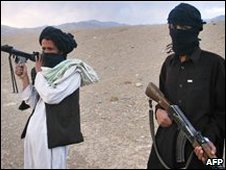
The Taleban are believed to have safe
havens in the Afghan border region

Great caution must be exercised in any talks with Afghan insurgents, an influential
think-tank has said in a warning to Kabul and Washington. The International Crisis
Group said previous deals had broken down within months and strengthened the
militants. Instead, it said Afghans needed a stronger state and the rule of law.

US President Barack Obama has floated the idea of talking to moderate Taleban
elements as part of a new strategy for the war against the militants. US Joint Chiefs
of Staff Chairman Adm Mike Mullen said on Friday that the Obama administration
was close to announcing the new strategy.

US officials say that key objectives will be getting Pakistani help in the fight against
extremism and reducing American expectations for military victory. The White House
expects to announce the new objectives for the war - which it admits is not being
won - next week.

President Obama has recently ordered the deployment of additional 17,000 troops
to Afghanistan. Since the Taleban was ousted in 2001, the number of US troops in
Afghanistan has risen to about 70,000.


'No easy options'

In its report, the Brussels-based ICG warned that previous truce deals with militants
in Afghanistan and Pakistan "enhanced the power and activities of violent insurgents,
while doing nothing to build sustainable institutions".

Instead, the ICG called for the strengthening of security, democracy and the rule of
law to win over war-weary Afghans. "Only when citizens perceive the state as legitimate
and capable of delivering security, good governance and [the] rule of law will Afghans
be able to resist jihadi presssures and overtures," the report said.

The think-tank admitted that there were no easy options in fighting militants. "We know
now what no to do... Knowing what to do, and how to do it, is harder," the ICG said.

President Barack Obama's administration is close to announcing its new strategy for
the war against the Taleban in Afghanistan, officials say. "We're just about done,"
Joint Chiefs of Staff Chairman Adm Mike Mullen said. Officials say that key objectives
will be getting Pakistani help in the fight against extremism and reducing American
expectations for military victory.

The White House expects to announce the new objectives for the war - which it admits
is not being won - next week.

Safe havens

Officials say that the role of Pakistan is critical within the new strategy and that it must
be made to realise that doing more to contain extremism is in its own interests as well
as those of the international community.

President Obama is expected to explain his plans to allies when he attends a Nato summit
in Europe next month. His priorities are expected to mirror 15 goals detailed in a 20-page
classified report to the White House from the Joint Chiefs of Staff. Prominent among them
are eradicating Taleban and al-Qaeda safe havens in north-western Pakistan, pursuing a
regional approach to reduce extremism while simultaneously boosting economic aid.

Another top priority is to ensure that the Afghan government does not collapse as a result
of the Taleban insurgency - an objective officials say again can only be fulfilled by securing
the co-operation of Pakistan and by substantially increasing the size of Afghanistan's security
forces.

Better governance

Adm Mullen said that the review addresses "the safe haven in Pakistan, making sure that
Afghanistan doesn't provide a capability in the long run or an environment in which al-Qaeda
could return or the Taleban could return". He said it was also important to ensure Afghanistan
remained stable and had better governance.

The in-house review was carried out by the White House National Security Council and details
objectives over the next three to five years. Officials stress that the timeframe of the review
does not mean that the US military will leave within that time.

Gen David Petraeus, head of US Central Command, and Richard Holbrooke, the US special
envoy to Afghanistan and Pakistan, met more 12 senators to discuss the war on Thursday.

Correspondents say that the meeting was part of the administration's effort to gather support
for trimmed-down US objectives in Afghanistan, especially in relation to democracy and
self-sufficiency.

A key premise is that the military alone cannot win the war, officials said. But part of the
strategy is also military, with the deployment of 17,000 additional troops this year in order
to "buy time" for less tangible counterinsurgency tactics to take hold.
 
Back
Top