The latest Tariff threat? Aircraft and Bombardier. Noah Note.
Noah
Jan 29, 2026
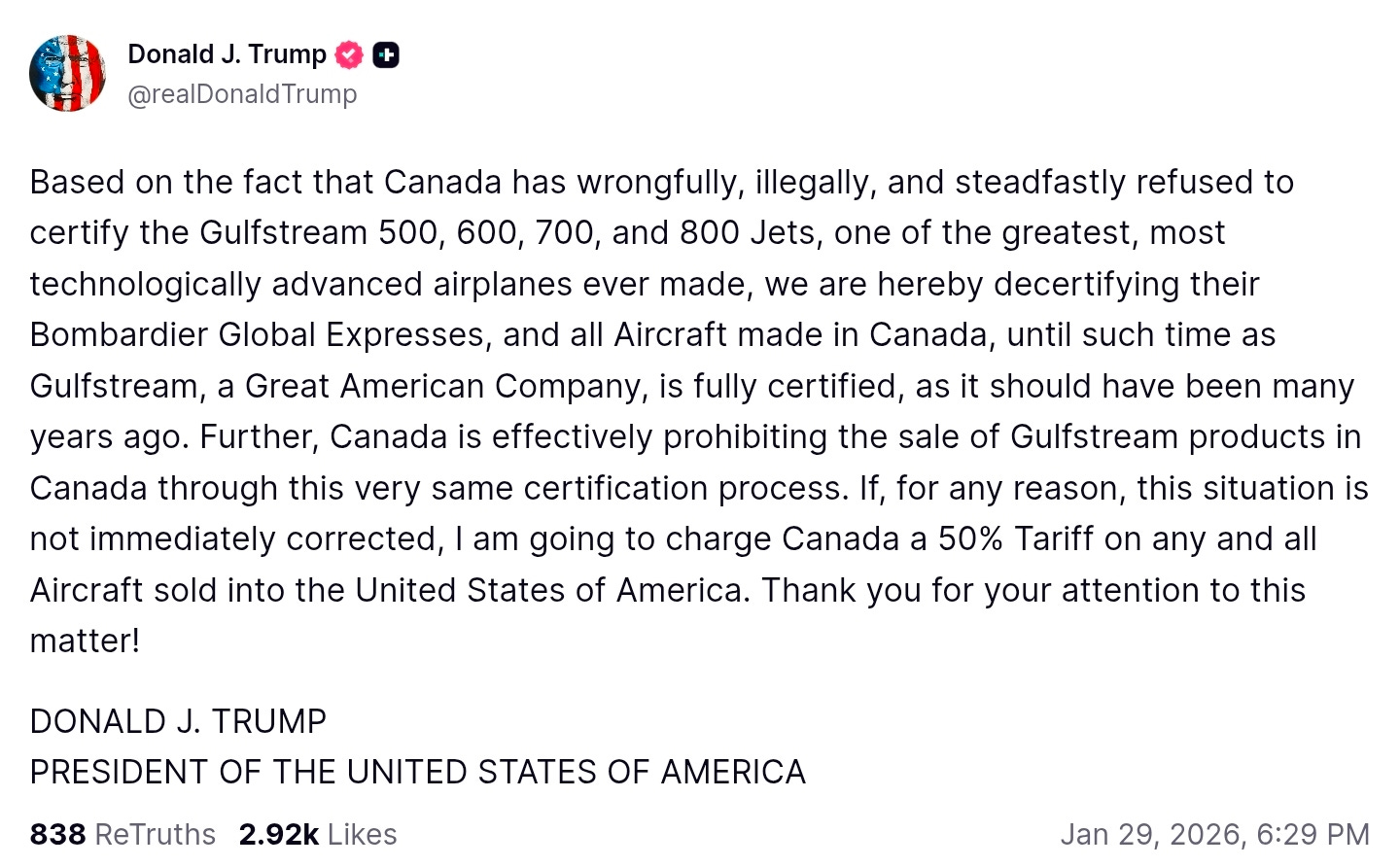
Another night, another tariff threat. This time we're moving from our traditional sectors to take a jab at our humble Aerospace industry. At a time when one would think the United States might care a bit about keeping Aerospace out of the Canadian discussion, President Trump has decided to once again beat the tariff drum and decided to go after the Canadian Aerospace industry, and specifically yelling at Bombardier.
Of course for this administration the belief that threats can solve everything is ever present, so not a surprise at all. All this stems from a long-standing regulatory logjam at Transport Canada. While the FAA in the U.S. has moved forward with certifying the latest Gulfstream fleet, Canadian regulators have been more deliberate, or "steadfastly refused," in the President's phrasing, to grant the final stamp of approval.
Of course what's not mentioned here is that the FAA had granted ongoing safety exemptions to the latest Gulfstream to get them certified that run through this year. A lot of this discussion is regarding engine software, Fuel-Icing, and other electronic equipment but I could be missing a few. Honestly im not up to date on the topic.
In the meantime Bombardier and the Global family continue to increase their American market share. This is backed by several major investments, the exact same the president is so desperate to see, into their U.S. operations.
This includes a brand-new, 46,000-square-foot component manufacturing facility in California last year, a
new 64,500 sq. ft service center in Indiana, and
the completion of their massive 300,000-square-foot service center in 2022. That's now the largest business aviation MRO (Maintenance, Repair, and Overhaul) facility in the U.S.
Bombardier, funny enough has been one of the more proactive major Canadian companies in investing in their American supply chain, yet still can't seem to escape the grasp of faux political interest. Never mind also that the United States military has also been a major supporter of Bombardier, with the Global airframe in use as both the E-11A and in the newer HADES. Again, irony.
Eventually this stuff gets a bit tiring. I expect Trump to back down again, especially as those with Bombardier aircraft among his circle hear the news. They don't seem to fond of Gulfstreams do they? However the constant threats, and now specifically going after our Aerospace industry make me feel more and more like debates on the F-35 are quickly moving to a breakoff conclusion.
It's hard to imagine the scenario that the Trump administration envisions. Threaten our Aerospace industry, bully us, and then tell us to buy your aircraft? Eventually people just say fuck it. They don't care. We were already very close to that, but the recent string of events feels like it's drawing us ever closer to a Swedish future.
There comes a point where platforms and capabilities take a back seat to political climate and downright exhaustion. Its tiring to have to watch this circus, to have to be in the middle. Eventually you just want to bite the bullet, because you know no matter whay the threats will keep coming, and they'll see you worse off if you do listen.
Anyways, I don't expect much to come of it, save more firm contracts for Bombardier. If you're Boeing or Lockheed you might be counting your losses by this end. Of course AEWC was always gonna be a mainly Bombardier show, given the Liberal promise for a Canadian-made aircraft.
Perhaps this will encourage the DIA to finally get inboard with me 20+ Global fleet with all my wanted variants. I think I could sell them.
Noah Note: This of course goes a lot wider than Bombardier. This also hits major suppliers like Bell and Dehavilland as well. Both of which hold significant shares of their markets as well.
The impact extends far beyond Bombardier. It threatens the entire North American aerospace corridor. This includes Bell’s commercial line, which produces the majority of their global helicopters in Quebec, and De Havilland’s Dash and CL families, which are critical for U.S. regional travel and wildfire suppression. Then you get into Airbus….
All of which would be hit by these proposed tariffs, and for what? To open up a new, already dominated market for the Gulfstream? It would seem so silly if it weren't so stupid.




 www.cnbc.com

:max_bytes(150000):strip_icc():focal(748x526:750x528)/Donald-Trump-Air-Force-One-January-2026-011226-e3e449db9e2f4dad9083a0ea8287d661.jpg)