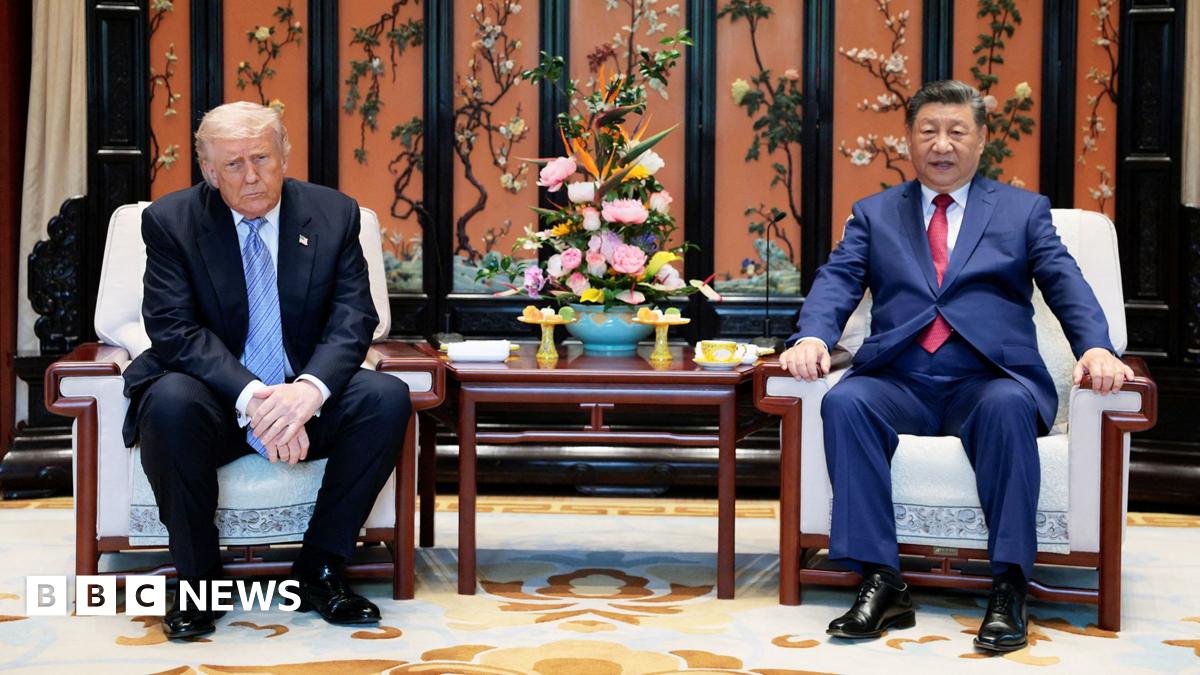
The US president says he wants Beijing and Taipei to "cool down" tensions over the self-governing island.

www.bbc.co.uk
This is a solid read of the current thinking of a former deputy national security advisor who ran the desk at the NY Federal Reserve. He lays out his thought process on dealing with increasing bond yields and he talks specifically on where he thinks the 10yr yield will be by end of year.
Daleep Singh knows how energy and markets intersect. He sees trouble ahead.

www.cnbc.com
Q: How great is the risk of the 10-year Treasury yield getting to 5% in the next couple of months?
Singh: I think it’s probable. We’re on the cusp of a bond-vigilante trade right now. It’s materializing in the U.K. These moves tend to take on a life of their own, and they don’t self-correct until there’s a policy response.
Q: The 10-year Treasury yield topped 4.6% at one point on Friday, the highest in nearly a year. Yields in the U.K., Japan, and elsewhere are rising. What is your diagnosis of the global bond market?
Singh: It’s the byproduct of these forces we’re discussing. If we’re going to live in a world in which
fiscal deficits continue to increase indefinitely, there’s really not any political will to do something about that, and you have, at least in the U.S., a central bank that’s, let’s just say, uniquely hesitant to hike, then it just stands to reason that the yield curve is going to steepen. Long-term yields will continue to increase, because buyers need more compensation against the fiscal risk and the inflation risk that they’re absorbing now.
If this continues, and let’s say Treasury yields [on the 10-year note] march to 5% or above, it won’t be long before the Treasury secretary says, “Listen, I have a toolkit as well, and I’m not afraid to use it.” The Treasury secretary can shorten the weighted average maturity of our debt issuance, make more aggressive use of the buyback tool, and potentially jawbone the market with the Fed and say we may have to engage in purchases of long-end bonds to align them with long-term fundamentals.
In other words, that is financial repression [when the government artificially holds interest rates down, making debt more manageable at the cost of harming savers, among other risks].
I think that’s the end game for the bond market, because 5%-plus bond yields are not sustainable for a variety of reasons.
Q: Let’s turn to Iran. Can you lay out your thinking on what is happening there?
Singh: I think neither side has escalation dominance, but neither the U.S. nor Iran fully realizes that reality.
The costs both politically and economically of a ground invasion that effectuates regime change in Iran are too high for President Trump, both because of the casualty count on the ground, but also because Iran would undoubtedly further weaponize its asymmetric advantages in the Strait of Hormuz and the Red Sea.
For Iran, I think it also understands that if it overplays its hand, it may precipitate what it’s trying to prevent, which is the U.S. sending in ground troops.
We require both sides to recognize this reality that neither side can subdue the other, and that’s why we’re in this stalemate.
That’s where
China comes in, and I’ll be interested to hear more details of what was said and agreed in Beijing [during Trump’s summit with Xi Jinping].
We’re probably a month or two away from this type of deal coming together, because if it lingers much longer then this becomes an unsustainable conflict for the White House.
Q: What is your sense of how long the Iranians can withstand the kind of economic pressure that they’re under now from the blockade?
Singh: My experience firsthand, in terms of applying maximal economic pressure to an autocratic regime, is they tend to have a much longer runway than democratic, Western leaders assume, because necessity is the mother of invention. They will, they will develop workarounds to get paid through barter arrangements, through crypto, through non-dollar currencies, and it becomes a cat-and-mouse game.
Because their risks are existential, they have a greater incentive to find ways to continue to get paid that are outside of our capacity to detect.
I’ve been very skeptical of claims that the blockade by itself is sufficient to cause the Iranian regime to surrender to an unfavorable deal.




 www.reuters.com