• Thanks for stopping by. Logging in to a registered account will remove all generic ads. Please reach out with any questions or concerns.

Trump administration 2024-2028

It still doesn’t justify Gestapo tactics and disguising you identity and legitimate law enforcement status.
Those are two different things. It isn't rhetorically clever to "AND" them to force an association. Gestapo tactics aren't justified. Disguising identity under some circumstances is. ICE isn't the first agency to conduct operations masked.
I don’t see anything about doxxing goons (I refuse to give them the respect of law enforcement officers so long as they act unprofessionally deploying questionable, if not illegal tactics) here.
You're condemning all for the actions of some - I suppose only a few. That makes no sense.
A psycho shoots randomly at a known ICE facility killing detainees. As far as I know, it’s still not clear if he was targeting agents or detainees. Even if he was targeting goons, they were employing these tactics before the incident.
We can never know, since he killed himself. But he was an anti-ICE activist, not an anti-immigrant activist.
 
So when your party goes off the deep end and there is no way to right the ship, you should just STFU. Got it.
The party has not gone off the deep end. The political structure of the US from top to bottom is much, much more than just a presidential administration.

It is impossible to know whether a ship can be righted if you don't put in some hard work first. The NeverTrumpers are spoiled children acting like control of Republican presidential politics should be handed to them on a platter by unquestioning voters who merely express gratitude for the benevolent rulers whose chief skills are regime change and other foreign interventionism, all of it very costly.

But, yeah, they and those who follow them are missing an excellent opportunity to say nothing, preferably for years. It's not as if they are pure disinterested critics delivering perspicacious objective insights from afar. They've mostly allied with what used to be their antithesis. And as I just wrote, there's a lot more going on in America than just a presidential administration. The fact that they focus on that so much reveals their power obsession.
 
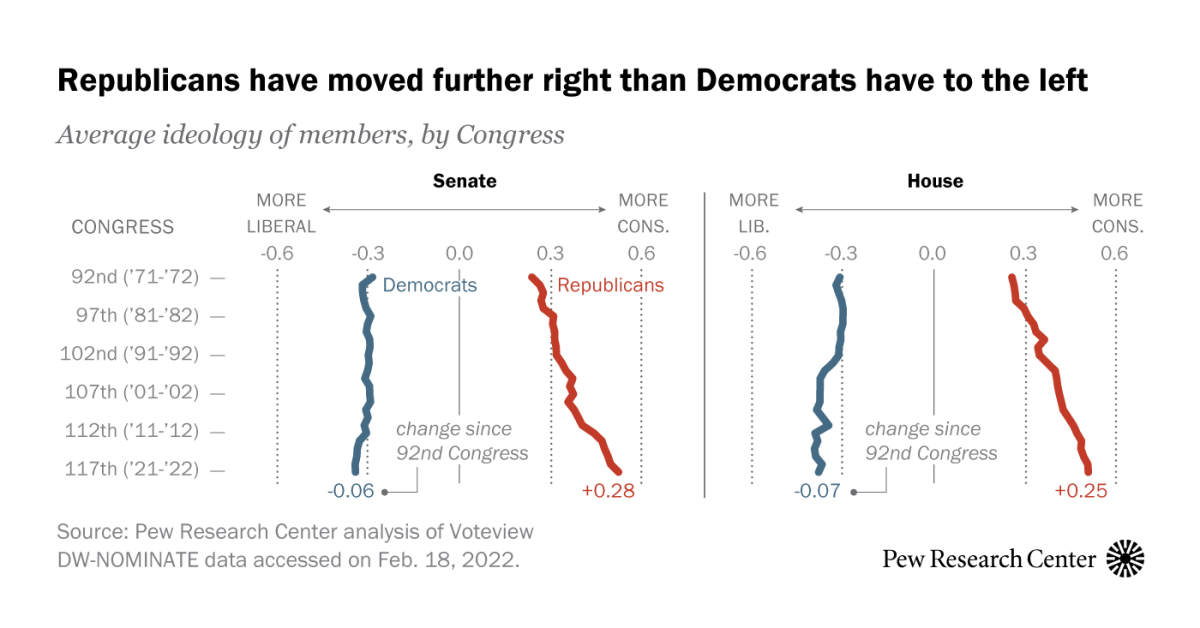
Political Values 1994-2017 (Pew Research).

That aside, is it your contention that Republicans are closing the ideological gap between them and Democrats, or that Republicans continue to drift rightward? The former seems absurd. To the latter, apply common sense: on matters of sexual expression alone, the median US conservative is more accepting now (eg. general lifestyle choices, acceptability in mainstream society, same-sex marriage) than during the Reagan/Clinton era. On matters of racial politics, the same. Bottom line, there is no evidence of more than a very small minority of extremists wanting to revert to pre-1980 norms let alone pre-1964 ones.

If Republicans are not actually drifting right and are not closing the gap with Democrats moving left, they cannot be moving with greater velocity in either direction. The claim that Republicans are becoming "more extreme" is a rhetorical misrepresentation of the increasing distance between the median ideological attitudes, but as in physics, there are no preferred frames of reference in politics. All we can do is pick a date and measure changes in attitudes since that time.

Definitionally: progressives seek more change than conservatives.

[Add: for the presidential succession comparison - which is not a reflection of the US as a whole - as a matter of policy positions, Trump is held by many US political observers to be approximately a 1990s Democrat].
Well, getting away from Presidents and focusing on congress, this Pew Research article from 2022 states that Republicans have become more conservative more than Democrats have become more liberal:

 
Well, getting away from Presidents and focusing on congress, this Pew Research article from 2022 states that Republicans have become more conservative more than Democrats have become more liberal:

That is interesting.

Is there an explanation consistent with my assertions?

The results for 1994-2017 are surveys of the American public using the same set of questions. Those are measurements relative to a fixed point, and my conclusions are drawn with reference to that fixed point.

The congressional polarization survey is a survey of congressional members voting records on issues measured by whatever DW_NOMINATE does.

"Both parties have moved further away from the ideological center since the early 1970s. Democrats on average have become somewhat more liberal, while Republicans on average have become much more conservative."

An ideological center is a midpoint between two ideologies, and necessarily moves as the respective ideologies change. Even if the claim is that the methodology is supposed to have a fixed center, DW_NOMINATE cannot define such a fixed point because legislative votes are not a set of fixed questions; there is a subjective judgement as to where they fit in the ideological space.

All that has to happen for Republicans to appear to move one way is for a not truly fixed center to move the other. But let the premise of the fixed center be granted. If Republicans on average started more moderate than Democrats, they would appear to move more as both parties purged their moderates - which is what is claimed: "Five decades ago, 144 House Republicans were less conservative than the most conservative Democrat, and 52 House Democrats were less liberal than the most liberal Republican, according to the analysis.".

Regardless, Congressional voting records on arbitrarily siloed and scored issues are not a proxy for public attitudes and in particular for the ideological shift of the American population of Democrats and Republicans throughout the country and up and down the levels of government. I maintain that progressives are, definitionally and empirically, moving left faster than conservatives, and that conservatives are moving left.
 

Last weekend, SNAP benefits lapsed for the first time in our nation’s history. This is a problem that could have and should have been avoided,” said U.S. District Judge John McConnell Jr., an Obama appointee. The government “knew there would be a long delay in paying [partial] SNAP benefits and failed to consider the harms individuals who rely on those benefits would suffer.”

McConnell also noted that President Donald Trump’s post on social media that benefits wouldn’t be funded until the government reopened “stated his intent to defy the court order.”

Seems we are at the ignoring the courts phase of this administration.
 
Seems we are at the ignoring the courts phase of this administration.
They aren't ignoring the courts; they're challenging the courts. An unanswered question is how much latitude the courts have to decide how Congress means appropriations to be spent. If Congress didn't intend the contingency fund to be used for covering a shortfall during a routine (for Congress) budget dispute in the legislature, a court may not have the power to order it so.

A separate observation: too much ridiculous behaviour from a few ideologically-motivated judges, and all judges will look equally ridiculous. The profession's reputational integrity is only as strong as its weakest members'. Judges, regulate thyselves.
 
Some more on the latest TACO with Beijing.


It has been a week—which means Donald Trump has already moved on to new outrages—but one of his decisions from his recent trip to Asia is going to stick. After meeting with China’s President Xi Jinping, Trump announced he would pull back from the trade war he launched shortly after taking office in January.

In doing so, Trump walked away from a worthwhile goal: pushing back against China’s decades-long assault on global manufacturing. Thanks to massive subsidies, Chinese industries now dominate world trade. Chinese factories produce one-third of all globally traded goods—more than the U.S., Germany, and Japan combined—while hollowing out manufacturing jobs at home and abroad.

Put simply, China doesn’t play fair. Its state-backed companies flood markets with cheap products to undercut competition. Presidents from George W. Bush to Joe Biden have tried to counter this with targeted tariffs. Trump initially implemented a broader but still rational tariff strategy, which Biden even kept in place. But in his return to office, Trump escalated that strategy into a chaotic trade war driven by personal impulse, not policy. He forgot that China had a powerful weapon of its own—and was more than willing to use it.


China controls the global control of rare earth minerals—critical components for high-tech manufacturing (worth noting, the US possesses plenty of these minerals, but mining restrictions and regulations have prevented access good or bad). Most importantly, it produces 98 percent of the world’s rare earth magnets, essential for everything from missiles to smartphones. On September 9, China imposed restrictions on rare earth exports, sending shockwaves through the tech industry. Trump’s trade representative, Jamieson Greer, put it bluntly: “This will give China control over basically the entire global economy and the technology supply chain.”

Outmaneuvered, the Trump administration quickly agreed to a deal that included:

  • A 50% reduction in U.S. tariffs on certain Chinese products
  • A drop in overall tariffs on Chinese goods, from 57% to 47%
  • A one-year pause on export controls for high-tech U.S. products like semiconductor equipment, which to this point had been restricted due to the AI race. This gives China a win, and a leg up in the race.
  • A similar pause on port fees for Chinese-built, owned, or flagged cargo ships
And what did the U.S. get in return? China agreed to suspend retaliatory tariffs on American agricultural products and buy 12 million metric tons of soybeans- EXACTLY what they were purchasing BEFORE. It also agreed to resume sales of rare earth metals and magnets.

The rare earth issue may have forced Trump’s retreat, but let’s be clear: long before that, his 125% tariffs on Chinese imports were already hurting Americans. Consumers paid higher prices for clothing, furniture, toys, electronics, and more. There is still no evidence that even a single American manufacturing job was created as a result. Meanwhile, China continues to dominate the booming market for solar panels and wind turbines, and it’s rapidly closing the gap with the U.S. in artificial intelligence and information technology.

So how did Trump respond to China’s growing strength? He canceled federal programs that supported renewable energy production in the U.S. He even proposed cutting a program that helps build domestic semiconductor manufacturing—the very technology that powers AI and keeps America competitive.

When it comes to China, Trump is missing intelligence in more ways than one. He doesn’t even understand who pays the price for his tariffs. Just weeks ago, Goldman Sachs released a report showing who actually bears the cost: American consumers pay 55%, U.S. companies pay 22%, and exporters in China and elsewhere pay just 18%.

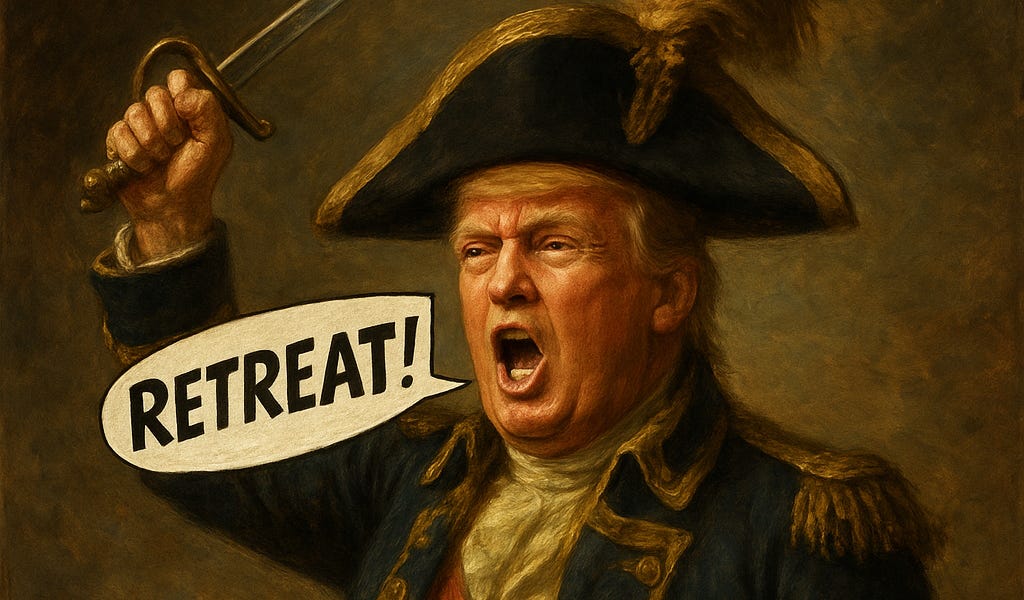
Trump and his allies keep insisting that America is “winning.” If that’s true, then why are we the ones retreating?

 
Assuming not everyone who works for ICE is a goon, it's reasonable for the ones worried about being doxxed and harassed or threatened to tell the FBI to go pound sand and tell all applicable LEOs to do their job and go after people impersonating officers.
Surely they have nothing to worry about identifying themselves if they arent breaking the law?
 
And “sandwich guy” acquitted.


The Feds refused to allow him to peacefully surrender himself to the police and went in with a tactical team and film crew instead.


The DOJ then failed to indict him for a raft of felonies, only getting him indicted on a single misdemeanour. I guess it’s not as easy to indict a ham sandwich as they say it is.
 
They aren't ignoring the courts; they're challenging the courts. An unanswered question is how much latitude the courts have to decide how Congress means appropriations to be spent. If Congress didn't intend the contingency fund to be used for covering a shortfall during a routine (for Congress) budget dispute in the legislature, a court may not have the power to order it so.

A separate observation: too much ridiculous behaviour from a few ideologically-motivated judges, and all judges will look equally ridiculous. The profession's reputational integrity is only as strong as its weakest members'. Judges, regulate thyselves.

Legislatures and courts are not opposing members of debating societies. Legislatures make laws. Courts are there to adjudicate between parties one of whom might be the executive acting in a way that they think is in accordance with the law. It's important to note that legislatures do not appear in court, its either private parties or government executives who are administering the law who generally appear in court to argue how the law is to be interpreted.

Sometimes courts say that the executive is not following the law. Sometimes the courts go so far as to say the law itself is unconstitutional. Once the court rules, the debate is done and the decision stands unless or until overturned on appeal. In the meantime, the ruling stands and must be obeyed unless that court or a higher court stays the ruling pending appeal.

If the nation's highest court does find the executive is acting outside the law then the only remedy that the executive has is to convince the legislature to change the law in a way that it likes. When a law is found unconstitutional then again, the legislature has the right to change the law in a way that is constitutional, and, in an extreme case, change the constitution (or in our case use a notwithstanding provision)

There is no "unanswered question" about "how much latitude the courts have to decide how Congress means appropriations to be spent." A court's very purpose is to interpret the law as written and to fill in the blanks where the law is vague. There is a vast body of law on statutory interpretation to assist the courts in this process. The power of the courts are derived from Article III of the US Constitution as augmented by the very laws passed by Congress.

Just a quick comment on "ridiculous behaviour from a few Ideologically-motivated judges." That cuts both ways. I personally find it amusing how some people think that only judges with an ideology opposed to theirs are the ridiculous ones. The profession is not: "only as strong as its weakest members." Quite the opposite, here and even in the US, the profession is strong despite its weakest members. It's the parties with the weakest arguments that try to demean or tear down those who decide against them.

🍻
 
And “sandwich guy” acquitted.


The Feds refused to allow him to peacefully surrender himself to the police and went in with a tactical team and film crew instead.


The DOJ then failed to indict him for a raft of felonies, only getting him indicted on a single misdemeanour. I guess it’s not as easy to indict a ham sandwich as they say it is.
The whole thing was an utter farce. Give the guy a ticket for drunk and disorderly or something appropriately minor like that. The administration tried to make an example of him and just got humiliated both by grand then trial juries. The criminal trial was almost certainly a case of jury nullification of a BS charge.

The guy was being a drunken buffoon. Handle it as such.

And now some dumb dumb federal agent gets to spend the rest of his career being the guy who took the stand to rather dubiously and exaggeratedly describe how the sandwich ‘exploded’ on him. And it had onions.
 
The whole thing was an utter farce. Give the guy a ticket for drunk and disorderly or something appropriately minor like that. The administration tried to make an example of him and just got humiliated both by grand then trial juries. The criminal trial was almost certainly a case of jury nullification of a BS charge.

The guy was being a drunken buffoon. Handle it as such.

And now some dumb dumb federal agent gets to spend the rest of his career being the guy who took the stand to rather dubiously and exaggeratedly describe how the sandwich ‘exploded’ on him. And it had onions.
His callsign is now; "The Onionator"
 
To be clear, I’m anti-throwing-sandwiches-at-police. I just think the Feds humiliated themselves humiliated themselves trying to portray him as some kind of radical terrorist and how public they were in trying to charge him as such.

If they just kicked him loose with a ticket, we would never have heard of this incident.
 
To be clear, I’m anti-throwing-sandwiches-at-police. I just think the Feds humiliated themselves humiliated themselves trying to portray him as some kind of radical terrorist and how public they were in trying to charge him as such.

If they just kicked him loose with a ticket, we would never have heard of this incident.
Absolutely agreed.
 
There is no "unanswered question" about "how much latitude the courts have to decide how Congress means appropriations to be spent." A court's very purpose is to interpret the law as written and to fill in the blanks where the law is vague. There is a vast body of law on statutory interpretation to assist the courts in this process. The power of the courts are derived from Article III of the US Constitution as augmented by the very laws passed by Congress.
As with most of what I write about American politics, I pass along American opinions about their own country and government. Most of those opinions are informed. Americans in America, some of whom work or have worked as lawyers or otherwise adjacent to legal matters of governance, hold the opinion that what courts can tell the administration to do in this particular matter is open to challenge. They don't believe the court can interpret what constitutes legitimate use of the contingency funds, and more strongly don't believe a court could require an administration to spend funds not yet formally appropriated if any judicial decision were to go that far.
Just a quick comment on "ridiculous behaviour from a few Ideologically-motivated judges." That cuts both ways.
It surely does. It manifests mostly against whatever party controls the WH. Today, that is Republicans.
I personally find it amusing how some people think that only judges with an ideology opposed to theirs are the ridiculous ones. The profession is not: "only as strong as its weakest members." Quite the opposite, here and even in the US, the profession is strong despite its weakest members. It's the parties with the weakest arguments that try to demean or tear down those who decide against them.
Whether or not the profession among its practitioners is strong is not my point. I wrote about its reputation. Degrade its reputation enough, and it loses popular support. This is a matter of critical importance: courts have very little power to enforce their decisions, ultimately depending on the polity to deliver the message to politicians (the executive branch in particular) that they better respect the courts, or else. If people see enough of what looks like partisan legal warfare, read opinions describing it as such, and then subsequently do indeed see the decisions slapped down by higher courts, sometimes in very strong terms, the collective reputation of all courts suffers.
 
Part of me is a little surprised he hasn't fashioned himself a gaudy uniform. He is CIC after all and seems to love lots of bling.

Maybe he gets a uniform like our GG. And a whole bunch of new medals too.
 
Back
Top