• Thanks for stopping by. Logging in to a registered account will remove all generic ads. Please reach out with any questions or concerns.

Bridges & Equipment of an Engineering Regiment

As an aside, have any of you ever driven/see any vehicle cross over the MGB (and isn't it a class 60 bridge max?)? I'd imagine it must be one scary  thing to do. How many (wheeled) vehicles can cross over it anyway (in its class 60 configuration)?  In ... errr.... 8 years of messing about with it,  I never saw a single vehicle cross over  it - a ruined back, ruined shoulders and never the satisfaction of seeing a purpose for the effort.  Maybe it's time to return to service the American 'Class 60 Over Bridge' (the one under the Sherman tank (or was it the Centurion?) that used to be in long gone and still lamented CFB  Chilliwack: By the way,  Are those monuments/tanks in Edmonton now, and does anyone know the history behind them - (I can remember the Sherman being on the Carl Gustav range in 1977 and the Centurions being in a vehicle dump in CFB Wainwright)).
    if it takes 7 months to become a skilled operator of a bridging tank, then maybe someone somewhere should persuade someone of the necessity to retain the skills (time to have an open house and time to invite in a few journalists to see a demonstration... but ummm.... i guess that career-wise that would be suicidal).
 
Jack, your memory must be fritzing.  Every bridge I ever built on a gallop (not dry training on base) was trafficed.  The build wasn't considered done till the bridge was crossed.  120' span junction MGB is mlc 60, I believe link reinforced is mlc 70. 10 years since I built a double story single span MGB, and that was in the 1CER compound in Edmonton, so I'm a little rusty on my facts.  3 months to make an Armoured Engineer, not including D&M.
 
Well, the rumours have it that MGB is also done.
We had effectively lost our EOD capability but re-learned it once the need came back in Afghanistan, so the branch has decided this demonstrates we can re-establish (on demand) capabilities that were cut when the demand was low.

... of course, the Air Force and Navy had kept the EOD capability and were available to re-teach the Army for Afghanistan.
 
Without bridging assets, how are Military Engineers going to maintain mobility  or Line of Communications for our BGs ? I think we are losing a pretty key capability that can not be recovered anytime soon. The highways department in Sask cut their Bridge Branch decades ago and many of the highways suffered as the private sector supposedly picked up the slack. Instead of roads being capable in a timely fashion it now takes several months to effectively get across any significant gap. Of course they build NSB like structures or substutute culverts which wash out during the next 10 yr flood event.

 
Hey Kat! Of course my memory is fritzing. I teach English in Poland - how can it not? It's not just the memory either.
    Seriously though, isn't 'aid to civil power' one of the roles of the military? So what can engineer units bring to the table - some  EOD work, the diving section, bridging, water supply, trained heavy equipment operators and trained and organized labour. Therefore it could be pointed out to the government the crucial need for modern rapid bridging materials in the event of natural disaster. Maybe a deal could be swung with provincial authorities for a stockpile of bridging materials (Acrow) and practice time for engineer units to train in their assembly (after-all, it could be pointed out that votes might be lost if aid is not gotten to people in time).
 
good article on it  http://www.thinkdefence.co.uk/2012/01/uk-military-bridging-equipment-medium-girder-bridge/

The aussie solution http://www.ausa.org/publications/armymagazine/archive/2004/6/Documents/SA_0604.pdf

Acrow is still being made and used by Highway departments and can be rented http://acrow.com/products-services/bridges/
 
speaking of bridging, this is interesting

the-week-in-photos-sept-28-oct-2-2.jpg
 
Colin P said:
speaking of bridging, this is interesting

the-week-in-photos-sept-28-oct-2-2.jpg

Recycling at its best.  Not for the claustrophobic, but a cure for those who are afraid of heights when on high level crossings.  Nice replacement for any covered bridge that may have been 'torched' by vandals.
 
delmiss said:
oh - I apologise. I should have written that I am surprised that 1 CER is not co-located with the land-area's bridge holdings - so where are those located?
  On the TQ5 course, does a corporal-to-be still learn to be a bridge commander? The course I had, I believe, was the last of the 'long' courses (1980) - great course - both staff and members.

If I am not mistaken some bridging equipment is still held in Chilliwack while the rest is with 1 EET in Wainwright (I think ).

As for bridge commander that is on the QL6A (DP3A) Section Commander Course (Sgt's course)
 
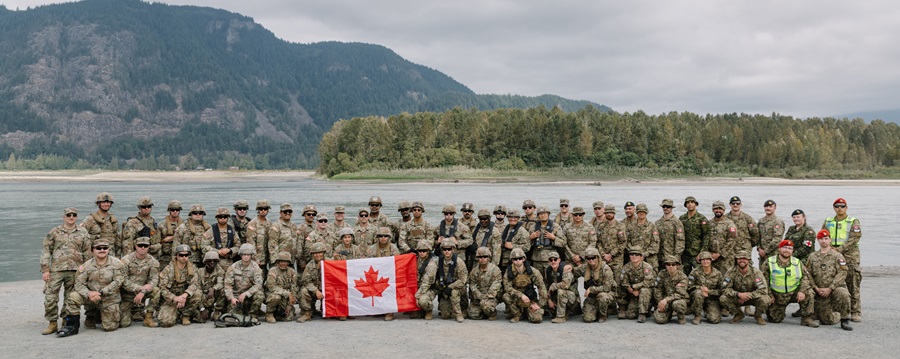
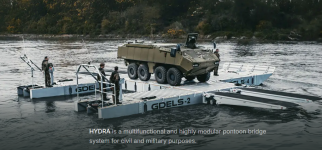
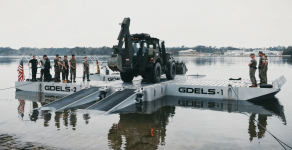
Bump, bridging equipment coming back into fasion....

Germany and the UK have also bought them, as has Latvia.

From available literature it appears that the UK is buying 36 units, with support, for 262 MUSD. That works out to about 7 MUSD apiece.


A few sets of these scattered around the country might be useful. One set for each province/territory/brigade as a starting point.
Might be handy the next time it floods in BC, Manitoba, Quebec or Newfoundland
 
Bump, bridging equipment coming back into fasion....

Germany and the UK have also bought them, as has Latvia.

From available literature it appears that the UK is buying 36 units, with support, for 262 MUSD. That works out to about 7 MUSD apiece.


A few sets of these scattered around the country might be useful. One set for each province/territory/brigade as a starting point.
Might be handy the next time it floods in BC, Manitoba, Quebec or Newfoundland

FWIW... USMC work with the Norge military using pre-positioned bridging equipment.

The US has a vast amount of materiel pre-positioned there, mainly because (until recently) Norway was the only NATO country bordering Russia, and the need to secure NATO's northern flank against a Russkie blitz out of Murmansk.

I wonder if this service will be extended to our newer NATO countries like Sweden and Finland...

 
It's not that the CA doesn't have any wet gap crossing capability.


But there is room for improvement.


A few sets of these scattered around the country might be useful. One set for each province/territory/brigade as a starting point.
Might be handy the next time it floods in BC, Manitoba, Quebec or Newfoundland

My view remains that the military shouldn't be buying equipment based on "might be useful" in case a province was too cheap to prepare properly for disaster. If there was a federal disaster response organization it should be civilian based, even if such an organization (heaven forbid) was an agency of DND. There are also "lighter" and "cheaper" bridge/ferry alternatives.

1765141965135.png

1765142318989.png
 
It's not that the CA doesn't have any wet gap crossing capability.


But there is room for improvement.


My view remains that the military shouldn't be buying equipment based on "might be useful" in case a province was too cheap to prepare properly for disaster. If there was a federal disaster response organization it should be civilian based, even if such an organization (heaven forbid) was an agency of DND. There are also "lighter" and "cheaper" bridge/ferry alternatives.

View attachment 97114

View attachment 97115


My view is that the entire rationale for a military is that it "might be useful". If it is being used daily then it is not being husbanded for that occasion when there are no other options.

And civil/military has never been as clear a distinction as some would wish.

Again, the US National Guard, answerable to both State and Federal governments in peace and war is a useful example.

They have cargo planes, heicopters, trucks and radios precisely because they are dual function kit. Supplying tha CAF with lots of gap and water crossing systems and nesting them across the country makes sense to me.
 
Last edited:
There are also "lighter" and "cheaper" bridge/ferry alternatives.
Not sure what quotation marks are supposed to communicate, but lighter rafts & floating bridge won’t carry our tanks nor heavy logistics vehicles.
 
Not sure what quotation marks are supposed to communicate, but lighter rafts & floating bridge won’t carry our tanks nor heavy logistics vehicles.

My post was a response to @Kirkhill's suggestion that M3s be acquired and positioned in each province just in case they "might be useful" if there was a civilian disaster situation that required some sort of wet gap crossing capability. My opinion is that the military should acquire, position and maintain equipment only for military (read warlike) requirements. That doesn't mean they can't be used for a civilian disaster response - the caveat being that if they are engaged in military operations, they are unavailable for that response. My reference to the lighter and cheaper versions (quotation marks were for emphasis) was not to suggest that the CAF get them instead of whatever is needed to accommodate military requirements but that they may be more appropriate for a civilian disaster response organization (which I believe should be the appropriate first provincial/federal response - the military being last responders).

All too often (at least on these means) the discussion of a military capability includes reference to its potential usefulness in disaster response, sometimes so much so that it's military purpose almost seems secondary. I understand that the political aspect may require using civilian disaster response usefulness as a selling point but that only adds to the inclination to request the military when the weather is particularly inclement.
 
So buy the Reserves equipment for disaster response along with being deployable. Buy the regular force equipment that is only deployable. (Can be the same equipment, just label one se disaster response and the other military property).
Then stock pile a metric crap ton of the Reserve equipment close to known disaster areas with Reserve Engineer units.
Stock pile a crap load of regular force equipment in the storage yards 25 Supply Depot Quebec.
Voila you have a simplified workable solution.
Then use our transport drivers with their new trucks to deliver and rotate stocks as required.
Failing all that just move aside and hire the numerous companies that offer temporary and permanent bridge capabilities in our country. They can use the business and or train in new methods of baily bridge/upgraded type construction, installation and demobilization.
 
Back
Top