• Thanks for stopping by. Logging in to a registered account will remove all generic ads. Please reach out with any questions or concerns.

Pipelines, energy and natural resources

  • Thread starter Thread starter QV
  • Start date Start date
You're continently glossing over the latitudes of those countries compared to one of our most southern cities, Toronto. Solar makes a heck of a lot more sense at the equator or even subtropical zones than it does in Toronto which averages about 3 hours of sunlight in the winter months.

They use what they have and we're forcing solutions into geography that doesn't work while locking abundant, cheap, natural gas behind ideology.
this is partially true but Toronto gets 8hrs and 55 minutes of sunlight on dec 21
 
And even that is irrelevant. Let's say a kW of panels magically became $2k to put on the roof? Pretty much every second home would have them. Price is all that matters.

its less than a $1/W in Australia
 
  • Like
Reactions: ytz
Compare to whom?

Depends on the industry.


its less than a $1/W in Australia

Yep. They reduced installation costs substantially. That's the barrier. Not even panel costs.

I find the politics of this interesting in Australia. They've been happy to take Chinese solar panels and EVs to keep letting them ship coal and LNG to China. Kinda like how Danielle Smith was fine letting in Chinese EVs cause Alberta doesn't have an auto sector to protect.

w=1350
 
It wasn't all clean economics. You forget the corruption then too.

Remember when doctors were paid to tell people that cigarettes were not harmful.
Mate, corruption is a given. Everybody considers self-interest.
Utimately that is my problem with every system. Every decision chain ends in a self-interested human that isn't me.


In any event. Like I keep saying, our domestic politics is largely irrelevant. Nobody in Africa or Pakistan is basing their decision on solar PV or EVs based on what Carney or Poilievre do. They do it based on economics.
Agreed, and as it should be.

Heck, even the Saudis are getting in on the game. Using their solar advantage to build cheap data centres. They'll happily use cheap Chinese solar. Despite all that cheap oil. Funny what happens when ideology goes out the window and there's money to be made. They can turn mostly useless desert to service dollars with data centres, while still exporting oil.
The Saudis will buy cheap joules if they can sell expensive ones.
If the Chinese are willing to subsidize the Saudis with cheap slave labour the Saudis aren't going to fret the details.
Likewise for the Africans and Pakistanis.
The Chinese get their pound of flesh one way or another.
 
  • Like
Reactions: ytz
The Saudis will buy cheap joules if they can sell expensive ones.

Except that their oil sales aren't tied to their solar ambitions. It's a basic business proposition. Use the cheap power and turn it into cheap flops and bytes that they can sell. Quebec could do that with hydro. I hope Nova Scotia does that with offshore wind.

If the Chinese are willing to subsidize the Saudis with cheap slave labour the Saudis aren't going to fret the details.

They are no more subsidising the export of solar PV anymore than they are subsidizing the sale of the smartphone or laptop you typed this on. I'm going to guess that buying cruelty free artisan isn't on your list when buying electronics or clothing.
 
Except that their oil sales aren't tied to their solar ambitions. It's a basic business proposition. Use the cheap power and turn it into cheap flops and bytes that they can sell. Quebec could do that with hydro. I hope Nova Scotia does that with offshore wind.


They are no more subsidising the export of solar PV anymore than they are subsidizing the sale of the smartphone or laptop you typed this on. I'm going to guess that buying cruelty free artisan isn't on your list when buying electronics or clothing.

I have principles. When I can afford them. I need a phone. I need t-shirts. It is hard to find either that isn't made in China.
 
i just question stacking multiple SMR's on a site instead of bigger ones. Its an investment in technology sure, it just seems to me that bigger is better when it comes to nuclear
I was under the impression that part of the reason for planting SMRs on an existing nuclear plot was a 'proof of concept' role. There's not a lot of real world experience with SMRs, and part of their alleged attraction is repeatability and scalability (up or down). At the OPG site east of Toronto, the engineering SMEs are already there.
 
I was under the impression that part of the reason for planting SMRs on an existing nuclear plot was a 'proof of concept' role. There's not a lot of real world experience with SMRs, and part of their alleged attraction is repeatability and scalability (up or down). At the OPG site east of Toronto, the engineering SMEs are already there.
i think youre 100% right on that. I question the concept for Ontario though. They are not small or modular
 
i think youre 100% right on that. I question the concept for Ontario though. They are not small or modular
They are small relative to bigger 750-1500MW single units. In the right place they make eminent sense, particularly when they reduce dependency on vast distribution system to send power from the south up northwards.

They are modular, which by definition in the nuclear power industry means their separate major components are fabricated *separately, then transported to the final site and assembled, quite unlike the in-place fabrication of large NPPs.
 
Last edited:
I have principles. When I can afford them. I need a phone. I need t-shirts. It is hard to find either that isn't made in China.

You can afford more expensive clothes far more easily than developing countries can afford energy.
 
Problem -


Solution -


....

Data centres apparently hog water as much as they hog energy.
I am going to guess that that is because a lot of these warm sunny places are using evaporative cooling. In Alberta we can probably bet on indirect air cooling for most of the year. Water is like to be a problem if we are restricted to surface water but much of Alberta sits on an ancient salty sea. We have lots of subterranean water but it is really briny.

Plus side

Lots of dissolved lithium and other minerals.

....

I am a fan of technology and imagination. And nothing being settled.
 
They are small relative to bigger 750-1500MW single units. In the right place they make eminent sense, particularly when they reduce dependency on vast distribution system to send power from the south up northwards.

They are modular, which by definition in the nuclear power industry means their separate major components are fabricated *separately, then transported to the final site and assembled, quite unlike the in-place fabrication of large NPPs.

As you suggest the whole point of the SMRs is that they are Small and Modular.

The ideal starting point is the smallest reactor that can be packaged and shipped.

A gas fired package boilers, shipped and installed as a single piece, can range from 3 to 350 MW. Or the equivalent of one wind-turbine working at 100% efficiency or a whole off shore wind farm of 350 turbines operating at their typical 25 to 30% efficiency.

So SMRs that can compete with package boilers would be an excellent starting point for any remote facility or community.
 
S9G - Virginia class - 210 MWt
S8G - Ohio class - 220 MWt
S6G - Seawolf - 230 MWt
A4W - Nimitz - 550 MWt
A1B - Ford - 700 MWt
30 years or so of life.
Refuel partially every 2 years during maintenance.

Darlington CANDU PWHR
2776 MWt and 878 MWe (net)
31% electrical efficiency
69% high quality waste heat
Comparable to any other steam cycle plant but with years of life from a single refuelling.

Slow Poke 2 - 20 kWt

SMRs aiming for 3 to 30 years of life from a single refuelling.
 

Nudder gooder idea.

Solar panels AND agriculture.

Rather than concentrating solar panels and competing with arable land, disperse them. Use the subsidies and the revenues to justify creating shelter, shade and wind blocks.

Up here on the prairies, after the dust bowl of the thirties, farmers were encouraged to plant windrows of bushes, often carraganis, to slow the wind and allow the dirt to fall out back on to the ground. The same principle applies to snow fences erected to protect highways fro blowing snow. Building those structures as single use structures was costly and limited pay back. But if they earned their keep generating revenue....


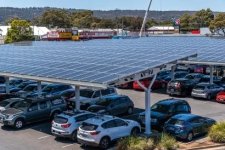
I could also see them as roofs over feed lots. Kind of like this parking lot.
1767310381692.jpeg

I am not against electrification. I particularly like solar panels due to the lack of moving parts. Unlike wind turbines.
But I still don't see electricity as fuel, as a source of energy. It is a conduit for transmitting energy from a fuel.
Concentrations of energy will always be required and batteries do not yet convince me.

Coal and oil yes.
Uranium and possibly thorium also yes.
Lakes of water until they run dry.
Pockets of heat, naturally occurring or man-made.
Solar power has its place.

Not a great fan of natural gas if it has to be compressed and frozen.
Definitely not a wind fan.

 
a whole off shore wind farm of 350 turbines operating at their typical 25 to 30% efficiency.

Not sure where you got this idea. But offshore wind is typically in 50-65% range.

I think what you're struggling with is the idea that there's a one size fits all solution. That was the old model. Build a plant to burn something. Make electricity. Today, what you build depends on where you are. Obviously, if you're in the UK, you build lots of offshore wind. Enough to power the entire country at brief moments. If you're sunny Australia you put solar on every roof. Enough to give out free electricity to millions. We've got a ton of hydro in this country. Heck, Albertan separatists are now whining on Twitter about Quebec's low electricity prices thanks ot their hydro. But we've not yet touched offshore wind. And Nova Scotia alone could power a quarter of the country. But yeah, maybe if you're in Prairies and Manitoba and BC don't want to share hydro you build some nuclear or gas. But in this world where renewables are actually cheap (in the correct locale) and power cost literally determines strategic outcomes in sectors like AI, resorting to ideology either green or anti-green will get you killed. Use whatever is cheapest where you are. It's really that simple. If you live in a cloudy and windy place and insist on putting up a solar panel instead of some wind turbines and maybe some nuclear or peaker gas? You deserve the economic outcome you get.

S9G - Virginia class - 210 MWt
S8G - Ohio class - 220 MWt
S6G - Seawolf - 230 MWt
A4W - Nimitz - 550 MWt
A1B - Ford - 700 MWt
30 years or so of life.
Refuel partially every 2 years during maintenance.

Darlington CANDU PWHR
2776 MWt and 878 MWe (net)
31% electrical efficiency
69% high quality waste heat
Comparable to any other steam cycle plant but with years of life from a single refuelling.

Slow Poke 2 - 20 kWt

SMRs aiming for 3 to 30 years of life from a single refuelling.

Like I said earlier that's what SMRs were supposed to be. The Modular part being key. They were supposed to be manufacturable in the same way that naval reactors were. And since that has not happened, SMRs today are basically a gimmick. They don't get the economy of scale of modularization. But also don't get the economy of scale that comes from size, which was traditionally the way to get costs down with nuclear. Incidentally the reason Chinese nuclear costs are so low? They do both. They use the same design repeatedly and build huge. The Western nuclear sector has struggled to do this. Partly getting sucked down the rabbithole of SMRs. Partly because that sector is fragmented across so many players. China has the benefit of having to provide power to 1.4B people.

Solar panels AND agriculture

It's fun watching you discover ideas that have been around for years or decades. The concept is called agrivoltaics. And the basic idea is really simple. There are plants which simply grow better under some shading or with reduced sunlight. So panels can be built with semitransparency or simply arranged to provide a certain amount of sunlight per day on shadowing to optimize agricultural output. It's effectively zero marginal cost power to the farmer. And most importantly this actually improves yield.


Kind of like this parking lot.

The only reason we don't have more of this is because power is relatively cheap and solar installation costs are high (relative to global standards). Go to places where this is not true and you'll see a lot of big box stores and factory roofs with solar. It is starting here though. But like many things in Canada, we're generally 5-10 years behind the rest of the world.
 
Not sure where you got this idea. But offshore wind is typically in 50-65% range.
65% efficiency is impossible.

The Betz limit is around 60% for turbine energy capture of wind going past it. After you calculate in other efficiency losses (turbine conversion to electricity, resistances both mechanical and electrical) the best efficiency you're every going to get is 80% of that 60%, (so 50%).

That's not a bad conversion rate.

But like all power generation you have to look at availability, reliability and cost FOR THE LOCATION YOU ARE BUILDING THE POWER GRID!!!. Solutions in one place don't match other places.
 
Back
Top