- Reaction score
- 19,188
- Points
- 1,160
Some WWII inspired camouflage for the RCD's?



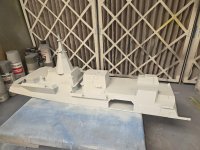
I was terrible in the Black Sea and Med. Better in northern lattitudes.I alway thought Seafoam Blue was a paint colour choice that did not work particularly well in the Pacific Ocean, Indian Ocean or Arabian Sea.

DCRN pointed out the colour change. So its happening AFAIK.Are you referring to the RCD no longer being that annoying light grey that I always complain about because its so bright to air targets?
I was wondering if that was intentional or just a function of the ship model just using a stock paint colour. You got some inside info on the colour change there FSTO?

Under certain lighting conditions (first/last light) Canadian ships actually glowed…I was terrible in the Black Sea and Med. Better in northern lattitudes.
I was doing research for a service paper on paint/coatings and their various signautures, so did some prelim research into the paint.
The current paint scheme was developed by research into North Atlantic Fog (which also looks like North Pacific Fog). The ships just vanish in fog, but given that we're not in the 1960's anymore and the ships missions are further afield than the North Atlantic, well changing things is a good idea.
I think honestly, if it isn't just a model builder choice, it will be a move towards a general purpose colour that works just as well in the Arctic or overseas.

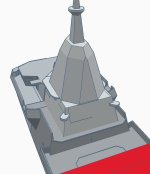
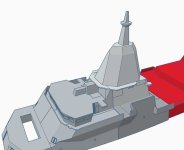
I also noticed the aft section where the funnel for the DG's likely is (and where the RAM is located) look wider than the other variants. Might be wrong on that, just might be an optical illusion after they installed different equipment there.Redesign of the main mast to match 'sharkfin' has begun....and I see there's a 'step' on the funnel as well that I'm going to have to adjust for too.

I would be immensely disappointed by switching to some generic haze gray paint scheme, given how Canada has its own very distinct paint colour not matched by anybody abroad. I'm also a bit skeptical due to the fact the exact shade of the paint seems to shift a lot to the eye in various lighting conditions, so it can look very different in different conditions and to different people.Are you referring to the RCD no longer being that annoying light grey that I always complain about because its so bright to air targets?
I was wondering if that was intentional or just a function of the ship model just using a stock paint colour. You got some inside info on the colour change there FSTO?
Its time to change things. That paint scheme in current drone warfare conditions is a danger. It was designed to hide from close range submarine observation in fog. We are now looking at long range IR/digital observation from air and surface. The colour needs to recognize that.I would be immensely disappointed by switching to some generic haze gray paint scheme, given how Canada has its own very distinct paint colour not matched by anybody abroad. I'm also a bit skeptical due to the fact the exact shade of the paint seems to shift a lot to the eye in various lighting conditions, so it can look very different in different conditions and to different people.

 msi-defencesystemsus.com
Is there a reason for the three variants to differ on ASW? Thales vs Ultra mission kit?The best quote in the RCD today I read was that "this will likely be the best General Purpose Ship in NATO" given its current configuration. It won't be the best AAW ship, it won't be the best ASuW ship, it might be right up there with the UK T26 for the best ASW ship.
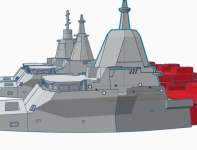
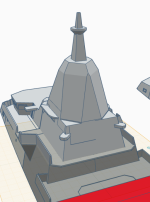
OK....here's a bit of puttering around in CAD. Gen 1, Gen 2 and Gen 3 - I'm reasonably OK with how #3 looks. Details to add, but I think I've got the essence of the 'shark fin'.
View attachment 99253
View attachment 99254
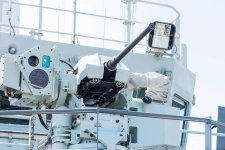
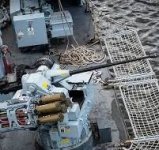
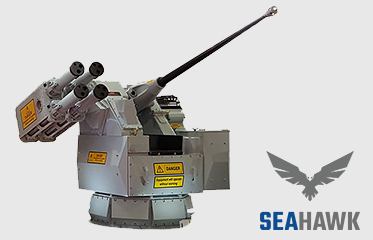
It gets me thinking about about how two platforms working together might deal with these kind of airborne threats. The first task force that an RCD might lead would likely have 2 HALIFAX class as well. How effective is the high fire rate 57 and the phalanx at dealing with drones? Could be that the two vessel classes complement each other well in these kinds of situations.A useful (and apparently now battle proven) addition to the Mk 38 Mod 4 30 mm mount that can be fitted quickly if needed at a cost of approx 1.6M USD$ to modify the mount would be the LMM.
The LMM (Martlet Missile) can take out aerial and surface drones at a range beyond the 30mm, adding another extended short range defence without resorting to the much higher cost of a RAM or ESSM missile. (Approx 35K USD$).
The mount is both remote and local controlled. The Martlet missile can be guided in flight by the same FCS as the gun mount, switch targets, and follow new targets. If the missile misses a target, the same won’t will continue to track and engage with gunfire when target crosses into effective range.
MSI-DS SEAHAWK SIGMA - MSI Defence Systems US LLC
Based upon the proven SEAHAWK mounting, the SIGMA upgrade offers a unique enhancement to our family of 30mm weapon systems. SEAHAWK SIGMA integrates the Thales Lightweight Multi-role Missile (LMM) onto the mount, providing capability to defeat air and surface targets up to approximately 6km...
Very interestingly this missile can launch from a ship, helicopter or ground vehicle and has been used the past month by British and other forces in Cyprus, Jordan, UAE and Kuwait.
Ukraine utilizes this missile with excellent results.
So could theoretically an RCD have 6 collapsing layers of hard kill self defence:
- ESSM - range ~ 40km ++
- 5”54 NG - range ~ 20 km
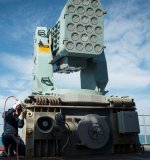
- RIM-116 Rolling Airframe Missile (RAM)- range ~9 km +
- LMM - range ~ 6 km
- Mk 38 30mm ~ 3 km
- NRWS .50 cal ~ 2 km
I'm going to struggle to articulate this and it might be silly- keep in mind- only naval exposure is TCU and this board.The best quote in the RCD today I read was that "this will likely be the best General Purpose Ship in NATO" given its current configuration. It won't be the best AAW ship, it won't be the best ASuW ship, it might be right up there with the UK T26 for the best ASW ship.
The doctrine on ASM usage refers to specific salvo weights when planning engagements that are required to penetrate enemy AAW defences. You need X NSM/Harpoon/whatever per enemy ship you are attacking to ensure a hit.I'm going to struggle to articulate this and it might be silly- keep in mind- only naval exposure is TCU and this board.
Following along with the recent pages of this thread, and the emphasis on (relatively) close in defense in both soft and hard kill systems. Say we got the LMM upgrade.
12x SM-2's + 48xESSM's + 21 RAMs + 10 LMM's, not counting the 5" and 30mm's, or soft kill systems and ECM, that's 91 missile based defensive hard kill opportunities.
Scale that to a TG of 3 Rivers, that's 273. That same task group has only 24 NSM's. That's a crazy ratio. Even at a 25% defensive success rate that suggests you need an offensive ratio of 3:1 to reasonably expect hits. (again ignoring guns, softkill and ECM)
Am I out to lunch inferring that the defensive evolution in response to land based swarming is effectively turning conventional open water Peer vs. Peer ASuW into a complete non factor, ditto conventional long range aerial maritime interdiction?
(Edit- i suppose with the aerial assets you could leverage multiple successive sorties to empty magazines and degrade that defensive capability)

I'm going to struggle to articulate this and it might be silly- keep in mind- only naval exposure is TCU and this board.
Following along with the recent pages of this thread, and the emphasis on (relatively) close in defense in both soft and hard kill systems. Say we got the LMM upgrade.
12x SM-2's + 48xESSM's + 21 RAMs + 10 LMM's, not counting the 5" and 30mm's, or soft kill systems and ECM, that's 91 missile based defensive hard kill opportunities.
Scale that to a TG of 3 Rivers, that's 273. That same task group has only 24 NSM's. That's a crazy ratio. Even at a 25% defensive success rate that suggests you need an offensive ratio of 3:1 to reasonably expect hits. (again ignoring guns, softkill and ECM)
Am I out to lunch inferring that the defensive evolution in response to land based swarming is effectively turning conventional open water Peer vs. Peer ASuW into a complete non factor, ditto conventional long range aerial maritime interdiction?
(Edit- i suppose with the aerial assets you could leverage multiple successive sorties to empty magazines and degrade that defensive capability)