• Thanks for stopping by. Logging in to a registered account will remove all generic ads. Please reach out with any questions or concerns.

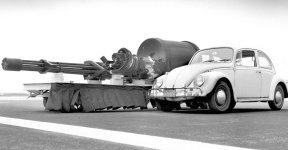
A-10 Warthog

Sure. But just a reminder that unmanned doesn't always equal remotely operated. Loitering munitions can do autonomous target recognition and even area denial. We're even moving to a world where the swarms can self target and prioritize sometimes without links between themselves.

And more than likely, in any scenario where somebody is jamming, the next move will be having a home-on-jam munition delivered. The EW cat-and-mouse game is going on in parallel.
Challenge with autonomous system, would we let them loose in battlefields still filled with significant civilian populations or where our troops are heavily mixed with the enemy? There are countries out there that would use civilians as human shields to deter our automated systems. Whatever we have, I want a mix of manned, remote and autonomous. That allows us to adapt to changing battlefield conditions.
 
At the controls of the unmanned (and not reliably autonomous) advantages.

Fair.

How many people do you need to put at risk to manage that potential failure?

I don't think every weapon system, every gun, missile, aircraft, tank or boat needs an onboard commander much less a dedicated at-risk crew.
 
Challenge with autonomous system, would we let them loose in battlefields still filled with significant civilian populations or where our troops are heavily mixed with the enemy? There are countries out there that would use civilians as human shields to deter our automated systems. Whatever we have, I want a mix of manned, remote and autonomous. That allows us to adapt to changing battlefield conditions.

In that situation it's highly unlikely your ROEs will allow an A-10 to go "brrrrrtttt" either.
 
Challenge with autonomous system, would we let them loose in battlefields still filled with significant civilian populations or where our troops are heavily mixed with the enemy? There are countries out there that would use civilians as human shields to deter our automated systems. Whatever we have, I want a mix of manned, remote and autonomous. That allows us to adapt to changing battlefield conditions.

That is where I argue that the proper role of boots on the ground is in the constabulary role after the machine on machine conflict has cleared the battlespace.

It can only be people wandering through the crowd sorting those people that are threats ftom those that aren't.

Those people confronting the crowds will benefit from machines in overwatch that have human supervisors and commanders.
 
Depends on how much you can prefix "remote" to "controls".

That also depends on how comprehensive an electronic effect the opposition can generate.

Can they only jam an FPV or a mine? Or can they jam an entire front?
 
if the JTAC's attention is mainly required only up to that point, one JTAC can deal with a lot more targets.

Multiple targets is fine, and normal. However attention doesnt drop at identification of target. Id argue that @FJAG 's assertion that target identification is a primary task is starting off on the wrong foot. Overwhelmingly we are moving back and taking targeting data from other sources. However air space management and deconfliction is ongoing and only getting more complex.


That said I do think as we get more drones and they become more autonomous, demand from the guys and gals on the ground will skyrocket. Trying to explain to a pilot the exact picture on the ground in the middle of a fight is way more challenging than simply being able to input instructions on a map on a tablet (by the JTAC) and having the aircraft autonomously execute.

That's why we pre brief. A10s have the advantage of probably the best ground SA tools in the US fleet. Its pretty easy to pass a blue force trace, especially with the data links we have now.
 
On rereading what @FJAG is suggesting - calling for and conducting terminal guidance of air or ground launched motions - is a JFO task. No reason to train people up as JTACs to do it.
 
Id argue that @FJAG 's assertion that target identification is a primary task is starting off on the wrong foot.

To be clear, I don't think identification is a primary task. But providing an accurate picture to somebody arriving on scene, while in contact, is still a sensitive and difficult task with a clock ticking.
 
To be clear, I don't think identification is a primary task. But providing an accurate picture to somebody arriving on scene, while in contact, is still a sensitive and difficult task with a clock ticking.

Right which is why I commented specifically to that. Theres a number of ways for us to give a pilot the ground picture. Frankly its pretty cursory because we provide restrictions to keep friendlies safe. Its not like pilots are arriving on station and getting read to every friendly position.
 
  • Like
Reactions: ytz
Given that war is about influencing humans we need to keep humans in the loops. The question becomes how many humans in which loops.

The Iran rescue shows that Special Forces are more vital than ever

This article argues that current circumstances suggest that the minimally "manned" Special Forces are a necessary element and will/can/should be a key consideration going forwards.

The author cites the latest rescue in Iran and the successes of Budanov's forces within Russia and in the Black Sea.

Span of control question?

How many exploding devices can one person control/supervise concurrently and for how long?

The more devices per person the harder it becomes for the opposition to gather a threatening mass of either people or exploding devices.
 
Following on from that, and bringing it back to A-10s, and specifically A-10s in Iran: I doubt that there is very much that can beat an A-10 doing low passes over your city to say "We own you!"

If you are a friend of the A-10s they are a comfort. If you are not they are a constant threat.

They supply a form of coercion that cannot be matched by satellites and other unseen forces, or by any uncrewed forces, precisely because there is a person at risk inside.

And its speed and survivability make it one of the least risk options for those kinds of "show the flag" missions. Just as frigates demonstrate who owns the waves by showing the flag at sea, it is useful to demonstrate who owns the skies inland.

 
Why does it have to be an A-10?

The same was done with F-16s, F-15s and F-18s during the GWOT.
 
And its speed and survivability make it one of the least risk options for those kinds of "show the flag" missions.

We're just going to ignore them getting shot down in the Gulf War, the invasion of Iraq and now in Iran, I guess.
 
Following on from that, and bringing it back to A-10s, and specifically A-10s in Iran: I doubt that there is very much that can beat an A-10 doing low passes over your city to say "We own you!"

If you are a friend of the A-10s they are a comfort. If you are not they are a constant threat.

They supply a form of coercion that cannot be matched by satellites and other unseen forces, or by any uncrewed forces, precisely because there is a person at risk inside.

And its speed and survivability make it one of the least risk options for those kinds of "show the flag" missions. Just as frigates demonstrate who owns the waves by showing the flag at sea, it is useful to demonstrate who owns the skies inland.


I sincerely doubt theres more or less psychological effect to the masses based on the platform.
 
I sincerely doubt theres more or less psychological effect to the masses based on the platform.
I recall videos of people in the Gulf States playing Shahed drone sounds to make people panic.
 
Back
Top