• Thanks for stopping by. Logging in to a registered account will remove all generic ads. Please reach out with any questions or concerns.

Iran Super Thread- Merged

Isn't the Hezbollah stronghold in the south near the Lebanon Israel border?

Don't get me wrong, love to see it, but the Canadian equivalent would be people protesting a Bloc Québécois rally in Ottawa or Toronto
Hezbollah is Shia backed.

Most Shias live south of the Litani River, having been "sponsored" by the Iranians and PLO to move into that area as a meat shield to prevent further Israeli expansion after the civil war.

Beirut (and surrounding area) has a larger Sunni and Christian populaion than anywhere else in Lebanon. Hezbollah has support in the Shia quarter of the city (which is essentially a Palestinian ghetto). The Christian and Sunni portions are ranging from opposed or indifferent to their efforts when Israeli bombs aren't dropping on them. Now that Israel is bombing the capital and they're caught in the crossfire....

Beirut, is the Gulf's version of Las Vegas.

Thanks to it's former French Mandate, drinking, gambling, sex work, et al are legal. I would watch rich Saudis, Emiratis, Qataris, and Kuwaitis get off a plane in robes and then quickly change in the airport bathroom into jeans and a Gucci t shirt, ready to hit the town. It made the Lebanese a lot of money.

Now that Hezboallah and their Iranian backers are upsetting the apple cart, hell yes people are going to to be pissed at them and their supporters.
 
Opinion piece from GCaptain about shipping

The Strait Isn’t 'Closed'—It’s Worse Than That
Six weeks into the conflict, the debate over whether the Strait of Hormuz is “open” has become almost irrelevant.

Because what we are witnessing is not a formal closure. It’s something far more destabilizing: a controlled, conditional, and deeply politicized chokepoint where access exists—but only on terms set by a weakened but still dangerous regime. That distinction matters.

Yes, Iran’s conventional military capabilities have taken a hit. But the one lever that still counts—the flow of oil and gas out of the Persian Gulf—remains firmly within its ability to disrupt. And today, that flow is not functioning in any meaningful commercial sense.

Traffic data, insurer behavior, and routing patterns all point to the same conclusion: this is not a market operating under stress. It’s a system that has effectively seized up.

The Illusion of “Open”

Certain officials continue to insist the strait is open. Technically, they’re not wrong. Ships can transit. But in practice, normal commercial shipping has not returned. Not even close.

Instead, what we’re seeing is a fragmented system:

Vessels routing close to Iranian territorial waters under implicit or explicit coordination
Select transits tied to Iran or aligned actors
Reports of ad hoc “tolls” or permissions governing passage
Western-linked operators largely staying out
This isn’t freedom of navigation. It’s a gatekeeping by a hostile, heavily-sanctioned regime. And for global energy and shipping markets, that distinction is everything.

The Real Constraint Isn’t Insurance—It’s Trust

Early in the crisis, the focus was on war-risk premiums and insurance withdrawals. That phase has passed.

Even with backstops like the U.S. maritime reinsurance initiative, the core problem remains unchanged: no one trusts the route.

Mines—confirmed or not—have altered risk perception. Conflicting navigation directives have undermined predictability. Military escalation risk remains embedded in every transit.

You can subsidize insurance. You cannot subsidize confidence.

Shipowners aren’t avoiding Hormuz because it’s expensive. They’re avoiding it because it’s unknowable.

Energy Flows Are the Only Metric That Matters

There’s a tendency in policy circles to point to U.S. energy dominance as a buffer.

It’s true that the United States is producing at record levels. But global oil and gas markets don’t operate on national self-sufficiency—they operate on marginal supply and price discovery.

Roughly a fifth of the world’s seaborne oil and gas still depends on Hormuz.
When that flow is disrupted:

Tanker availability tightens globally
LNG supply chains begin to fracture
Freight rates, bunker costs, and insurance premiums cascade outward
The idea that the world’s largest economy can fully insulate itself from that shock is, at best, optimistic—and at worst, dangerously complacent.

This Isn’t a Blockade. It’s Leverage.

What makes this crisis different—and more dangerous—is that it doesn’t require a full shutdown to be effective.

Iran doesn’t need to “close” or control the strait. It only needs to make normal operations impossible—and right now, it is.

A degraded regime is effectively controlling access to a corridor that carries a massive share of global energy—not through dominance, but through disruption, ambiguity, and selective permission.

That’s a far more sustainable form of leverage than outright confrontation.

The ‘Toll’ Narrative

Much has been made of reports that ships are paying Iran for passage, but the reality is far less clear-cut.

A handful of reported cases does not equate to a functioning system, and more importantly, it ignores a basic truth that compliant, Western-linked operators don't casually engage in off-the-books payments that could trigger sanctions exposure.

If anything, Iran's leverage lies in deterring those players—not successfully monetizing them.

Why Markets Haven’t Caught Up

Perhaps the most puzzling element is the relative calm in global markets.
Oil has risen—but not to levels that reflect a sustained disruption of this magnitude.

There are a few possible explanations:

Traders betting on a near-term diplomatic resolution
Strategic reserves and rerouting masking short-term shortages
A belief that flows will normalize faster than history suggests
But each of those assumptions carries risk. Because normalization is not just about a ceasefire.

What Actually Reopens Hormuz

A ceasefire alone won’t fix this. What’s required is far more complex:

Verified clearance of potential mines
A clear, unified navigation framework—not competing directives
Restoration of insurer confidence
Credible guarantees of safe passage for all flags and nationalities
In other words, a rebuilding of trust in the system itself. That doesn’t happen overnight.

It takes time, coordination, and sustained political alignment—none of which currently exist at the level required.

If there’s any doubt about how long this kind of disruption can linger, look no further than the Red Sea. More than two years after that crisis began, the security overhang has never fully lifted.

Even following last year's ceasefire and a sustained absence of major attacks, many shipowners remain reluctant to fully re-engage the route, with diversions and elevated risk calculations still baked into commercial decision-making.

The lesson is clear: once confidence in a critical maritime corridor is broken, it doesn’t simply snap back with a political agreement. It erodes slowly—and rebuilds even slower.

Let's Not Forget The Humanitarian Crisis

Lost in the geopolitical calculus is the human reality playing out at sea. An estimated 20,000 seafarers remain effectively trapped aboard vessels across the Persian Gulf, unable to safely transit, rotate crews, or even access consistent resupply.

These are not abstract numbers—they are mariners stuck in limbo, facing mounting shortages of fuel, food, and medical support while uncertainty drags on with no clear resolution.

The longer the crisis persists, the more it shifts from a supply-chain disruption to a humanitarian one, raising serious questions about the industry’s—and governments’—ability to protect the very people who keep global trade moving.

The Bottom Line
The most dangerous misconception right now is that this crisis is nearing resolution.

It isn’t. The Strait of Hormuz isn’t reopening—it’s being redefined in real-time.

And until global shipping regains the ability to move freely, predictably, and without political permission, the disruption to energy markets will persist—regardless of what officials say.

Because in maritime trade, words don’t move cargo. Confidence does.

— Mike Schuler
 
Some Hormuz stuff:

A couple Chinese tankers were allowed through by Iran.


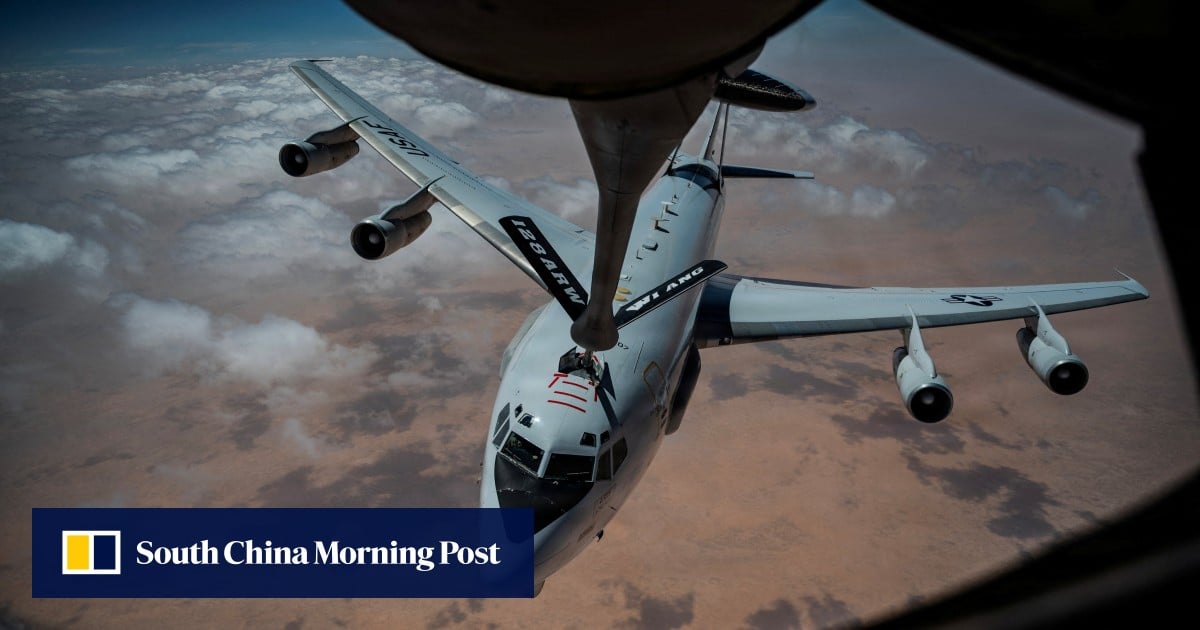
US Navy appears to have conducted a Freedom of Navigation exercise with a few warships, seemingly times to coincide with the negotiations in Islamabad. Arleigh Burke-class USS Michael Murphy was apparently the designated Charlie Team, and briefly broadcast her position on AIS well inside the gulf, I guess to let the online ship nerds disseminate the message.

EDIT TO ADD: AIS can be spoofed, if course. The claim ships transited is just that - a claim. But it shouldn’t be hard to verify, someone will have seen them, and of course adversary states with satellites were likely watching.


Iran claims the ships were forced to turn around. That doesn’t appear to be supported by evidence. Iran also claims to have threatened the vessels if they transited.


Not totally sure how to read this, but I think it’s the U.S. trying to flex a bit in the face of the not great position Iran has everyone else in regarding the Strait.
 
Time to send in troops; gotta get those gas prices down.

Or go back to my plan of disabling closed top delivery vehicles capable of hiding those drones
 
Ok, I'm not certain what to make of this news -


Trump says U.S. will blockade Strait of Hormuz after Iran peace talks fail​


  • President Donald Trump said the U.S. will blockade the Strait of Hormuz after talks to end the Iran war ended without a resolution over the weekend.
  • Trump also said the U.S. Navy will “seek and interdict every vessel in International Waters that has paid a toll to Iran.”
  • Iran is preparing to charge a toll on vessels seeking passage through the strait, a move that invoked Trump’s ire as Tehran tries to cement its grip on the passage amid a two-week ceasefire.
So now its the US that is blocking the Strait, not the Iranians? How will the US know if a ship has paid a toll to Iran? Ask to see the receipt? Check the companies bank statement? Ask them nicely?
 
Ok, I'm not certain what to make of this news -
Confirms that meddling with traffic isn't a chip only Iran can play.

Might as well do whatever is needed to stop Iran from tolling traffic now. Otherwise, it's easy to foresee the following:
  • tolls are a source of Iranian revenue
  • Iranian revenues are used to promote terrorism against Israel
  • Israel takes up the challenge of damaging shipping and the Strait is effectively "closed" again
 
Ok, I'm not certain what to make of this news -


Trump says U.S. will blockade Strait of Hormuz after Iran peace talks fail​


  • President Donald Trump said the U.S. will blockade the Strait of Hormuz after talks to end the Iran war ended without a resolution over the weekend.
  • Trump also said the U.S. Navy will “seek and interdict every vessel in International Waters that has paid a toll to Iran.”
  • Iran is preparing to charge a toll on vessels seeking passage through the strait, a move that invoked Trump’s ire as Tehran tries to cement its grip on the passage amid a two-week ceasefire.
So now its the US that is blocking the Strait, not the Iranians? How will the US know if a ship has paid a toll to Iran? Ask to see the receipt? Check the companies bank statement? Ask them nicely?

IMG_8711.jpeg
 
Confirms that meddling with traffic isn't a chip only Iran can play.

Might as well do whatever is needed to stop Iran from tolling traffic now. Otherwise, it's easy to foresee the following:
  • tolls are a source of Iranian revenue
  • Iranian revenues are used to promote terrorism against Israel
  • Israel takes up the challenge of damaging shipping and the Strait is effectively "closed" again
If this occurs, the US blocking the Strait for all, it will be interesting to see what the world opinion of the US's actions are.
 
Ok, I'm not certain what to make of this news -


(...)
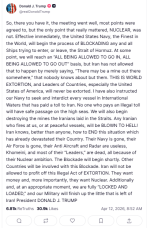
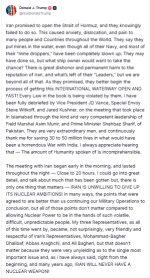
This from POTUS47's socials, for reference:
1776004622782.png
Previous SM post before that one re: "the meeting" in Islamabad.
1776004724138.png

So, for shits & giggles, let's see what aggregated AI says about the average-rated success to this point of the campaign, in descending order of success *:
  • Degradation of Iranian military capability - 7.8/10 (6-9/10)
  • Eliminating Iran's nuclear program -- 4.8/10 (scores ranging from 3-7/10)
  • Discouraging Iran-supported proxies from launching attacks against countries outside Iran - 3.3/10 (2-4/10)
  • Opening opportunities for public uprising - 2.8/10 (2-4/10)
  • Keeping the Strait of Hormuz open - 2/10 (1-5/10)
  • Regime change - 1.3/10 (0-2/10)
  • Increasing stability across the Middle East - 1/10 (0-2/10)
* - Five systems (Grok, Chat GPT, Perplexity, Claude & Duck.ai) asked: "On a scale of 0-10, assess America's success in the following goals of the Iran campaign: eliminating Iran's nuclear program; regime change; opening opportunities for public uprising; degradation of Iranian military capability; keeping the Strait of Hormuz open; increasing stability across the Middle East; and discouraging Iran-supported proxies from launching attacks against countries outside Iran."
 
If this occurs, the US blocking the Strait for all, it will be interesting to see what the world opinion of the US's actions are.
And how they react when a Chinese flagged tanker says “We are a Chinese registered vessel exercising our right of transit passage under international law. We wish you a good day.” Is the U.S. going to commit act ms of war against China to enforce this?

He hasn’t thought this through. He’ll come out of this still looking impotent.
 
And how they react when a Chinese flagged tanker says “We are a Chinese registered vessel exercising our right of transit passage under international law. We wish you a good day.” Is the U.S. going to commit act ms of war against China to enforce this?

He hasn’t thought this through. He’ll come out of this still looking impotent.

I fear this may accelerate China's plans for Taiwan, if not just blockade it right out of the door. Remember he pulled a ton of stuff from the region for this little adventure.

There is also the minerals elephant in the room.
 
Good to hear that Khomeni, who died in 1989, is still dead.

This is, of course, a ludicrous idea that is highly unlikely to be executed, and if it actually is, could well accelerate a) the collapse of the global economy, b) the death of the petrodollar, c) the dismantling of NATO, d) the further diminishment and isolation of the US, and e) the Taiwan timeline.

Firefighters who put out blazes that they started are not heroes (but will probably get a calendar anyway). They are arsonists and criminals and should be treated as such.

World leaders who use wars of choice to avoid domestic consequences (like jail for example) are beneath contempt. Increasingly the countries they lead will be treated with the same contempt.
 
Last edited:
If this occurs, the US blocking the Strait for all, it will be interesting to see what the world opinion of the US's actions are.
It will. Iran wants to extort money. The US wants to restore free passage in international waters. Sides will be chosen, and voters will be paying attention.
 
Ok, so, sitting back and trying to parse what Trump truly intends by this and what policy/actions might result, and some of the issues…

We have only what Trump has specifically said on social media to go off of. That’s an unfortunately thin starting point when trying to infer coherent policy, but it’s what we’ve got.

Paring down what he typed to what he’s actually saying regarding shipping:

  1. The USN will blockade all entry, exit, and transit of SoH. He attaches no conditions to this.
  2. The USN will ‘interdict’ (Board? Seize?) vessels in international waters that have paid a toll to Iran.
  3. Anyone who paid a toll will not have safe passage in international waters.
  4. The blockade will begin soon and other countries will be involved.
Everything else is tangential or bluster; those are the stated policy and action intentions.

They are, in a word, bananas. Not the first through eighth words that came to me but I’m trying to reduce distracting invective… It’s a lot of things but we’ll go with bananas.

1. The U.S. proposes to replace a near but not totally Iranian blockade with a total U.S. one. Nothing he actually said suggests that a Kuwaiti tanker traveling to Singapore and hugging the Omani coast to avoid Iranian checkpoints would be good to go. There’s obviously no legal basis for this; America has no authority to blockade an international strait that’s an economic lifeline for numerous countries. This appears to be Trump trying to take something largely out of his control - the Iranian blockade - and supersede it with something he does control and direct.

Practical obstacles to this:
  • USN commanders may be ordered to conduct vessel boarding, search, and seizure with no legal basis.
  • Utterly innocent shipping will get caught up in this, delaying or halting trade.
  • Shippers will face further unpredictability and uncertainty.
  • What happens when a Chinese or Indian flagged vessel simply says ‘nope’ and declines to stop? Will the USN shoot at them? Will we see rapid reflagging of shipping to states like China to permit transit because the U.S. will pick some but not all fights?
2 + 3. Similarly I see no obvious legal authority to board and seize vessels on the high seas because they came to an arrangement with Iran to transit. My best guess is the U.S. will articulate it as sanctions enforcement but that’s pretty questionable in the circumstances. Similar obstacles and challenges to this one for the U.S. Navy. The U.S. faces major credibility challenges here. It’s one thing to order the Panamanian-flagged and Philippine-crewed MV Frontfelloff to heave to for boarding and inspection. But what’s their plan for a Karachi-bound VLCC escorted by the Pakistani navy? Are they gonna board and seize even an unescorted Chinese vessel?

4. The claim that other countries will join such a blockade - however total it proves to be or not - is an eyebrow raiser. So far most comments we’re seeing from other nations are decidedly affirming the existing law of the sea, and the rights of innocent and transit passage. Who else would join a blockade, and why the hell would they do it?

So… This whole notion seems impulsive, half baked, and quite illegal. I suspect we’ll see it quickly pared down to the U.S. asserting a right to their own checkpoint the way out to make sure ships didn’t pay off a Iran, but the obstacles to that remain numerous.


But he has already gone and committed himself to a pretty maximalist position here and has painted himself into a really dumb corner. Iran will likely respond by saying “fine then, nothing goes through at all” (except I suspect they’ll keep a side deal with China). The world economic crisis will continue to get worse and the brief potential relief that was felt just days ago will go away. A bunch of countries in the Asia Pacific are about to start running out of critical petroleum distillates. To quote Samuel L Jackson in Jurassic Park: “Hold on to your butts”.
 
Ok, so, sitting back and trying to parse what Trump truly intends by this and what policy/actions might result, and some of the issues…

We have only what Trump has specifically said on social media to go off of. That’s an unfortunately thin starting point when trying to infer coherent policy, but it’s what we’ve got.

Paring down what he typed to what he’s actually saying regarding shipping:

  1. The USN will blockade all entry, exit, and transit of SoH. He attaches no conditions to this.
  2. The USN will ‘interdict’ (Board? Seize?) vessels in international waters that have paid a toll to Iran.
  3. Anyone who paid a toll will not have safe passage in international waters.
  4. The blockade will begin soon and other countries will be involved.
Everything else is tangential or bluster; those are the stated policy and action intentions.

They are, in a word, bananas. Not the first through eighth words that came to me but I’m trying to reduce distracting invective… It’s a lot of things but we’ll go with bananas.

1. The U.S. proposes to replace a near but not totally Iranian blockade with a total U.S. one. Nothing he actually said suggests that a Kuwaiti tanker traveling to Singapore and hugging the Omani coast to avoid Iranian checkpoints would be good to go. There’s obviously no legal basis for this; America has no authority to blockade an international strait that’s an economic lifeline for numerous countries. This appears to be Trump trying to take something largely out of his control - the Iranian blockade - and supersede it with something he does control and direct.

Practical obstacles to this:
  • USN commanders may be ordered to conduct vessel boarding, search, and seizure with no legal basis.
  • Utterly innocent shipping will get caught up in this, delaying or halting trade.
  • Shippers will face further unpredictability and uncertainty.
  • What happens when a Chinese or Indian flagged vessel simply says ‘nope’ and declines to stop? Will the USN shoot at them? Will we see rapid reflagging of shipping to states like China to permit transit because the U.S. will pick some but not all fights?
2 + 3. Similarly I see no obvious legal authority to board and seize vessels on the high seas because they came to an arrangement with Iran to transit. My best guess is the U.S. will articulate it as sanctions enforcement but that’s pretty questionable in the circumstances. Similar obstacles and challenges to this one for the U.S. Navy. The U.S. faces major credibility challenges here. It’s one thing to order the Panamanian-flagged and Philippine-crewed MV Frontfelloff to heave to for boarding and inspection. But what’s their plan for a Karachi-bound VLCC escorted by the Pakistani navy? Are they gonna board and seize even an unescorted Chinese vessel?

4. The claim that other countries will join such a blockade - however total it proves to be or not - is an eyebrow raiser. So far most comments we’re seeing from other nations are decidedly affirming the existing law of the sea, and the rights of innocent and transit passage. Who else would join a blockade, and why the hell would they do it?

So… This whole notion seems impulsive, half baked, and quite illegal. I suspect we’ll see it quickly pared down to the U.S. asserting a right to their own checkpoint the way out to make sure ships didn’t pay off a Iran, but the obstacles to that remain numerous.
Great analysis.
But he has already gone and committed himself to a pretty maximalist position here and has painted himself into a really dumb corner. Iran will likely respond by saying “fine then, nothing goes through at all” (except I suspect they’ll keep a side deal with China). The world economic crisis will continue to get worse and the brief potential relief that was felt just days ago will go away. A bunch of countries in the Asia Pacific are about to start running out of critical petroleum distillates. To quote Samuel L Jackson in Jurassic Park: “Hold on to your butts”.
Which sets up an opportunity for China, especially given that a minimum of 2 Carrier Battle Groups will have to be permanently stationed on either side of the strait (according to Adm Stavridis this morning). Throw in the 'interdiction on the High Seas" of any Chinese flagged or protected vessels, and they will have handed the Chinese a Causus Belli to invade Taiwan.
 
Back
Top