Ok, so, sitting back and trying to parse what Trump truly intends by this and what policy/actions might result, and some of the issues…
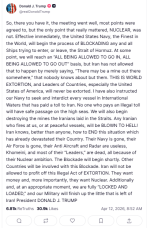
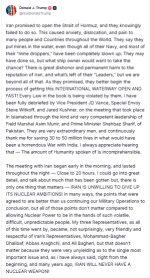
We have only what Trump has specifically said on social media to go off of. That’s an unfortunately thin starting point when trying to infer coherent policy, but it’s what we’ve got.
Paring down what he typed to what he’s actually saying regarding shipping:
- The USN will blockade all entry, exit, and transit of SoH. He attaches no conditions to this.
- The USN will ‘interdict’ (Board? Seize?) vessels in international waters that have paid a toll to Iran.
- Anyone who paid a toll will not have safe passage in international waters.
- The blockade will begin soon and other countries will be involved.
Everything else is tangential or bluster; those are the stated policy and action intentions.
They are, in a word, bananas. Not the first through eighth words that came to me but I’m trying to reduce distracting invective… It’s a lot of things but we’ll go with bananas.
1. The U.S. proposes to replace a near but not totally Iranian blockade with a total U.S. one. Nothing he actually said suggests that a Kuwaiti tanker traveling to Singapore and hugging the Omani coast to avoid Iranian checkpoints would be good to go. There’s obviously no legal basis for this; America has no authority to blockade an international strait that’s an economic lifeline for numerous countries. This appears to be Trump trying to take something largely out of his control - the Iranian blockade - and supersede it with something he does control and direct.
Practical obstacles to this:
- USN commanders may be ordered to conduct vessel boarding, search, and seizure with no legal basis.
- Utterly innocent shipping will get caught up in this, delaying or halting trade.
- Shippers will face further unpredictability and uncertainty.
- What happens when a Chinese or Indian flagged vessel simply says ‘nope’ and declines to stop? Will the USN shoot at them? Will we see rapid reflagging of shipping to states like China to permit transit because the U.S. will pick some but not all fights?
2 + 3. Similarly I see no obvious legal authority to board and seize vessels on the high seas because they came to an arrangement with Iran to transit. My best guess is the U.S. will articulate it as sanctions enforcement but that’s pretty questionable in the circumstances. Similar obstacles and challenges to this one for the U.S. Navy. The U.S. faces major credibility challenges here. It’s one thing to order the Panamanian-flagged and Philippine-crewed MV Frontfelloff to heave to for boarding and inspection. But what’s their plan for a Karachi-bound VLCC escorted by the Pakistani navy? Are they gonna board and seize even an unescorted Chinese vessel?
4. The claim that other countries will join such a blockade - however total it proves to be or not - is an eyebrow raiser. So far most comments we’re seeing from other nations are decidedly affirming the existing law of the sea, and the rights of innocent and transit passage. Who else would join a blockade, and why the hell would they do it?
So… This whole notion seems impulsive, half baked, and quite illegal. I suspect we’ll see it quickly pared down to the U.S. asserting a right to their own checkpoint the way out to make sure ships didn’t pay off a Iran, but the obstacles to that remain numerous.