• Thanks for stopping by. Logging in to a registered account will remove all generic ads. Please reach out with any questions or concerns.

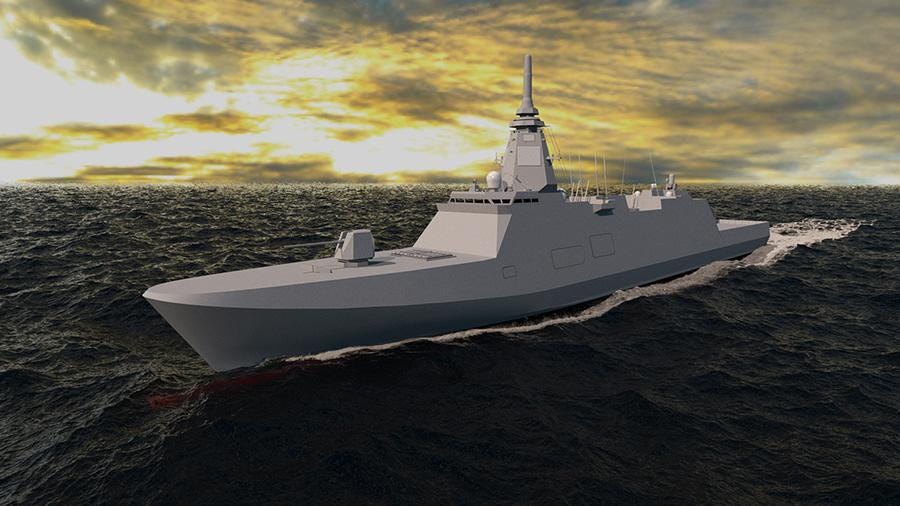
Continental Defence Corvette

Doesn't really answer the asked question. It is telling that, to my knowledge, the GoC (including the minister) has not weighed in, nor have the necessary policy steps been started to get TB approval.

A lot of the press coverage says something akin to "the CRCN wants..." Our system is (thankfully) not set up to respond to what one L1 "wants." It responds to what the people of Canada, through their elected officials, decide the nation needs. Hence the requirement to prove to TB that the requirement matches the policy (disfunctional as the process currently is, the intention is correct).

One of the sayings I've picked up somewhere along the way: "if you tell the military you have a large pot of gold for them to spend, everything suddenly becomes gold plated."

Time will tell whether this vision has staying power. I actually hope it does, because even though I may not agree with the RCN's priorities (as I understand them), I think this is an important step towards a well rounded mid-tier Navy.

15 River Class, all in the same config, I'm not as sure about anymore.
Could it be the case of the Minister not weighing in because of the rumors that he's in the process of being moved out and has decided that this is something that the new Minister can address once they are installed?
 
Could it be the case of the Minister not weighing in because of the rumors that he's in the process of being moved out and has decided that this is something that the new Minister can address once they are installed?
I don't think so... I think the government is wholly engaged elsewhere. They found a lot of money to make a particular defense problem go away for now, and they are leveraging the opportunities politically that spending it gives them, but don't have the capacity to work on that particualr policy file.

And to be fair, Defence policy follows Foreign policy, as it should. The PM is doing a relatively good job (in my opinion) of defining a vision of Canada in the current world, but Foreign policy hasn't really firmed up yet. Hopefully the CDS and DM is supporting the minister as best as possible under those conditions.
 
would it not be simpler to just have a continuous order for one every 18 months with a life span of 20 years and not be concerned about the total number? I am certain that long before even the tenth hull is delivered that our requirements for the navy will have changed and to spend the time debating 10 or 15 is foolishness. Paraphrasing Trump, the principal task is to build baby, build. At the moment we need everything for today but in 10 years when we are ordering the 3rd lot we may be in need of a drone carrier or sub tenders. Also in 10 years the first of the Arctic vessels will be in need of replacement.
I’m pretty sure the the concept was batches (fleets?) of 3-4 in the same configuration, and adjust as needed.

I gather the ‘size’ doesn’t allow for a lot of flexibility in adding, unless something goes to make room. But again, down here we have notoriously grown Destroyers to ‘Cruiser’ size over various cycles.

So perhaps the River batches will have some additional length and girth (err beam?) to them?
 
I’m pretty sure the the concept was batches (fleets?) of 3-4 in the same configuration, and adjust as needed.

I gather the ‘size’ doesn’t allow for a lot of flexibility in adding, unless something goes to make room. But again, down here we have notoriously grown Destroyers to ‘Cruiser’ size over various cycles.

So perhaps the River batches will have some additional length and girth (err beam?) to them?
Hunter Class added a bit of length and beam to accommodate what the Aussies wanted. Most people think those changes are going to cost them in speed. But if they are successful, it's possible the last two batches of RCD's might see those hull form changes incorporated.
 
15 River Class, all in the same config, I'm not as sure about anymore.

I'm pretty sure the the concept was batches (fleets?) of 3-4 in the same configuration, and adjust as needed.
I don't think all the same config is in the cards either, however I expect evolutionary changes not revolutionary changes.

Batch 1 (flight one? block one?) are as currently defined.

Batch 2 is anticipated to be 6 ships of an evoloved configuration using lessons from the employment/build of the first three.

Batch 3 will be the final 6, again with further refinement or changes.

The reason for 6 is you maximize build efficiencies around ship 5. Hopefull the similarities in hull will remain.

Firstly, define what the policy is wrt the RCN’s focus on “Canada first.”

Secondly, define (properly) the need for a Canadian Task Group and what effects that formation will deliver.

Based on those two things, define how many task groups we need and can afford.
From Leadmark 2040 (10 year old document but most things haven't changed):


This will require a blue-water navy that is:
  • Balanced—with an appropriate mix of ships, submarines, aircraft and unmanned vehicles in sufficient numbers to meet commitments at home and abroad, while retaining a naval task group at high readiness.
  • Combat-effective—capable of combat at sea across all naval warfare disciplines, crewed for sustained high-intensity operations, able to contribute to operations ashore and highly interoperable with Canada’s allies and defence partners.
  • Multi-purpose—across the spectrum of operations at sea and from the sea, ableto work effectively with a wide range of national and international defence and security partners among government and civil society.
  • Arctic-capable—able to conduct sustained operations in each of Canada’s three oceans, including in the High Arctic.
  • Globally deployable—with ships and submarines that are capable of independent ocean crossing, but enabled by support ships, operating together for the duration of any assigned mission, anywhere in the world.
  • Forward-postured—a fleet operated and sustained in a manner that allows our ships and submarines to be deployed on an ongoing basis to regions of Canadian strategic interest.
  • Survivable—with platforms that are designed for all physical and operating environments, able to sustain and recover from significant damage.
  • Adaptable and agile—an institution imbued with the ethos to excel and the values to make Canadians proud, whose men and women are prepared for the complexities and ambiguities of future operations in the skills and knowledge they possess.
This is the navy that Canada needs.


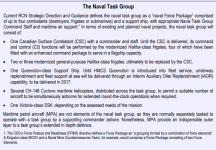
1777396011955.png
That task group definition hasn't changed though the specifics may have (Protecteur not Queenston, replacement submarine, and we know what the CSC looks like now). I agree that this document needs a refresher, we've got a lot of water under the bridge since 2016.

Those numbers point to 15 RCD. You'll need 15 to have 4 high readyness at the same time. And you'll need CDC to cover off domestic requirements if the RCD leave the continental waters.

IF CDC becomes an actual thing then they may be able to sub into the HFX spot on that list in some circumstances (arctic response for example where they are likely more capable than an RCD in near ice situations). However in a full spectrum conflict the ideal would be 4 RCD and one AOR. Making a TG scalable is good strategy.
 
From Leadmark 2040 (10 year old document but most things haven't changed):

Most things haven't changed? The PM seems to disagree:
For decades, countries like Canada prospered under what we called the rules-based international order. We joined its institutions, we praised its principles, we benefited from its predictability. And because of that, we could pursue values-based foreign policies under its protection.
The multilateral institutions on which the middle powers have relied – the WTO, the UN, the COP – the architecture, the very architecture of collective problem solving – are under threat.
We are rapidly diversifying abroad. We have agreed a comprehensive strategic partnership with the European Union, including joining SAFE, Europe’s defence procurement arrangements.
We are working with our NATO allies (including the Nordic Baltic 8) to further secure the alliance’s northern and western flanks, including through Canada’s unprecedented investments in over-the-horizon radar, submarines, in aircraft, and boots on the ground, boots on the ice.

The thing that isn't yet clear is what is the Government's defintion of "blue-water," and what is the Canadian people's view on "world-wide?" Hint: there is a very strong under current saying "the world at large" is no longer our problem.

As a very specific example... Taiwan. Is this now solely a "great-power" problem? If Canadian Foreign policy says it is, then it can no longer be used as a reason for anything.

I think the real problem is there are a lot of Canadians asking questions about where their money is going, and the RCN doesn't get to decide that on it's own. Even in this forum there has been a great deal of some asking questions and other's saying "the RCN already has the answers." I've said this before, but if the RCN doesn't understand who they work for they'll very quickly find themselves unemployed. Ask Adm Landymore (or evening Norman in a lesser way) how that works out.

I think I've very clearly said that I think 4 CTGs are eventually required, but they are not the top priority right now. In my mind, the PMs remarks would seem to indicate that's where his mind is (although he isn't, and shouldn't, dictate the how).
 
I was just re-reading Leadmark 2050, and two things jumped out at me (however, I may have been reading with a biased position):
  • the main effect it seems it has the RCN delivering is "presence," with the ability to maintain it in the face of adversary. It doesn't envision the RCN delviering actual Joint effects. It doesn't even robustly speak to the need to get the Canadian army somewhere, even if contested, as that wasn't a thing when it was written.
  • It openly says (bold, italicised, and underlined) "To defend the global system at sea and from the sea, both at home and abroad." The official policy of Canada is that global system is no longer working for us, as stated by the PM.
  • It speaks about the need for Canada to operate within that Global system and protect it, including specifc examples such as Sino-American. Again, seems a little out of place, me thinks.

Not convinced by the argument.
 
Most things haven't changed? The PM seems to disagree:


The thing that isn't yet clear is what is the Government's defintion of "blue-water," and what is the Canadian people's view on "world-wide?" Hint: there is a very strong under current saying "the world at large" is no longer our problem.

As a very specific example... Taiwan. Is this now solely a "great-power" problem? If Canadian Foreign policy says it is, then it can no longer be used as a reason for anything.

I think the real problem is there are a lot of Canadians asking questions about where their money is going, and the RCN doesn't get to decide that on it's own. Even in this forum there has been a great deal of some asking questions and other's saying "the RCN already has the answers." I've said this before, but if the RCN doesn't understand who they work for they'll very quickly find themselves unemployed. Ask Adm Landymore (or evening Norman in a lesser way) how that works out.

I think I've very clearly said that I think 4 CTGs are eventually required, but they are not the top priority right now. In my mind, the PMs remarks would seem to indicate that's where his mind is (although he isn't, and shouldn't, dictate the how).
I would argue that makes having a naval task group as defined in my post even more important.

We'll need to enforce our own rules and protect our own trade. Sure the "global system" may be straining, but it doesn't mean that the ships themselves can't be employed differently to protect our own version of what we need from a trade perspective. Working within the global system is more of an ethical/moral employment not an actual force employment discussion.

A little inside baseball, there are new documents coming. The RCN is rewriting Leadmark (or whatever its going to be called) based on that. I don't suspect much will change except the wording and the urgency. Our naval strategic situation hasn't changed. All that has changed is that we're going to be expected to do more of it on our own.
 
I was just re-reading Leadmark 2050, and two things jumped out at me (however, I may have been reading with a biased position):
  • the main effect it seems it has the RCN delivering is "presence," with the ability to maintain it in the face of adversary. It doesn't envision the RCN delviering actual Joint effects. It doesn't even robustly speak to the need to get the Canadian army somewhere, even if contested, as that wasn't a thing when it was written.
  • It openly says (bold, italicised, and underlined) "To defend the global system at sea and from the sea, both at home and abroad." The official policy of Canada is that global system is no longer working for us, as stated by the PM.
  • It speaks about the need for Canada to operate within that Global system and protect it, including specifc examples such as Sino-American. Again, seems a little out of place, me thinks.

Not convinced by the argument.
The system he was referring to was the one where the US was the hegemon. He didn't mean that the system of disparate economies connected by world wide maritime trade was dead. He meant that we can't rely on the US to provide the blanket of security and stability; we have to go enforce it ourselves. Hence, a large ass Navy.

15 RCDs, 12-20 CDCs, 3-4 JSS, 12 CPS, 6 AOPS...who else wants to become the next maritime empire à la Britain during the 1800s?!
 
A little inside baseball, there are new documents coming. The RCN is rewriting Leadmark (or whatever its going to be called) based on that. I don't suspect much will change except the wording and the urgency. Our naval strategic situation hasn't changed. All that has changed is that we're going to be expected to do more of it on our own.
A little inside baseball, I've been doing this a long time, as have some other's on this forums in different specialties. My primary point of reference on these issues is not these forums, and my primary point of residual influence is also not here. The institutional barriers that will allow the RCN to wish this into existence have not disappeared.

As I've said repeatedly, I completely agree with the capabilities the CRCN is asking for, but not necessarily the priorities. History tells me there is unfortunately good chance the RCN has to try to learn the lessons again it should have learned with the original MacKenzie's, Unification, the Bonnie, the eventual 280s, the complete rust out of the steamers before replacement, the tortured history of buying just two tankers, and the drawn out timelines of the River Class (although, kudos where due, the Canadian version is arguably the best Type-26 there is, if we deliver),,,
 
Back
Top