• Thanks for stopping by. Logging in to a registered account will remove all generic ads. Please reach out with any questions or concerns.

Multi Role Boats (and other small boats thread).

I'm guessing the RCN hasn't been interested in it, because they aren't normally tasked with patrolling internal Canadian waterways. Most of the sailing on the inside passages out West is training sails, not patrols.

The RCN's interest might change with the way the RCN managed trades are evolving. There may be more room for "patrol craft" specific occupations in the Nav Res, with most of the hard sea trades shifting to a structure where part-time service doesn't mesh with the work/training.
It was an interesting thing to watch the MCDVs evolving. I had a colleague who was a NavRes officer and a civilian lawyer in Edmonton who got his ticket and ran an MCDV for a year. On top of that I sat in as legal advisor on a number of projects to try to reform the PRes terms of service. These were primarily initiated by the RCN with a view towards creating a structure that would have the NavRes operating the majority of the MCDVs. (As an aside, I liked the ship but the concept of its operation had really not been well thought out in my mind because some folks just don't want to understand what "other than continuing, full time service" means)

Long story short, this was one of the first areas where it struck me that the concept of hybrid units needs to come from. Some capabilities, such as being the skipper of a 1,000 ton vessel, just isn't a thing that you can pick up and become proficient at on a weekend a month and two weeks in the summer. You absolutely need some RegF folks in the loop so you need to design a force structure from square 1 where the two can coexist and harmonize. That's not a strong suit in the CAF. (And in fairness, I don't see many other navies who are good at that)

I can see a coastal patrol squadron with a mix of RegF RCN and NavRes sailors and a mix of RegF and ARes soldiers, where the RegF folks patrol day to day while they train themselves - and possibly other RegF sailors - and then also work with the Class A NavRes and ARes folks. It's all a matter of scheduling so that jobs get done while people don't get screwed over. - I know, the CAF isn't great at that. It would take a sound plan, good leadership, and strong discipline. Service in such an organization could be a stepping stone to the continental corvette.

🍻
 
My nod goes to the CB90 with the capability of taking a half platoon as dismounts. IMHO, these make excellent patrol, craft of coastal infrastructure on both coasts and quite possibly could be positioned to operate out of small coastal harbours by NavRes pers with small ARes platoons. Simple and relatively cheap and a strong national/local community ties.

🍻

Why use the ARes at all ?

If we're expanding, lets give NAV Res some NLBP(ish) taskings and plug them in here ? The already have a Naval Security tasking, warts and all.

Or an expanded and armed role for the CCG ?
 
Why use the ARes at all ?

If we're expanding, lets give NAV Res some NLBP(ish) taskings and plug them in here ? The already have a Naval Security tasking, warts and all.

Or an expanded and armed role for the CCG ?

Not everybody that goes to sea needs to be able to pilot their ship. On the other hand some people that get a taste of the sea and find their sea legs might want to move from being passengers to drivers and mechanics.
 
It was an interesting thing to watch the MCDVs evolving. I had a colleague who was a NavRes officer and a civilian lawyer in Edmonton who got his ticket and ran an MCDV for a year. On top of that I sat in as legal advisor on a number of projects to try to reform the PRes terms of service. These were primarily initiated by the RCN with a view towards creating a structure that would have the NavRes operating the majority of the MCDVs. (As an aside, I liked the ship but the concept of its operation had really not been well thought out in my mind because some folks just don't want to understand what "other than continuing, full time service" means)

Long story short, this was one of the first areas where it struck me that the concept of hybrid units needs to come from. Some capabilities, such as being the skipper of a 1,000 ton vessel, just isn't a thing that you can pick up and become proficient at on a weekend a month and two weeks in the summer. You absolutely need some RegF folks in the loop so you need to design a force structure from square 1 where the two can coexist and harmonize. That's not a strong suit in the CAF. (And in fairness, I don't see many other navies who are good at that)

I can see a coastal patrol squadron with a mix of RegF RCN and NavRes sailors and a mix of RegF and ARes soldiers, where the RegF folks patrol day to day while they train themselves - and possibly other RegF sailors - and then also work with the Class A NavRes and ARes folks. It's all a matter of scheduling so that jobs get done while people don't get screwed over. - I know, the CAF isn't great at that. It would take a sound plan, good leadership, and strong discipline. Service in such an organization could be a stepping stone to the continental corvette.

🍻

FWIW, the Ulster Defence Regiment was an effective hybrid unit, and the largest regiment in the British Army at 11 battalions. It's role was purely dismounted infantry conducing low level COIN ops, and they were never deployed outside of NI.

At one point their organization was based on one regular company, and two reserve companies, per battalion. All key roles were regulars e.g., CO, OCs, Pl Comds, RSM etc. CO's and some OCs were usually lateraled over from the British Army, others were grown organically. It was a very expensive unit to maintain, the Regular component was a costly investment, with alot of turnover, equipment and training issues familiar to the CAF Reserves.

The Reservist terms of service were a blend of what we would call Class A and Class B positions. On a weeknight/ weekend the Class A soldiers would typically parade at their base, draw weapons and vehicles, and do rural patrols, searches, VCPs etc usually in conjunction with regular troops. Many units were spectacularly successful, local knowledge was obviously excellent, although they had their share of controversy.

The need for their 'horsepower' was obvious though, so the expense was easier to rationalize.

I'm not sure how a similar CAF/RCN force could be justified outside of a conflict scenario.

 
Personally I like to see two Naval Reserve units stood up in the Arctic, one in the West and one in the East. They would operate on the water during the open water season and then have their vessel hangered in the winter with room for classrooms, admin and maintenance. Start with smaller boats, build up the crews, then go to bigger vessel like the CB90. These units can support the Rangers and other government agencies. Have them on Class B in the boating season and most revert to Class A. Build the infrastructure so it can host both the Rangers , Nav Res and visiting units.

Initial monies can come from PW/DND and perhaps other agencies, for infrastructure and civilian support personal.
 
Personally I like to see two Naval Reserve units stood up in the Arctic, one in the West and one in the East. They would operate on the water during the open water season and then have their vessel hangered in the winter with room for classrooms, admin and maintenance. Start with smaller boats, build up the crews, then go to bigger vessel like the CB90. These units can support the Rangers and other government agencies. Have them on Class B in the boating season and most revert to Class A. Build the infrastructure so it can host both the Rangers , Nav Res and visiting units.

Initial monies can come from PW/DND and perhaps other agencies, for infrastructure and civilian support personal.

I like where your head is at. But let me inject some Geography:

Canada's Atlantic coast is 42 thousand Kms long.
Canada's Pacific coast is 27 thousand Kms long.
Canada's Arctic coast is 162 thousand Kms long.

We will need more than 3 units.
 
Why use the ARes at all ?

If we're expanding, lets give NAV Res some NLBP(ish) taskings and plug them in here ? The already have a Naval Security tasking, warts and all.

Or an expanded and armed role for the CCG ?
I could see an expanded role for the NAVRes but I also see these types of security operations as ones that have a role on land/shorelines/infrastructure etc. Here, basic light infantry and air defence matters. I think both the Swedes and Norwegians understand this type of role better than we do. We do have a great benefit from the distance that the oceans give us from our potential adversaries, but that doesn't negate the need.
The need for their 'horsepower' was obvious though, so the expense was easier to rationalize.

I'm not sure how a similar CAF/RCN force could be justified outside of a conflict scenario.
It's the same issue that's plagued the CAF for over a half a century. It can't distinguish for the "CAF that it needs for today" and the "CAF it may need for tomorrow." Creating a reserve force of any type has as its primary objective the creation of a comparably cheaper cost that is available fairly quickly when the need does arise.

The "justified outside of a conflict scenario" applies even more to a full-time/full-cost force. Why do we even have a regular army? We're not at war and there are large oceans around us. Like anything else militarily, you cannot justify the cost in peacetime except with the understanding that it takes time to build the expertise and structures needed to deter an enemy and to deal with them when the time comes. Canada has fallen into the trap of thinking that only by spending all its cash on a full-time force will it reach the required level of security. IMHO, that's pure fantasy.

🍻
 
My guess is that its not the government but the navy that has little interest in this - or for that matter the army.

🍻

See the part in yellow. Once again: Just as it is for amphibious operations, if the Army expresses no interest whatsoever, the Navy will concentrate on its primary operations. When, and only when, the Army tells the governement ''listen, we think we need to be able to do this and that, but we need the Navy onboard'', then the Navy will tell the governement what is needed to effect what the Army wants - and it will be up to the governement if they want to finance it.
 
See the part in yellow. Once again: Just as it is for amphibious operations, if the Army expresses no interest whatsoever, the Navy will concentrate on its primary operations. When, and only when, the Army tells the governement ''listen, we think we need to be able to do this and that, but we need the Navy onboard'', then the Navy will tell the governement what is needed to effect what the Army wants - and it will be up to the governement if they want to finance it.
There are times when I honestly believe that both services pretentend to be blissfully unaware of each other's existence.
Strategic thinking of any sort seems sometimes beyond our military's capacity
And I also get the hopefully mistaken impression that they like that way.
 
There are times when I honestly believe that both services pretentend to be blissfully unaware of each other's existence.
Strategic thinking of any sort seems sometimes beyond our military's capacity
And I also get the hopefully mistaken impression that they like that way.
Is it lack of strategic thinking, or is it restraint in the face of budgets that were insufficient for the capabilities we already had?

When you can't fix the boats you already own, you don't go out there asking for more boats. When you can't afford to keep tanks and GBAD, you don't go asking to develop a new niche capability.
 
I like where your head is at. But let me inject some Geography:

Canada's Atlantic coast is 42 thousand Kms long.
Canada's Pacific coast is 27 thousand Kms long.
Canada's Arctic coast is 162 thousand Kms long.

We will need more than 3 units.
I think two will be a big enough challenge at this point
 
Is it lack of strategic thinking, or is it restraint in the face of budgets that were insufficient for the capabilities we already had?

When you can't fix the boats you already own, you don't go out there asking for more boats. When you can't afford to keep tanks and GBAD, you don't go asking to develop a new niche capability.
The most important harbour in Western Canada, has no effective naval response capability, to terrorist attack, drones or mines. In most countries that is not a "niche responsibility", but a primary one.

As for not being able to fix their boats, it seems the RCN cannot be trusted on anything outside of the Frigates and subs.
 
The most important harbour in Western Canada, has no effective naval response capability, to terrorist attack, drones or mines. In most countries that is not a "niche responsibility", but a primary one.
Because Victoria is so far away...

CAF responses are intelligence driven, for anything routine it's the police that hold that responsibility. It's akin to being upset that Vancouver Fire doesn't have a armed tactical team to deal with hostage situations.

When there is a threat, the RCN send ships to patrol the waters around Vancouver. You don't need CB90s/landing craft to patrol a harbour.
As for not being able to fix their boats, it seems the RCN cannot be trusted on anything outside of the Frigates and subs.
Ah yes... Because when the government cuts funding, it's the RCN that can't be trusted.

Let me ask this; If you couldn't afford to fuel and repair the cars you own, would you go buy a new one? The frigates and subs are the tools the RCN uses to achieve it's government mandated tasks. Spending that money on amphibious capability (a niche task), at the cost of the core tasks would be irresponsible and untrustworthy.

I'm not against cool new toys, but the cost of buying, maintaining, and training on cool new toys has to be accounted for. If new toys mean the core jobs can't be done, then the cool new toys need to wait. Just like you don't buy cool new toys when the house needs a new roof, and cars need tires, and the washing machine is on it's last legs.
 
Because Victoria is so far away...

CAF responses are intelligence driven, for anything routine it's the police that hold that responsibility. It's akin to being upset that Vancouver Fire doesn't have a armed tactical team to deal with hostage situations.

When there is a threat, the RCN send ships to patrol the waters around Vancouver. You don't need CB90s/landing craft to patrol a harbour.
All of that works fine if the threat is low and singular but goes to hell in a handbasket when multiple overt events become part of the aggressor's repetoire.
Ah yes... Because when the government cuts funding, it's the RCN that can't be trusted.

Let me ask this; If you couldn't afford to fuel and repair the cars you own, would you go buy a new one? The frigates and subs are the tools the RCN uses to achieve it's government mandated tasks. Spending that money on amphibious capability (a niche task), at the cost of the core tasks would be irresponsible and untrustworthy.
This is all part of an "all my eggs in one basket" philosophy. We both know the frigate isn't the right tool for harbour patrolling, especially when there are several harbours and vital ports involved. Besides they will be somewhere far away as part of a task force.
I'm not against cool new toys, but the cost of buying, maintaining, and training on cool new toys has to be accounted for. If new toys mean the core jobs can't be done, then the cool new toys need to wait. Just like you don't buy cool new toys when the house needs a new roof, and cars need tires, and the washing machine is on it's last legs.
"Cool new toys" is the crutch revsorted to by those invested in a single minded vision. If one wants to talk money, a single River-class would pay for several fleets of coastal patrol craft and their crews, fuel and training and weapons. Which is the "cool new toy?" Which is the "core job?" If we need four Rivers to keep one deployed, is that a good ROI on the multiple billions spent?

🍻
 
There are times when I honestly believe that both services pretentend to be blissfully unaware of each other's existence.
Strategic thinking of any sort seems sometimes beyond our military's capacity
And I also get the hopefully mistaken impression that they like that way.

That deserves an answer. But I cannot give it right now (time constraint). I'll get back to you on that in the next few days.
 
All of that works fine if the threat is low and singular but goes to hell in a handbasket when multiple overt events become part of the aggressor's repetoire.
Tell that to the government that decided the RegF should only be 70K, and the MND who decided the CA should eat most of those numbers...
his is all part of an "all my eggs in one basket" philosophy. We both know the frigate isn't the right tool for harbour patrolling, especially when there are several harbours and vital ports involved. Besides they will be somewhere far away as part of a task force.
There are more tools in the tool shed than just CPFs and subs. There are various small boats, up to and including the Orcas and remaining MCDVs. The various police and fire services also have craft that can be used to augment the RCN.

If Canada is facing a threat that requires CPFs at home, they won't be far away. If we are caught so off-guard that no ships are available, the problem is CFINTCOM/CSIS/RCMP, not the RCN.

"Cool new toys" is the crutch revsorted to by those invested in a single minded vision. If one wants to talk money, a single River-class would pay for several fleets of coastal patrol craft and their crews, fuel and training and weapons. Which is the "cool new toy?" Which is the "core job?" If we need four Rivers to keep one deployed, is that a good ROI on the multiple billions spent?
Cool new toys are exactly what people are talking about. It's not a crutch to point that out in a discussion that is solely focused on the cool new toy.

A single RCD will deliver exactly what the GoC wants the RCN to deliver, both domestically and on foreign operations in support of allies.

How many boats would cutting the army's commitment in Latvia buy? How many tanks, IFVs, and SPGs do we need to defend Canada's ports from terrorists, drones, and mines? How many do we need to protect Canada at all? Particularly if we have more boats to patrol our waters, and more aircraft to keep the enemy far from our shores.

As you are keen to point out in army threads, the CAF needs to project power to support allies abroad. Cutting that capability to buy NASMs for every airport is about as silly as cutting RCDs to buy CB90s to patrol our shores.

Edit: As I have already said, with an increased budget it might be a worthwhile investment to buy smaller inshore patrol craft for homeland security, but that's only if it isn't at the cost of the core capability/role of the RCN.
 
I could see an expanded role for the NAVRes but I also see these types of security operations as ones that have a role on land/shorelines/infrastructure etc. Here, basic light infantry and air defence matters. I think both the Swedes and Norwegians understand this type of role better than we do. We do have a great benefit from the distance that the oceans give us from our potential adversaries, but that doesn't negate the need.

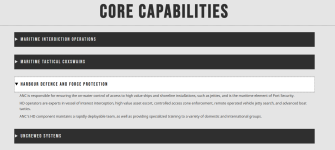
We have the Naval security team and ANCU. I'll note from that ANCU link:

1787221497465.png

I can see a role for the CA in some sort of shore detection and anti ship battery set up. But I don't see a need from them to be on RCN small boats patrolling, IMHO this is something RCN should be dealing with.
 
Back
Top