• Thanks for stopping by. Logging in to a registered account will remove all generic ads. Please reach out with any questions or concerns.

CAN-USA Tariff Strife (split from various pol threads)

Both sides said thenother side brought last minutes changes to the deal.
Dealers odds are it being the Americans but our government is hardly deserving of "just trust us".

I mean the specific clauses. No US official has denied the specific clauses. I could care less when these were I produced or not.
 
I mean the specific clauses. No US official has denied the specific clauses. I could care less when these were I produced or not.
I'm not sure. I just see both sides blaming the other side.with livelihoods and $20b on the line Canadians deserve to see what's being negotiated on their behalf.
 
“As Trump has declared over and over again, his ultimate goal in this trade war is to add Canada as a 51st state.”

“Against Canada, Trump is fighting a trade war that very few Americans support, under leadership that most Americans reject, to achieve results that virtually all Americans would dismiss as pointless if not crazy.”

 
WTF is Liberal MP Anthony Housefather doing campaigning in Florida a few days ago for a democratic candidate in the mid terms? Seriously?

If a republican did that up here, some of you would literally explode with anger.

How about we watch our steps here and not get our asses handed to us?
Is that worse than Jamil Jivani having a university bro-fest a couple of time with the Veep and doing a drive-by howdy in the Oval office?
 
Jivani joins Gladu and the rest of the floor crossing MPs demonstrating why constituents should have a mechanism to call a by election.
 
I'd rather see people who voted for him fire him rather than a party leader do it. Seems more democratic.
He would still be an MP. Still be in parliament, still collect his salary.

He wouldn't be getting fired by any metric.
 
If he loses a constituent initiated by-election he'll need to get a job somewhere else.
The rebel would hire him in a heartbeat. Or some Vance linked consulting job in the states.

But if PP kicked him out of the CPC to sit as an independent, Jamil Jivani loses a lot of his credibility, and PP gets rid of an actual headache and a potential Brutus.

So of course Jivani is going to stick around.
 
If I were GoC king for a day, I’d hold off on announcing the type and scale of export taxes on resources ( 😉 ) until after 9/11 remembrance ceremonies, and the American 24-48 memory span still potentially remembers how Canada looked after all the Americans away from home when they not permitted to come back into their own country.
Fun fact: even right afterwards, the first list of countries thanked didn’t include Canada for some reason, so I suspect you have more faith in American collective memory than I do.
 
Fun fact: even right afterwards, the first list of countries thanked didn’t include Canada for some reason, so I suspect you have more faith in American collective memory than I do.
If he does mention us on 9/11 it will probably be in the context of "loyalty and friendship to America deserving of statehood".
 
If he loses a constituent initiated by-election he'll need to get a job somewhere else.
Still doesn't stop the coach from kicking him off the team, leaving him as an independent MP.

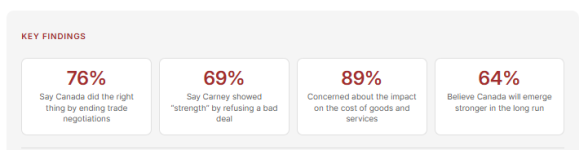
Meanwhile, initial survey says: "Three-in-four Canadians are endorsing the Carney government’s decision to walk away from trade negotiations with the United States late Friday night, confirming that long-expressed national resolve and desire to see Canadian negotiators take a “hard line” with Washington was more than theoretical."
1787558268064.png
How it was done:
The Angus Reid Institute conducted an online survey from Aug. 22–23, 2026, among a randomized sample of 1,468 Canadian adults. Respondents are drawn from the Angus Reid Forum, a large-scale online panel developed to include Canadian residents in each of the 343 federal ridings in Canada and representative of the Canadian population by age, gender, family income, ethnic status and education. The sample was weighted to be representative of adults nationwide according to region, gender, age, household income, and education, based on the Canadian census. For comparison purposes only, a probability sample of this size would carry a margin of error of +/– 2 percentage points, 19 times out of 20. Discrepancies in or between totals are due to rounding. The survey was self-commissioned and paid for by ARI.
More in link and in attached PDF.
 

Attachments

Absolutely a significant part of this is hegemony, although I also believe Trump actually is trade stupid and thinks general tariffs are sound economics versus free trade.

The U.S. is adopting a modernized Monroe Doctrine and asserting a hegemonic right to dominate the Americas. They still have a serious Manifest Destiny hangover. They can hardly hope to be taken seriously in this if they can’t break and dominate Canada. They’re increasingly tipping their hand that they don’t want us to have our own sovereign foreign and trade policy. Canadian sovereignty means little to them; our assertion of it is an impediment to their goals.

They are hypocrites in most of their criticisms of our domestic economic and trade policy, but that and a couple of bucks will buy you a coffee. They won’t be shamed or cajoled by their own hypocrisy, so it’s only a useful indicator of bad faith.

Trump has unleashed this but he is not the sole owner, else it probably would have bankrupted already. We need to be prepared for the very real possibility that this is America going forward.

It's only unsound if you are taking a globalist rules-based international order perspective. My perspective is that globalization and the rules-based international order is dead and we are back to an era of great power competition. I've argued such a point many times in the past.

My perspective is grounded in a realist critique of modern geopolitics. The post-Cold War illusion of a globalized, rules-based international order is officially dead and has been replaced by a ruthless era of great power competition where economic tools are weaponized for national survival. Viewing the Trump Administration's aggressive tariffs and structural protectionism as merely "trade stupid" ignores this systemic shift.

In the multipolar world we now find ourselves living in, general tariffs are no longer deployed for pure economic efficiency, but rather as weapons of economic nationalism meant to secure supply chains, decouple from adversaries like China, and reassert a modernized Monroe Doctrine over North America.

Expecting Washington to prioritize abstract notions of Canadian trade sovereignty over its own domestic security is a luxury of a bygone era. The United States is tipping its hand because hegemony, not international law, is the organizing principle of the future.

My principal argument is that for Canada to survive this permanent American trajectory, it must abandon its reliance on legacy treaties and legalistic grievances about U.S. hypocrisy. Crying foul at the UN or invoking the spirit of free trade will not stop a superpower experiencing a Manifest Destiny hangover. Instead, Canada must pivot to a transaction-based foreign policy, leveraging the tangible assets the U.S. desperately needs to fuel its fortress-style economy.

By ruthlessly trading on our vast reserves of critical minerals, continental energy security, and joint Arctic defense infrastructure, Canada can carve out a position of indispensable utility. We cannot shame the Americans into respecting our sovereignty, but we can make it in their absolute self-interest to secure a strong, integrated northern partner rather than a broken satellite state.

Well if it walks like a duck and talks like a duck...
Predicting a hurricane doesn't mean I support high winds. I'm not rooting for an attack on Canadian independence, I’m analyzing the reality of the neighbor we live next to. Ignoring the return of great power competition won't protect Canada from it. We have to see the world as it is, not how we wish it would be.
So you concur its immoral, but your in support of it?
Morality has nothing to do with it. Calling it 'immoral' doesn't stop the tariffs. My point is that if Canada relies on moral outrage instead of strategic leverage, we lose. Wanting Canada to smarten up, drop the legalistic grievances, and play the geopolitical game to win isn’t opposing Canada, it’s the only way to actually save our independence.
Again your in support of an attack on Canadian independance because you dont like the party in charge?
We live in a democracy where we are allowed to look at complex political situations from all sides. Labeling someone 'treasonous' just for finding merit in an opposing viewpoint completely shuts down healthy political debate.

As for Canadian political parties, this has nothing to do with which party is in charge in Ottawa. Whether it's the Liberals, Conservatives, or anyone else, any Canadian Government is going to face this exact same aggressive American posture going forward. It's not a Trump anomaly; it's a permanent shift in U.S. foreign policy, and we need a strategy, not just hurt feelings.

The current Government, aka the LPC, is using a playbook that was designed for the World as it was two decades ago. That World is gone.
 
It's only unsound if you are taking a globalist rules-based international order perspective. My perspective is that globalization and the rules-based international order is dead and we are back to an era of great power competition. I've argued such a point many times in the past.

My perspective is grounded in a realist critique of modern geopolitics. The post-Cold War illusion of a globalized, rules-based international order is officially dead and has been replaced by a ruthless era of great power competition where economic tools are weaponized for national survival. Viewing the Trump Administration's aggressive tariffs and structural protectionism as merely "trade stupid" ignores this systemic shift.

In the multipolar world we now find ourselves living in, general tariffs are no longer deployed for pure economic efficiency, but rather as weapons of economic nationalism meant to secure supply chains, decouple from adversaries like China, and reassert a modernized Monroe Doctrine over North America.

Expecting Washington to prioritize abstract notions of Canadian trade sovereignty over its own domestic security is a luxury of a bygone era. The United States is tipping its hand because hegemony, not international law, is the organizing principle of the future.

My principal argument is that for Canada to survive this permanent American trajectory, it must abandon its reliance on legacy treaties and legalistic grievances about U.S. hypocrisy. Crying foul at the UN or invoking the spirit of free trade will not stop a superpower experiencing a Manifest Destiny hangover. Instead, Canada must pivot to a transaction-based foreign policy, leveraging the tangible assets the U.S. desperately needs to fuel its fortress-style economy.

By ruthlessly trading on our vast reserves of critical minerals, continental energy security, and joint Arctic defense infrastructure, Canada can carve out a position of indispensable utility. We cannot shame the Americans into respecting our sovereignty, but we can make it in their absolute self-interest to secure a strong, integrated northern partner rather than a broken satellite state.


Predicting a hurricane doesn't mean I support high winds. I'm not rooting for an attack on Canadian independence, I’m analyzing the reality of the neighbor we live next to. Ignoring the return of great power competition won't protect Canada from it. We have to see the world as it is, not how we wish it would be.

Morality has nothing to do with it. Calling it 'immoral' doesn't stop the tariffs. My point is that if Canada relies on moral outrage instead of strategic leverage, we lose. Wanting Canada to smarten up, drop the legalistic grievances, and play the geopolitical game to win isn’t opposing Canada, it’s the only way to actually save our independence.

We live in a democracy where we are allowed to look at complex political situations from all sides. Labeling someone 'treasonous' just for finding merit in an opposing viewpoint completely shuts down healthy political debate.

As for Canadian political parties, this has nothing to do with which party is in charge in Ottawa. Whether it's the Liberals, Conservatives, or anyone else, any Canadian Government is going to face this exact same aggressive American posture going forward. It's not a Trump anomaly; it's a permanent shift in U.S. foreign policy, and we need a strategy, not just hurt feelings.

The current Government, aka the LPC, is using a playbook that was designed for the World as it was two decades ago. That World is gone.

Great post.
 
It's only unsound if you are taking a globalist rules-based international order perspective. My perspective is that globalization and the rules-based international order is dead and we are back to an era of great power competition. I've argued such a point many times in the past.

My perspective is grounded in a realist critique of modern geopolitics. The post-Cold War illusion of a globalized, rules-based international order is officially dead and has been replaced by a ruthless era of great power competition where economic tools are weaponized for national survival. Viewing the Trump Administration's aggressive tariffs and structural protectionism as merely "trade stupid" ignores this systemic shift.

In the multipolar world we now find ourselves living in, general tariffs are no longer deployed for pure economic efficiency, but rather as weapons of economic nationalism meant to secure supply chains, decouple from adversaries like China, and reassert a modernized Monroe Doctrine over North America.

Expecting Washington to prioritize abstract notions of Canadian trade sovereignty over its own domestic security is a luxury of a bygone era. The United States is tipping its hand because hegemony, not international law, is the organizing principle of the future.

My principal argument is that for Canada to survive this permanent American trajectory, it must abandon its reliance on legacy treaties and legalistic grievances about U.S. hypocrisy. Crying foul at the UN or invoking the spirit of free trade will not stop a superpower experiencing a Manifest Destiny hangover. Instead, Canada must pivot to a transaction-based foreign policy, leveraging the tangible assets the U.S. desperately needs to fuel its fortress-style economy.

By ruthlessly trading on our vast reserves of critical minerals, continental energy security, and joint Arctic defense infrastructure, Canada can carve out a position of indispensable utility. We cannot shame the Americans into respecting our sovereignty, but we can make it in their absolute self-interest to secure a strong, integrated northern partner rather than a broken satellite state.
You misunderstand me. I’m not suggesting the tariffs are economically unsound out of some pink and fuzzy rules based world view. If you think I’m still here hanging my hat on the rules based international order and a Canada-US relationship based on principle, you’ve not been paying attention to my posts for the past year. We need to meet ruthless transactional with ruthless transactional. I’m not sure what ‘legacy treaty’ you think we’re foolishly relying on in our trade with the U.S., unless you mean Trump’s own CUSMA from just a decade ago? If there’s something else you think we as a country are inappropriately nostalgic about there, let me know. It’s sadly true though that even his own signed and bragged-on agreements are now so easy to doubt the reliability of. “Signed in pencil” indeed. Even in a transactional, competitive world, agreed upon deals still need to mean what they say they mean, or transactions themselves break down. I’ve said many times now that business can deal with and price around a bad rule set as long as the rules are reliably and predictable enforced. It’s that wild unreliability and unpredictability that is hurting America’s full faith and credit.

Generalized tariffs are stupid because they are stupid. Liberalized trade allows countries to make the most out of their comparative and absolute advantages, and it allows their businesses and consumers to get the most out of their buck. Generalized tariffs add needless friction and cost, and harm your own industries’ competitiveness in world markets. I suspect from our past discussions that you have a somewhat more than passing familiarity with the economic advantages of liberalized cross border trade, and on the straight market economics of this I suspect I’m preaching to the choir.

I understand your reasoning about the power dynamics, and yes, specific tariffs can indeed operate to distort market pricing and, through these inefficient externalities, incentivize growth of domestic industries that would not otherwise be competitive. “We want to have this industry on-shore; we can’t do it as well as the other guy, so we’ll artificially price the other guy out by charging our importers a tax so our own producers have a nice bubble to work in”. If the industry is important enough to have sovereign control over, and if you’re willing to eat above market pricing, fair enough.

So I mean, sure, specific tariffs can protect individual industries or sectors that are deemed to be of national importance. The stupidity of the U.S. position though is in how hamfistedly they’ve applied tariffs as far across the board as existing trade agreements allow, and sometimes even despite those agreements. They’re just taxing the shit out of their own people on a multitude of goods and services that don’t merit such protections.

Ironically, by eroding purchasing power both immediately through price hikes at the docks, and through the resulting inflationary pressure, they destroy some of the very demand these now sheltered domestic industries increasingly rely on. And of course they’re also inviting reciprocal and retaliatory measures that hurt their own industries that do enjoy comparative advantage and will now face less access to external markets.

I understand the concepts of economic nationalism well. They’re just going about it in an incredibly dumb way. Most of what they need to have economic security they could easily just buy from reliable partners if they decide to pay enough to make it worth it for producers. The ones in the administration down there who still have brain cells to rub together are still quietly pushing exactly this approach on things like critical mineral development in partnership with our businesses. But now they’re having to do it sailing upwind against policy Choices that cause the rest of us not to trust them or to want to rely on them.

America could very easily have come out with a strong and coherent policy on certain key sectors, clearly said they were going to use restrictive trade practices to protect and stimulate those sectors, and that otherwise they remain open for business to let their companies buy and sell as freely as they choose. It would have pissed some people and some industries off, but it would have been articulable and reasonable, so long as it involved consciously accepting the inherent inefficiencies of being an economic island in a given sector. But instead they just blindly tariffed everyone including an island full of penguins, and only when things started to bite did they reassess some of their initial rules that had had extremely predictable detrimental impacts on their own people. Maybe that’s when Trump learned how ‘dumb’ is spelled?

Absolutely agreed that we must aggressively leverage our own advantages and reassert that if they want to work with us, it must be a just partnership. We need to heavily build out export infrastructure and continue making advantageous trade deals with other countries and trading blocs, and then the Americans can enjoy competing with other potential purchasers. I remain happy to sell them stuff, but we have a lot of stuff everybody wants, not just them. Our government seems to grasp the importance of policy that makes it easier to sell into the broader world market. We need to keep acting aggressively on that. More trade deals, expanded ports, and expanded lateral infrastructure east to west across Canada, as well as north to where there’s more good stuff in the ground.

 
Absolutely agreed that we must aggressively leverage our own advantages and reassert that if they want to work with us, it must be a just partnership. We need to heavily build out export infrastructure and continue making advantageous trade deals with other countries and trading blocs, and then the Americans can enjoy competing with other potential purchasers. I remain happy to sell them stuff, but we have a lot of stuff everybody wants, not just them. Our government seems to grasp the importance of policy that makes it easier to sell into the broader world market. We need to keep acting aggressively on that. More trade deals, expanded ports, and expanded lateral infrastructure east to west across Canada, as well as north to where there’s more good stuff in the ground.

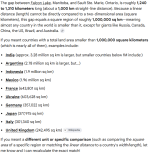
The gap between Falcon Lake Manitoba and Sault St Marie Ontario needs to be the #1 priority to fix.
Expand the port of Thunder Bay
Twin the TCH
Twin the CNR and CPR (Is it already? Bogart should know)
Eventually a pipeline to Sarnia but we could have a terminal in Thunder Bay and use ships to get it there. (That the locks at the Soo being completely on the US side of the border could be an issue)

Just spitballing but the time for talk is done, time for some action, bitches!!
 
You misunderstand me. I’m not suggesting the tariffs are economically unsound out of some pink and fuzzy rules based world view. If you think I’m still here hanging my hat on the rules based international order and a Canada-US relationship based on principle, you’ve not been paying attention to my posts for the past year. We need to meet ruthless transactional with ruthless transactional. I’m not sure what ‘legacy treaty’ you think we’re foolishly relying on in our trade with the U.S., unless you mean Trump’s own CUSMA from just a decade ago? If there’s something else you think we as a country are inappropriately nostalgic about there, let me know. It’s sadly true though that even his own signed and bragged-on agreements are now so easy to doubt the reliability of. “Signed in pencil” indeed. Even in a transactional, competitive world, agreed upon deals still need to mean what they say they mean, or transactions themselves break down. I’ve said many times now that business can deal with and price around a bad rule set as long as the rules are reliably and predictable enforced. It’s that wild unreliability and unpredictability that is hurting America’s full faith and credit.

Generalized tariffs are stupid because they are stupid. Liberalized trade allows countries to make the most out of their comparative and absolute advantages, and it allows their businesses and consumers to get the most out of their buck. Generalized tariffs add needless friction and cost, and harm your own industries’ competitiveness in world markets. I suspect from our past discussions that you have a somewhat more than passing familiarity with the economic advantages of liberalized cross border trade, and on the straight market economics of this I suspect I’m preaching to the choir.

I understand your reasoning about the power dynamics, and yes, specific tariffs can indeed operate to distort market pricing and, through these inefficient externalities, incentivize growth of domestic industries that would not otherwise be competitive. “We want to have this industry on-shore; we can’t do it as well as the other guy, so we’ll artificially price the other guy out by charging our importers a tax so our own producers have a nice bubble to work in”. If the industry is important enough to have sovereign control over, and if you’re willing to eat above market pricing, fair enough.

So I mean, sure, specific tariffs can protect individual industries or sectors that are deemed to be of national importance. The stupidity of the U.S. position though is in how hamfistedly they’ve applied tariffs as far across the board as existing trade agreements allow, and sometimes even despite those agreements. They’re just taxing the shit out of their own people on a multitude of goods and services that don’t merit such protections.

Ironically, by eroding purchasing power both immediately through price hikes at the docks, and through the resulting inflationary pressure, they destroy some of the very demand these now sheltered domestic industries increasingly rely on. And of course they’re also inviting reciprocal and retaliatory measures that hurt their own industries that do enjoy comparative advantage and will now face less access to external markets.

I understand the concepts of economic nationalism well. They’re just going about it in an incredibly dumb way. Most of what they need to have economic security they could easily just buy from reliable partners if they decide to pay enough to make it worth it for producers. The ones in the administration down there who still have brain cells to rub together are still quietly pushing exactly this approach on things like critical mineral development in partnership with our businesses. But now they’re having to do it sailing upwind against policy Choices that cause the rest of us not to trust them or to want to rely on them.

America could very easily have come out with a strong and coherent policy on certain key sectors, clearly said they were going to use restrictive trade practices to protect and stimulate those sectors, and that otherwise they remain open for business to let their companies buy and sell as freely as they choose. It would have pissed some people and some industries off, but it would have been articulable and reasonable, so long as it involved consciously accepting the inherent inefficiencies of being an economic island in a given sector. But instead they just blindly tariffed everyone including an island full of penguins, and only when things started to bite did they reassess some of their initial rules that had had extremely predictable detrimental impacts on their own people. Maybe that’s when Trump learned how ‘dumb’ is spelled?

Absolutely agreed that we must aggressively leverage our own advantages and reassert that if they want to work with us, it must be a just partnership. We need to heavily build out export infrastructure and continue making advantageous trade deals with other countries and trading blocs, and then the Americans can enjoy competing with other potential purchasers. I remain happy to sell them stuff, but we have a lot of stuff everybody wants, not just them. Our government seems to grasp the importance of policy that makes it easier to sell into the broader world market. We need to keep acting aggressively on that. More trade deals, expanded ports, and expanded lateral infrastructure east to west across Canada, as well as north to where there’s more good stuff in the ground.
Great post.
 
Back
Top