

You are using an out of date browser. It may not display this or other websites correctly.
You should upgrade or use an alternative browser.
You should upgrade or use an alternative browser.
USMC Future of Warfare Video
- Thread starter KevinB
- Start date

- Reaction score
- 13,985
- Points
- 1,160
Wondering how the video matches up with this latest release from the Commandant USMC (hope he is recovering from his cardiac arrest)
The word of the day is "campaigning"
 www.usni.org
The word of the day is "campaigning"
Campaigning is inherently deliberate and proactive, compared with many crisis response missions, which are inherently unpredictable and reactive;
...familiar to generations of Marines and sailors...The general concept is not new, but the implications of its renewed use should serve as a wakeup call for the Sea Services. A deliberate refocus on campaigning requires reexamining how the Marine Corps can best contribute and align core concepts and doctrine with these efforts, particularly given ongoing and rising threats from China and elsewhere to U.S. national security interests in the world’s most critical maritime regions.
Our forward presence and inherent versatility ensure relevancy across the entire range of military operations—from competition to high-end conflict
Rethink the Marine Corps’ Role in Global Campaigning
Campaigning is not a new concept, but its renewed use is a wakeup call.
We must accelerate the implementation of new concepts at the forward edge. By employing formations in new ways, with new technologies, and alongside allies and partners, the naval services will continue to present an uncertain operational picture for our adversaries. Amphibious motherships for unmanned platforms; expanded kill webs linking the joint force together; closer integration with special operations forces and the Coast Guard; and new maritime domain awareness platforms and intratheater connectors will all enhance naval campaigning efforts.
Codifying global campaigning through our doctrine.
Reexamining the global environment.
Modernizing formations and employment concepts.
Being aggressive with unmanned technologies.
Above all, we must innovate and challenge convention. As we reevaluate the Marine Corps’ role in global campaigning, we cannot be constrained by how things have been done in the past.
- Reaction score
- 13,985
- Points
- 1,160
USMC Update 2025
"Marines have tested new tactics in big exercises. In BALIKATAN 25, I MEF practiced hiding small teams on islands, using NMESIS (Navy-Marine Corps Expeditionary Ship Interdiction Systems) to sink ships, MADIS (Marine Air Defense Integrated Systems) to shoot down drones, and G/ATOR (Ground/Air Task-Oriented Radar) radar to spot threats. They trained with Japan and the Philippines. Exercises like TALISMAN SABRE and RESOLUTE DRAGON sharpened precision strikes and base defense with allies. ATLANTIC ALLIANCE 25 was the biggest amphibious drill in the Atlantic in years, practicing distributed operations with NATO partners."
" Two Marine Littoral Regiments (MLRs) are now in III MEF: 3d MLR is fully operational since 2023, 12th hits that mark in 2026. These units are built for island fighting with advanced sensors and missiles. The 4th Marines stays as a beefed-up infantry regiment. MEUs now carry the same high-tech gear as MLRs. Infantry battalions added a Fires and Recon company for drones and rockets, and squads went back to 13 Marines, including a drone operator. Notably, the Marine Corps recently created a new Attack Drone Team to hone these skills."
"New weapons are being fielded across the field. Including the aforementioned NMESIS anti-ship missiles: six launchers delivered, heading to 18 per battery by 2033. HIMARS (High Mobility Artillery Rocket System) status: all 10 batteries complete. G/ATOR radars: 60% fielded by end of 2025. Organic Precision Fires and loitering munitions for infantry will start arriving in 2026. F-35 jets: 11 squadrons are done with more transitioning. MQ-9A drones fly recon over the Pacific. 3D printing labs (12 big ones, 25 small) let Marines conduct additive manufacturing to make parts on site.
"Air defense is ramping up. MRIC (Medium-Range Intercept Capability) stops cruise missiles, three batteries coming soon. MADIS on vehicles: 20 delivered. L-MADIS on light trucks: 10 in 2026. Bases received counter-drone systems, and every unit will soon have portable anti-drone kits to address the ever evolving threat.
"Doctrines are updating. Expeditionary Advanced Base Operations (EABO) and Stand-in Forces concepts are becoming official guidance. Bases are modernizing barracks and defenses. Recruiting and retention hit record highs. Training now includes AI, drones, and joint operations."
.....
"Maneuver and mobility mean moving fast across sea, land, and air. The Corps wants 31 amphibious ships minimum. New landing craft are in development. Ground vehicles: Advanced Recon Vehicle for scouts, Amphibious Combat Vehicle (257 fielded), JLTVs (over 5,000 delivered), and ultra-light trucks. Aviation spreads out with distributed ops using KC-130s, CH-53s, and MV-22s.
"Lethality gets upgrades. NMESIS and HIMARS will work in jammed environments. A new rocket launcher is coming. Infantry experiments continue. Drone teams will hunt targets. F-35s pair with XQ-58 unmanned wingmen. Long-range missiles expand strike options.
"Joint kill webs link sensors to shooters faster. In order to improve these kill webs - new command systems will speed decisions. MQ-9 drones will receive better Artificial Intelligence (AI) integration. Aviation assets will get more flexible targeting tools."
....
"As has been the case since Force Design was first promulgated, logistics will remain a major highlight going forward. Logistics in contested environments focus on keeping Marines supplied when enemies try to cut off traditional sea and air routes. The Corps is expanding its Global Positioning Network with prepositioned ships loaded with gear in the Indo-Pacific, Norway, and on Maritime Prepositioning Force vessels to fix current shortfalls and speed up resupply. Autonomous systems will start taking center stage: the Autonomous Low-Profile Vessel (also known as the “ALPV”) acts as an unmanned supply boat, while Tactical Resupply UAS drones and the Medium Aerial Resupply Vehicle deliver critical items like ammo, fuel, and medical supplies to forward teams without risking manned aircraft. Advanced Logistics Analytics will use AI to crunch data from sensors and predict needs, then reroute shipments in real time to dodge threats and keep the fight going. This setup cuts reliance on big, vulnerable convoys and ensures even small, dispersed units stay in the fight longer."
"Marines have tested new tactics in big exercises. In BALIKATAN 25, I MEF practiced hiding small teams on islands, using NMESIS (Navy-Marine Corps Expeditionary Ship Interdiction Systems) to sink ships, MADIS (Marine Air Defense Integrated Systems) to shoot down drones, and G/ATOR (Ground/Air Task-Oriented Radar) radar to spot threats. They trained with Japan and the Philippines. Exercises like TALISMAN SABRE and RESOLUTE DRAGON sharpened precision strikes and base defense with allies. ATLANTIC ALLIANCE 25 was the biggest amphibious drill in the Atlantic in years, practicing distributed operations with NATO partners."
" Two Marine Littoral Regiments (MLRs) are now in III MEF: 3d MLR is fully operational since 2023, 12th hits that mark in 2026. These units are built for island fighting with advanced sensors and missiles. The 4th Marines stays as a beefed-up infantry regiment. MEUs now carry the same high-tech gear as MLRs. Infantry battalions added a Fires and Recon company for drones and rockets, and squads went back to 13 Marines, including a drone operator. Notably, the Marine Corps recently created a new Attack Drone Team to hone these skills."
"New weapons are being fielded across the field. Including the aforementioned NMESIS anti-ship missiles: six launchers delivered, heading to 18 per battery by 2033. HIMARS (High Mobility Artillery Rocket System) status: all 10 batteries complete. G/ATOR radars: 60% fielded by end of 2025. Organic Precision Fires and loitering munitions for infantry will start arriving in 2026. F-35 jets: 11 squadrons are done with more transitioning. MQ-9A drones fly recon over the Pacific. 3D printing labs (12 big ones, 25 small) let Marines conduct additive manufacturing to make parts on site.
"Air defense is ramping up. MRIC (Medium-Range Intercept Capability) stops cruise missiles, three batteries coming soon. MADIS on vehicles: 20 delivered. L-MADIS on light trucks: 10 in 2026. Bases received counter-drone systems, and every unit will soon have portable anti-drone kits to address the ever evolving threat.
"Doctrines are updating. Expeditionary Advanced Base Operations (EABO) and Stand-in Forces concepts are becoming official guidance. Bases are modernizing barracks and defenses. Recruiting and retention hit record highs. Training now includes AI, drones, and joint operations."
.....
"Maneuver and mobility mean moving fast across sea, land, and air. The Corps wants 31 amphibious ships minimum. New landing craft are in development. Ground vehicles: Advanced Recon Vehicle for scouts, Amphibious Combat Vehicle (257 fielded), JLTVs (over 5,000 delivered), and ultra-light trucks. Aviation spreads out with distributed ops using KC-130s, CH-53s, and MV-22s.
"Lethality gets upgrades. NMESIS and HIMARS will work in jammed environments. A new rocket launcher is coming. Infantry experiments continue. Drone teams will hunt targets. F-35s pair with XQ-58 unmanned wingmen. Long-range missiles expand strike options.
"Joint kill webs link sensors to shooters faster. In order to improve these kill webs - new command systems will speed decisions. MQ-9 drones will receive better Artificial Intelligence (AI) integration. Aviation assets will get more flexible targeting tools."
....
"As has been the case since Force Design was first promulgated, logistics will remain a major highlight going forward. Logistics in contested environments focus on keeping Marines supplied when enemies try to cut off traditional sea and air routes. The Corps is expanding its Global Positioning Network with prepositioned ships loaded with gear in the Indo-Pacific, Norway, and on Maritime Prepositioning Force vessels to fix current shortfalls and speed up resupply. Autonomous systems will start taking center stage: the Autonomous Low-Profile Vessel (also known as the “ALPV”) acts as an unmanned supply boat, while Tactical Resupply UAS drones and the Medium Aerial Resupply Vehicle deliver critical items like ammo, fuel, and medical supplies to forward teams without risking manned aircraft. Advanced Logistics Analytics will use AI to crunch data from sensors and predict needs, then reroute shipments in real time to dodge threats and keep the fight going. This setup cuts reliance on big, vulnerable convoys and ensures even small, dispersed units stay in the fight longer."
- Reaction score
- 13,985
- Points
- 1,160
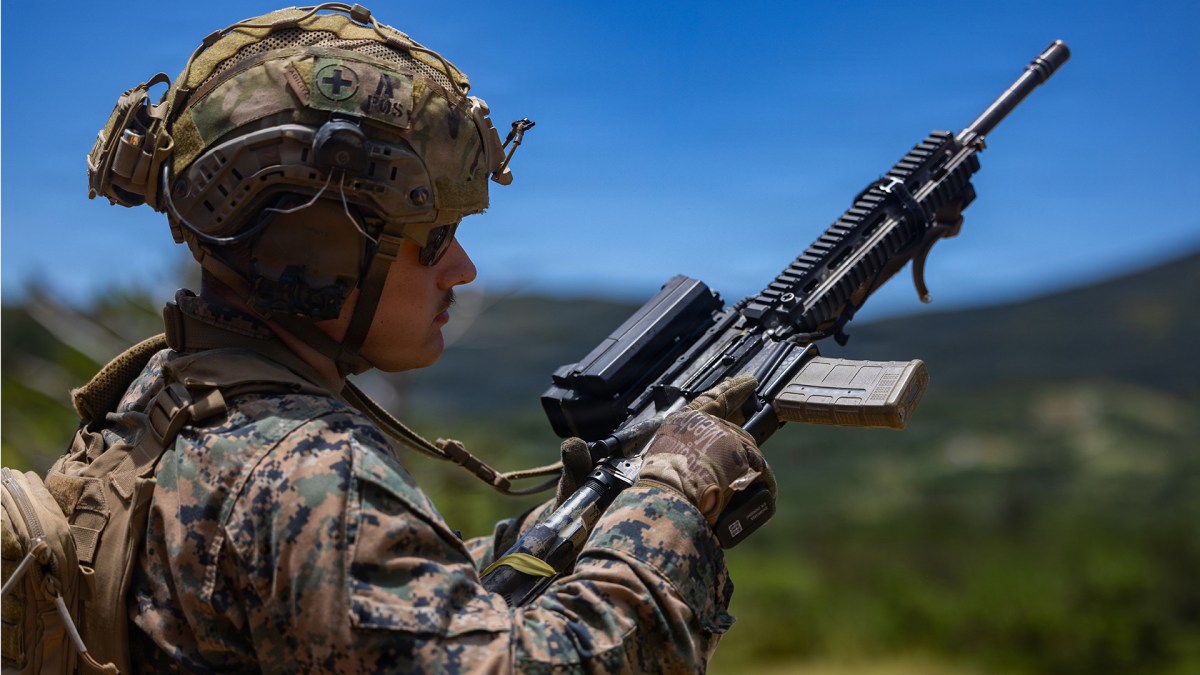
Marine Corps releases roadmap for infantry in drone-covered world
The Marines have already begun fielding more than 80 new systems to help squads detect and destroy small drones.
 taskandpurpose.com
....
"a vision for how the basic elements of infantry squads and platoons will be equipped on battlefields swarming with drones."
“The widespread use of drones underscores the need for effective organic protective measures across the [Ground Combat Element], down to the squad level,”
.”The evolving drone threat presents the most significant risk to ground maneuver, requiring layered active and passive counter-[unmanned aircraft systems] capabilities to retain the initiative.”
“The ability for our lowest echelon units – squad, platoon, company – to defend themselves against these one-way attack systems is really maybe one of the biggest holes in our swing,” Bargeron told reporters on Wednesday. “So we’re working hard on that.”
......
"So far this year, the Marine Corps has fielded more than 80 sets of what it calls the “organic counter small UAS system,” which allows squads to jam and destroy small drones, Corps officials said.
"Bargeron mentioned that the Marine Corps has also purchased 400,000 anti-drone rounds for Marines’ M4 carbine and M27 Infantry Automatic Rifles. Designed specifically to be used against small drones, the ammunition separates into five distinct projectiles after being fired."
....
the Marine Corps is also fielding the “Home Alone” countermeasure to detect drones from several kilometers away,....“Home Alone is a Counter small Unmanned Aircraft Systems (CsUAS) that is a semi-fixed site [ground-based air defense] solution that supports our layered defense structure,”
....
the Corps is in the process of fielding loitering munitions to squads that will give them the ability to strike targets up to 20 kilometers away.
Marine anti-tank missile gunners will be responsible for the loitering munitions, and there are no current plans to create a new military occupational specialty for that purpose, Corps officials said.
.............................................
The Marines continue their two decade evolution of the dispersed squad.
The bit about giving squads 20 km loitering munitions by issuing loitering munitions to the anti-tank missile gunners is a bit confusing to me.
I thought those gunners were only found in the Company Heavy Weapons Platoon and the Battalion Combined Arms Platoon.
Does this mean that the USMC will be more routinely distributing those gunners downwards to the squads as attachments? Effectively creating a larger Squad, or a Squad Combat Team?

- Reaction score
- 31,520
- Points
- 1,260
The USMC Squad has been in a near constant state of flux for the past decade..........................................
The Marines continue their two decade evolution of the dispersed squad.
The bit about giving squads 20 km loitering munitions by issuing loitering munitions to the anti-tank missile gunners is a bit confusing to me.
I thought those gunners were only found in the Company Heavy Weapons Platoon and the Battalion Combined Arms Platoon.
Does this mean that the USMC will be more routinely distributing those gunners downwards to the squads as attachments? Effectively creating a larger Squad, or a Squad Combat Team?
It is already very large, and has been shift back and forth from 13-17 Marines.
I do not see the logic in pushing a 20km system down below the Company Wpns Platoon. In an extremely dispersed environment, one could farm squads off the Coy Wpns Pl to send to the Rifle platoons.

FJAG
Army.ca Myth
- Reaction score
- 21,119
- Points
- 1,160
It's interesting to watch. I haven't seen too much in recent organizational changes but here was this one from three years ago and another that discussed the downsizing of battalions from close to 1,000 to roughly 880.The USMC Squad has been in a near constant state of flux for the past decade.
It is already very large, and has been shift back and forth from 13-17 Marines.
I do not see the logic in pushing a 20km system down below the Company Wpns Platoon. In an extremely dispersed environment, one could farm squads off the Coy Wpns Pl to send to the Rifle platoons.
We always consider the division to be the place where one transitions from the deep to the close fight. The more that I see the development of weapons systems that a rifleman can operate and is capable of fighting over the horizon, the more I wonder if the battalion too shouldn't be organized into deep and close fighting concept. Do we really need a platoon to have 20 km weapons? or should the battalion be divided into two "deep" companies and two "close" companies that are equipped and trained accordingly?

- Reaction score
- 31,520
- Points
- 1,260
To me anything a rifleman carries should be optimized for the close fight.
With things like NLOS MAPAT missiles, the distinction of what is close starts to get blurred.
I tend to believe it is better to have things with with ranges +10km at a function higher than an Armor or Infantry (or Combined Arms) Bn in a maneuver Bde.
I think that targeting, control (not necessarily the same as targeting) and logistics support for LM’s and LR NLOS systems would be better at the Fire’s Bde at Div level or in a Fire’s Cell at Bde.
But I’m not looking at a USMC dispersed island setup — so I guess it may make sense to download some of those capabilities in those cases. Maybe?
With things like NLOS MAPAT missiles, the distinction of what is close starts to get blurred.
I tend to believe it is better to have things with with ranges +10km at a function higher than an Armor or Infantry (or Combined Arms) Bn in a maneuver Bde.
I think that targeting, control (not necessarily the same as targeting) and logistics support for LM’s and LR NLOS systems would be better at the Fire’s Bde at Div level or in a Fire’s Cell at Bde.
But I’m not looking at a USMC dispersed island setup — so I guess it may make sense to download some of those capabilities in those cases. Maybe?
- Reaction score
- 13,985
- Points
- 1,160
It's interesting to watch. I haven't seen too much in recent organizational changes but here was this one from three years ago and another that discussed the downsizing of battalions from close to 1,000 to roughly 880.
We always consider the division to be the place where one transitions from the deep to the close fight. The more that I see the development of weapons systems that a rifleman can operate and is capable of fighting over the horizon, the more I wonder if the battalion too shouldn't be organized into deep and close fighting concept. Do we really need a platoon to have 20 km weapons? or should the battalion be divided into two "deep" companies and two "close" companies that are equipped and trained accordingly?
How is that different from the existing Rifle and Support dichotomy?
We can debate whether there should be 2, 3 or 4 Rifle/Close Combat Companies and their sizes and whether there should be a Mortar Platoon within the Support Company or there should be a separate Mortar Company to complement the Support Company.
We can debate whether the Support Company should include an Air Defence element.
We can debate whether the Rifles exist to defend the long range elements of the Support Platoons or whether the Support Platoons exist to support the Rifles.
Or it is all of the above and the battalion "unit" is infinitely adaptable to the needs of the situation.

- Reaction score
- 12,286
- Points
- 1,040
People in the close fight already have a lot to deal with.
Enemy artillery (fires) suppression is the job of friendly artillery (fires) units and formations.
Enemy drone suppression (neutralization, destruction) should be the job of friendly supporting units and formations.
Enemy artillery (fires) suppression is the job of friendly artillery (fires) units and formations.
Enemy drone suppression (neutralization, destruction) should be the job of friendly supporting units and formations.
- Reaction score
- 13,985
- Points
- 1,160
To me anything a rifleman carries should be optimized for the close fight.
With things like NLOS MAPAT missiles, the distinction of what is close starts to get blurred.
I tend to believe it is better to have things with with ranges +10km at a function higher than an Armor or Infantry (or Combined Arms) Bn in a maneuver Bde.
I think that targeting, control (not necessarily the same as targeting) and logistics support for LM’s and LR NLOS systems would be better at the Fire’s Bde at Div level or in a Fire’s Cell at Bde.
But I’m not looking at a USMC dispersed island setup — so I guess it may make sense to download some of those capabilities in those cases. Maybe?
Is dispersion only a function of the marine environment?
How about all those spaces where you don't have enough, and never will have enough, heavy elements to concentrate everywhere? Tundra, Taiga, Prairie or Desert, Mountain or Urban you are always going to be looking to deny a lot of ground with minimal resources, minimal manpower.
Some portion of your force will be devoted to that area denial role. Even 20 km Riflemen can add to the enemy's confusion. Just the same way submarines do for navies.
- Reaction score
- 13,985
- Points
- 1,160
People in the close fight already have a lot to deal with.
Enemy artillery (fires) suppression is the job of friendly artillery (fires) units and formations.
Enemy drone suppression (neutralization, destruction) should be the job of friendly supporting units and formations.
If you have 24 AT Gunners in a battalion you can either concentrate them or disperse them. Concentration seems to get people killed these days. Being an AT Gunner also seems to attract the kind of attention Machine Gunners did.
Let's stick with the 5 km Battalion for a moment: the range of the battalion mortars and missiles. You issue a 20 km loitering munition to the battalion. The munition can either fly 20 km in a straight line or it can run in circles. It can't do both. The advantage is in its ability to loiter, to circle overhead and attack on short notice. 20 km in a straight line is a deep strike.
Assume that we disperse the 24 gunners at 2.5 km intervals, operating overlapping 5 km circles, how much terrain can they observe and cover by fire? The battalion still has its 81mm mortars on ISVs to rapidly concentrate for a strike and dispersal.
Do each of those 24 gunners warrant a protection section of their own to cover local security and CUAS defence? Perhaps with CUAS tm attached from the Battalion AD platoon?
I suggest that the same battalion can be adapted to both concentrated and dispersed missions, just as they can switch from attack to defence. A significant change in their TTPs, a change in role, will require a retraining period, if the enemy allows it.
....
In this instance, the 24 dispersed gunners with protection sections, are now emulating a cavalry force and form part of a Recce Strike complex.
- Reaction score
- 31,520
- Points
- 1,260
Biggest issues for the Marine environment is supply and support.Is dispersion only a function of the marine environment?
How about all those spaces where you don't have enough, and never will have enough, heavy elements to concentrate everywhere? Tundra, Taiga, Prairie or Desert, Mountain or Urban you are always going to be looking to deny a lot of ground with minimal resources, minimal manpower.
Unlike the other terrain you mention above, a BN has no integral assets to resupply over water.
As well unless you get big into the man made island game, you can’t just sit down HIMARS systems all over the ocean to provide fire support.
Who coordinates the 20km rifleman?Some portion of your force will be devoted to that area denial role. Even 20 km Riflemen can add to the enemy's confusion. Just the same way submarines do for navies.
Fires - especially LRPF are concentrated and coordinated.
We network Air Defense for very specific reasons as well.
If Joe Bob is going to be firing this LM on his own (within his squad).
Who tells him there is a target?
Who tells him what to target?
Who deconflicts the LM track with other air occupiers...
This isn’t a SOF team with their own dedicated JTAC and Real Time Data updates.
In 5 years that Squad MAY be able to have that sort of data feed - but why am I detracting them from their primary mission with an OTH one?
Data transmission is not infinite - the key is to prioritize what is an is not necessary.
A Squad primary armed with small arms - doesn’t need to know the exact disposition of the Chinese fleet 20miles away via TAK -
LandWarrior, NetWarrior, DCGS-A, IronMan and several other programs have shown that inundating the solider (and it doesn’t matter if it is a bootcamp trainee, or a 20+yr veteran Tier 1 Assaulter) with data not needed to prosecute the immediate mission has a negative effect on mission success.
- Reaction score
- 12,286
- Points
- 1,040
What you propose would overlap the higher (brigade and division) commanders' responsibilities, and complicate the jobs of everyone at the lowest HQ echelon (unit) at which people are just starting to learn how to do the kinds of things HQs have to do.If you have 24 AT Gunners in a battalion you can either concentrate them or disperse them. Concentration seems to get people killed these days. Being an AT Gunner also seems to attract the kind of attention Machine Gunners did.
Let's stick with the 5 km Battalion for a moment: the range of the battalion mortars and missiles. You issue a 20 km loitering munition to the battalion. The munition can either fly 20 km in a straight line or it can run in circles. It can't do both. The advantage is in its ability to loiter, to circle overhead and attack on short notice. 20 km in a straight line is a deep strike.
We should try to keep things simple to the extent possible.
- Reaction score
- 13,985
- Points
- 1,160
Biggest issues for the Marine environment is supply and support.
Unlike the other terrain you mention above, a BN has no integral assets to resupply over water.
As well unless you get big into the man made island game, you can’t just sit down HIMARS systems all over the ocean to provide fire support.
Who coordinates the 20km rifleman?
Fires - especially LRPF are concentrated and coordinated.
We network Air Defense for very specific reasons as well.
If Joe Bob is going to be firing this LM on his own (within his squad).
Who tells him there is a target?
Who tells him what to target?
Who deconflicts the LM track with other air occupiers...
This isn’t a SOF team with their own dedicated JTAC and Real Time Data updates.
In 5 years that Squad MAY be able to have that sort of data feed - but why am I detracting them from their primary mission with an OTH one?
Data transmission is not infinite - the key is to prioritize what is an is not necessary.
A Squad primary armed with small arms - doesn’t need to know the exact disposition of the Chinese fleet 20miles away via TAK -
LandWarrior, NetWarrior, DCGS-A, IronMan and several other programs have shown that inundating the solider (and it doesn’t matter if it is a bootcamp trainee, or a 20+yr veteran Tier 1 Assaulter) with data not needed to prosecute the immediate mission has a negative effect on mission success.
I think we are heading in the same direction.
Joe Bob does need to be netted in. But the voice in his ear isn't 10 m away. It may be 10 km away. In many ways he is taking on SOF attributes.
But I don't see that as a great leap in evolutionary terms.
Joe Bob used to fight elbow to elbow to concentrate bayonets and balls, commanded by drums and bellowing Corporals.
Then some folks got issued rifles and they spread out, commanded by bugles and whistles.
Joe Bob got his rifle and spread out a generation later.
Then some folks got issued machine guns and covered a lot more terrain, commanded by radios.
Joe Bob got his machine gun a generation later
Then some folks got issued their personal role radios and dispersed even more
Joe Bob got his radio a generation later
Some folks got issued Switch Blades about 15 years back
Joe Bob is just starting to get his issued today.
None of this stops Joe Bob joining up with his buddies, elbow to elbow, if the situation demands and/or requires it.
- Reaction score
- 13,985
- Points
- 1,160
What you propose would overlap the higher (brigade and division) commanders' responsibilities, and complicate the jobs of everyone at the lowest HQ echelon (unit) at which people are just starting to learn how to do the kinds of things HQs have to do.
We should try to keep things simple to the extent possible.
I don't think so.
I think the Brigade is going to be concerned with the 100 km fight (155s with ramjets). The Division will be reaching out to 500 km (PrSMs) and the Corps 2500 km (Hypersonics and CCAs).
I also think each level is going to engage Joint or Multi-Domain elements.
- Reaction score
- 31,520
- Points
- 1,260
I think you miss that Artillery (Cannon or Rocket) needs to be setback from the Forward Edge (and I don’t know if we call it the FEBA or Forward Edge of Sensor Dominance, or Edge of the A2AD or...)I don't think so.
I think the Brigade is going to be concerned with the 100 km fight (155s with ramjets). The Division will be reaching out to 500 km (PrSMs) and the Corps 2500 km (Hypersonics and CCAs).
So your 155mm with 100km range probably have 60km of stuff past the Forward Edge
Also it is a Fires Bde at Division - not a Artillery Regiment/Bn at Bde
Beyond Corps there is Field Army, Army Group, and Theatre.
Joint realistically does not exist below Division.I also think each level is going to engaging Joint or Multi-Domain elements.
Multi-Domain assets are fairly a large umbrella, but the ones at the top are NLI items, and controlled by Theatre Command at the lowest.
- Reaction score
- 31,520
- Points
- 1,260
There is not currently the capability to do that much LPI DataI think we are heading in the same direction.
Joe Bob does need to be netted in. But the voice in his ear isn't 10 m away. It may be 10 km away. In many ways he is taking on SOF attributes.
But I don't see that as a great leap in evolutionary terms.
The Infantry soldier carries anywhere from 75-145lbs on their body depending on country and role.Joe Bob used to fight elbow to elbow to concentrate bayonets and balls, commanded by drums and bellowing Corporals.
Then some folks got issued rifles and they spread out, commanded by bugles and whistles.
Joe Bob got his rifle and spread out a generation later.
Then some folks got issued machine guns and covered a lot more terrain, commanded by radios.
Joe Bob got his machine gun a generation later
Then some folks got issued their personal role radios and dispersed even more
Joe Bob got his radio a generation later
Some folks got issued Switch Blades about 15 years back
Joe Bob is just starting to get his issued today.
None of this stops Joe Bob joining up with his buddies, elbow to elbow, if the situation demands and/or requires it.
Carrying more stuff is getting to be a non starter.
I put to you that a USMC Squad could be given something like a Switchblade 600 -- simply to bring to an island.
It may come from their BN Weapons Coy - or from higher.
It may even get dropped off at/near their position by UAS/UGV/UUV or manned vehicle/vessel.
All they do is place it and the map where told, or it is already there in something like a relief in place . --- it can be controlled from higher - and the Squad doesn’t need to pay any attention to it.
There are much better ISR systems than a Switchblade, I’ve been around Switchblade 600 demonstrations - I like it - but I think the local ISR aspect is over hyped -- I would rather use a less detectable system for local ISR, one that was focused on spectrum detection and LPI transmission.
- Reaction score
- 13,985
- Points
- 1,160
I think you miss that Artillery (Cannon or Rocket) needs to be setback from the Forward Edge (and I don’t know if we call it the FEBA or Forward Edge of Sensor Dominance, or Edge of the A2AD or...)
So your 155mm with 100km range probably have 60km of stuff past the Forward Edge
Also it is a Fires Bde at Division - not a Artillery Regiment/Bn at Bde
Beyond Corps there is Field Army, Army Group, and Theatre.
Joint realistically does not exist below Division.
Multi-Domain assets are fairly a large umbrella, but the ones at the top are NLI items, and controlled by Theatre Command at the lowest.
The Multi Domain Task Force was originally pitched as Theater asset wrapped around the Long Range Hypersonic Weapon. The MDTFs were aligned with specific Theaters and specific Corps. Ergo 1 MDTF. 1 Corps. 1 Theater. 2500 km radius.
Not many countries with the ability to field an Army Group these days.
Edit - Joint may not exist at low levels but every Joint element is becoming Multi-Domain at all levels, and trying to figure out who's on first.
- Reaction score
- 13,985
- Points
- 1,160
There is not currently the capability to do that much LPI Data
There is not currently the capability to launch Heavy Divisions every where.
The solution to both problems is the same: isolate their application in time and space to where they are best employed.
In both instances the ultimate solution will be the application of more resources if the situation warrants.
The Infantry soldier carries anywhere from 75-145lbs on their body depending on country and role.
Carrying more stuff is getting to be a non starter.
The infantry soldier now has a follow-me mule with legs/wheels/tracks/rotors.
I put to you that a USMC Squad could be given something like a Switchblade 600 -- simply to bring to an island.
It may come from their BN Weapons Coy - or from higher.
It may even get dropped off at/near their position by UAS/UGV/UUV or manned vehicle/vessel.
All they do is place it and the map where told, or it is already there in something like a relief in place . --- it can be controlled from higher - and the Squad doesn’t need to pay any attention to it.
We agree.
There are much better ISR systems than a Switchblade, I’ve been around Switchblade 600 demonstrations - I like it - but I think the local ISR aspect is over hyped -- I would rather use a less detectable system for local ISR, one that was focused on spectrum detection and LPI transmission.
That's fine too.
But Area Denial has always been a goal. We are simply moving on from trenches, barbed wire, minefields and machine guns.
And of course somebody has to co-ordinate the effort.
WW1 platoons were originally an effort to apply autonomy to a comms compromised environment. The situation evolved faster than even Battalion COs could adapt once the fighting started.
- Reaction score
- 31,520
- Points
- 1,260
You are missing the major pieces of MDTF’s and the Higher Level MD aspects if you focus around a missileThe Multi Domain Task Force was originally pitched as Theater asset wrapped around the Long Range Hypersonic Weapon. The MDTFs were aligned with specific Theaters and specific Corps. Ergo 1 MDTF. 1 Corps. 1 Theater. 2500 km radius.
Many able, few willingNot many countries with the ability to field an Army Group these days.
Realistically one could organize the CA Reg and PRes into more than one Corps — which means Army Group in terms of formation
But if you aren’t using it as that, it’s generally a waste of PY.
JADC2/JADC6ISR/NGC2 all have joint aspects.Edit - Joint may not exist at low levels but every Joint element is becoming Multi-Domain at all levels, and trying to figure out who's on first.
The goal isn’t to send Heavy Divisions everywhere.There is not currently the capability to launch Heavy Divisions every where.
The solution to both problems is the same: isolate their application in time and space to where they are best employed.
In both instances the ultimate solution will be the application of more resources if the situation warrants.
The solution is knowledge of the enemy’s intentions, and capabilities, denying same to them, and being able to decide and act before the enemy can react.
That takes space, weight and its own logistics footprint.The infantry soldier now has a follow-me mule with legs/wheels/tracks/rotors.
We deny what we can’t control, with the goal to be unfettered control.But Area Denial has always been a goal. We are simply moving on from trenches, barbed wire, minefields and machine guns.
Again going back to the JADC6ISR/NGC2 backbone is the key to all.And of course somebody has to co-ordinate the effort.
WW1 platoons were originally an effort to apply autonomy to a comms compromised environment. The situation evolved faster than even Battalion COs could adapt once the fighting started.
We have failed somewhere along the route if we need an Infanteer with a LM aiming for a 20km shot
Similar threads


- Replies
- 1
- Views
- 524


- Replies
- 7
- Views
- 1K


