• Thanks for stopping by. Logging in to a registered account will remove all generic ads. Please reach out with any questions or concerns.

The RCAF's Next Generation Fighter (CF-188 Replacement)

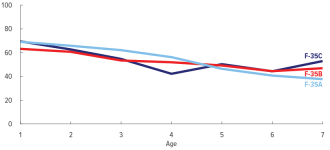
F35's don't appear to be aging very well.

Availability Rates of F-35s, by Age​

Percent1000192962.png

"As F-35s have aged, their availability and use have decreased, CBO finds. The availability and use of F-35s have been lower, in some cases much lower, than those of other fighter aircraft of the same age. For example, the average availability rate of a 7-year-old F-35A has been about the same as that of a 36-year-old F-16C/D and a 17-year-old F-22. "

https://www.cbo.gov/publication/61482


​

 
F35's don't appear to be aging very well.

Availability Rates of F-35s, by Age​

PercentView attachment 102458

"As F-35s have aged, their availability and use have decreased, CBO finds. The availability and use of F-35s have been lower, in some cases much lower, than those of other fighter aircraft of the same age. For example, the average availability rate of a 7-year-old F-35A has been about the same as that of a 36-year-old F-16C/D and a 17-year-old F-22. "

https://www.cbo.gov/publication/61482


​


Internal vs external equipment. If an F16s pod breaks thats not part of the F16, on an F35 it is.
 
  • Like
Reactions: ytz
Internal vs external equipment. If an F16s pod breaks thats not part of the F16, on an F35 it is.
Thats a bit of a distinction without a difference isnt it? If something internal breaks on a F35 I consider it broken. I want the RCAF flying CF35s as much as the next guy but I think we would be remiss to hand-wave the troubling maintenance issues they seem to be having - especially considering those issues are coming from a military who's new budget is like 60% of our GDP.
 
The government report is based upon data collected by bean counters. Full mission means that the aircraft is readied to the point that it can perform any mission that it was purchased to perform. For instance, if the mission today is to attack a ground target but the ground tracking mode of the radar is offline then park it.

Most of our day to day in the RCAF is not FMC. That's most air forces actually. This is why that stat sounds sensational to anybody in blue.

What really matters is how many times they are cancelling missions on the board because the aircraft is u/s in a manner which violates the MEL (Minimum Equipment List) or is not PMC for said mission code. The Americans are flying jets with no radars because you can still use that bird for say crew currency. You don't need the radar to shoot approaches and touch and gos for your 30 day.
 
Thats a bit of a distinction without a difference isnt it? If something internal breaks on a F35 I consider it broken. I want the RCAF flying CF35s as much as the next guy but I think we would be remiss to hand-wave the troubling maintenance issues they seem to be having - especially considering those issues are coming from a military who's new budget is like 60% of our GDP.

No not really. If the targetting pod on an F35 is broken itll still fly air to air just fine - however that part is internal so it counts against it. If an F16 squadron is down a targetting pod they dont count it against the F16 even though its an equal overall effect.
 
Most of our day to day in the RCAF is not FMC. That's most air forces actually. This is why that stat sounds sensational to anybody in blue.

What really matters is how many times they are cancelling missions on the board because the aircraft is u/s in a manner which violates the MEL (Minimum Equipment List) or is not PMC for said mission code. The Americans are flying jets with no radars because you can still use that bird for say crew currency. You don't need the radar to shoot approaches and touch and gos for your 30 day.
too true when you have 500 of them. What happens when you only have 12 total for the squadron? Second question, when they first started with the F35 it was supposed to replace all the other types. So why has the F16 been given a totally new lease on life? What is the hidden hitch in their grandiose plans?
 
. What happens when you only have 12 total for the squadron?

Same thing. Go to 429 . On any given day, 2 of 5 C-17s will be flyable. And probably 50/50 on whether both of those are FMC.

Second question, when they first started with the F35 it was supposed to replace all the other types.

You seem to be the expert. Please lay out what types you think they were meant to replace.

So why has the F16 been given a totally new lease on life? What is the hidden hitch in their grandiose plans?

Because the US mandates a minimum combat fleet size. They are at 1100. They want to grow to 1500 while continuing the retirement of aging aircraft (their fleet age is higher than its been in decades). So an easy and cheap way to do this is substantially modernized F-16, using datalinks, radars, stealth coatings, etc. based on the F-35. This is largely a problem that is unique to very large air forces. They care about their industrial base and total mass size. So they constantly have to take delivery and will always operate multiple generations of aircraft simultaneously with a target percentage fleet mix benchmarked against an adversary's fleet mix. We will never be in that position because we don't take delivery of aircraft continuously.
 
o, with its limited bits and bites was there a real problem with the shuttles? Did they fail accomplish the task they were given?

You really seem to be missing the point. The Space Shuttle worked just fine. But it took that much code to run it. And all that code has to be maintained. It also generates output. That output drives work. So if a given system has 100X the code for example, it's not unreasonable to expect a 10x demand in overall manning. Best I can say without really getting into the weeds. The code comparison was to show you the relative difference in complexity.

Which further reduces the skilled labour required.

No it doesn't. It just drives demands for different labour and different skills.

The F-35 and P-8 alone are driving the creation of 3 new trades in the RCAF and substantially changing a whole bunch of doctrine, TTPs, etc.

Just because a bunch of retired Boomers think it's all mumbo-jumbo doesn't change the reality of the transformation the RCAF has to pull off.

What are the actual number for those tasks, and what parts of those tasks can be double hatted?

EW is a pretty broad domain, and until you're down into the weeds on software and hardware specirfic details there is likely a lot of work that overlaps quite a bit.

My point is, nobody is denying that a mixed fleet adds to the support numbers/requirements, the real question is: What are the numbers, and can a CAF of 100K absorb that number?

Depends. How much of that growth is allocated to the RCAF and in what time horizon. Double the RCAF in size and maybe we'll be able to operate two fleets. Insist that we many two fighter fleets in 2035, and I tell you right now, there will be lots of parked aircraft wasting away....

As it stands, everybody is basically crossing fingers and hoping that pilot training plans will meet current fleet projections in 2035. And these were all sized for the fleet plans we have. Increase the fleet projection for 2035, and you now have to substantially change the training system to deliver more. We aren't even buying enough lead in aircraft, for example, to train more pilots than the what we need for the 88 F-35. Imagine having to double the FLIT pipeline in like 7 years. I don't think something like that would happen. I think the RCAF would just quietly park aircraft.

In what other areas can we make savings? How much is the CAF willing to give-up to meet the GoC priorities of minimizing American content? Is the RCAF willing to die on the "F-35 or bust" hill?

No. And really, we're all preparing ourselves mentally to get stuck with Cyclone 2.0. But the math is just not mathing. The personnel growth (both planned and actual) is not lining up the visions that people have off two fleets. I hate the assertion that this is just some RCAF fetish with American kit. When I hang up my uniform every night, I'm still Canadian and I want this country succeed. However, I also recognize that an institution that has been starved for literally decades can't just pivot on a dime. There is no spare capacity. And there's a lot of people in staff jobs, standards, etc. working multiple jobs or more than their allocated share and burning out.

And in the immediate term, the question becomes what do you tradeoff. For example, we still have exercised the two options on the P-8s. We only booked 6 Globaleyes, instead of 8. We have a Deep Sensing and Electronic Attack capability on the books with another half dozen (probably) Globals. We have space capabilities, various EW and munitions projects we want to pull off over the next decade or so. Hell, 1 Wing is proposing completely replacing the Griffon with a mix of medium lift, attack helos and theatre level MALE UAS. How much of all that should get scrapped to buy fourth gen jets that will obsolete within a decade of delivery and have very low YFR flown because we don't have the techs or pilots anyway?

If you're in the Navy, you should be mad as hell that nobody is pushing for more P-8s. If you're in the Army, you should be upset that you might be riding a Griffon in 2035 thanks to the Gripen and have zero deep sensing and EA capability. None of the chuds online think of opportunity cost. But it's disappointing that so many people here who wore a uniform can't seem to grasp this either.
 
Depends. How much of that growth is allocated to the RCAF and in what time horizon. Double the RCAF in size and maybe we'll be able to operate two fleets. Insist that we many two fighter fleets in 2035, and I tell you right now, there will be lots of parked aircraft wasting away....
First - I'm not here to start an argument or to try to pin you or anyone down and saying - 'got ya'. I'm trying to understand the math.

Can you or someone else, lay out, using approx numbers as actual numbers would likely be against the rules, how many RCAF personnel are used to today - 'from soup to nuts' - to maintain our existing 45-55 CF-188's? How many of the roughing 23,000 RCAF personnel?

Now, how many will be required, again approx., will be needed, under the scenario that we acquire the originally broadcast number of 88 F35's?

Going from 45-55 CF-188s to 88 F35's will require X number of people for those 33-43 additional frames. Is it 30 people per net new airframe? Is it 50 people per net new airframe? Is it 75 people per net new airframe? Or, is it 42 people per net new airframe plus 12 new people per existing airframe? Because using that last one, it means that the RCAF will require 2,300 new personnel for the 88 F35's. Realistic number? Too low? Too high?

Now, do the same but with say 60 F35's and 60 Gripens. What is the number? Will we need 50 people per airframe for the 10 net new F35s airframes, plus 10 new people for per each existing airframe that will be replaced by a F35? In addition, we will require 75 net new people for each of the 60 Gripens acquired? Because in the above scenario it works out to be roughly 5,550 new personnel required. I have no idea if this is too high or too low but I am only discussing a scenario where a mixed fighter fleet occurs.

Using back of the napkin math again, if we look at the timeframe from 2027 to 2035, that 9yrs, let's shorten it down to 2028 to 2035 and go with 8yrs. 5,550 personnel into 8yrs is 694 new RCAF members required each and every year dedicated solely to the needs of a mixed fighter fleet. Allowing for year to year attrition of say 9%, lets call it really as 756 each year.

Anything needed for the C177's, C130's, P8's C295's, the CH149's, etc, etc, etc. if a constant new recruit intake occurs over those 8yrs of 7,250/yr, that works out to be 10.5% of the total yearly intake going solely 100% to the needs of a mixed fleet. Is that realistic? Is that fantasy? If another 750 new recruits goes to the RCAF each and year but is assigned to all the other airframes and needs of the RCAF is that sufficient? Both combined reflect the RCAF intaking 22% of all new recruits each and every year from 2028 to 2035? Realistic? Fantasy?

The target number of 2026/27 is 8,200, so I'm using a number the is 1,000/yr less for each of the 8yrs above.

I'm trying to understand the math. I understand that chronic, systemic withering on the vine occurred for 1 to 2 decades in terms of money, resources and care by the Federal Government has happened.

 
No it doesn't. It just drives demands for different labour and different skills.

The F-35 and P-8 alone are driving the creation of 3 new trades in the RCAF and substantially changing a whole bunch of doctrine, TTPs, etc.

Just because a bunch of retired Boomers think it's all mumbo-jumbo doesn't change the reality of the transformation the RCAF has to pull off.
I can imagine what it was like for the RCAF to move from props to jets, to radars on all fighters, to guided missiles from guns. I suspect that many of the problems you mention are cyclical upon getting newer technolgy.
 
I'm trying to understand the math. I understand that chronic, systemic withering on the vine occurred for 1 to 2 decades in terms of money, resources and care by the Federal Government has happened.

3+ decades… last time we were at 2% gdp was 1988 and it has been on active decline since.
 
  • Like
Reactions: ytz
3+ decades… last time we were at 2% gdp was 1988 and it has been on active decline since.
Defence spending as a percentage of GDP shrunk under Stephen Harper, and grew under Justin Trudeau.

And having excess platforms is a feaure, not a bug, as long as the maintenance capacity is present - it lengthens the life of the platforms, permits attrition, and provides proper equipment for training.
 
  • Like
Reactions: ytz
Defence spending as a percentage of GDP shrunk under Stephen Harper, and grew under Justin Trudeau.

And having excess platforms is a feaure, not a bug, as long as the maintenance capacity is present - it lengthens the life of the platforms, permits attrition, and provides proper equipment for training.
To be fair, all spending was reduced under Harper in a bid to reduce the debt.
 
Defence spending as a percentage of GDP shrunk under Stephen Harper, and grew under Justin Trudeau.
Using that as a metric makes a great soundbite until you realize that it was achieved by having one of the weakest per capita GDP growth in Canadian history.
 
Using that as a metric makes a great soundbite until you realize that it was achieved by having one of the weakest per capita GDP growth in Canadian history.
And creative accounting to list things as defense that aren't really defense items, to look like they're spending more without actually increasing funding.
 
Can you or someone else, lay out, using approx numbers as actual numbers would likely be against the rules, how many RCAF personnel are used to today - 'from soup to nuts' - to maintain our existing 45-55 CF-188's? How many of the roughing 23,000 RCAF personnel?

Now, how many will be required, again approx., will be needed, under the scenario that we acquire the originally broadcast number of 88 F35's?

Going from 45-55 CF-188s to 88 F35's will require X number of people for those 33-43 additional frames. Is it 30 people per net new airframe? Is it 50 people per net new airframe? Is it 75 people per net new airframe? Or, is it 42 people per net new airframe plus 12 new people per existing airframe? Because using that last one, it means that the RCAF will require 2,300 new personnel for the 88 F35's. Realistic number? Too low? Too high?

Aside from OPSEC considerations what you're asking is really difficult to say.

You can look at how many personnel are posted in Cold Lake (about 2000) and Bagotville (1400). But that doesn't tell you how those Wings scale with number of aircraft. There's the overlap with 2 Wing in Bag. And none of this tells you about the overhead across the supply system, tech authorities, ops airports or even infrastructure. Some of those personnel are not even RCAF. Also doesn't speak to how much more would be added with the F-35, given the coming addition of the Security Forces and the mission planner trade.

Beyond that, the F-35 is such a data hoover that we're creating new IT architectures and new intelligence frameworks to collect and exploit the spectrum, imagery, etc with that aircraft. These are capabilities that the RCAF really doesn't do today, but are really essential in the 5th Gen world. The intelligence and IT ramp between the F-35, P-8, MQ-9 and space is pretty substantial. We're talking about billions and hundreds of people. How much does that count towards the F-35 specifically?

What about the training chain? How much of that counts towards the fighters? Can't have a fighter force without FLIT. And if you increase the numbers of fighters those fleets have to grow.

So you tell me what your exact definition is and then we can work on an estimate.

But also, like I've said earlier. It's not raw numbers. Just because you allocate more, doesn't mean you'll have them. It takes at least 4 years of military and flight training to produce a new line pilot in a fighter squadron. Adding RMC, that's 7 years total. 5 for an engineering officer. 2-3 years for most techs. This means, that in a best case scenario, we're taking recruits today who will become techs in 2029, engineers in 2031 and pilots in 2033. So if we're adding more than the 88 forecast jets or doing mixed fleet (which drives inefficiency), then we literally have to start training all of these people today. But hell, right now we don't even have a FLIT to train our pilots. We send them to Texas and Italy.
 
I can imagine what it was like for the RCAF to move from props to jets, to radars on all fighters, to guided missiles from guns. I suspect that many of the problems you mention are cyclical upon getting newer technolgy.

To some extent. When you only buy new capability every 3-4 decades, you tend to lose the ability to learn.

But we aren't just doing the fighters. We're replacing the Auroras. The strat airlift fleet is getting an 800% increase in offload capability for AAR (no that's not a typo). We're 10x ing space with the Wing going from 80 to 800. We're both modernizing the Griffons and going to replace them with attack and medium lift helps. We're inducting armed MALE UAS, a capability we never had before. Also, AEW, a capability the RCAF has never had organically. There's projects that people consider boring like the complete rework of the CAOC. And every fleet not being replaced is going through at least a substantial avionics upgrade. If not major modernization like HEP and GLLE.

I am not exaggerating when I say this. The RCAF is going through more change between 2025 - 2035 than it has from 1985 - 2025. And now on top of all this, people are calling us "whiny" for saying doing more would be challenging.

I look forward to the inevitable Cyclone 2.0 reports in 2040 talking about how the Gripen a we bought aren't getting flown much. Probably even the F-35s. Might as well break both fleets evenly.
 
Back
Top